
The Engine Shop
Joe Wagner
927 Pine Ave., Ozark, AL 36360
Remembering Fred Reese
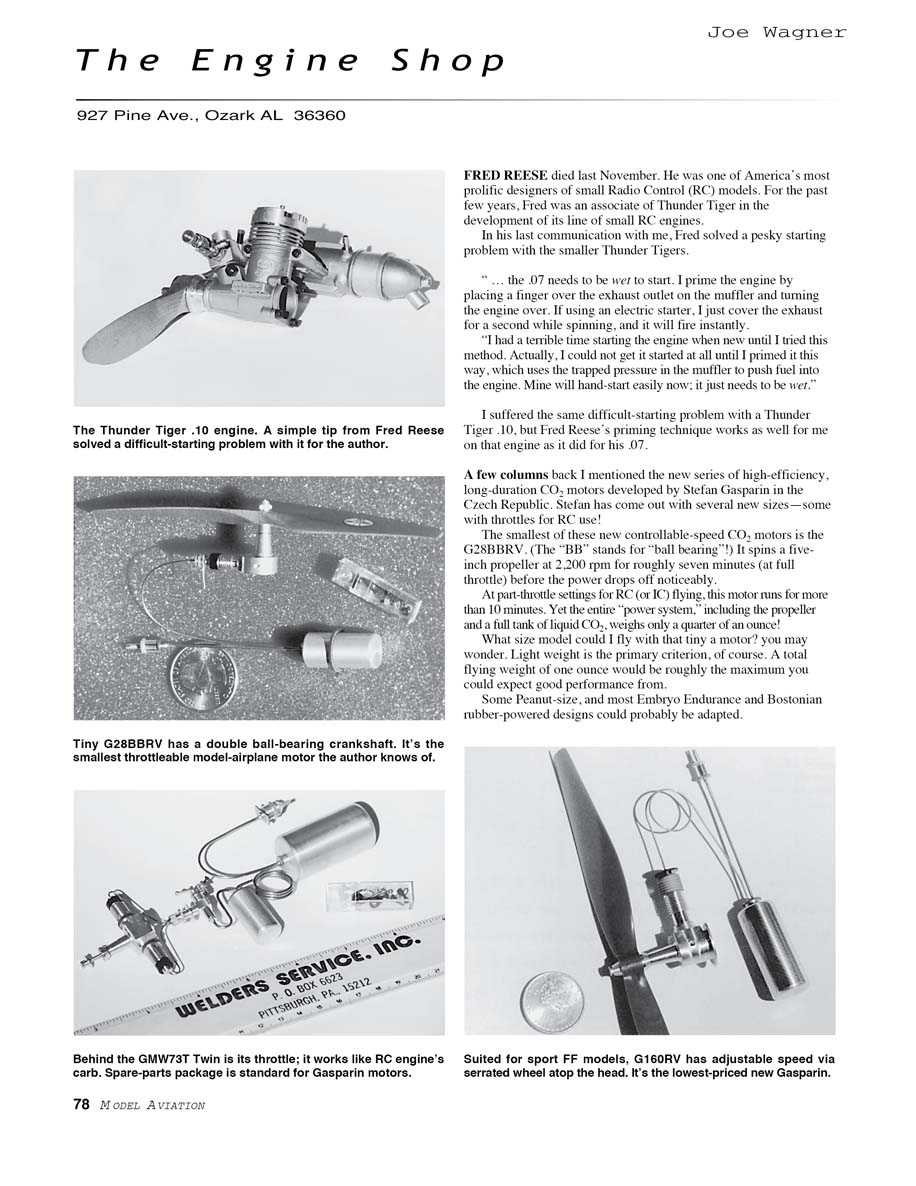
Fred Reese died last November. He was one of America’s most prolific designers of small radio-control (RC) models. For the past few years Fred was an associate of Thunder Tiger in the development of its line of small RC engines.
In his last communication with me, Fred solved a pesky starting problem with the smaller Thunder Tigers. He wrote:
"I had to prime the .07 to start. I place a finger over the muffler exhaust outlet and turn the engine over. If using an electric starter, I just cover the exhaust for a second while spinning, and it will fire instantly.
"I had a terrible time starting the engine when new until I tried this method. Actually, I could not get it started at all until I primed it this way, which uses the trapped pressure in the muffler to push fuel into the engine. Mine will hand-start easily now; it just needs to be wet."
I suffered the same difficult-starting problem with a Thunder Tiger .10, but Fred Reese’s priming technique works just as well for me on that engine.
Gasparin CO2 Motors — new sizes and throttles
A few columns back I mentioned the new series of high-efficiency, long-duration CO2 motors developed by Stefan Gasparin in the Czech Republic. Stefan has come out with several new sizes—some with throttles for RC use.
The smallest of these new controllable-speed CO2 motors is the G28BBRV (the "BB" stands for "ball bearing"). It spins a five-inch propeller at about 2,200 rpm for roughly seven minutes at full throttle. At part-throttle settings for RC (or IC) flying, this motor runs for more than 10 minutes. The entire "power system," including the propeller and a full tank of liquid CO2, weighs only a quarter of an ounce. Light weight is the primary criterion for using such a motor; a total flying weight of about one ounce is roughly the maximum for good performance. Some Peanut-size designs and many Embryo Endurance and Bostonian rubber-powered designs could probably be adapted.
CO2 power has much in common with rubber power: good flight performance requires large-diameter, high-pitch propellers turning slowly. As a rule of thumb, a good monoplane size for sport CO2 flying has a wingspan between three and four times the prop diameter.
The largest (so far) of Gasparin’s high-efficiency CO2 motors is a throttleable version of the GMW73T Twin I wrote about earlier. The motor itself is unchanged; a variable throttle assembly replaces the firewall-mounted manifold of the first model, simplifying speed-control linkage.
Performance figures (recap):
- GMW73T Twin (throttleable): swings a 7-inch prop at about 2,000 rpm for six minutes at full throttle, or a 9½-inch P-30 prop at about 1,250 rpm for seven minutes. A suitable RC model for this motor should weigh seven ounces or less, with a wing area near 200 square inches.
- G28BBRV: 5-inch prop at ~2,200 rpm for ~7 minutes (full throttle); >10 minutes at part-throttle.
- G160: turns a 7-inch prop at more than 1,500 rpm for three minutes, and weighs about 3/4 ounce complete with tank and prop. The G160 features an easy-to-adjust manual speed control built into the head assembly; a knurled wheel on top makes rpm adjustment quick and easy for free flight (FF) use.
A close look at the G160 shows a significant difference from older CO2 motors: its exhaust ports are much smaller.
How CO2 motors work (and why moderate pressure is better)
CO2 motors produce power through gas expansion, not through stored pressure as in a compressed-air system. Yes, pressure is supplied from the CO2 tank, but because of CO2’s physical properties the tank pressure is far too high for efficient use in small piston-type motors.
Only moderate pressure is needed to provide adequate cold gas at the top of the piston stroke for full-power output. High pressure is a handicap, not an advantage. In the early days of CO2 motors (they first appeared in 1947, developed by Bill Brown), many of us mistakenly boosted charging pressure by preheating CO2 capsules and ruined motors. More pressure does not improve performance — it shortens life and reduces efficiency. An analogy: if a six-ounce tack hammer drives brads well, a 12-pound sledgehammer would not do better.
Gasparin motors use quite small-diameter tubing to supply CO2 to the heads. The flow restriction from the small internal area of this tubing acts as a pressure reducer. The piston-actuated valve in the head further reduces incoming gas pressure. The result is longer runs, higher propulsion efficiency, and longer motor life.
Refueling options and charging technique
For decades the standard source for model-flying CO2 has been capsules. The original "Sparklites" capsule held eight grams of CO2. That provided a couple or three recharges of a Telco motor, perhaps four or five for a Brown A-23. Nowadays 12-gram CO2 capsules are available from Wal‑Mart for about 50–60 cents each (depending on pack size).
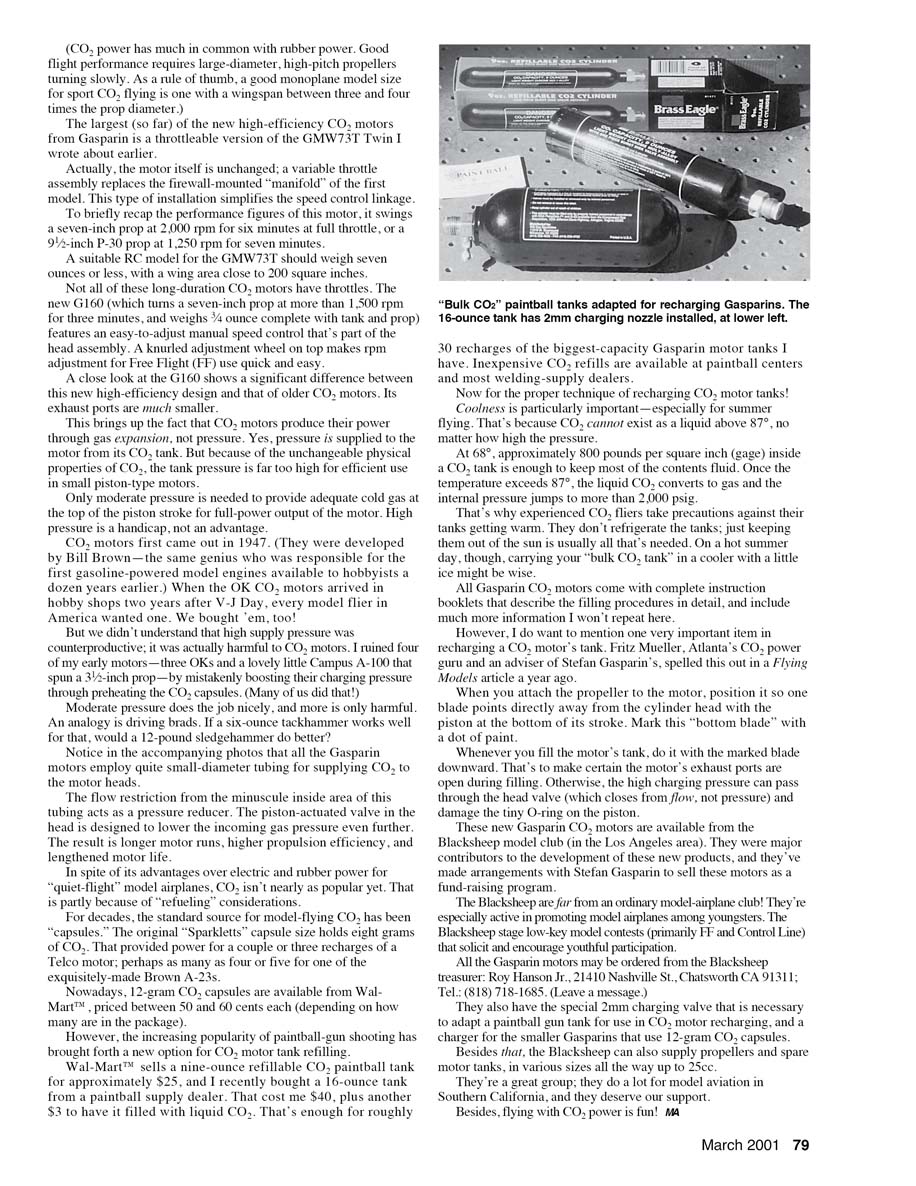
The popularity of paintball has brought a new option: refillable paintball CO2 tanks. Wal‑Mart sells a 9-ounce refillable CO2 paintball tank for about $25; I bought a 16-ounce tank from a paintball dealer for $40 plus $3 to have it filled with liquid CO2. That’s enough for roughly 30 recharges of the largest Gasparin motor tanks I have. Inexpensive CO2 refills are available at paintball centers and most welding-supply dealers.
Temperature is important when recharging CO2 motor tanks. CO2 cannot exist as a liquid above 87°F, no matter the pressure. At about 68°F, roughly 800 psi (gage) is enough to keep most contents liquid. Above 87°F the liquid converts to gas and internal pressure can jump to more than 2,000 psi. Experienced CO2 fliers take precautions against tanks getting warm: they don’t refrigerate tanks, but keep them out of the sun. On a hot day, carrying a bulk tank in a cooler with a little ice can be wise.
All Gasparin CO2 motors come with instruction booklets that describe filling procedures in detail, but one important item deserves emphasis. Fritz Mueller, Atlanta’s CO2-power guru and adviser to Stefan Gasparin, pointed this out in a Flying Models article:
- When you attach the propeller to the motor, position it so one blade points directly away from the cylinder head with the piston at the bottom of its stroke. Mark this "bottom blade" with a dot of paint.
- Whenever you fill the motor’s tank, do it with the marked blade downward. This ensures the motor’s exhaust ports are open during filling. If the exhaust ports are closed, high charging pressure can pass through the head valve (which closes from flow, not pressure) and damage the tiny O-ring on the piston.
Gasparin motors are supplied with the small parts needed for proper charging; for example, the small 2 mm charging valve necessary to adapt a paintball tank for motor charging.
Ordering and support — The Blacksheep model club
The new Gasparin CO2 motors are available through the Blacksheep model club (Los Angeles area). The Blacksheep were major contributors to the development of these products and have arranged with Stefan Gasparin to sell the motors as a fundraising program.
The Blacksheep are far from an ordinary model-airplane club. They are especially active in promoting model aviation among youngsters and stage low-key model contests (primarily FF and control-line) that encourage youth participation.
Contact/order information:
- Roy Hanson Jr., Blacksheep treasurer
- Address: 21410 Nashville St., Chatsworth, CA 91311
- Tel.: (818) 718-1685 (leave a message)
The Blacksheep also supply the special 2 mm charging valve, a charger for the smaller Gasparins that use 12-gram CO2 capsules, propellers, and spare motor tanks in various sizes up to 25 cc. They do a lot for model aviation in Southern California and deserve support.
Flying with CO2 power is fun!
Transcribed from original scans by AI. Minor OCR errors may remain.

