
The Engine Shop
Joe Wagner
927 Pine Ave., Ozark, AL 36360
CO2 developments
Developments continue in CO2 power. Stefan Gasparin has just released a "universal throttle" control, which works with any CO2 motor (except for the very smallest, such as the Brown A-23).
With this universal throttle, someone with an original 1947 OK CO2 motor could use it (equipped with a modern refillable CO2 tank) to power an Old-Timer CO2 Free Flight (FF) model in "RC Assist mode."
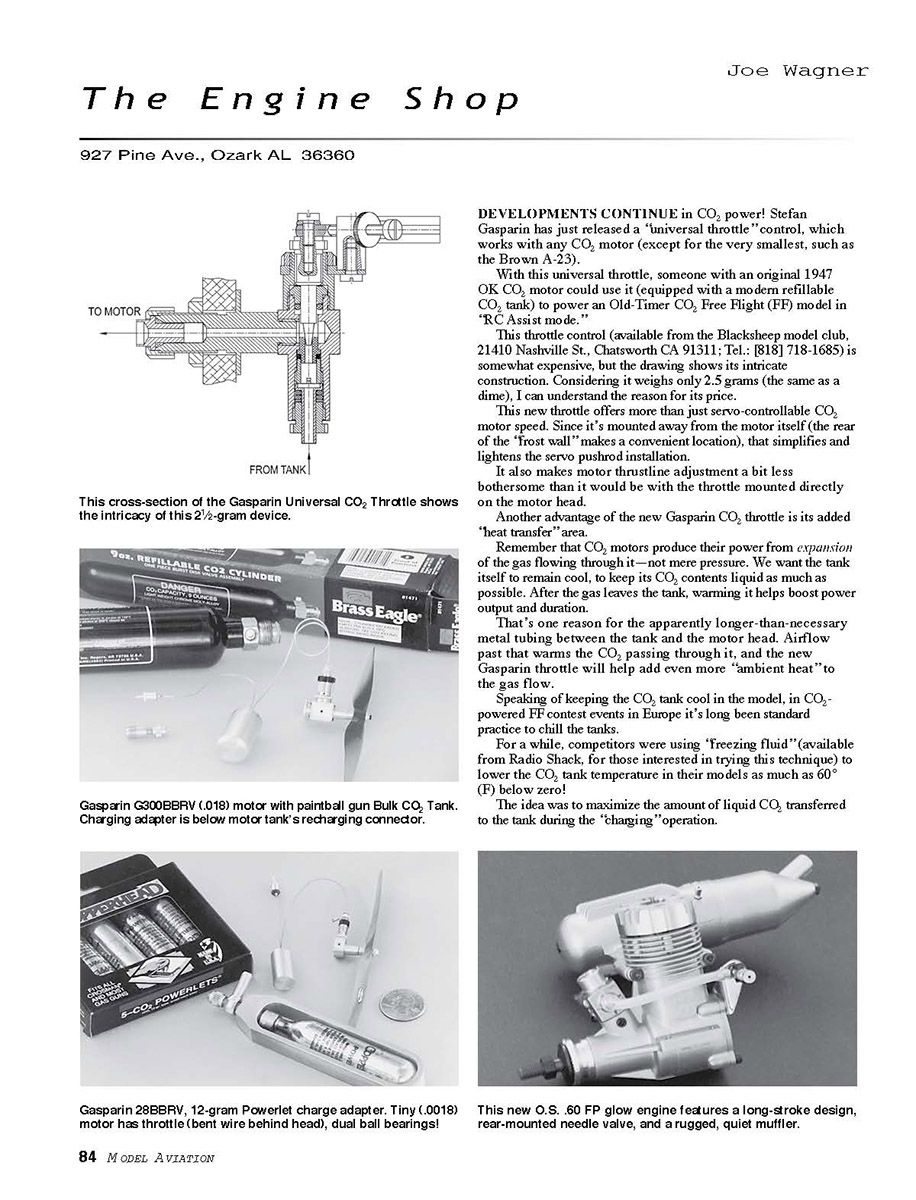
This throttle control is available from the Blacksheep model club, 21410 Nashville St., Chatsworth, CA 91311; Tel.: (818) 718-1685. It is somewhat expensive, but the drawing shows its intricate construction. Considering it weighs only 2.5 grams (the same as a dime), the price is understandable.
The new throttle offers more than just servo-controllable CO2 motor speed. Since it's mounted away from the motor itself (the rear of the "frost wall" makes a convenient location), that simplifies and lightens the servo pushrod installation. It also makes motor thrust-line adjustment a bit less bothersome than it would be with the throttle mounted directly on the motor head.
Another advantage of the Gasparin CO2 throttle is its added "heat transfer" area. CO2 motors produce their power from expansion of the gas flowing through them—not mere pressure. We want the tank itself to remain cool, to keep its CO2 contents liquid as much as possible. After the gas leaves the tank, warming it helps boost power output and duration. That's one reason for the apparently longer-than-necessary metal tubing between the tank and the motor head. Airflow past that tubing warms the CO2 passing through it, and the new Gasparin throttle will help add even more ambient heat to the gas flow.
Tank chilling and run times
In CO2-powered FF contest events in Europe it's long been standard practice to chill the tanks. For a while competitors were using "freezing fluid" (available from Radio Shack, for those interested in trying this technique) to lower the CO2 tank temperature in their models as much as 60°F below zero. The idea was to maximize the amount of liquid CO2 transferred to the tank during the charging operation.
That practice was later outlawed for competition; now CO2 tank pre-chilling is limited to the use of ice water. I don't see much need for such technique in sport flying, except in hot weather.
The new high-efficiency Gasparin motors run for three to eight minutes (depending on the type). If anyone needs longer running time, it's easy to replace the stock Gasparin CO2 tank with a larger one (also available from the Blacksheep club). They come in:
- 5 cc
- 13 cc
- 16 cc
- 25 cc
The stock tank for the G300BBRV motor is 13 cc. That's enough for spinning a seven-inch high-pitch prop at roughly 3,000 rpm for nearly six minutes. A 25 cc tank would almost double that duration.
Refilling and adapters
New developments have also taken place in refilling CO2 model tanks. For the smallest-size motors, a new all-metal charging adapter that uses the easily attainable 12-gram Powerlets provides a pocket-size CO2 supply for small sport FF airplanes. Earlier molded-plastic devices of this type were troublesome; the new one (also available from the Blacksheep) should last a lifetime.
For large-capacity model tanks, recharging from 12-gram CO2 capsules is neither economical nor efficient. Paintball gun tanks are a much better choice. A good mail-order source for these tanks is piratepaintball.com, which advertises free shipping. It also has a toll-free telephone order number: (866) 777-5287.
PiratePaintball also sells Universal Fill Adapters for the gun tanks. These provide safety, convenient mounting for the adapter required for recharging model airplane CO2 tanks, and essentially leak-free bulk CO2 storage between flying sessions.
Typical prices (January 2001):
- Universal Fill Adapter: $13
- Bulk tanks (depending on size): $20–$30
Terminology: "motor" vs. "engine"
Have you noticed my use of the word "motor" when referring to CO2 and compressed-air model power plants? That's because, as with electric motors, their power comes from an external storage supply. In contrast, model airplane engines develop their power by internal combustion.
Yet the terminology isn't quite that rigid. Since early in the last century, "motor" has been commonly used with reference to "gasoline engines." Think of motor oil, motorcycle, General Motors, Department of Motor Vehicles, outboard motors, and motorists.
The old-time Air Corps sergeants who chewed out rookies for calling a Flying Fortress a "four-motored bomber," snarling, "This airplane has 67 'motors,' but only four engines, you knuckleheads!" were merely showing off their authority, not conveying eternal truth.
Recent developments in model engines
There have also been interesting recent developments in the model engine area. Enya has announced its re-entry into the realm of small power plants, with a glow .049 and .061, and a "diesel" .061.
That brings up another matter of terminology. There are no genuine diesel engines made in model sizes, and there never has been. Our so-called "model diesels" are really compression-ignition types, because they lack the direct-in-the-cylinder fuel injection of real diesels. This might seem a minor point, but I have received reader inquiries about using truck diesel fuel in model power plants.
Another new item: Randall Hopkins, 5024 Old Mayfield Rd., Paducah, KY 42008; Tel.: (270) 554-3589, has been custom-assembling Fox .049 "FAI Special" engines for use in Nostalgia-type FF competition for some time. These engines have proved so popular that the stock of original Fox-made parts ran out. To keep this engine available to FF fliers, Randy has made arrangements with the Japanese O.S. company to supply new parts for it.
Besides the .049, Randy's H&P Engines company has returned the old-time Fox .09 production—again with help from the O.S. factory.
O.S. engines and mufflers
Speaking of O.S., I've noticed with interest that in its latest line of engines—the F series with rear-mounted needle valves but conventional front rotary intakes—the .60 is a long-stroke design, with a stroke of .944 and a bore diameter of .905. All others—the .10, .15, .20, .25, .35, and .40—use a larger bore than stroke (however, the .20 has its bore and stroke almost equal). All this indicates that each O.S. engine is a unique design; the various sizes aren't mere scaling up or down of a standard configuration.
O.S. also seems to have made improvements in its mufflers. Though I haven't subjected any of them to crash impact tests, they appear to be much more ruggedly constructed and attached than those of some earlier-model O.S. engines I own. The mufflers' noise attenuation has been improved too, I've been told. The mufflers for the .10FP and .15FP include a special internal "mute" to quell the annoying shriek that small-displacement model glow engines have long been notorious for.
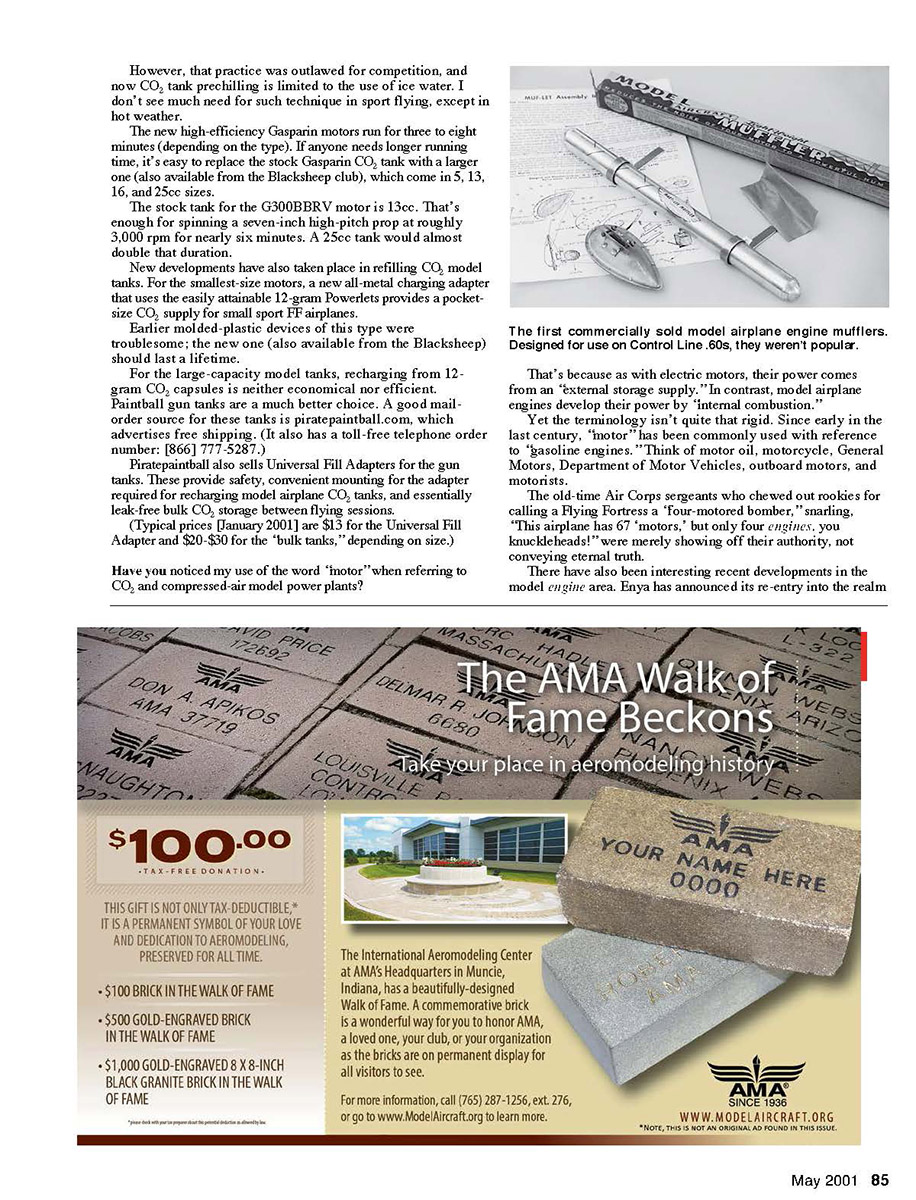
The subject of model-engine mufflers reminds me that they are fairly new. As far back as 1947, Henry Owicki (the famous West Coast model-engine manufacturer) developed a muffler for CL flying and put it on the market, with the help of noted Control Line stunt fliers J.C. Yates and Bob Palmer. This was called the Muff-Let, and it came in an "Assemble-It-Yourself" kit of sheet-metal parts and rivets.
The instructions claimed remarkable sound-reducing ability: "Your Muff-Let has been designed to give you a quiet but effective operation for all city flying, but with use, many noises will be heard that have gone unnoticed in the past."
The Muff-Let and its contemporary companion, the long, tubular Mart-Lee muffler, were meant for use on spark-ignition engines—mostly .60, such as Super Cyclone and Owicki .64s. It's not that these engines were especially noisy. After all, even the mighty Owicki developed considerably less brute power than most modern .15 glow units do.
However, in C/L flying the monotonous "whir—whir—whir" of five or more continuous minutes, caused by the airplane's traveling around and around and accompanied by engine noise, alienated many people. In those days, practically all C/L model flying took place in parks and school yards, right in the midst of residential areas. The Muff-Let and Mart-Lee mufflers—though fragile and awkward to install—were possibly the earliest preventive measures for keeping our flying fields quiet. It's too bad they weren't widely used.
Transcribed from original scans by AI. Minor OCR errors may remain.

