
The Engine Shop
Joe Wagner
212 S. Pine Ave., Ozark AL 36360
Catalysis and glow plugs
In the previous column I discussed catalysis: how some substances (such as zinc) promote reactions between other chemicals without being chemically affected themselves. I mentioned an experience with a brass fuel-tank clunk weight that catalyzed glow fuel into acetic acid (a potent rust inducer) and told about how a die-cast zinc-alloy model-engine part once converted a jarful of “cleaning-solvent methanol” into acid, which then completely ate away the casting.
Much useful work in model engines is performed by catalysis. Glow plugs wouldn’t work without it. Glow plugs provide fuel-air ignition for practically all the two- and four-stroke engines that power American model airplanes. They also account for many of the difficulties we have to overcome to get our model engines to perform the way we want. Much of that trouble is caused by the fact that few modelers understand exactly how glow plugs work.
How glow plugs actually work
The usual explanation of glow-plug operation is: “The plug contains a coiled-wire heating element which glows orange-hot when connected to a battery. This glowing filament ignites the fuel-air mixture in the combustion chamber when you flip the propeller. Then after the engine starts, the battery can be disconnected because the burning fuel keeps the plug element hot, and the engine continues firing.”
That sounds logical. But if that were really all there was to it, glow plugs could be made with cheap nichrome heating coils (like toaster elements) instead of expensive platinum—and glow plugs would retail for approximately 50 cents apiece.
What actually makes a glow plug ignite a fuel-air mixture is the catalytic action of the platinum alloy in its coiled-wire element. The ability of platinum to initiate combustion of alcohol fuels was discovered by Sir Humphry Davy in 1816; “automatic lighters” using platinum as an ignitor were on sale in the 1830s—long before practical matches had been developed.
Platinum can “start fires” without becoming a participant in the combustion process—and even without being hot. A simplified analogy: think of platinum atoms as tiny golf balls with deep, tapered dimples that strongly attract atoms of hydrogen and oxygen. In nestling into the dimples, the oxygen and hydrogen atoms are wedged tightly against each other so they combine. That produces heat and initiates combustion. As hydrogen and oxygen merge catalytically on a platinum atom (forming H2O), the energy released expels the H2O from the dimple, leaving it ready to accept new atoms. None of this activity requires heating of the platinum itself; the catalytic action can initiate at room temperature. Because of that, it’s possible—though not easy—to start a glow engine without a battery.
Heating a glow-plug filament does ease starting and has other beneficial effects. Heat drives carbon monoxide (CO) out of platinum's dimples. CO molecules adhere firmly to room-temperature platinum whenever they get a chance, thus “poisoning” its catalytic activity. Heating the filament red-hot drives off such impurities and restores the metal’s ability to initiate hydrogen-oxygen combustion.
Poisoning and contamination
Glow-plug filaments can be poisoned in ways heat cannot fix. One example surfaced with the all-aluminum Sportsman engines K&B made some years ago. During break-in, wear particles from the aluminum piston contacted the hot glow-plug element and alloyed into the platinum. That reduced the filament’s melting temperature and the plug burned out.
Even an intact and brightly glowing plug element can be slowly ruined by silicone contamination. The major cause appears to be some form of silicone compound in the glow fuel—perhaps from a surfactant or foam-inhibiting chemical added by the manufacturer, or dissolved from the interior of a modeler’s rubber squeeze-bulb fueler. As the engine runs, a glassy coating slowly but permanently deposits onto the platinum wire coil. The coil will still glow, but its catalytic ability degrades with each piston stroke. The only cure is a new plug and silicone-free fuel. (Some model fliers add a dash of Armor All to a gallon of glow fuel to reduce foaming. That’s not a lot, but I advise against doing it.)
Glow-plug designs
A great variety of glow-plug designs have been marketed since the first ones appeared in 1947. Notable designs include:
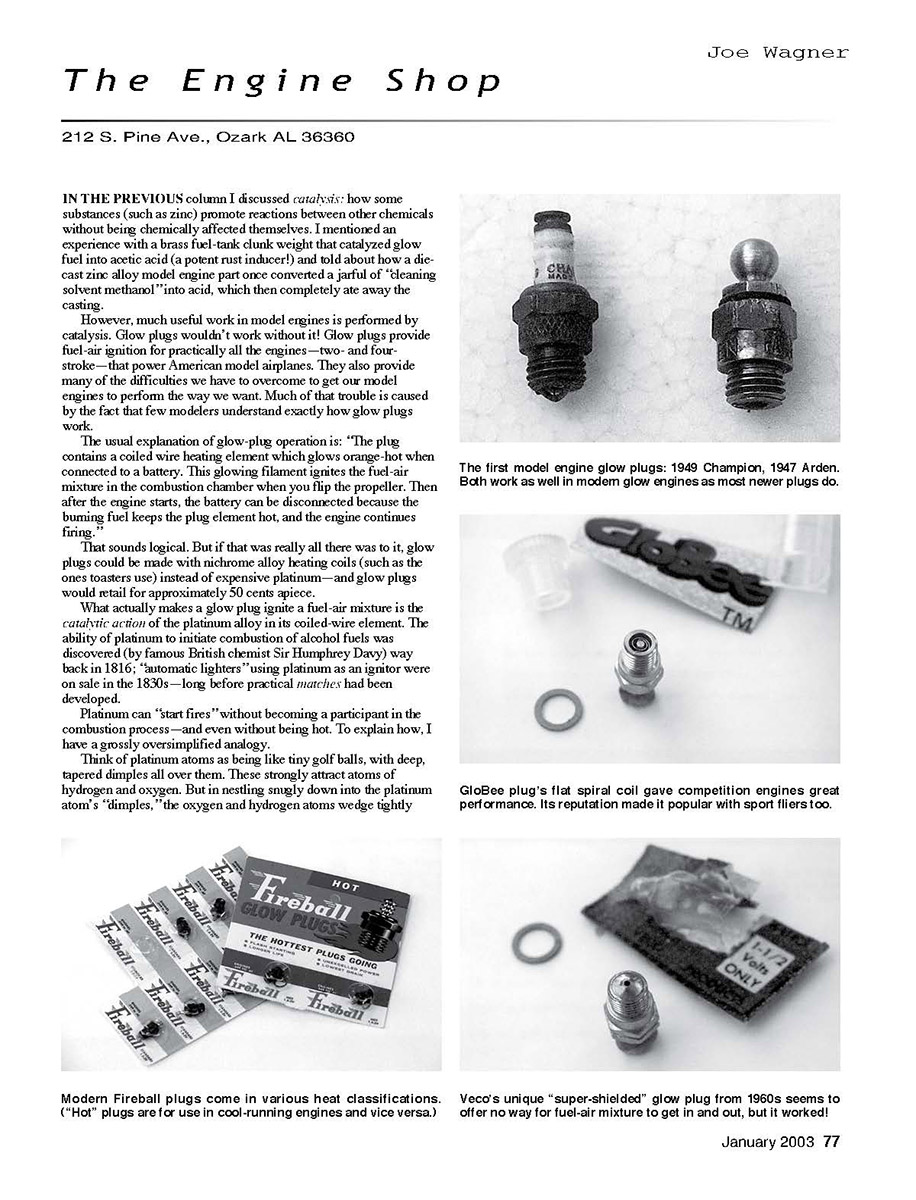
- Arden plugs (1947): easily identified by their ball-shaped brass tips; they featured replaceable elements.
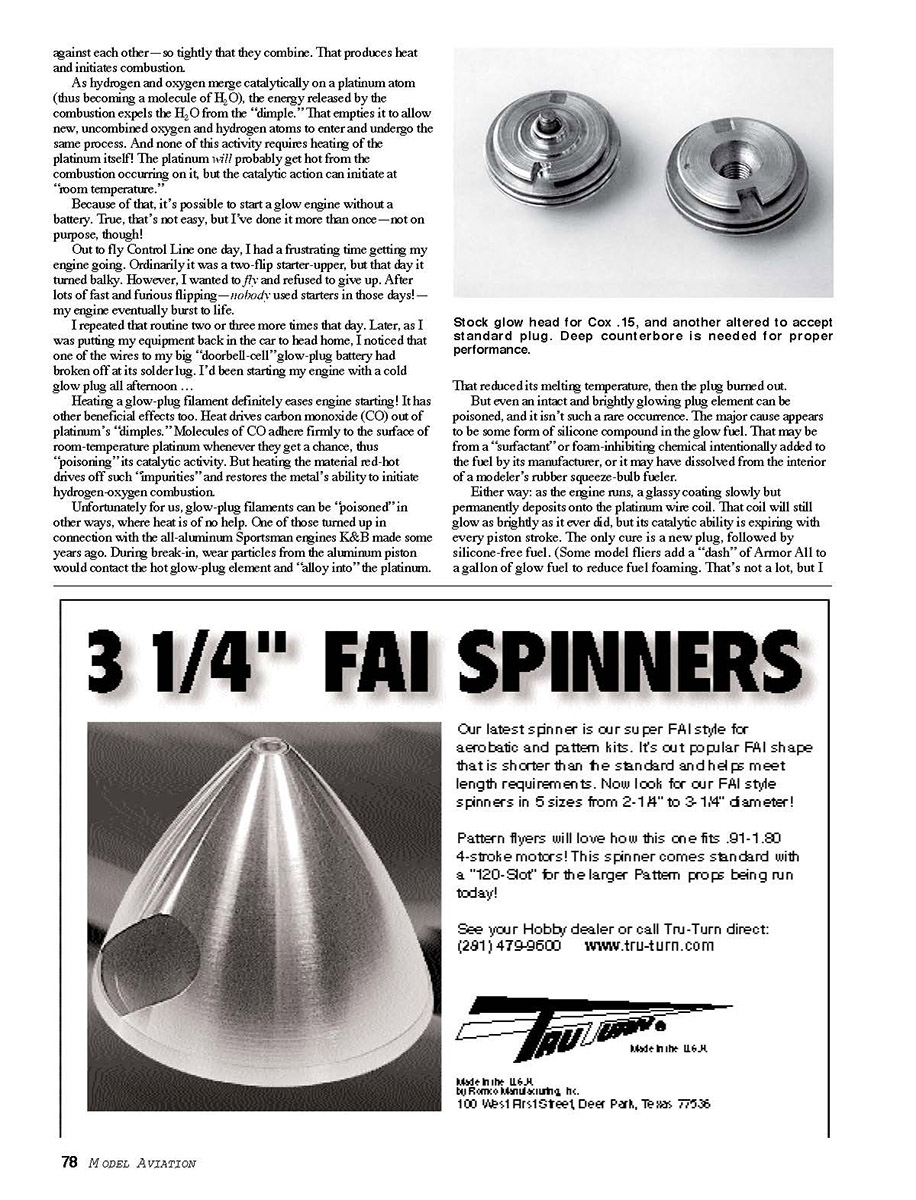
- Various coil shapes: manufacturers have used different coil geometries successfully—K&B once made a plug with a V-shaped element, and for years GloBee’s flat-spiral plug was a favorite among competition fliers.
- Champion idle-bar plugs (originated 1949): designed to protect the element from raw fuel squirted into the exhaust port during starting.
- Jets idle-bar variants: included a massive machined idle-bar section (the more common welded-on bars were known to come off occasionally).
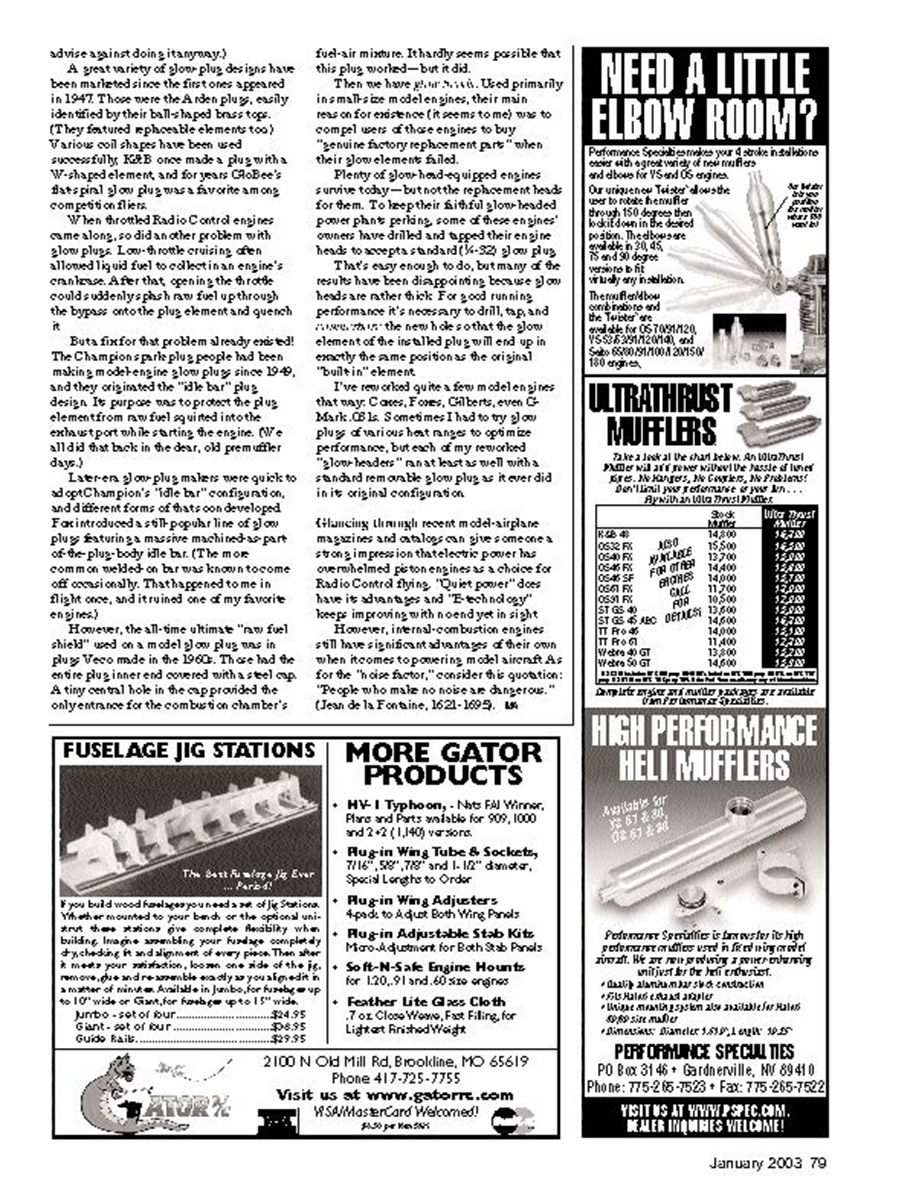
- Veco cap-style plugs (1960s): used a steel cap over the center plug insert with a tiny central hole as the only entrance for the combustion mixture; it worked surprisingly well.
- Piston plugs: used primarily in small engines; they often required buying “genuine factory replacement parts” when the glow element failed.
When throttle radio-control engines arrived, another problem emerged. Low-throttle cruising often allowed liquid fuel to collect in the crankcase; opening the throttle could suddenly push raw fuel up through the bypass onto the plug element and quench it. Champion’s idle-bar design and subsequent variants helped solve that problem.
Converting slow heads to removable plugs
Plenty of slow-head-equipped engines survive today, but replacement heads are hard to come by. Some owners have drilled and tapped their engine heads to accept a standard 1/4-32 glow plug. That’s easy enough, but glow heads are thicker than removable-plug heads. For good running performance it’s necessary to drill, tap, and recess the new hole so that the glow element of the installed plug ends up in exactly the same position as the original built-in element.
I’ve worked on a number of engines that way—Cokes, Foxes, Gilberts, even G-Mark. Sometimes I had to try a few plugs of various heat ranges to optimize performance, but each reworked slow head ran at least as well with a standard removable glow plug as it ever did in its original configuration.
Internal combustion versus electric
Glancing through recent model-airplane magazines and catalogs can give the strong impression that electric power has overwhelmed internal combustion for radio control flying. Quiet electric power does have its advantages, and E-technology keeps improving.
However, internal-combustion engines still have significant advantages of their own when it comes to powering model aircraft. As for the “noise factor,” consider this quotation: “People who make the most noise are the least able to bear it.” — Jean de La Fontaine (1621–1695).
Transcribed from original scans by AI. Minor OCR errors may remain.

