
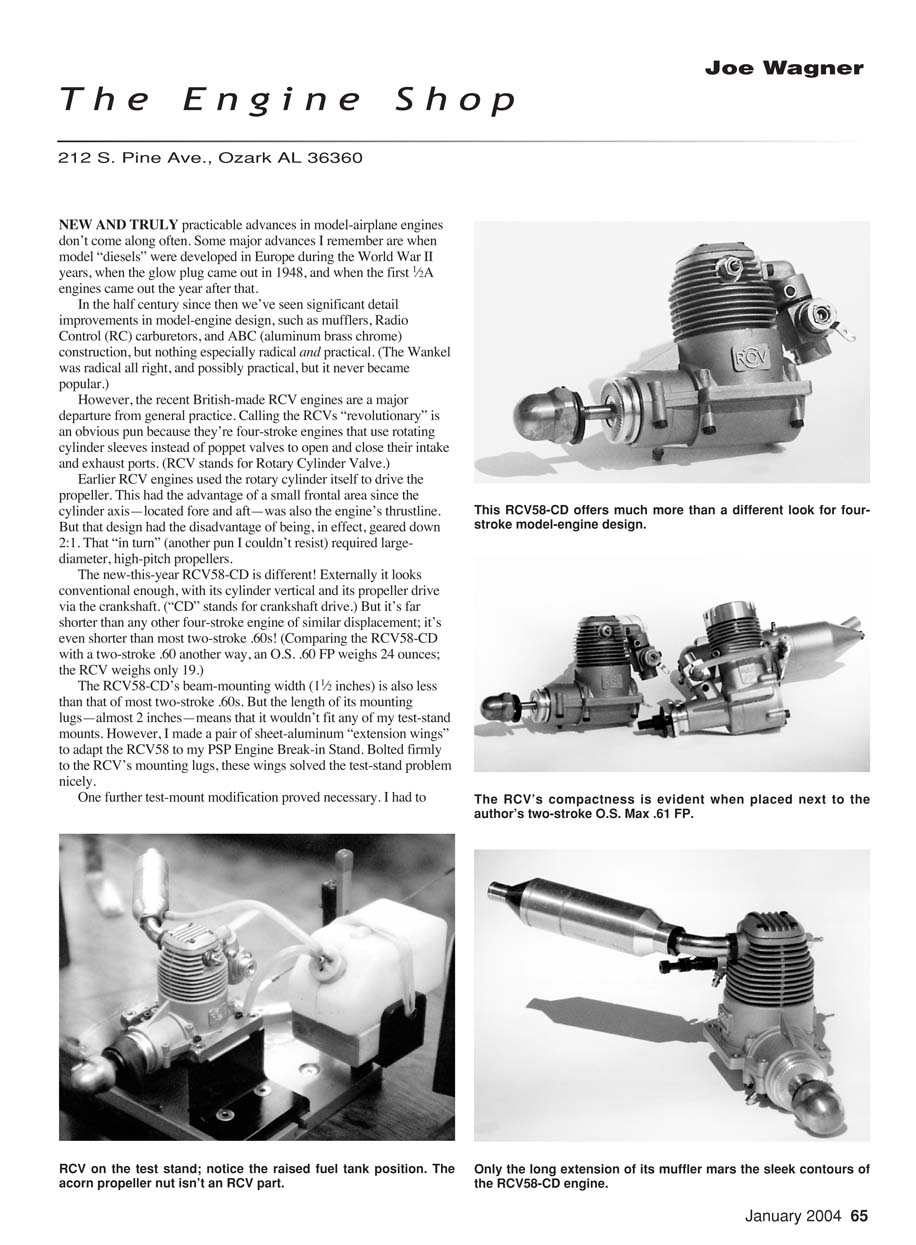
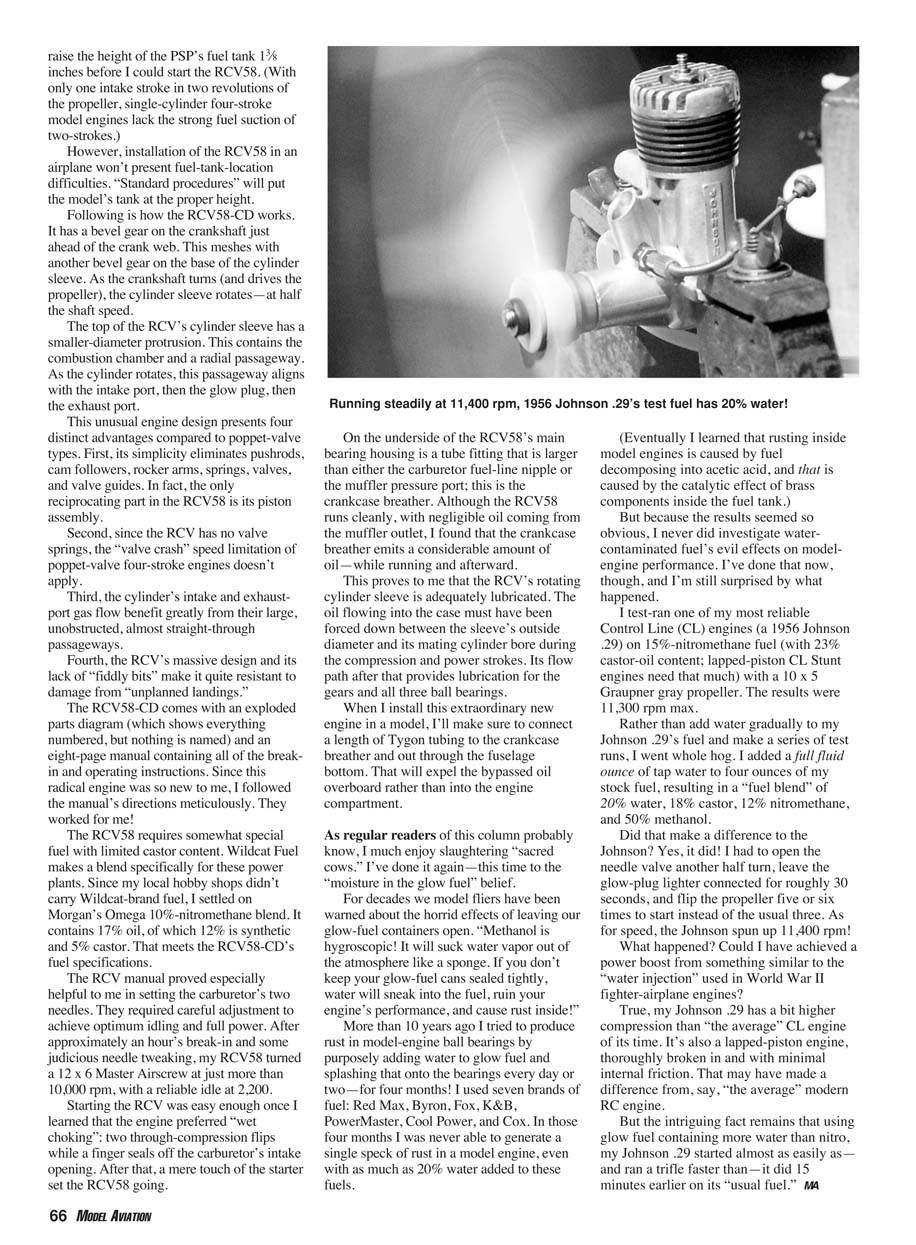
The Engine Shop
Joe Wagner
212 S. Pine Ave., Ozark, AL 36360
NEW AND TRULY practicable advances in model-airplane engines don't come along often. Some major advances I remember are when model "diesels" were developed in Europe during the World War II years, when the glow plug came out in 1948, and when the first 1/2A engines came out the year after that.
In the half century since then we've seen significant detail improvements in model-engine design, such as mufflers, radio-control (RC) carburetors, and ABC (aluminum-brass-chrome) construction, but nothing especially radical and practical. (The Wankel was radical all right, and possibly practical, but it never became popular.)
However, the recent British-made RCV engines are a major departure from general practice. Calling the RCVs "revolutionary" is an obvious pun because they're four-stroke engines that use rotating cylinder sleeves instead of poppet valves to open and close their intake and exhaust ports. (RCV stands for Rotary Cylinder Valve.)
Rotary Cylinder Valve concept
Earlier RCV engines used the rotary cylinder itself to drive the propeller. This had the advantage of a small frontal area since the cylinder axis—located fore and aft—was also the engine's thrustline. But that design had the disadvantage of being, in effect, geared down 2:1. That "in turn" (another pun I couldn't resist) required large-diameter, high-pitch propellers.
The new-this-year RCV58-CD is different. Externally it looks conventional enough, with its cylinder vertical and its propeller drive via the crankshaft. ("CD" stands for crankshaft drive.) But it's far shorter than any other four-stroke engine of similar displacement; it's even shorter than most two-stroke .60s. Comparing the RCV58-CD with a two-stroke .60 another way, an O.S. .60 FP weighs 24 ounces; the RCV weighs only 19.
Mounting and test-stand adaptations
The RCV58-CD's beam-mounting width (1 1/2 inches) is also less than that of most two-stroke .60s. But the length of its mounting lugs—almost 2 inches—means that it wouldn't fit any of my test-stand mounts. I made a pair of sheet-aluminum "extension wings" to adapt the RCV58 to my PSP Engine Break-in Stand. Bolted firmly to the RCV's mounting lugs, these wings solved the test-stand problem nicely.
One further test-mount modification proved necessary. I had to raise the height of the PSP's fuel tank 1 3/8 inches before I could start the RCV58. With only one intake stroke in two revolutions of the propeller, single-cylinder four-stroke model engines lack the strong fuel suction of two-strokes. However, installation of the RCV58 in an airplane shouldn't present fuel-tank-location difficulties; standard procedures will put the model's tank at the proper height.
How the RCV58-CD works
The RCV58-CD has a bevel gear on the crankshaft just ahead of the crank web. This meshes with another bevel gear on the base of the cylinder sleeve. As the crankshaft turns (and drives the propeller), the cylinder sleeve rotates at half the shaft speed.
The top of the RCV's cylinder sleeve has a smaller-diameter protrusion. This contains the combustion chamber and a radial passageway. As the cylinder rotates, this passageway aligns with the intake port, then the glow plug, then the exhaust port.
This unusual engine design presents four distinct advantages compared to poppet-valve types:
- Simplicity: it eliminates pushrods, cam followers, rocker arms, springs, valves, and valve guides. In fact, the only reciprocating part in the RCV58 is its piston assembly.
- No valve-crash limitation: since the RCV has no valve springs, the "valve-crash" speed limitation of poppet-valve four-stroke engines doesn't apply.
- Improved gas flow: the cylinder's intake and exhaust-port gas flow benefit greatly from their large, unobstructed, almost straight-through passageways.
- Durability: the RCV's massive design and its lack of "fiddly bits" make it quite resistant to damage from unplanned landings.
Documentation and break-in
The RCV58-CD comes with an exploded parts diagram (which shows everything numbered, but nothing is named) and an eight-page manual containing all of the break-in and operating instructions. Since this radical engine was so new to me, I followed the manual's directions meticulously. They worked for me.
The RCV58 requires somewhat special fuel with limited castor content. Wildcat Fuel makes a blend specifically for these power plants. Since my local hobby shops didn't carry Wildcat-brand fuel, I used Morgan's Omega 10%-nitromethane blend. It contains 17% oil, of which 12% is synthetic and 5% castor. That meets the RCV58-CD's fuel specifications.
The RCV manual proved especially helpful in setting the carburetor's two needles. They required careful adjustment to achieve optimum idling and full power. After approximately an hour's break-in and some judicious needle tweaking, my RCV58 turned a 12 x 6 Master Airscrew at just more than 10,000 rpm, with a reliable idle at 2,200.
Starting the RCV was easy once I learned that the engine preferred "wet choking": two through-compression flips while a finger seals off the carburetor's intake opening. After that, a mere touch of the starter set the RCV58 going.
Crankcase breather and lubrication
On the underside of the RCV58's main bearing housing is a tube fitting that is larger than either the carburetor fuel-line nipple or the muffler pressure port; this is the crankcase breather. Although the RCV58 runs cleanly, with negligible oil coming from the muffler outlet, I found that the crankcase breather emits a considerable amount of oil—while running and afterward.
This indicates that the RCV's rotating cylinder sleeve is adequately lubricated. The oil flowing into the case must have been forced down between the sleeve's outside diameter and its mating cylinder bore during the compression and power strokes. Its flow path after that provides lubrication for the gears and all three ball bearings.
When I install this engine in a model, I'll make sure to connect a length of Tygon tubing to the crankcase breather and out through the fuselage bottom. That will expel the bypassed oil overboard rather than into the engine compartment.
Moisture in glow fuel — experiment
As regular readers of this column probably know, I much enjoy slaughtering "sacred cows." I've done it again—this time to the "moisture in the glow fuel" belief.
For decades we model fliers have been warned about the horrid effects of leaving our glow-fuel containers open. "Methanol is hygroscopic!" it will suck water vapor out of the atmosphere like a sponge. If you don't keep your glow-fuel cans sealed tightly, water will soak into the fuel, ruin your engine's performance, and cause rust inside!
More than 10 years ago I tried to produce rust in model-engine ball bearings by purposefully adding water to glow fuel and splashing that fuel onto the bearings every day or two—for four months. I used seven brands of fuel: Red Max, Byron, Fox, K&B, PowerMaster, Cool Power, and Cox. In those trials I was never able to generate a single speck of rust in a model engine, even with as much as 20% water added to these fuels.
Eventually I learned that rusting inside model engines is caused by fuel decomposing into acetic acid, and that is caused by the catalytic effect of brass components inside the fuel tank.
Because the results seemed so obvious, I never did investigate water-contaminated fuel's effects on model-engine performance. I've done that now, and I'm still surprised by what happened.
I test-ran one of my most reliable control-line (CL) engines (a 1956 Johnson .29) on 15%-nitromethane fuel (with 23% castor-oil content; lapped-piston CL stunt engines need that much) with a 10 x 5 Graupner gray propeller. The result was 11,300 rpm max.
Rather than add water gradually to the Johnson .29's fuel and make a series of test runs, I went whole hog. I added a full fluid ounce of tap water to four ounces of my stock fuel, resulting in a fuel blend of 20% water, 18% castor, 12% nitromethane, and 50% methanol.
Did that make a difference to the Johnson? Yes, it did. I had to open the needle valve another half turn, leave the glow-plug lighter connected for roughly 30 seconds, and flip the propeller five or six times to start instead of the usual three. As for speed, the Johnson spun up to 11,400 rpm.
What happened? Could I have achieved a power boost from something similar to the "water injection" used in World War II fighter-airplane engines?
True, my Johnson .29 has a bit higher compression than the average CL engine of its time. It's also a lapped-piston engine, thoroughly broken in and with minimal internal friction. That may have made a difference compared to the average modern RC engine.
But the intriguing fact remains that using glow fuel containing more water than nitro, my Johnson .29 started almost as easily as—and ran a trifle faster than—it did 15 minutes earlier on its usual fuel.
MA
Transcribed from original scans by AI. Minor OCR errors may remain.

