
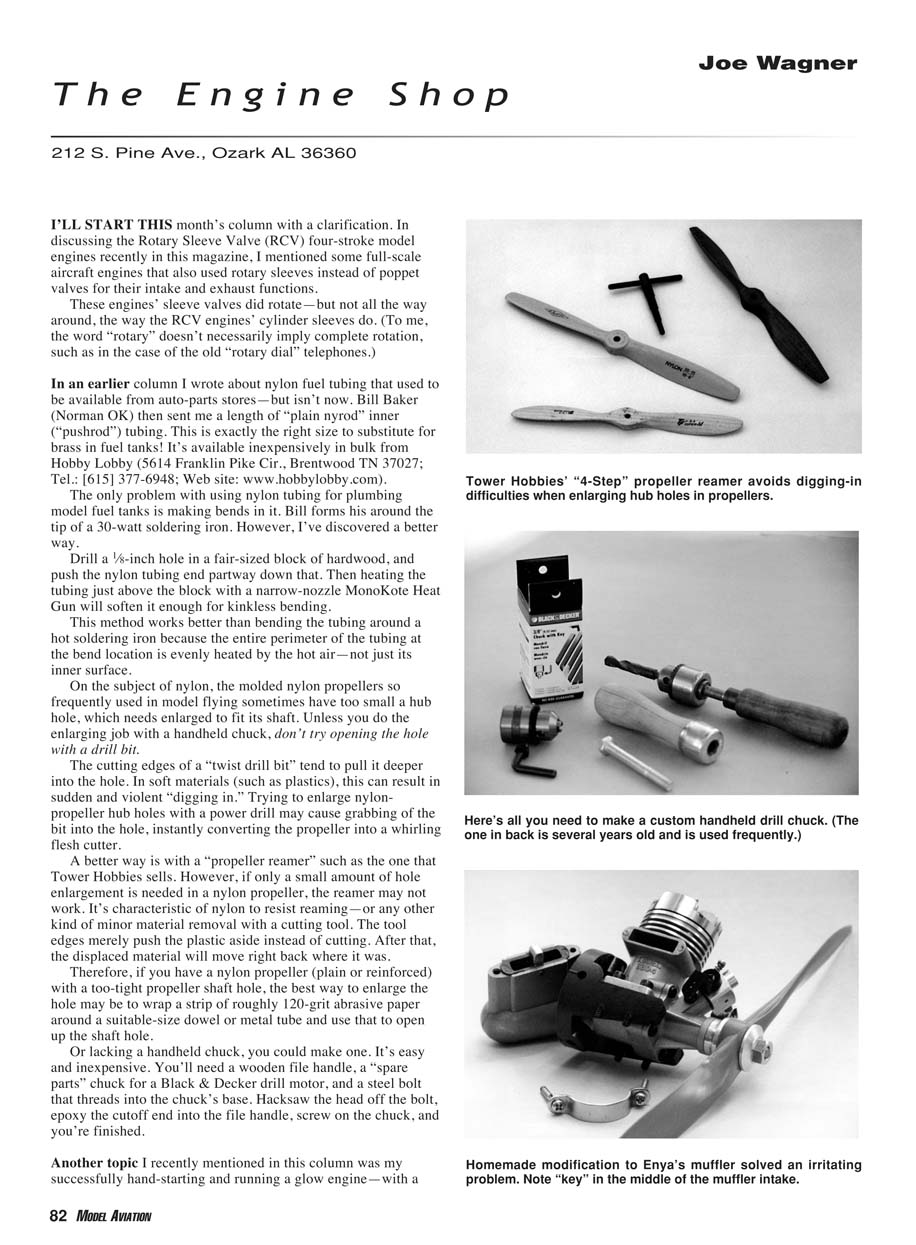
The Engine Shop
212 S. Pine Ave., Ozark AL 36360
Clarification on rotary sleeve valves
I'll start this month's column with a clarification. In discussing the Rotary Sleeve Valve (RCV) four-stroke model engines recently in this magazine, I mentioned some full-scale aircraft engines that also used rotary sleeves instead of poppet valves for their intake and exhaust functions.
These engines' sleeve valves did rotate—but not all the way around, the way the RCV engines' cylinder sleeves do. (To me, the word "rotary" doesn't necessarily imply complete rotation, such as in the case of the old "rotary dial" telephones.)
Nylon fuel tubing as fuel-tank plumbing
In an earlier column I wrote about nylon fuel tubing that used to be available from auto-parts stores—but isn't now. Bill Baker (Norman OK) then sent me a length of "plain Nyrod" inner ("pushrod") tubing. This is exactly the right size to substitute for brass in fuel tanks! It's available inexpensively in bulk from Hobby Lobby (5614 Franklin Pike Cir., Brentwood TN 37027; Tel.: [615] 377-6948; Web site: www.hobbylobby.com).
The only problem with using nylon tubing for plumbing model fuel tanks is making bends in it. Bill forms his around the tip of a 30-watt soldering iron. However, I've discovered a better way.
Bending nylon tubing
Drill a 1/8-inch hole in a fair-sized block of hardwood, and push the nylon tubing end partway down that. Then heat the tubing just above the block with a narrow-nozzle MonoKote heat gun; this will soften it enough for kinkless bending.
This method works better than bending the tubing around a hot soldering iron because the entire perimeter of the tubing at the bend location is evenly heated by the hot air—not just its inner surface.
Enlarging nylon propeller hub holes
On the subject of nylon, the molded nylon propellers so frequently used in model flying sometimes have too small a hub hole, which needs enlarging to fit its shaft. Unless you do the enlarging job with a handheld chuck, don't try opening the hole with a drill bit.
The cutting edges of a twist drill bit tend to pull it deeper into the hole. In soft materials (such as plastics), this can result in sudden and violent digging in. Trying to enlarge nylon-propeller hub holes with a power drill may cause grabbing of the bit into the hole, instantly converting the propeller into a whirling flesh cutter.
A better way is with a propeller reamer such as the one that Tower Hobbies sells. However, if only a small amount of hole enlargement is needed in a nylon propeller, the reamer may not work. It's characteristic of nylon to resist reaming—or any other kind of minor material removal with a cutting tool. The tool edges merely push the plastic aside instead of cutting. After that, the displaced material will move right back where it was.
Therefore, if you have a nylon propeller (plain or reinforced) with a too-tight propeller shaft hole, the best way to enlarge the hole may be to wrap a strip of roughly 120-grit abrasive paper around a suitable-size dowel or metal tube and use that to open up the shaft hole.
Or, lacking a handheld chuck, you could make one. It's easy and inexpensive. You'll need:
- a wooden file handle,
- a "spare parts" chuck for a Black & Decker drill motor, and
- a steel bolt that threads into the chuck's base.
Hacksaw the head off the bolt, epoxy the cutoff end into the file handle, screw on the chuck, and you're finished.
Water in glow fuel — experiments and observations
Another topic I recently mentioned in this column was my successfully hand-starting and running a glow engine—with a small actual gain in performance—on fuel containing 20% water.
Bob Angel (Santa Maria CA), who is the newsletter editor for the Central Coast Chapter of the Society of Antique Modelers, wrote to tell of similar experiments that he'd conducted a few years ago with a Cox reed-valve .049.
Instead of adding the water to his glow fuel all at once, as I did, Bob made his water additions gradually. He noticed no difference in the engine's performance until he reached 15% water content.
I suggested that the difference between my recent results with a Johnson .29 and his with a Cox .049 was because 1/2A engines have a larger cooling area in proportion to their combustion-chamber volumes. Thus they naturally run cooler than larger engines—and the addition of noncombustible water to the fuel for a 1/2A would cause a performance loss at a lower percentage level.
This interchange led to further technical correspondence on model-engine fuel between Bob and me. He had often wondered why methanol is the preferred "maximum power fuel" for model airplanes, race cars, etc., when gasoline is known to have a far higher energy content.
Why methanol is preferred
The reason lies in the fact that what limits the power output of an internal-combustion engine (of any type, large or small) is the amount of air available in the combustion chamber for burning the fuel. (That's why supercharging boosts power output; it packs more air into the cylinder.)
Combustion is a complicated process, with many possible variables—as anyone can learn from the section on combustion in Van Nostrand's Scientific Encyclopedia. The fundamental facts (for complete combustion) are:
- Methyl alcohol (methanol) produces about 10,000 British Thermal Units (BTU) per pound and needs approximately seven times its weight of air to do that.
- Ethyl alcohol (ethanol) produces about 12,000 BTU per pound and needs roughly 14 times its weight of air to do that.
- Gasoline (which isn't a single chemical compound—not even a standardized blend of hydrocarbons) produces roughly 20,000 BTU per pound and needs more than 30 times its weight of air for that.
Therefore, if a given internal-combustion engine's air-intake ability is a constant, only approximately one-quarter as much gasoline can be burned in it per revolution as methanol.
Since gasoline's energy content (and potential power output) is 20,000 BTU and methanol's is 10,000 BTU, it follows that an engine burning four times as much methanol as gasoline will produce roughly double the power. (As for ethyl alcohol, the numbers given show that there's no power advantage in using it instead of methanol or gasoline.)
Aluminum fuel containers
Also on the subject of model-engine fuel, Dale Steiner (Detroit MI) asked whether the aluminum fuel containers (described in an earlier "The Engine Shop" column, with reference to model diesel fuel) would also work for glow.
Yes! They're suitable for any kind of model fuel, and the modifications I suggested allow convenient, gravity-flow fueling of all kinds of model airplanes. No pump or syringe is needed, and the aluminum containers won't rust or split a seam. Designed for safe use by backpacking campers, they can stand up to considerable rough handling.
Muffler fix on an Enya .15 R/C
I'm now retired from doing model-engine rework, but from time to time an old friend will come over with a "small problem" that needs fixing. Last year one of them brought in an Enya .15 R/C with an annoying habit: its strap-on muffler kept sliding off in flight, no matter how much its retaining screws had been tightened. I fixed that problem in a jiffy—and almost entirely with hand tools.
I found a length of rectangular aluminum bar in my scrap box, hacksawed off a short piece, and then filed that to fit snugly into the inlet passage of the Enya's muffler. This acted as a key to stop the muffler from slipping away from its proper position on the engine's exhaust stack. Then to prevent the added key from being shifted by vibration, I drilled a small hole through the muffler and key to admit a piece of solid copper electrical wire.
Slightly countersinking both external ends of this hole allowed me to use the copper wire as a rivet. That was far easier to do—and neater-looking when finished—than using a machine screw and nut. (And rivets never vibrate loose!)
Making minor modifications such as this used to be a common activity of most power fliers. Some of the changes made to their engines were more or less to personalize a modeler's power plant. Other revisions were intended to improve performance in some way. Whether they accomplished that or not, the results were almost always educational—one way or another.
Many older model engines that are in good condition are still available for cheap. These can provide excellent subjects for experimentation. You don't necessarily need a machine shop; considerable work can be done with hand tools.
Small machine tools and my experience
To handle more ambitious projects, Hobby Lobby sells a tabletop-sized Taig micro metal-cutting lathe, which can handle parts as large as 4-1/2 inches in diameter. It even has an optional milling attachment for work such as slotting and other straight-line cutting of metal, wood, and plastic.
For several years in the late 1950s, I did all my own model-engine modifications with a similar mini machine tool. That tool took ingenuity and time; small metal lathes lack the power for making deep cuts in one pass. But the work provided me with a pleasant challenge and a rewarding pastime.
MA
Transcribed from original scans by AI. Minor OCR errors may remain.

