
The Engine Shop
Joe Wagner 212 S. Pine Ave., Ozark AL 36360
The Rossi company
The Italian Rossi company has been famous for high-performance model engines since 1966. Its founder, Ugo Rossi, won several World Championships in CL Speed events with his engines. Today the Rossi company, under the management of Ugo's son Alessandro, has been expanding its product line. Rossi manufactures a wide variety of model power plants—among them some of the fastest-revving car and boat engines ever made. Some of these turn more than 40,000 rpm!
For powering RC model airplanes, Rossi has an exceptionally large selection, including pylon racing engines, helicopter power plants, ducted-fan engines, and several sport RC types. These RC engines range in size from .21 cu. in. (3.5 cc) to .67 cu. in. (11.0 cc). Examples of the .60-size offerings:
- Two .60s (long and short stroke) plus a long-stroke .65.
- All three use the same case but have different bores and strokes.
- Options include side or rear exhaust, mufflers, and tuned pipes of various kinds.
Rossi’s U.S. importer is SG Model Engines, Box 280303, Northridge CA 91328; Tel.: (818) 472-8460. To help modelers choose among the various Rossi engines, SG Model Engines has set up two web sites:
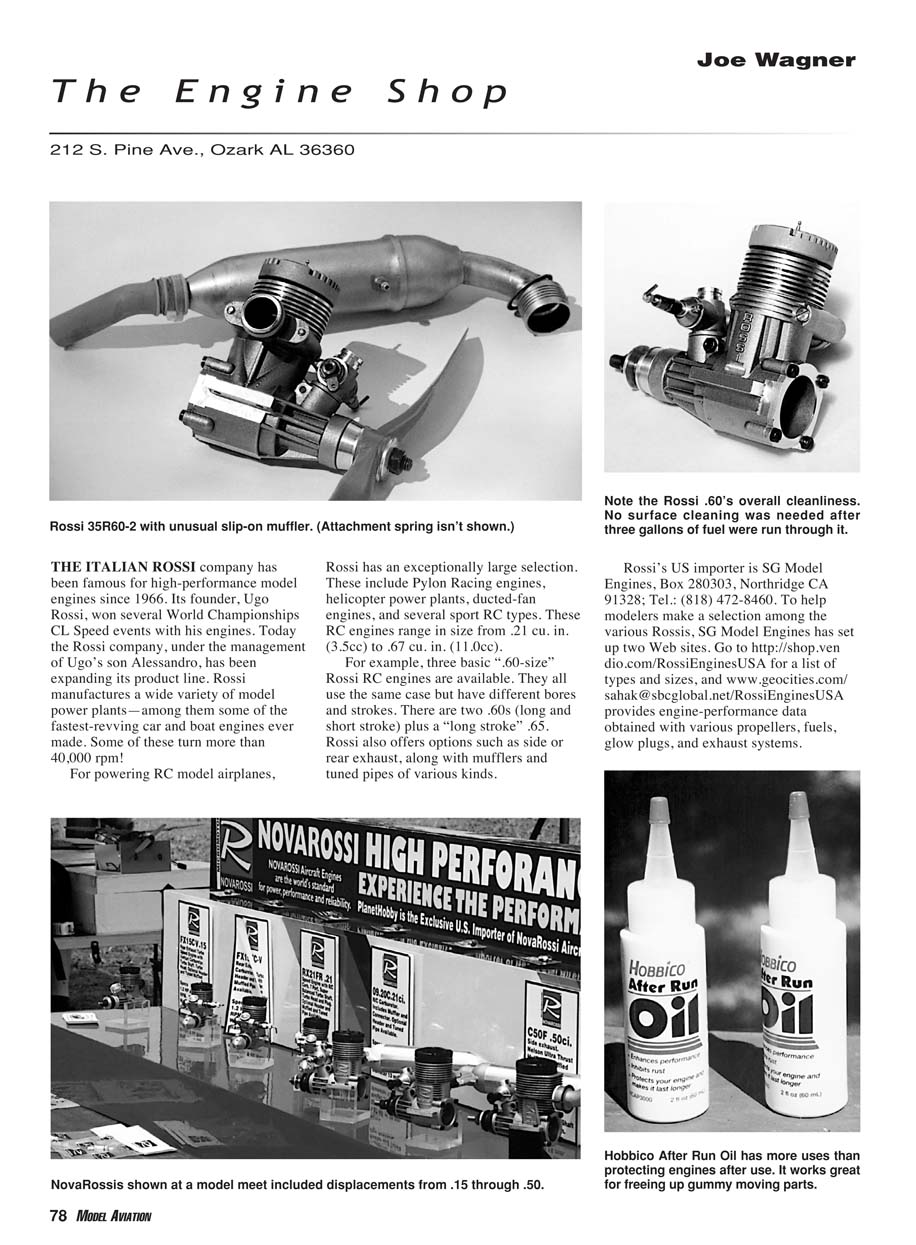
Rossi .60 long-stroke (Model 35R60-2)
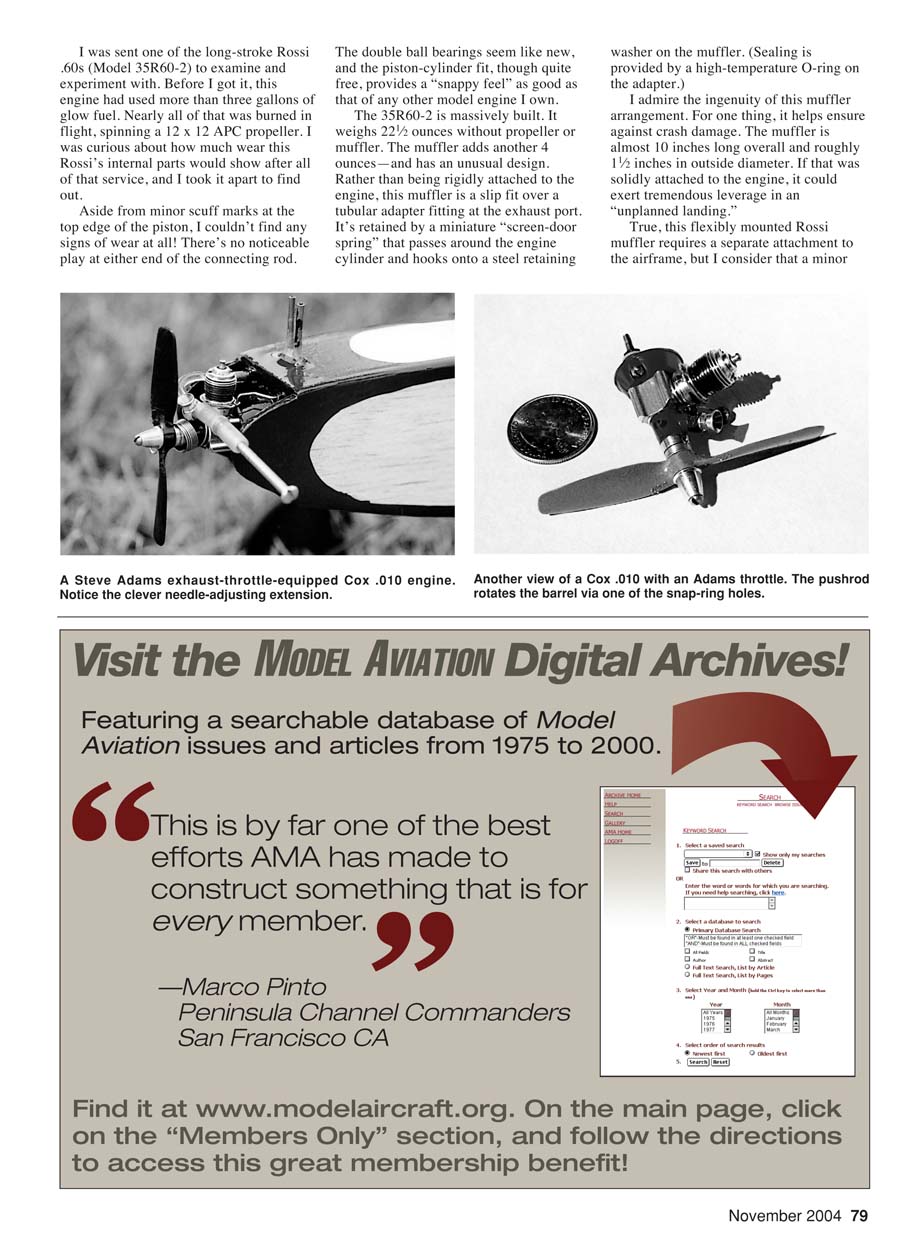
I was sent one of the long-stroke Rossi .60s (Model 35R60-2) to examine and experiment with. Before I got it, this engine had used more than three gallons of glow fuel; nearly all of that was burned in flight, spinning a 12 x 12 APC propeller. I was curious how much wear the Rossi’s internal parts would show after that service, so I disassembled it.
Findings:
- Aside from minor scuff marks at the top edge of the piston, there were no signs of wear.
- No noticeable play at either end of the connecting rod.
- The double ball bearings seemed like new.
- The piston-to-cylinder fit, though quite free, provides a snappy feel comparable to any other model engine I own.
The 35R60-2 is massively built. It weighs 22 1/2 ounces without propeller or muffler. The muffler adds another 4 ounces.
Muffler design
The muffler has an unusual, clever design: rather than being rigidly attached to the engine, it is a slip fit over a tubular adapter at the exhaust port. It is retained by a miniature “screen-door spring” that passes around the engine cylinder and hooks onto a steel retaining washer on the muffler. Sealing is provided by a high-temperature O-ring on the adapter.
Advantages:
- Flexibly mounted muffler reduces crash damage by avoiding large leverage forces on impact.
- The muffler is nearly 10 inches long and about 1 1/2 inches in outside diameter; a rigid mount would exert tremendous leverage in an unplanned landing.
Drawbacks and solutions:
- The flexible muffler requires a separate attachment to the airframe. I consider that a minor inconvenience and easily solved—e.g., mounting the Rossi sidewinder style with the muffler extending back under the fuselage and anchoring it to the tempered aluminum landing gear.
Carburetor and performance
The Rossi has a ruggedly constructed two-needle carburetor. One minor issue is that the idle needle is quite sensitive—an eighth of a turn either way makes a noticeable difference. Because my fuel-tank arrangement differed from the airplane this Rossi came from, I had to adjust the idle needle to get consistent throttle response from minimum to maximum speed.
With a 12½ x 6 Graupner propeller and 10% nitromethane fuel, my Rossi .60 turns a maximum of 12,200 rpm and idles reliably at 2,300 rpm. It hand-starts without trouble—although I recommend wearing a heavy leather glove when doing that.
NovaRossi
An interesting sidelight: the original Rossi company was a cooperative venture of Ugo Rossi and his brother. After several years a disagreement occurred and the brother left to start his own company, NovaRossi (“New Rossi”). Today NovaRossi makes its own line of high-quality model engines. NovaRossi’s U.S. importer is Allen Worley, 7477 Wood Rail Cove, Memphis TN 38119; Tel.: (901) 755-1536. Web site: www.planethobby.com.
After Run Oil (A-R-O) and restoring old CL engines
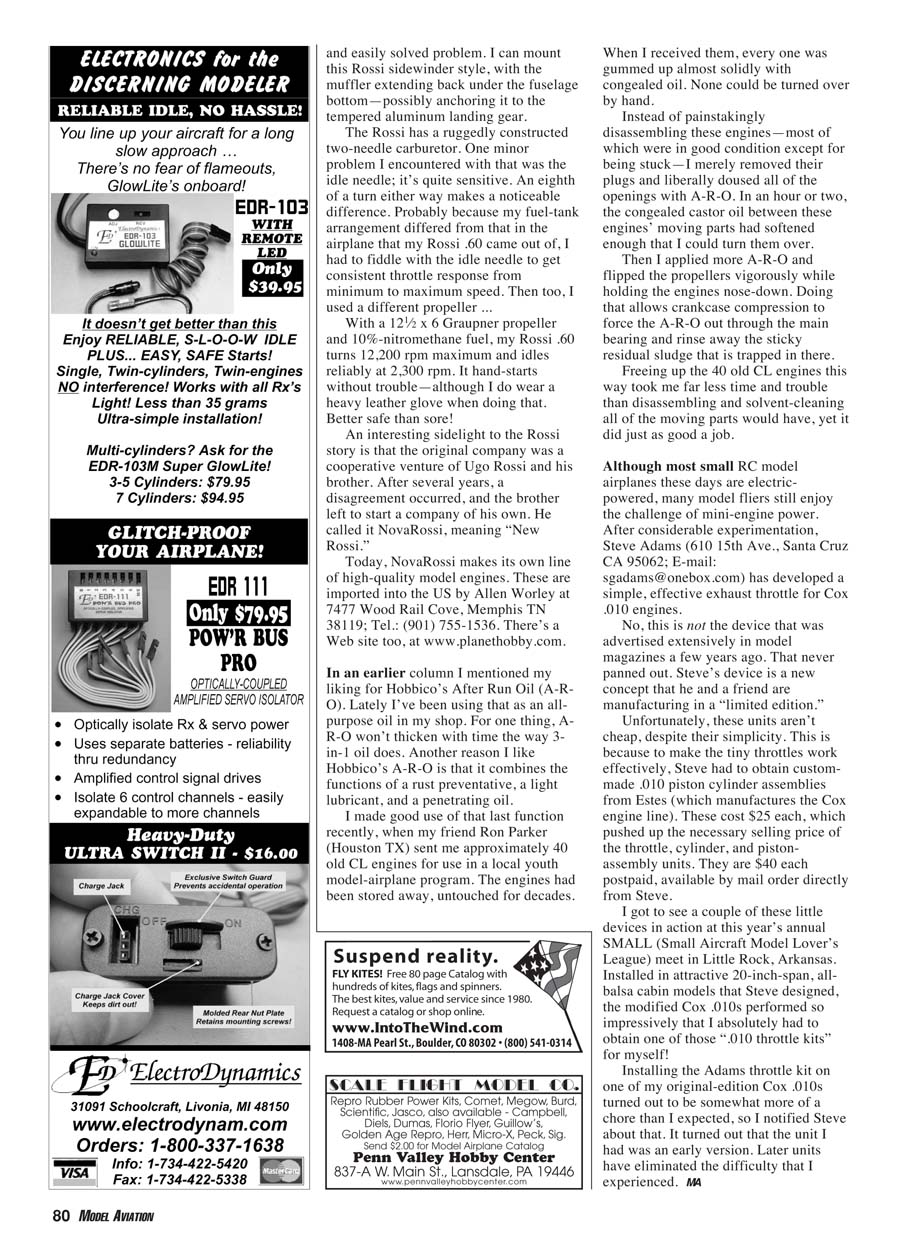
In an earlier column I mentioned my liking for Hobbico’s After Run Oil (A-R-O). Lately I’ve been using it as an all-purpose oil in my shop. Reasons I like A-R-O:
- It won’t thicken with time the way 3‑in‑1 oil does.
- It combines the functions of a rust preventative, a light lubricant, and a penetrating oil.
A recent use: my friend Ron Parker (Houston, TX) sent me approximately 40 old CL engines for a local youth model-airplane program. They had been stored for decades and were gummed up with congealed oil—none could be turned over by hand.
Procedure that worked well:
- Remove the plugs and liberally douse all openings with A-R-O.
- Wait an hour or two for the congealed castor oil to soften.
- Flip the propellers to break the sludge free.
- Apply more A-R-O and flip the propellers vigorously while holding the engines nose-down. Crankcase compression forces the A-R-O out through the main bearing and rinses away the sticky residue.
This method freed up all 40 engines far more quickly and easily than disassembling and solvent-cleaning each engine would have.
Cox .010 exhaust throttle kit
Although most small RC model airplanes today are electric-powered, many fliers still enjoy the challenge of mini-engine power. After considerable experimentation, Steve Adams (6118 15th Ave., Santa Cruz CA 95062; E-mail: sgadams@onebox.com) developed a simple, effective exhaust throttle for Cox .010 engines.
Notes:
- This is not the widely advertised device from a few years ago that never panned out; it is a new concept produced in a limited edition.
- The units are not cheap because Steve obtains custom-made .010 piston cylinder assemblies from Estes (which manufactures the Cox engine line). The custom assemblies cost $25 each and raise the final selling price.
- The throttle, cylinder, and piston-assembly units are $40 each postpaid, available by mail order directly from Steve.
I saw a couple of these devices in action at this year’s SMALL (Small Aircraft Model Lover’s League) meet in Little Rock, Arkansas. Installed in attractive 20-inch-span, all-balsa cabin models that Steve designed, the modified Cox .010s performed impressively, and I had to obtain one of the .010 throttle kits for myself.
Installing the Adams throttle kit on one of my original-edition Cox .010s was more of a chore than I expected; I notified Steve and learned that my unit was an early version. Later units have eliminated the difficulty I experienced.
Transcribed from original scans by AI. Minor OCR errors may remain.

