


The Engine Shop
927 Pine Avenue, Ozark, AL 36360 E-Mail: engshop@snowhill.com
MISCELLANY MONTH! There's a new address at the head of this column. My recent move to Alabama will allow me to do considerably more model flying from now on than western Pennsylvania's weather permitted in the last few years. I'll also be able to experiment more with model engines. I have some truly unusual engine developments to complete and test, and to write about in "The Engine Shop."
Several readers have written to discuss topics I mentioned in previous columns. One of those was my two-stroke/four-stroke comparison, where I stated that the effective displacement of two-stroke engines has always been wrongly specified. That's because the mathematical formula for "geometric piston displacement" neglects the inactive part of the stroke between Bottom Dead Center (BDC) and the point where the piston crown passes the top edge of the exhaust ports.
I received two dissenting letters about that. Neither came from a model engine manufacturer, however, nor from a renowned expert such as Clarence Lee, Bill Wisniewski, or George Aldrich. Those who have worked for many years on the development and testing of model airplane engines know from experience about "port timing" and the ill effects of excessive exhaust port height.
Anyone who still feels that the geometric piston displacement of a two-stroke engine is what determines its power output—regardless of its exhaust port dimensions—might try reworking the sleeve of a typical two-stroke glow engine by grinding its exhaust ports 1/4 inch higher. I'll guarantee that no power gain will result.
But there was one point that I neglected to mention in my explanation of how and why a four-stroke model airplane engine can put out essentially the same useful propulsive power as a two-stroke of the same nominal size, despite the fact that it provides only half as many power strokes at any given rpm:
Besides the "corrected displacement factor" I just mentioned, some of a two-stroke engine's "gross energy output" has to be expended in compressing the fresh fuel/oil/air mixture in its crankcase each time its piston drives downward. That energy contributes nothing toward rotating the propeller.
Two letters about my column on lubrication of model engines repeated a groundless rumor that's been circulating among model fliers for several months: that all of today's castor oil is being produced by a "solvent extraction" process that makes the oil useless as a model fuel lubricant.
Castor oil being used by American model fuel producers today works just as well as it always has. It does not produce insoluble wax flakes that clog needle valve orifices, nor any other detrimental effect. The "insoluble castor oil" rumor had to be false; how could any model fuel blender hope to stay in business if he sold a product that made his customers' engines unrunnable?
Model Diesel Engines
Since the end of World War II, diesels have been extremely popular in Europe for powering model airplane flying. Until recently, diesels never appealed much to American model fliers. A possible reason was the poor reputation of the first U.S.-made model diesels—the Drone .29 and the Mite .098 of 1947. Both lacked adjustable compression and used a highly inefficient fuel blend (ethyl ether and drugstore mineral oil), which made few friends.
Today's model diesels are almost totally different in design and operation. A typical fuel mix for modern diesels is approximately one-third ether, kerosene, and castor oil, with a small percentage of amyl nitrite added as a combustion stabilizer. The adjustable-compression feature makes today's model diesel engines usable on an exceedingly wide range of propellers. A PAW .03 will spin a 10x4 Graupner prop and will just reliably do a 6x3.
Model diesels provide more power output per minute and longer run time per ounce of total power-system weight (engine, prop, mount, fuel supply, etc.) than any other type of energy source for model airplane flying—they can get thrust for a longer time at less weight.
Another recurring question about castor oil concerns medicinal vs. laxative-grade: medicinal castor oil works just as well for model engine lubrication as any other type. The only difference is that laxative-grade castor oil costs more because it's pressed from a special variety of castor bean with a mild flavor.
There are still other advantages to model diesels:
- Softer sound: In a test I ran a few years ago, four men and three women whose opinion I asked reported that the diesel's noise was less bothersome than that of a same-sized glow engine running at the same speed—even though my Radio Shack sound meter indicated essentially the same reading in dBA (A-weighted decibels) for both engines.
- Consistent performance: All use the same fuel and perform consistently with it winter and summer, in high or low humidity, and at any altitude.
- Versatility in props and efficiency: On a nationwide car trip in 1995 I carried a portable test stand and two of my best small engines—one glow and one diesel. In several widely differing environments from Pennsylvania to California, I tested both engines for ease of starting and peak rpm, using the same fuels and props throughout. As I expected, the glow engine performance varied considerably, but the diesel's adjustable compression made it possible to attain the same rpm anywhere. Though its startability lessened a little at Albuquerque's 7,200-foot altitude, I had no real difficulty getting it perking there or anywhere else.
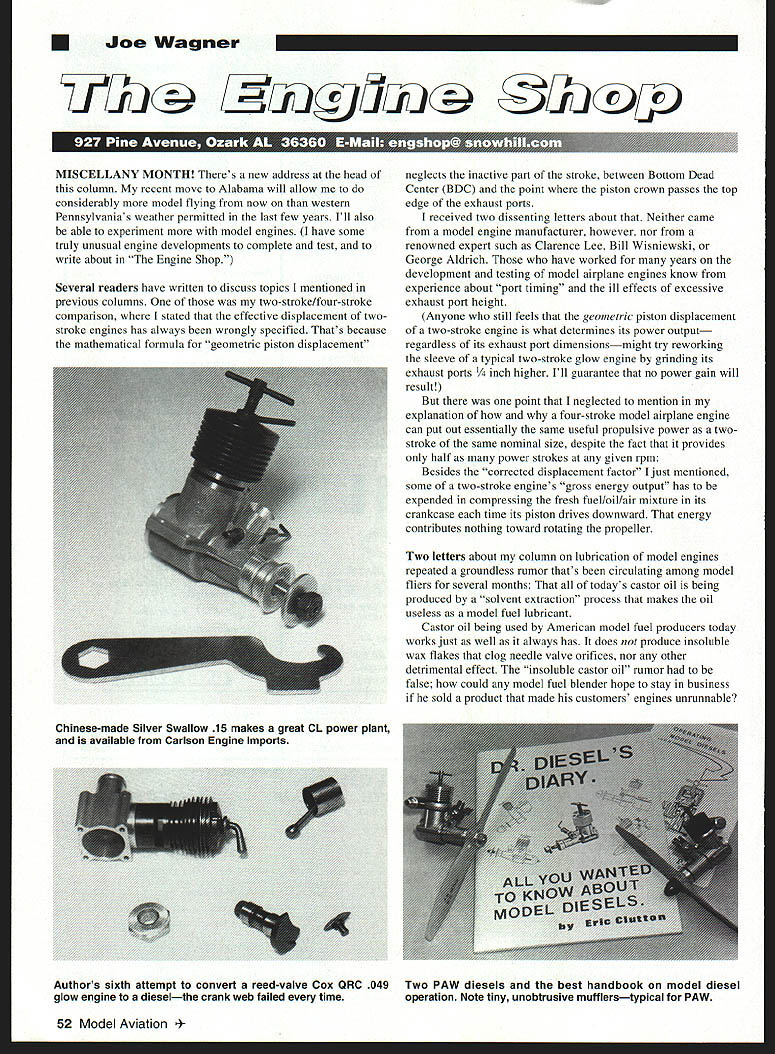
Replacement head kits are available for converting various glow engines into diesels. However, for my own flying I much prefer diesels that were specifically designed for that purpose. Operating stresses on diesel crankpins, rods, and wristpins reach a higher level than in glow engines; that's why the diesel components are more massive. The crankcase in a PAW .19 is as hefty as the rods used in most glow .29s. Do not convert any Cox reed‑valve engine to a diesel— their shafts and rods cannot take the extra punishment for long.
A common-but-false belief about model diesel engines is that the higher their compression the better their power output. Not so. Overcompression ignites the fuel/air mixture too soon, while the piston is still moving upward. That causes higher stresses, higher operating temperature, and lower rpm.
High compression is needed for starting a model diesel when the engine is cold. But once it's running, the diesel's compression screw should be backed off gradually as the engine warms up to normal operating temperature.
Ordinarily, a model diesel's warmup takes 30 seconds to a minute. It's sometimes necessary to repeatedly adjust the compression and the needle in alternate steps for optimum performance. As you lean out its mixture, a diesel runs hotter and requires less compression.
This adjustment sequence, so different from that of a glow engine, baffles some modelers at first but soon becomes an automatic habit. Here's a rule of thumb to simplify the diesel learning process:
Adjust your engine's running compression so that its exhaust discharge is no darker than a pale tan. Black exhaust oil is a sure sign of overcompression, high stresses, and lower power output.
(Some model diesels will run quite steadily on a test stand with their compression backed off to the point where their exhaust output looks as clear as olive oil. However, diesels usually run cooler in flight than they do on the test stand. RC-type diesels in particular may not perform consistently in the air if they're undercompressed.)
Two objections often raised against model diesel engines involve their fuel:
- The mixture of ether and kerosene smells much different than glow fuel or gasoline, and its pungent aroma tends to linger a long time—especially on clothing.
- The exhaust discharge is rather oily. Fastidious model fliers have called diesel users "The Oily Rag Brigade."
To counteract the first problem: with a little care you can handle your diesel-powered models so that only your hands and forearms contact fuel and the exhaust outflow. I do that and have found that a thorough washup with Lava soap from elbows to fingertips after flying removes all trace of diesel fuel aroma.
A friend of mine uses a skin protectant made for fiberglass workers. It's applied like a lotion, dries to a thin, impermeable film, but washes off readily with soap and water.
The problem of oily exhaust residue on the airplane is easily solved with the same after-flying cleanup procedures used by glow fliers—you merely need a few more paper towels.
For cleanliness fanatics, there's another approach: extend the exhaust away from the model. Most RC diesels I've used seem quite insensitive to exhaust back pressure and lose no power even with quite long extensions to their muffler outlets.
To anyone who'd like to give model diesel engines a try, I highly recommend Eric Clutton's book Dr. Diesel's Diary. Subtitled All You Wanted To Know About Model Diesels, it fulfills that description admirably. It's available by first-class mail from the author (913 Cedar Ln., Tullahoma, TN 37388) at $11.50 postpaid.
Two Helpful Hints
- Test-stand throttle: A simple modification to an all-metal engine test stand is a throttle-actuating arrangement made from sheet aluminum and pop-riveted to the rear of the "fixed" part of the test stand. The throttle pushrod is best if made from a common bicycle spoke, which has the same end threads as an RC clevis.
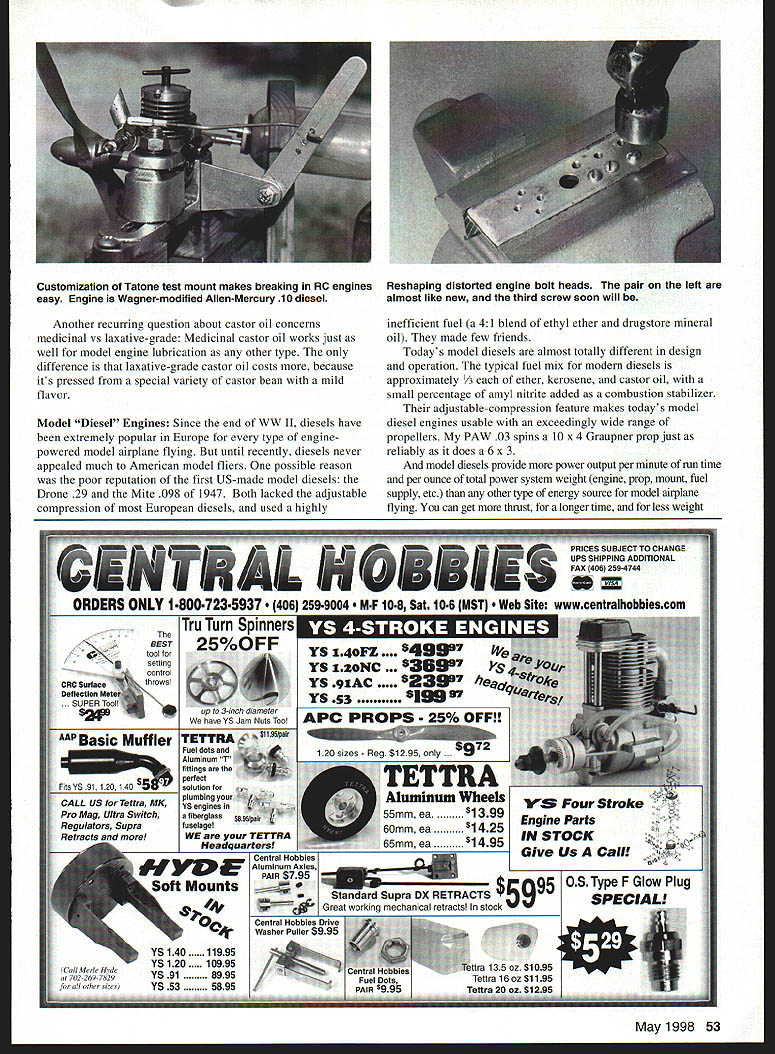
- Restoring damaged screw slots: This method works equally well for straight-slot and Phillips screws. Drill holes (sized so that your damaged screws will just slip in snugly) into a piece of mild steel—anywhere from 1/8" to 1/4" thick. Clamp the steel firmly in a vise; insert the screws; then reform the slots with light, carefully aimed ball-peen hammer strokes. Since the slot distortion is usually just metal displaced by excessive force (or the wrong-size screwdriver), it can almost always be fixed by progressively driving the displaced metal back where it originally was.
Transcribed from original scans by AI. Minor OCR errors may remain.

