
The Engine Shop
Joe Wagner
927 Pine Avenue, Ozark AL 36360 E-Mail: engineshop1@juno.com
Introduction
Because this column will be coming out roughly the same time as AMA's Celebration of Pioneers, I’m devoting it to the model airplane engines that got "Gas Model" flying started. These old‑timer spark‑ignition types still provide the motive power for many models today, such as in the popular SAM (Society of Antique Modelers) free‑flight events.
Early history
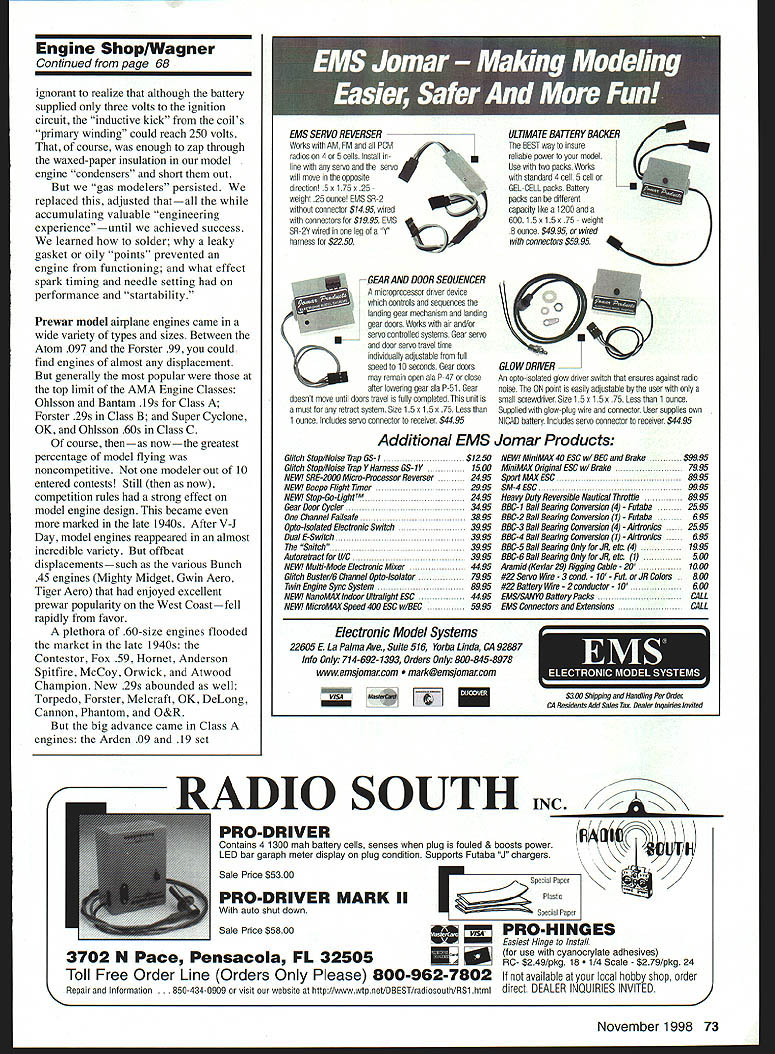
Primitive miniature "gas engines" have been used for flying model airplanes since before World War I, but they didn't become obtainable to average model fliers until the mid‑1930s. That was when the Brown Junior .60 (manufactured in Philadelphia) and the Baby Cyclone .36 (made in Los Angeles) first appeared in America's hobby shops.
Those were the darkest days of the Depression era, when a working man felt lucky to earn $25 a week. The Brown Jr.'s $21.50 price tag put it beyond the reach of most modelers (the Baby Cyclone sold for a little less). Still, those two pioneer power plants hauled enough gas models aloft to stir up a deep desire for engine power among America's youth.
Model kit makers partly satisfied that desire by issuing rubber‑powered kits. Scientific's $1.95 "Flea" was one that was designed to look like a gassie. Kits came with turned hardwood parts for constructing a dummy engine and even included a ratchet‑like gizmo to be installed on the rear of the propeller to simulate the sound of a gas engine.
During the next few years America's economic climate gradually improved, engine prices dropped, and model engine offerings grew. In 1938 several engines were introduced, including:
- The "Ten‑Dollar Brown"
- Dennymite .57
- Trojan .19
- Bullet .275
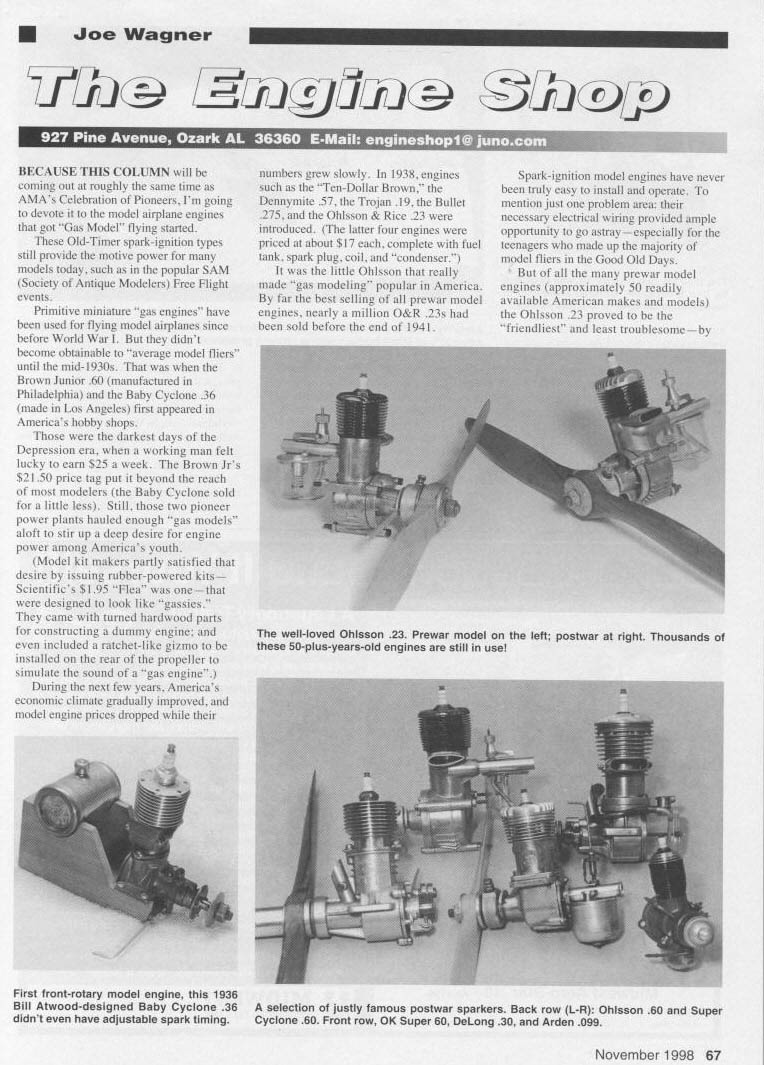
- Ohlsson & Rice (O&R) .23
The latter four were priced at about $17 each, complete with tank, spark plug, coil and condenser.
The Ohlsson & Rice .23
It was the little Ohlsson that really made gas modeling popular in America. By far the best‑selling of all prewar model engines, nearly a million O&R .23s had been sold before the end of 1941.
The Ohlsson .23 proved to be friendly and reliable. Owners routinely took engines apart and put them back together with a small screwdriver and crescent wrench. True disassembly and reassembly took much less time, and hardly anyone "hopped up" the O&R .23—there just wasn't much that could be done. The engine was cleverly designed and parts failures seldom occurred.
Spare parts were easily and inexpensively available: there were some 3,400 official O&R dealers in the U.S. in 1941. Commonly replaced items included crankcase gaskets, point springs and insulating washers. One big advantage prewar tinkerers gained from fiddling with their power plants was educational — hands‑on experience teaching how engines worked, the function of various parts, and what caused failures.
Spark‑ignition problems and what we learned
Spark‑ignition components provided most of the trouble for early gas modelers:
- Pencell (zinc‑carbon) batteries were of poor quality; serious modelers bought boxes of a dozen hoping a few would be good enough.
- Flight condensers were unreliable. While the battery supplied only about three volts to the ignition circuit, the inductive "kick" from the coil's primary winding could reach 250 volts — enough to zap through waxed‑paper insulation and short condensers.
Despite these problems, modelers persisted. They replaced and adjusted parts, gradually accumulating valuable engineering experience. They learned to solder, repair leaky gaskets, clean oily contact points, and discovered how spark timing, needle setting, plug gap and compression affected performance and startability.
Prewar engine variety and AMA classes
Prewar model engines came in a wide variety of displacements — between the Atom .097 and the Forster .99 you could find almost anything. Generally the most popular engines were those at the top limit of the AMA engine classes:
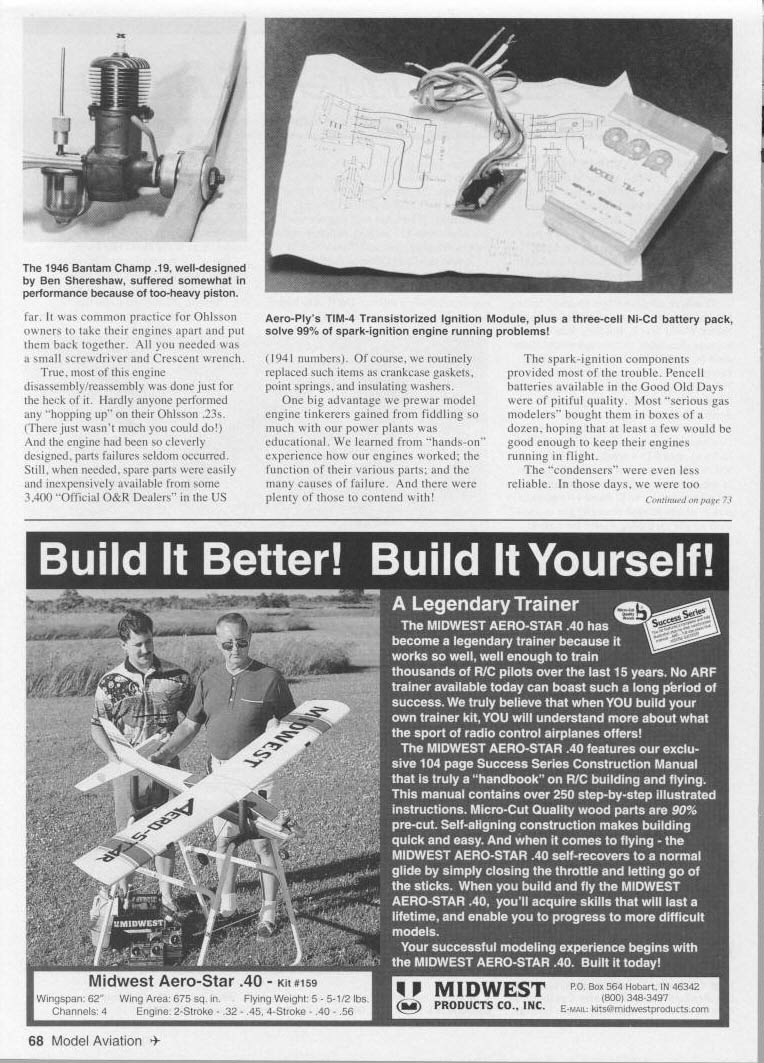
- Class A: Ohlsson and Bantam .19s
- Class B: Forster .29s
- Class C: Super Cyclone, OK, and Ohlsson .60s
Most model flying then, as now, was noncompetitive; only about one in ten modelers entered contests. Nevertheless, competition rules strongly influenced engine design.
Postwar developments
After V‑J Day, model engines reappeared in an almost incredible variety, but some prewar favorites fell from favor. Offbeat displacements such as various Bunch .45 engines (Mighty Midget, Gavin Aero, Tiger Aero) lost popularity.
A plethora of .60‑size engines flooded the late‑1940s market: Contestor, Fox .59, Hornet, Anderson Spitfire, McCoy, Orwick, and Atwood Champion. New .29s included Torpedo, Forster, Melcraft, OK, DeLong, Cannon, Phantom, and O&R.
The big advance came in Class A engines: the Arden .09 and .19 set standards for clean design, meticulous manufacture and reliable performance, and soon developed glow‑plug versions. That change revolutionized the American model engine business and shifted much of the market to glow ignition.
Spark‑ignition survival, collectors and replicas
Spark‑ignition engines never completely died out. They were designed for long life — I still have my first model engine, a Brown Jr. I acquired used in 1937, and it still runs fine.
Many modelers remained sentimental about old sparkers, hanging them on walls even if they used glow engines for flying. Collectors sprang up to acquire and preserve antique engines, and around 1964 the Society of Antique Modelers (SAM) arose to resume flying those great old spark‑ignition engines.
SAM activities became so popular that the increasing demand for suitable engines triggered modern production of numerous spark‑ignition replicas. Though some runs are no longer in production, high‑quality replicas have been made by various makers.
Replica and parts suppliers (examples):
- Herb Wahl: made numerous replica Browns, Ohlsson Gold Seals, and Bunch Tigers (produced roughly a decade or so prior to this writing).
- Shilen Aerosports: sells replica K&B Torpedo .24, .29 and .32 sparkers, plus a SAM‑approved .19 resembling the prewar Atwood Hi‑Speed. Price: $225 each. Address: Shilen Aerosports, 205 Metro Park Blvd., Ennis, TX 75120. Tel: (972) 875‑1442.
- RJL Industries: makes replica Forster .99s and .29s, Cunningham Blue Streak .65s (an Orwick derivative), and Remco .29s. Prices range from $100 for the Remco to $175 for the Forster .29, $289 for the big Forster, and $270 for the Cunningham. Address: RJL Industries, Box 5, Sierra Madre CA 91025. Tel: (626) 359‑0106.
Advantages of spark‑ignition engines
Aside from nostalgic value, spark‑ignition engines have practical advantages that offset their drawbacks (added complexity and weight from ignition components, and difficulty controlling engine speed in flight):
- Quieter operation: generally under 10,000 rpm with a softer, less annoying exhaust note than many glow engines.
- Low fuel cost: the old standard 3:1 gasoline and SAE‑70 oil fuel mixture is inexpensive (less than $7 a gallon) and stores well if tightly capped.
- Alcohol‑based fuels run cooler and can deliver a little more power; these are usually mixed without nitro. FAI‑type glow fuel is the usual blend for alcohol‑fueled spark engines.
Modern technology fixes old problems
Modern technology has eliminated many former difficulties:
- Ni‑Cd batteries have largely overcome the low‑voltage troubles suffered with zinc‑carbon pencils.
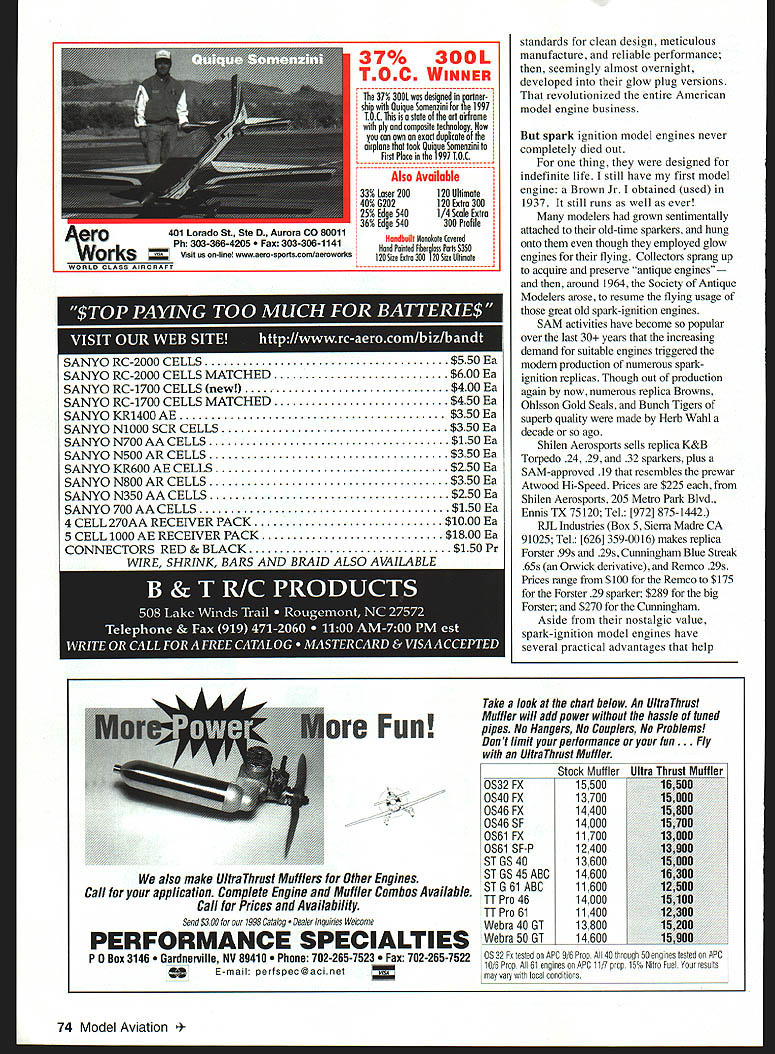
- Transistorized Ignition Modules (TIM) provide a major troubleshooting breakthrough for spark ignition.
Aero‑Ply Research makes a matchbook‑sized electronic unit (TIM‑4) that essentially eliminates most starting and running problems caused by oily or misaligned contact points. The old standard spark‑ignition circuit required heavy current flow through the contact points—especially during starting—and those points were subject to high‑resistance problems that could drastically reduce spark strength.
The TIM‑4 requires only a few milliamps of current through the points; the heavy current needed by the spark coil (approximately 1.2 A while running using a recommended three‑cell Ni‑Cd battery) is handled by a heavy‑duty switching transistor. With a TIM‑4 you don't need a condenser for spark timing. The TIM‑4 plus a three‑cell Ni‑Cd battery pack solves the majority of spark‑ignition running problems. Aero‑Ply Research: 2029 Crist Dr., Los Altos CA 94024. Tel: (415) 968‑4246.
Conclusion
We learned much from early spark‑ignition model engines: soldering, diagnosing leaks and oily contacts, and the effects of timing and tuning. Sentiment, collectors, and organizations like SAM have preserved the flying use of these engines, and modern replicas and electronics make them practical to fly again.
Transcribed from original scans by AI. Minor OCR errors may remain.

