
The Engine Shop
Joe Wagner
Mail topics
Most mail I've received in response to this column falls into three main topics:
- Where can I buy the products you recommended?
- How can I modernize an older engine?
- Trouble-shooting operating problems.
Cleaning solvents and freeing stuck engines
Sometimes a product I recommend is discontinued by the time the column appears. That happened with the engine-cleaning solvents I mentioned last year—Sokoff disappeared from Sears (likely because of hazards from such a powerful solvent). Accidental spillage on a child (or a mishap with milder cleaners such as Z-Best Engine Cleaner) could be dangerous.
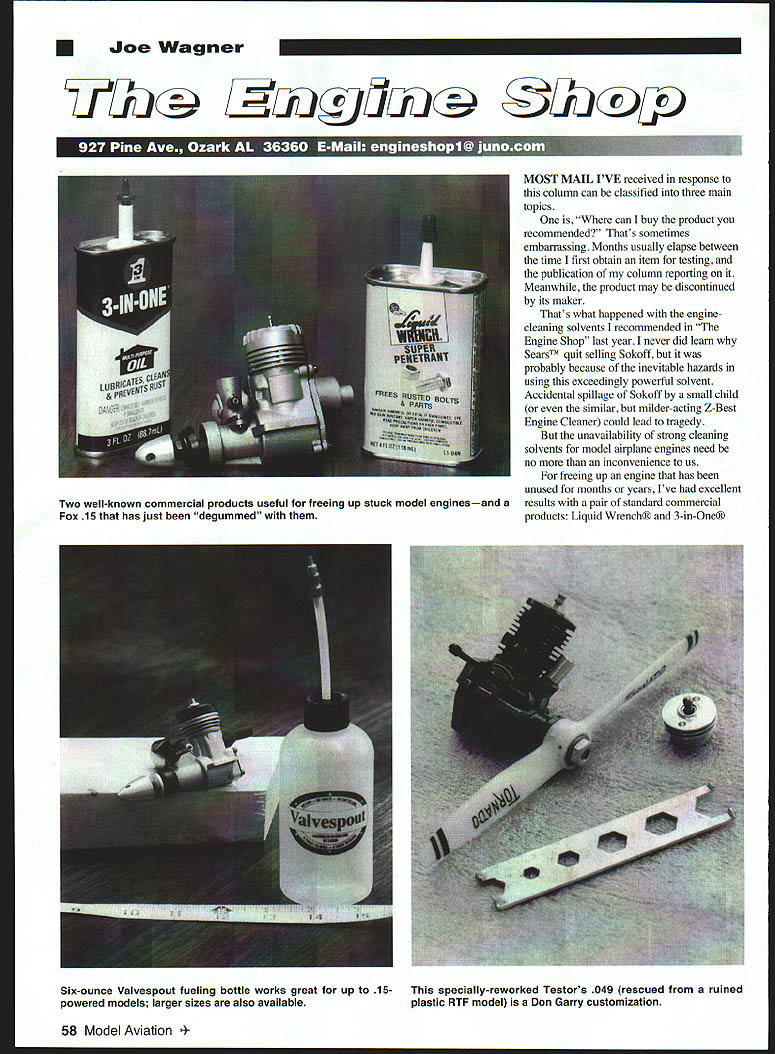
The unavailability of strong cleaning solvents need not be a major inconvenience. For freeing up engines unused for months or years I've had excellent results with two common commercial products: Liquid Wrench® and 3-in-One®. Both are penetrating oils with solvent action. Liquid Wrench contains considerably more solvent than 3-in-One and will often free a stuck engine after a few hours or days of soaking. No solvent will magically remove congealed oil from inside an engine; once parts are freed enough to move, disassemble the engine, thoroughly rinse and clean it, then reassemble with ample 3-in-One on interior parts.
Mufflers and paint
The grungiest component of most model airplane engines is the muffler—carbonized oil can discolor mufflers and engine paint. Tips:
- Use high-temperature spray-can enamels (available at auto-parts stores) in various colors.
- Model mufflers rarely get hot enough to require a 500°F automotive engine enamel; just remove surface oil before spraying.
- Carbonized material baked into the metal pores won't prevent paint adhesion as long as no oil film remains.
Modernizing older engines
Many readers ask how to update 1950s-era engines (for example, a McCoy .049) for RC use when they lack a throttle, muffler, or have older cross-scavenged porting.
- Adding an RC carburetor: not particularly difficult if you can find a carburetor with an intake-throat diameter similar to the original inlet and make an adapter. A high-school metalworking shop could likely help.
- Add-on mufflers: until a few years ago there were universal mufflers for older glow engines, but they're scarce now. For vintage engines I power on Control Line models, I've made my own:
- Body from lengths of aluminum tubing (salvaged from lawn-chair frames), file a slot so it fits over the exhaust stack.
- End plugs turned from hardwood.
- A chunk of nylon-mesh scouring pad squeezed into the aft section before installing the rear end cap.
- Attachment can be crude (wire wrap), though I later adopted a cleaner method.
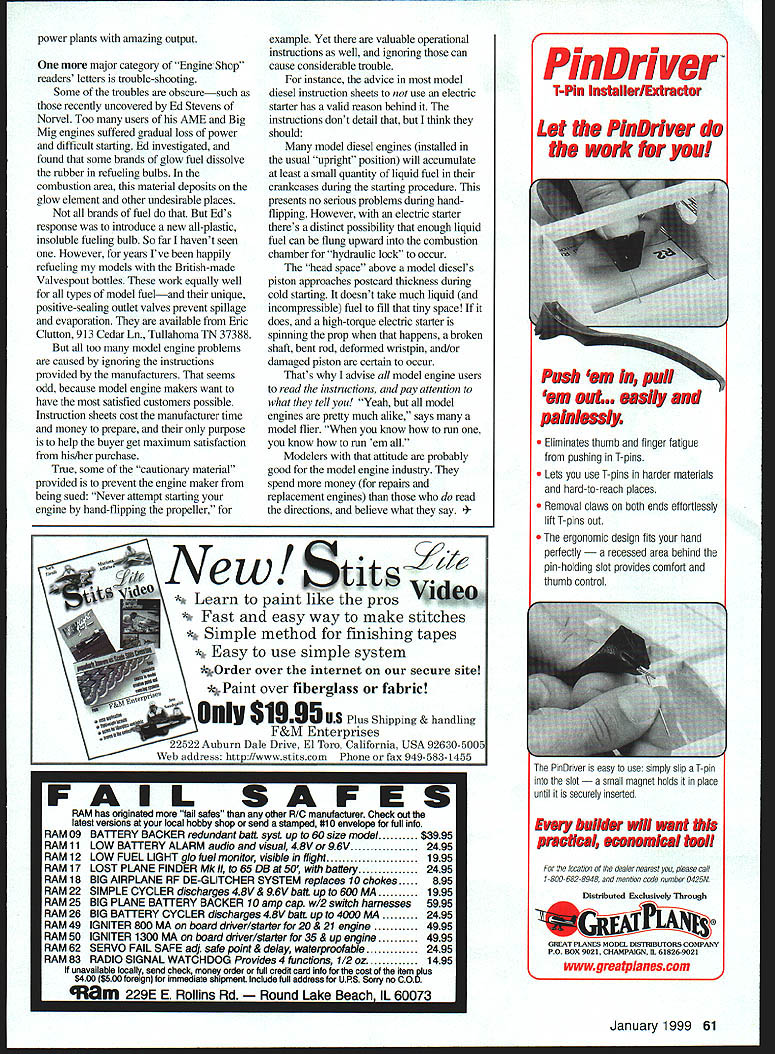
- Another simple one-piece muffler design I borrowed uses rectangular aluminum bar stock with numerous drilled holes for exhaust outflow. Using holes of several sizes improves sound attenuation while minimizing exhaust restriction. With adequate decibel reduction, the homemade muffler makes the engine AMA-legal and softens the already-low exhaust sound.
Porting: cross-scavenged vs. Schnuerle
Occasionally I'm asked about converting a cross-scavenged engine to Schnuerle porting by grinding grooves. The assumption that a simple reworked groove will produce significant power gains is generally false.
- Modern Schnuerle-type engines typically make more power than average cross-scavenged motors, but mainly because:
- The Schnuerle uses a flatter, lighter piston (less energy wasted accelerating/decelerating the piston).
- It permits a more efficient combustion-chamber shape.
- Two-stroke efficiency depends on exhausting burned fuel while directing a fresh charge into the upper cylinder. Cross-scavenged engines use a piston baffle to deflect incoming mixture away from the exhaust; Schnuerle engines use bypass ports to control inflow direction.
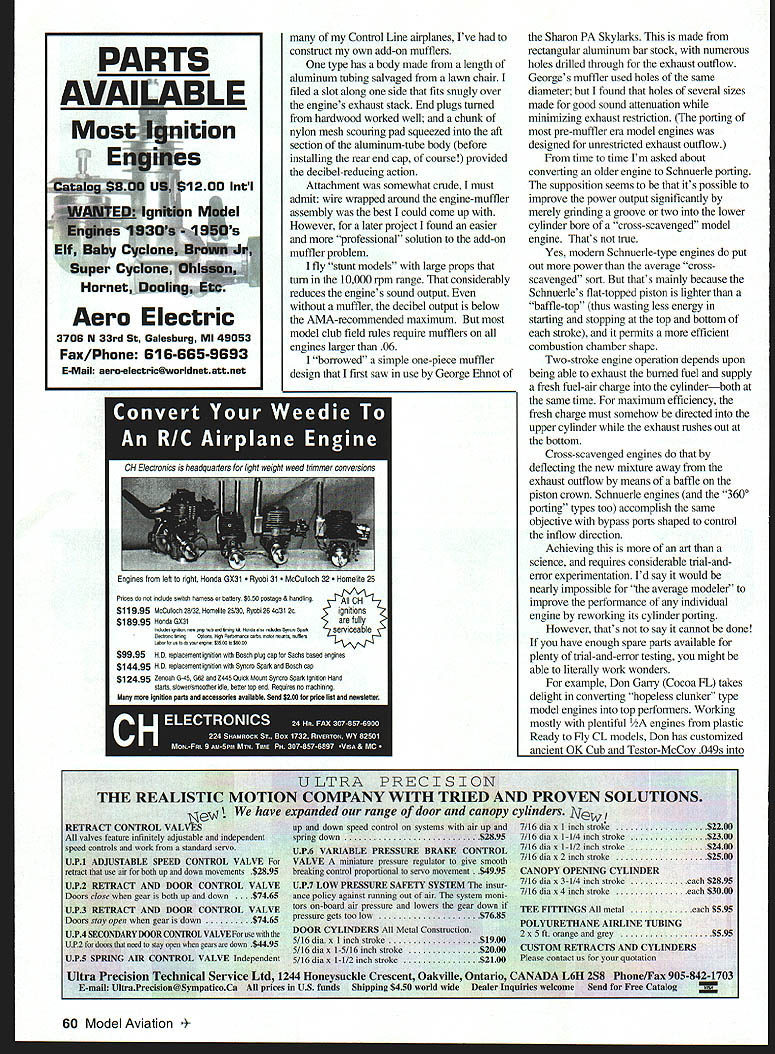
- Achieving effective scavenging is more art than science and requires considerable trial-and-error. For the average modeler, improving an individual engine by reworking cylinder porting is nearly impossible. However, with lots of spare parts and patience, remarkable improvements can be achieved—see Don Garry (Cocoa, FL), who has converted many low-grade .049s into surprisingly powerful engines through extensive experimentation.
Trouble-shooting and fuels
Some problems are obscure. For example, Ed Stevens of Norvel found that certain brands of glow fuel dissolve the rubber in refueling bulbs; rubber deposits then collect on the glow element and other combustion-area surfaces, causing gradual loss of power and hard starting. Not all fuels do this; Ed introduced an all-plastic, insoluble fueling bulb in response.
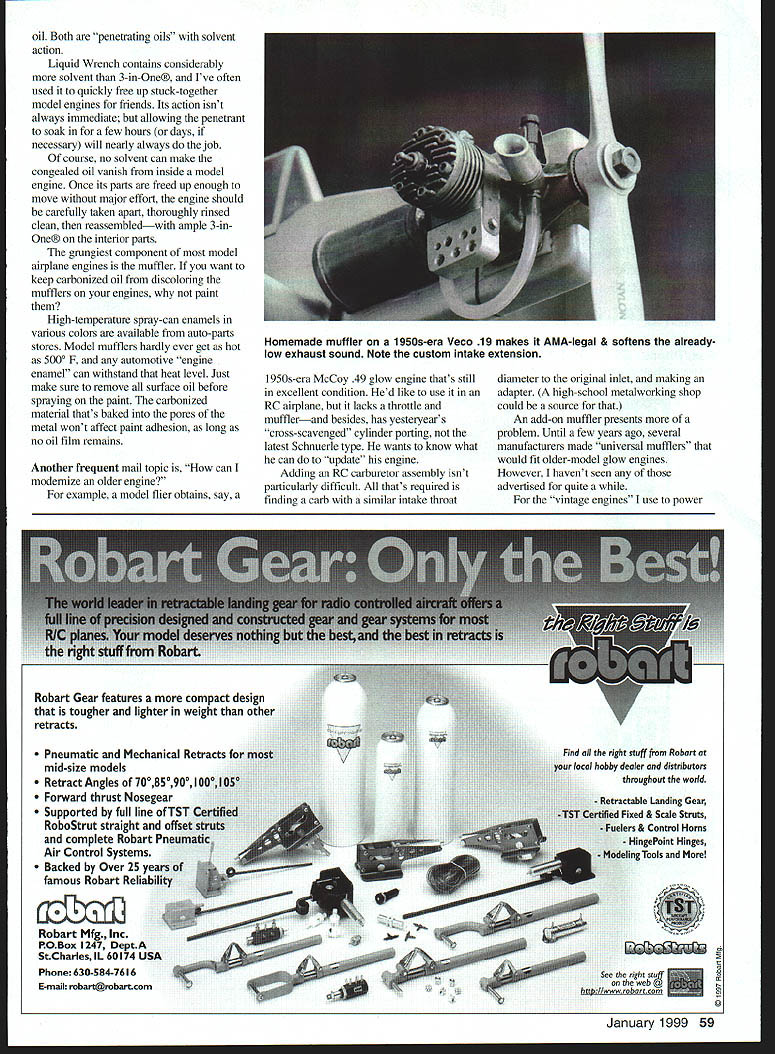
For years I've refueled with British-made Valvespout bottles. They work well with all types of model fuel and their positive-sealing outlet valves prevent spillage and evaporation. Available from: Eric Clutton 913 Cedar Ln. Tullahoma, TN 37388
Read and heed the instructions
Too many engine problems result from ignoring manufacturers' instructions. Instruction sheets cost time and money to prepare and exist to help buyers get maximum satisfaction.
Example: many model diesel instruction sheets advise against using an electric starter. The reason is not always detailed, but it's important:
- During starting, some liquid fuel can accumulate in the crankcase of an upright diesel.
- Hand-flipping generally poses no problem, but an electric starter can fling liquid fuel into the combustion chamber, creating hydraulic lock.
- The tiny headspace above a cold diesel piston can be filled by a small amount of liquid fuel; if a high-torque starter continues to spin the prop, broken shafts, bent rods, deformed wristpins, or damaged pistons can result.
So read the instructions and follow them. Modelers who ignore directions may be good customers for repair shops and replacement-engine suppliers, but they'll save themselves trouble and expense by paying attention to the makers' guidance.
Transcribed from original scans by AI. Minor OCR errors may remain.

