
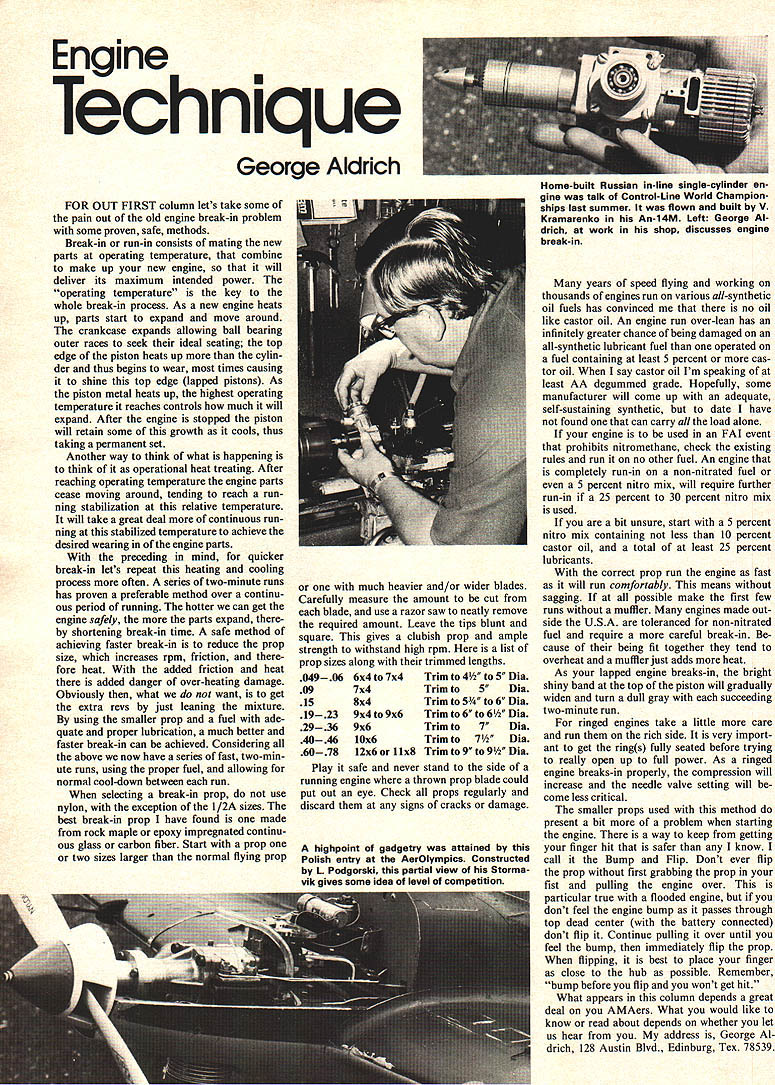
Engine Technique
George Aldrich
FOR OUR FIRST column let's take some pain out of the old engine break-in problem with some proven, safe methods.
Break-in or run-in consists of mating the new parts at operating temperature, that combine to make up your new engine, so that it will deliver its maximum intended power. The "operating temperature" is the key to the whole break-in process. As an engine heats up, parts start to expand and move around. The crankcase expands allowing ball bearing outer races to seek their ideal seating; the top edge of the piston heats up more than the cylinder and thus begins to wear, most times causing it to shine to this top edge (lapped pistons). As piston metal heats up, the highest operating temperature it reaches controls how much it will expand. After the engine is stopped the piston will retain some of this growth as it cools, thus taking a permanent set.
Another way to think of what is happening is to think of it as operational heat treating. After reaching operating temperature the engine parts cease moving around, tending to reach a running stabilization at this relative temperature. It will take a great deal more of continuous running at this stabilized temperature to achieve the desired wearing in of the engine parts.
With the preceding in mind, for quicker break-in let's repeat this heating and cooling process more often. A series of two-minute runs has proven a preferable method over a continuous period of running. The hotter we can get the engine safely the more the parts expand, therefore shortening break-in time. A safe method of achieving faster break-in is to reduce the prop size, which increases rpm, friction and therefore heat. With the added friction and heat there is added danger of over-heating damage. Obviously then, what we do not want, is to get the extra revs by just leaning the mixture. By using the smaller prop and a fuel with adequate and proper lubrication, a much better and faster break-in can be achieved. Considering all the above now we have a series of fast, two-minute runs, using the proper fuel, and allowing for normal cool-down between each run.
When selecting a break-in prop, do not use nylon, with the exception of the 1/2A sizes. The best break-in prop I have found is one made from rock maple or epoxy impregnated continuous glass or carbon fiber. Start with a prop one or two sizes larger than the normal flying prop or one with much heavier and/or wider blades. Carefully measure the amount to be cut from each blade, and use a razor saw to neatly remove the required amount. Leave the tips blunt and square. This gives a clubbish prop and ample strength to withstand high rpm. Here is a list of prop sizes along with their trimmed lengths.
- .049–.06 6x4 to 7x4 Trim to 4½" to 5" Dia.
- .09 7x4 Trim to 4¾" to 5" Dia.
- .15 8x4 Trim to 5¼" to 6" Dia.
- .19–.23 9x4 to 9x6 Trim to 5¾" to 6½" Dia.
- .29–.36 9x6 Trim to 6" Dia.
- .40–.46 10x6 Trim to 7½" Dia.
- .60–.78 12x6 or 11x8 Trim to 9" to 9½" Dia.
Play it safe and never stand to the side of a running engine where a thrown prop blade could put out an eye. Check all props regularly and discard them at any signs of cracks or damage.
Many years of speed flying and working on thousands of engines run on various all-synthetic oil fuels has convinced me that there is no oil like castor oil. An engine run over-lean has infinitely greater chance of being damaged on an all-synthetic lubricant than one operated on a fuel containing at least 5 percent or more castor oil. When I say castor oil I'm speaking of at least AA degummed grade. Hopefully, some manufacturer will come up with an adequate, self-sustaining synthetic, but to date I have not found one that can carry all the load alone.
If your engine is to be used in an FAI event that prohibits nitromethane, check the existing rules and run no other fuel. An engine completely run-in on a non-nitrated fuel or even a 5 percent nitro mix will require further run-in if a 25 percent to 30 percent nitro mix is used.
If you are a bit unsure, start with a 5 percent nitro mix containing not less than 10 percent castor oil, and a total of at least 25 percent lubricants.
With the correct prop run the engine as fast as it will run comfortably. This means without sagging. If at all possible make the first few runs without a muffler. Many engines made outside the U.S.A. toleranced on non-nitrated fuel require careful break-in because being fit together they tend to overheat and a muffler just adds more heat. As a lapped engine breaks in the bright shiny band at the top of the piston will gradually widen and turn a dull gray with each succeeding two-minute run.
For ringed engines take a little more care and run them on the rich side. It is very important to get the rings fully seated before trying to really open up the motor to get full power. As a ringed engine breaks in properly, the compression will increase and the needle valve setting will become less critical. The smaller props used with this method may present a bit more of a problem when starting the engine. There is a way to keep from getting your finger hit that is safer than any I know. I call it the Bump and Flip. Don't ever flip the prop without first grabbing the prop in your fist and pulling the engine over. This is particularly true with a flooded engine, but if you don't feel the bump pass through top dead center (with the battery connected) don't flip it. Continue pulling it over until you feel the bump, then immediately flip the prop. When flipping, it is best to place the finger as close to the hub as possible. Remember, "bump before you flip and you won't get hit."
What appears in this column depends a great deal on you AMAers. What you would like to know or read about depends on whether you let us hear from you. My address is, George Aldrich, 128 Austin Blvd., Edinburg, Tex. 78539.
Transcribed from original scans by AI. Minor OCR errors may remain.

