
Engine Technique
George Aldrich
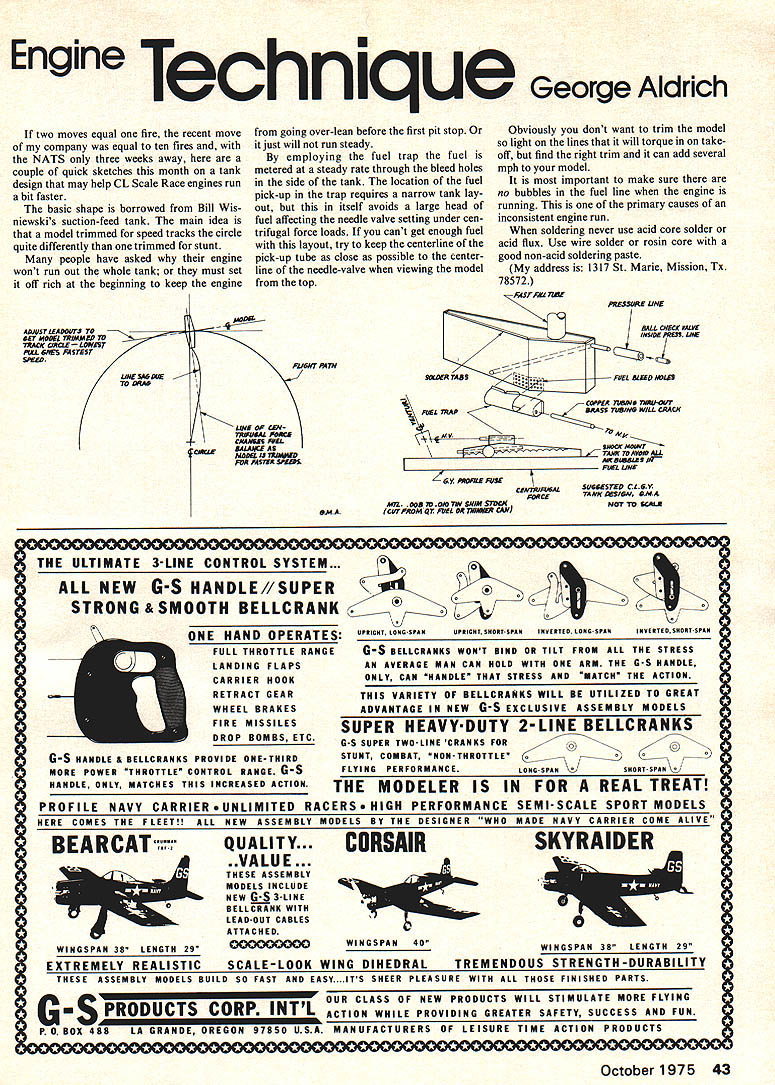
If two moves equal one fire, the recent move of my company was equal to ten fires and, with the NATS only three weeks away, here are a couple of quick sketches this month on a tank design that may help CL Scale Race engines run a bit faster.
The basic shape is borrowed from Bill Wisniewski's suction-feed tank. The main idea is that a model trimmed for speed tracks the circle quite differently than one trimmed for stunt.
Many people have asked why their engine won't run out the whole tank; or they must set it off rich at the beginning to keep the engine from going over-lean before the first pit stop. Or it just will not run steady.
By employing the fuel trap the fuel is metered at a steady rate through the bleed holes in the side of the tank. The location of the fuel pick-up in the trap requires a narrow tank layout, but this in itself avoids a large head of fuel affecting the needle-valve setting under centrifugal force loads. If you can't get enough fuel with this layout, try to keep the centerline of the pick-up tube as close as possible to the centerline of the needle-valve when viewing the model from the top.
Obviously you don't want to trim the model so light on the lines that it will torque in on takeoff, but find the right trim and it can add several mph to your model.
It is most important to make sure there are no bubbles in the fuel line when the engine is running. This is one of the primary causes of an inconsistent engine run.
When soldering never use acid core solder or acid flux. Use wire solder or rosin core with a good non-acid soldering paste.
(My address is: 1317 St. Marie, Mission, Tx. 78572.)
Transcribed from original scans by AI. Minor OCR errors may remain.

