
Engines that made HISTORY
Don Berliner
Classic powerplants, as well as famous aircraft, played a vital part in the evolution of aviation as we know it today. AN AIRPLANE without an engine is just a pathetic lump of wood and metal and fabric. It's not a glider or sailplane—that's another breed of cat, entirely. An engineless airplane is good for absolutely nothing, except maybe spare parts. It really isn't even an airplane.
When man finally flew for the first time in 1903, it was the airplane that got all the attention, not its engine. The airplane was the obviously unusual part of the whole roaring success. But it was the engine that provided the roar! And it was the lack of suitable engines that kept airplanes on the ground until the Wright brothers built their own in-line, four-cylinder powerplant and proceeded to make history.
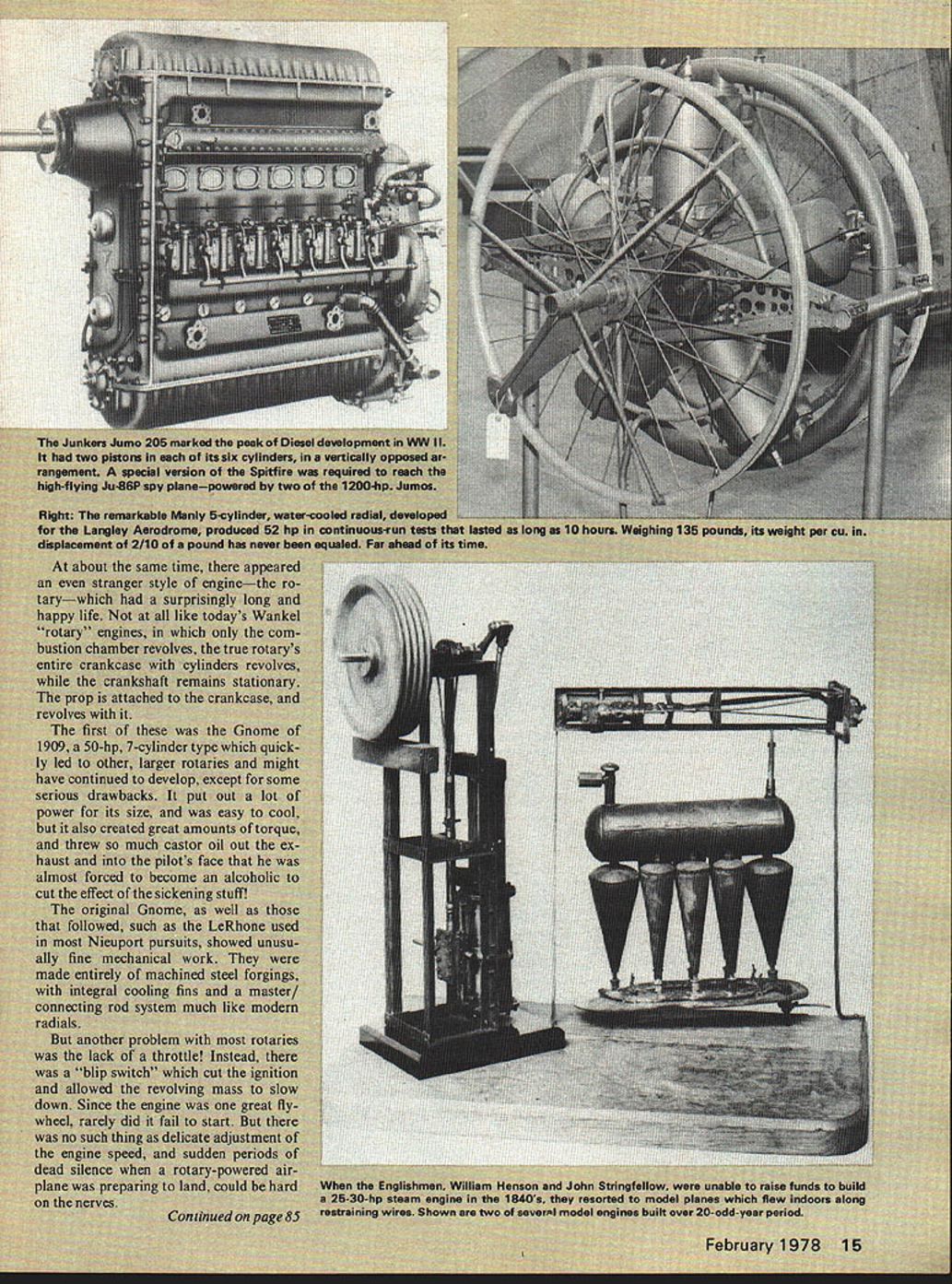
If there had been better engines a long time before, that first flight might have been made way back in the 19th Century. It could have happened as long ago as the 1840's, because the Englishmen, William Henson and John Stringfellow, had designed a flying machine—the "Aerial"—which looks a lot more like a modern airplane than any of the first crates built and flown by the Wrights.
Their 1842 design was a wire-braced monoplane with tricycle landing gear, a cambered airfoil and dual pusher propellers. The wings were braced with streamlined wires, and the advanced craft had a pretty conventional rudder and elevator, though no ailerons. Almost 70 years later, the graceful Antoinette used a very similar layout, even to the extent of a near-identical airfoil.
All that was missing from the design was a good engine. The plan had been to use a steam engine of 25-30 hp which would weigh about 600 lbs., with boiler and 20 gallons of water. It was an interesting idea, but attempts to raise funds to produce "Aerial Steam Carriages" fell flat, and the designers fell back and began to work on models.
One was built with a small steam engine in the mid-1840's, another around 1848. Both flew (more or less) along a restraining wire, indoors. Neither showed much built-in stability, and understandably failed to lead to man-carrying planes. In 1868, Stringfellow built yet another steam engine, no doubt intended for a new model; weighing around 16 lbs., it produced more than 1 hp. This engine, slightly modified, is now in the National Air & Space Museum, though not on display.
For the next few decades, interest was centered on the steam engine, for it wasn't until 1885 that the first true piston engine was advanced enough to power a car. In 1890, Clement Ader tested a steam-powered airplane with marginal results, as did the Russian, Alexander Mozhayski in 1894, and Hiram Maxim the same year. None of these machines achieved more than very brief hops, thanks to heavy and weak engines. But as the 20th Century dawned, progress with gliders and with piston engines was so rapid that the flight of a real airplane seemed to be just a matter of time. The apparent leader was Prof. Samuel Langley, whose steam-powered models of considerable size flew with great success, for which one of them is hanging in the entrance hall of the National Air & Space Museum.
Piston engines had been used in lighter-than-air craft as far back as 1872, though the first gasoline-fueled one didn't power an airship until 1897, when Davis Schwarz flew briefly in Germany.
Then, in the Spring of 1901, Prof. Langley flew a 1/4-scale model of his "Aerodrome," powered by the first of the modern design aero engines: a 5-cylinder, air-cooled radial which put out 3.2 hp and weighed just 7 lbs. The power-to-weight ratio was truly historic, and credit must go to designer Stephen Balzer and developer Charles Manly. The model flew 350 feet in June, 1901, and then 1,000 feet in August, 1903.
This led directly to the full-scale Langley engine, and it was phenomenal... even, in some ways, when compared with modern aero engines. A 687 cu. in., 5-cylinder, water-cooled radial, it weighed 135 lbs. and produced 52 hp in tests that lasted as long as 10 hours! The weight and power ratios compare favorably with small engines used in today's homebuilts, while the weight, cu. in., of less than 2/10 of a pound, has never been equalled.
In construction, too, it was far ahead of its time. The cylinders were steel, with .020" cast-iron liners, while the crankcase, cylinders, rods and other vital parts were machined with great precision. The engine was a masterpiece. Unfortunately, the aeroplane was not. Two completely unsuccessful tries to launch it from a houseboat on the Potomac River brought the project to an end. Today, the 1/4-scale and full-size Langley Aerodromes are stored by the National Air & Space Museum, while the engines are on display. The Wrights, in great contrast to Langley, were men of great practicality. They carefully perfected their flying machine and their flying skill before adding an engine to their glider. When the time came to join them together, it worked: the engine may not have been the greatest, and the airplane may have been barely flyable, but together they made history.
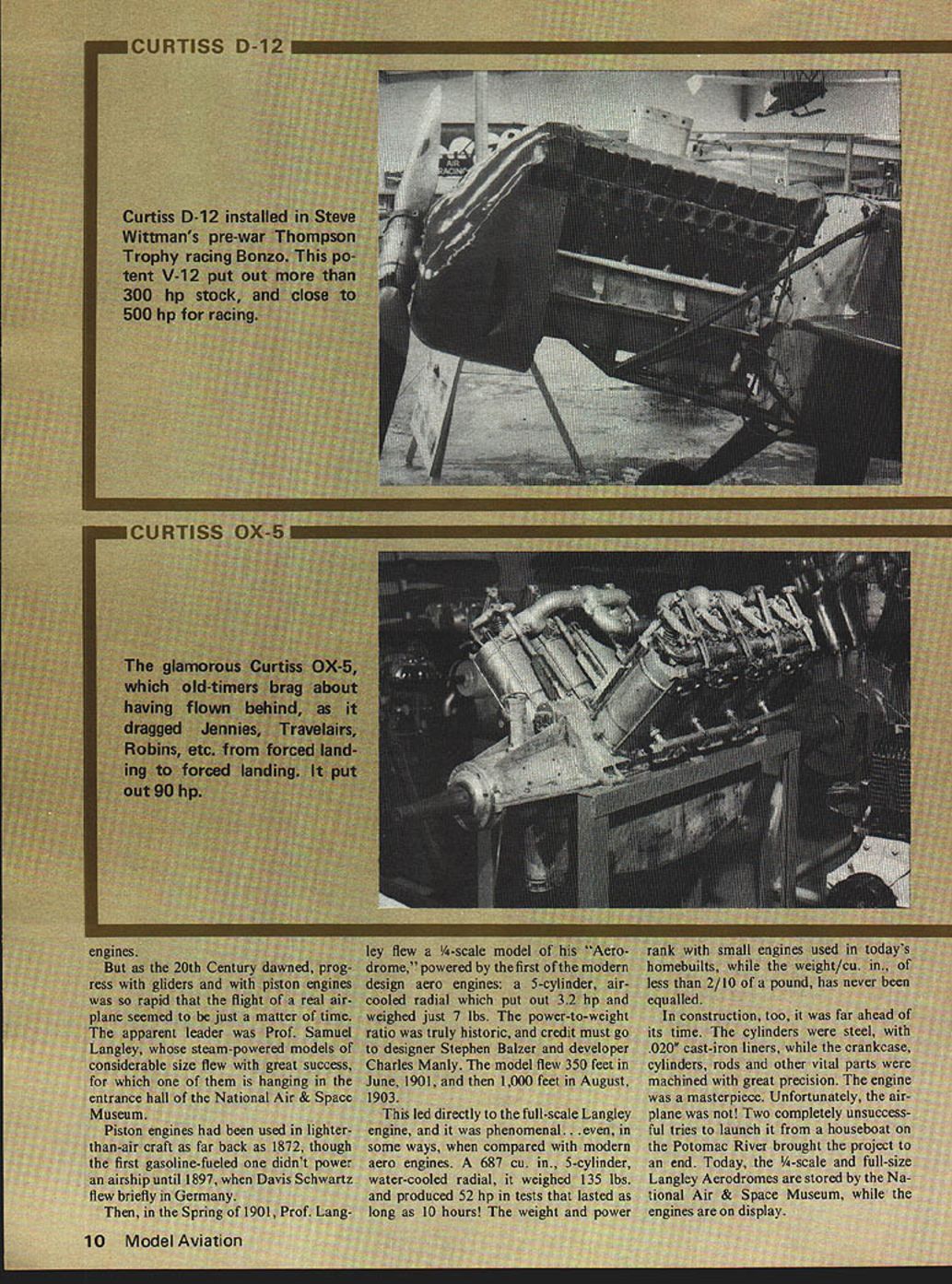
The Wright engine—designed by Orville and Wilbur and built with the help of their chief mechanic, Charles Taylor—was a four-cylinder, in-line, water-cooled type which developed 16 hp at 1100 rpm for the first minute, and about 12 hp after that. The engine weighed about 180 lbs., and had a piston displacement of 200 cu. in., much like the Continental O-200 which, in a good Formula One racer, develops 135 hp at 4000 rpm.
The engine in the first airplane had a cast-aluminum crankcase with an integral cast-aluminum water jacket. Fuel feed was by gravity from the overhead tank into a small can atop the engine and then to a carburetor in the intake manifold. The ignition system used a magneto, as have all later aircraft engines. Continued development of the original design brought it up to 30 hp, with no increase in weight, but it was still far behind the Langley engine.
For four full years, the Wrights were ahead of the world. It wasn't until late 1907 that anyone else flew for more than a minute, or more than a half mile, which the Wrights had been doing routinely. And when another name finally entered the history books, it was because there had been a major advance in engines, not airframes.
The Antoinette engines were water-cooled V-8's built since 1905 by Levavasseur in Paris for cars and then adapted for aerial uses. Santos-Dumont used a 24-hp one in his "14-bis" to make the first true flight in Europe, in 1906. A year later, Henri Farman flew his 50-hp Antoinette biplane almost 1/2 of a mile; his engine weighed 150 lbs. and so had a power/weight ratio almost as good as the Langley engine. The first helicopter to actually lift a man off the ground was Antoinette- powered.
All the Antoinette engines, from the first small V-8 through later V-16's and even V-32 models, had machined steel cylinders with brass water jackets. And they led to a whole string of V-type aircraft engines, from the OX-5 and Liberty of World War I through the Allison and Merlin of World War II. A typical early 32-hp Antoinette had "square" pistons (3.15" bore and stroke), developed full power from 196 cu. in. at 1400 rpm, and weighed but 93 lbs.
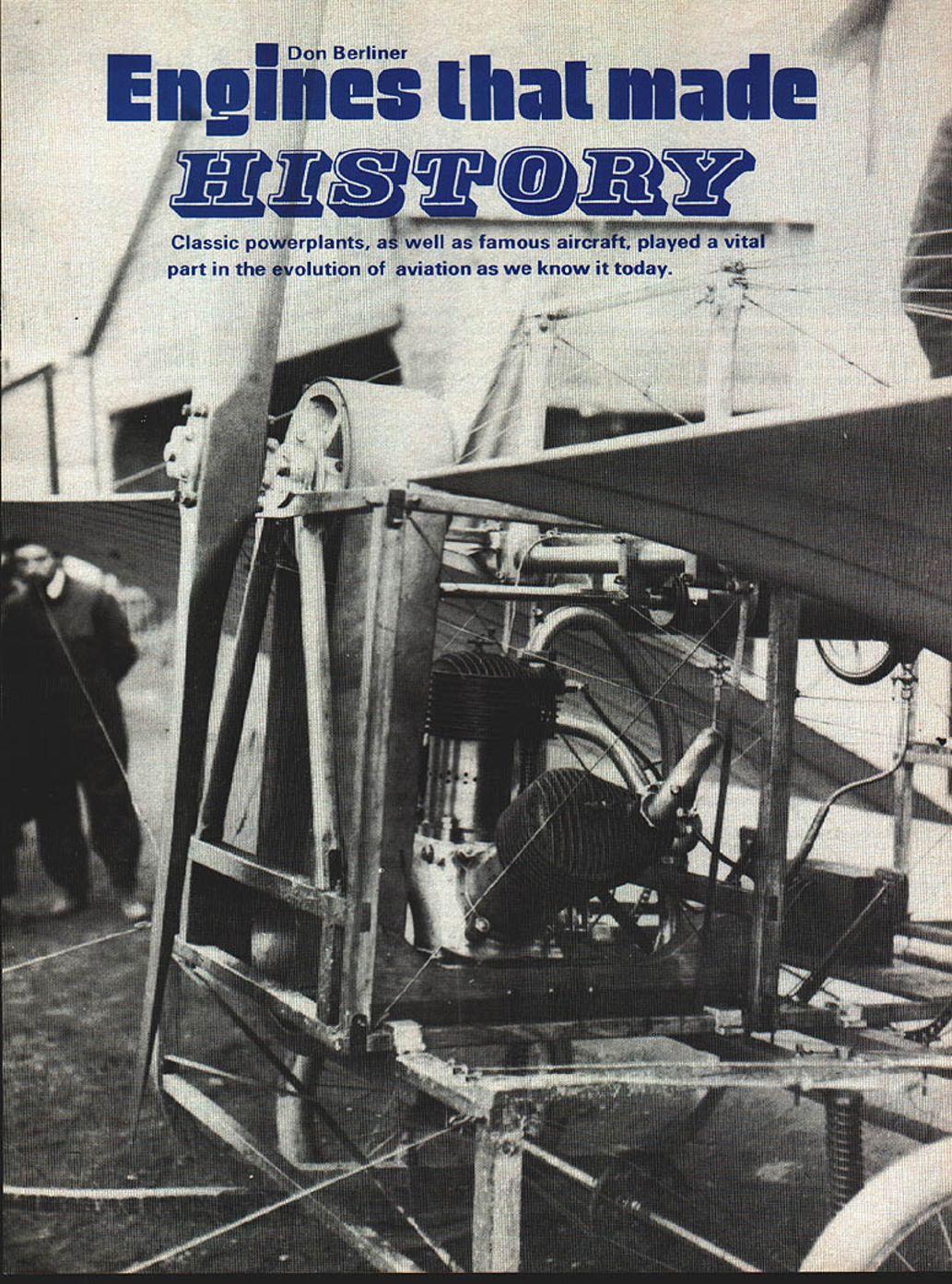
There were some interesting exceptions to the general rule that one good design led directly to others, one of them being the little 3-cylinder, fan-type Anzani, which played a brief and valuable role, but never became the forerunner of anything else.
In contrast to later 3-cylinder radials (such as the Lambert and Szekeley which
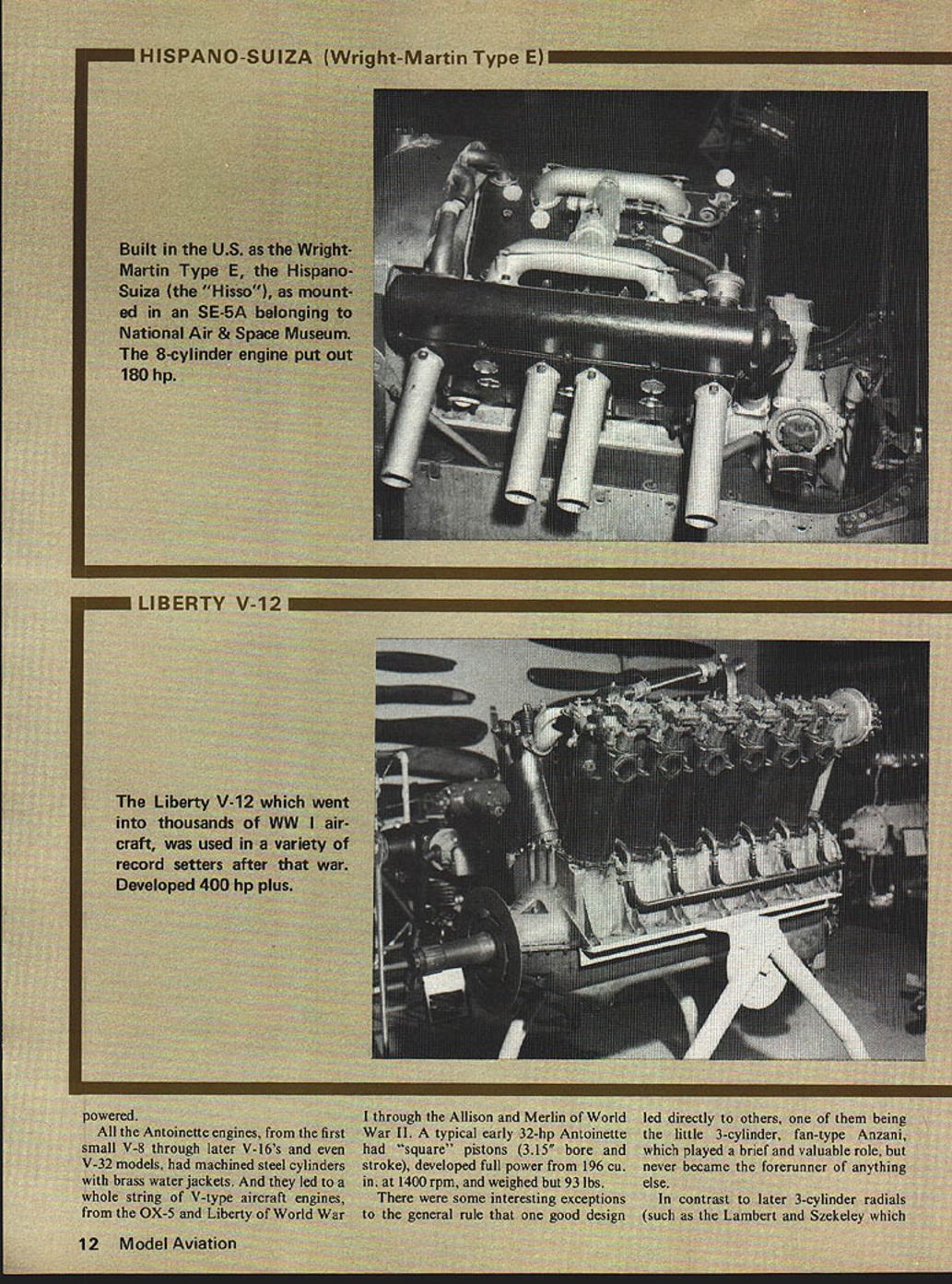
HISPANO-SUIZA (Wright-Martin Type E)
Built in the U.S. as the Wright-Martin Type E, the Hispano-Suiza (the "Hisso"), is mounted in an SE-5A belonging to the National Air & Space Museum. The 8-cylinder engine put out 180 hp.
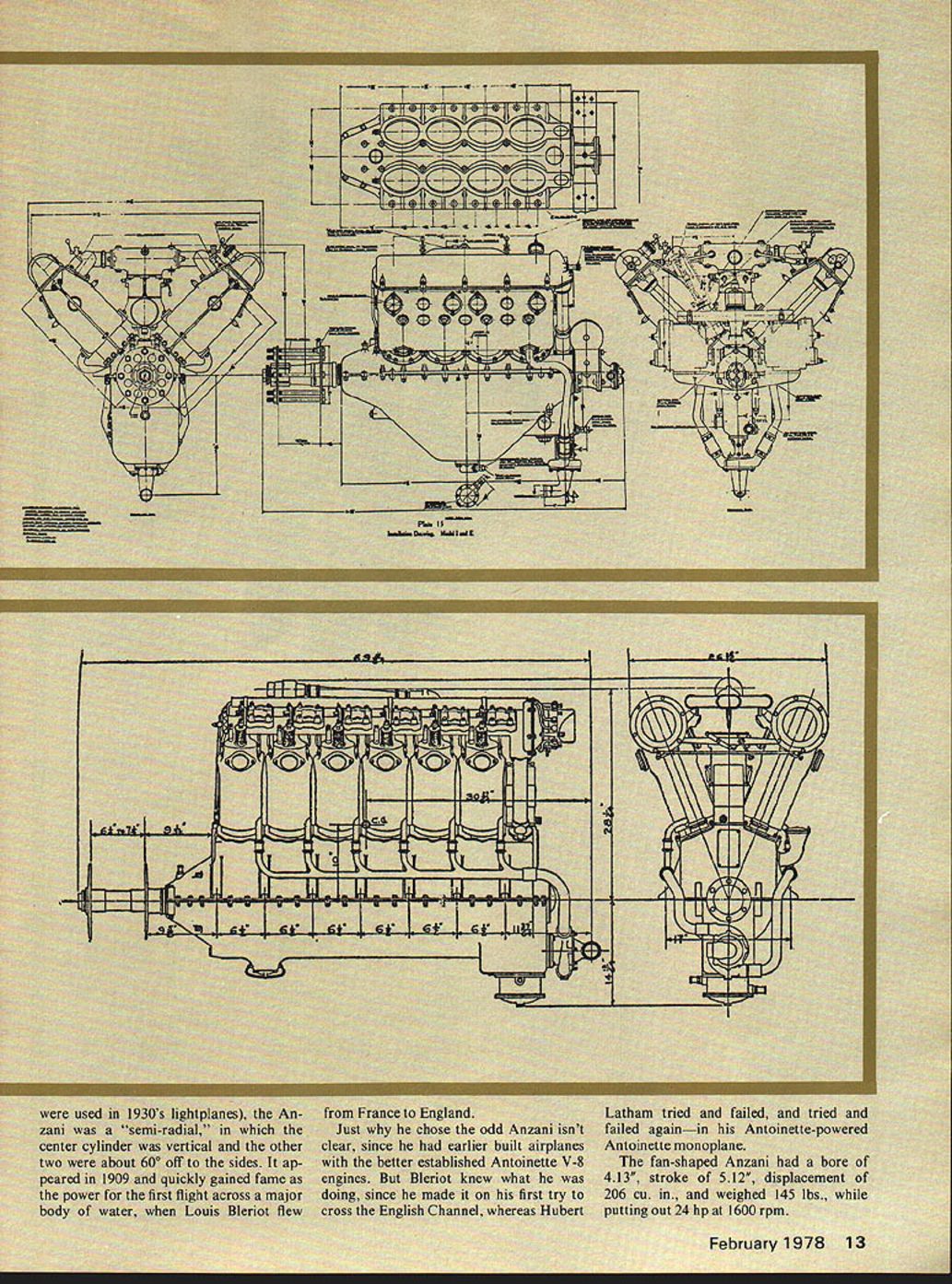
LIBERTY V-12
The Liberty V-12, which went into thousands of WW I aircraft, was used in a variety of record setters after that war. Developed 400 hp plus. were used in 1930's lightplanes), the Anzani was a "semi-radial," in which the center cylinder was vertical and the other two were about 60° off to the sides. It appeared in 1909 and quickly gained fame as the power for the first flight across a major body of water, when Louis Bleriot flew from France to England.
Just why he chose the odd Anzani isn't clear, since he had earlier built airplanes with the better established Antoinette V-8 engines. But Bleriot knew what he was doing, since he made it on his first try to cross the English Channel, whereas Hubert Latham tried and failed, and tried and failed again — in his Antoinette-powered Antoinette monoplane.
The fan-shaped Anzani had a bore of 4.13", stroke of 5.12", displacement of 206 cu. in., and weighed 145 lbs., while putting out 24 hp at 1600 rpm.
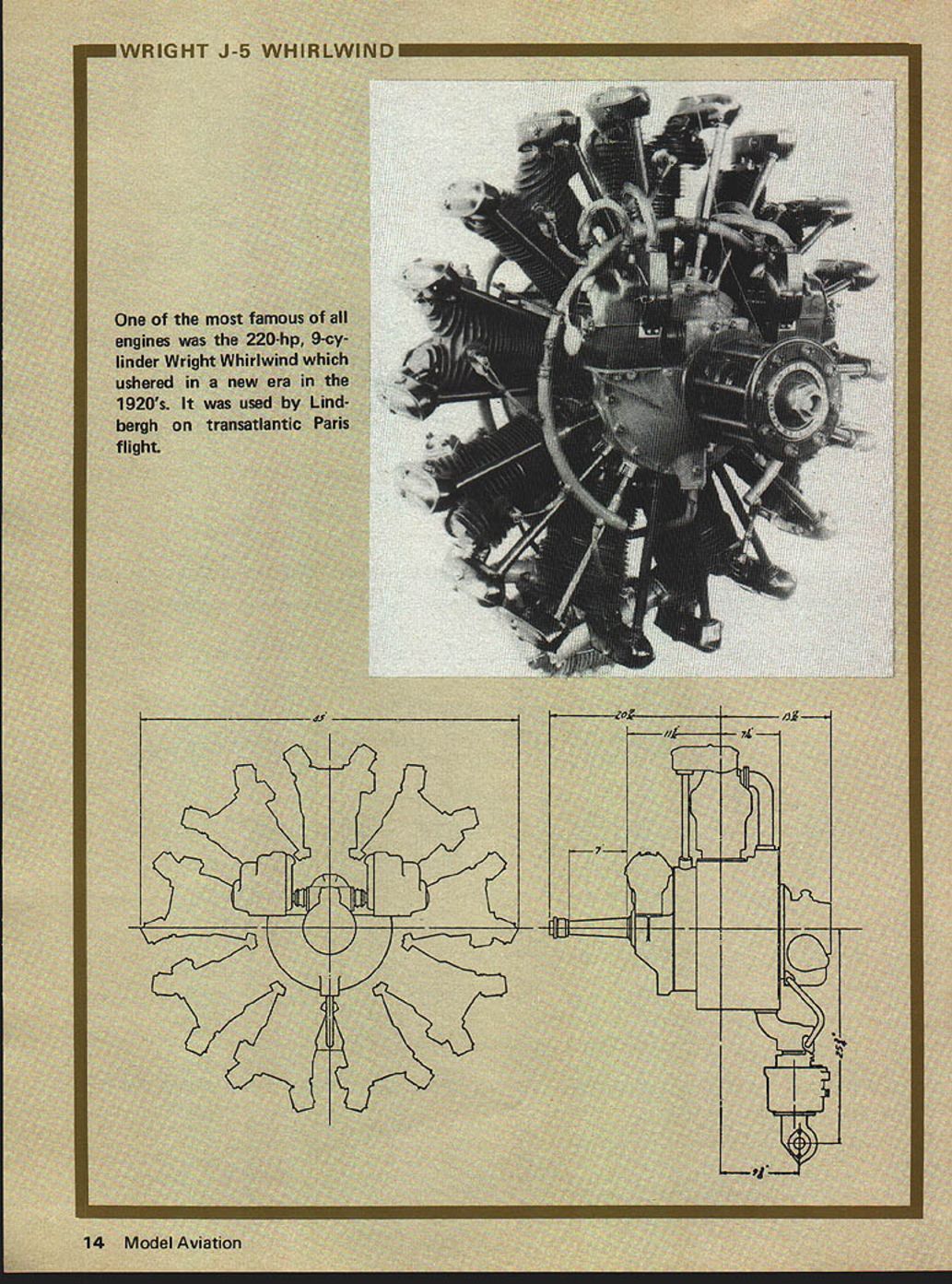
WRIGHT J-5 WHIRLWIND
One of the most famous of all engines was the 220-hp, 9-cylinder Wright Whirlwind which ushered in a new era in the 1920's. It was used by Lindbergh on transatlantic Paris flight. At about the same time, there appeared an even stranger style of engine — the rotary — which had a surprisingly long and happy life. Not at all like today's Wankel "rotary" engines, in which only the combustion chamber revolves, the true rotary's entire crankcase with cylinders revolves, while the crankshaft remains stationary. The prop is attached to the crankcase, and revolves with it.
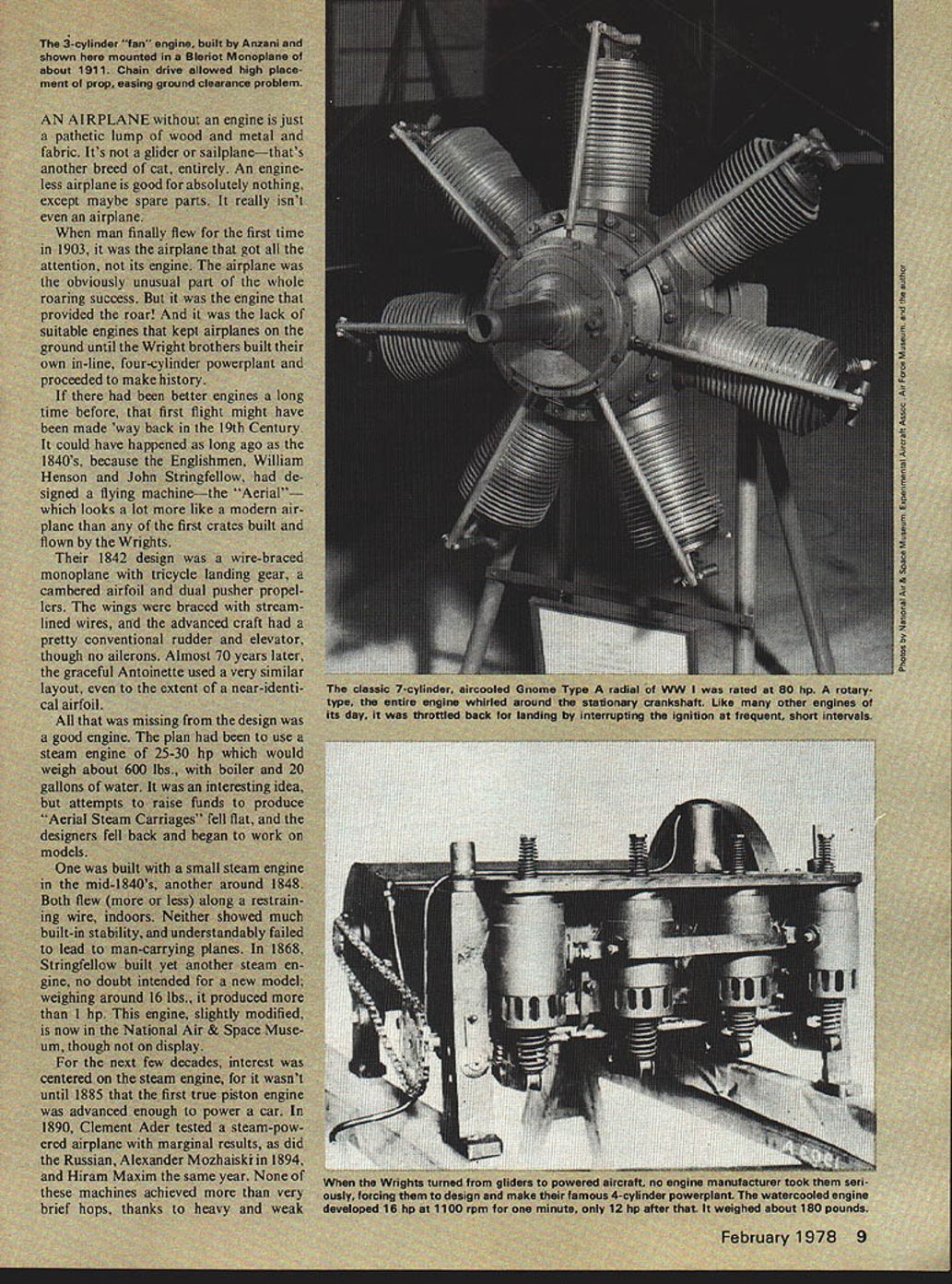
The first of these was the Gnome of 1909, a 50-hp, 7-cylinder type which quickly led to other, larger rotaries and might have continued to develop, except for some serious drawbacks. It put out a lot of power for its size, and was easy to cool, but it also created great amounts of torque, and threw so much castor oil out the exhaust and into the pilot's face that he was almost forced to become an alcoholic to cut the effect of the sickening stuff!
The original Gnome, as well as those that followed, such as the Le Rhone used in most Nieuport pursuits, showed unusually fine mechanical work. They were made entirely of machined steel forgings, with integral cooling fins and a master/connecting rod system much like modern radials.
But another problem with most rotaries was the lack of a throttle! Instead, there was a "blip switch" which cut the ignition and allowed the revolving mass to slow down. Since the engine was one great flywheel, rarely did it fail to start. But there was no such thing as delicate adjustment of the engine speed, and sudden periods of dead silence when a rotary-powered airplane was preparing to land could be hard on the nerves. The first Gnome rotary had "square" pistons (3.93" bore and stroke), 335 cu. in. displacement, and weight of 165 lbs. It produced its 50 hp at 1150 rpm. A few of the later Le Rhones can still be seen lugging full-scale reproductions of World War I airplanes in displays.
World War I began with sputtering engines and wobbling airplanes, but before long they both had seen amazing advances. The rotary engines were, for the most part, replaced by water-cooled V-8's, which became the direct ancestors of the superb V-12's which all nations used in World War II. And of the early Vees, none had the impact of the creation of a Swiss engineer, living in Spain, which went into production in France, Britain and later in the U.S.A.
It was the Hispano-Suiza, familiarly known as the "Hisso." Its advanced design included en bloc cylinder construction, with a cast-aluminum water jacket enclosing steel cylinders and effectively lubricated valves and gearing. It had a combination automatic and manual mixture control, and a fuel system which permitted inverted flight.
The development potential of the Hispano-Suiza was vast. From the first production model which put out 150 hp at 1400 rpm, it was boosted to 240 hp at 2200 rpm with no increase in internal dimensions. Once the bore and stroke were enlarged, it was up-rated to more than 300 hp. During World War I almost 50,000 were produced, mainly for the classic SPAD and SE-5A, along with some Bristol F.2B's and Sopwith Dolphins.
All production Hissos were 90° V-8's. The most common versions (150-220 hp) had a bore of 4.72", stroke of 5.11", displacement of 718 cu. in. and weight of 455-465 lbs. While they were as free from troubles as any engines of the time, they did have difficulties in the high-pressure lubrication system, and in the reduction gear, where contemporary metallurgy wasn't up to it.
Meanwhile, back on the safe side of the Atlantic, America was getting into the act with its first important production engine, the Curtiss OX-5. It powered the U.S.' sole original contribution to World War I in the air: the JN-4 "Jenny." More than 4000 of the famous trainers were built, and hundreds of surplus engines poured into the private market after the war, to become the basis for a whole range of civil aircraft, including such famous marks as Travelair, Waco and the Curtiss Robin. Such is the nostalgia connected with the OX-5 that there has long been a club for those who have flown behind them and enjoy swapping tales of their adventures.
The OX-5 was, like others of the day, water-cooled, and had an aluminum crankcase, cylinders of cast iron with monel-metal water jackets brazed onto the barrels, and pushrod actuated overhead valves. It was one of the last major engines to have single ignition, which was a cause of many forced landings, as was the tendency of the water pump to leak into the carburetor.
The basic OX-5 had a 4" bore, 5" stroke, piston displacement of 503 cu. in. and a weight of 320 lbs. For all this, it ground out only 90 hp at 1400 rpm.
The OX-5 was merely the first step for the very young American aircraft engine industry. The second step was the Liberty V-12, and it was an excellent engine. While the first Liberty wasn't delivered until late 1917, more than 5000 of them went into wartime de Havilland DH-4's built on license in the U.S., and a hundred more into Handley-Page O/400 bombers.
But it was the post-war use of the Liberty which permanently enshrined it in the engine hall-of-fame. Four of them powered the Curtiss NC-4 on the first transatlantic flight by an airplane, in 1919. One was in the nose of the Fokker T-2 which made the first non-stop, coast-to-coast flight across the U.S. in 1923. And Libertys were in the two hefty Douglas World Cruisers which became the first airplanes to fly around the world, in 1924. Such flights proved, better than any advertising slogans, that the Liberty was quite a powerplant.
Compared with the OX-5, the Liberty was a big engine, but otherwise was pretty conventional. Based on the Mercedes style of welded cylinders, it suffered from such common complaints as burned exhaust valves, cracked water jackets and broken accessory gears. And still it was a good engine, as long as there were enough spare parts handy. With a bore of 5" and stroke of 7", it had a displacement of 1650 cu. in., which was later duplicated by the Rolls Royce Merlin. The Liberty weighed 850 lbs. and was rated at 420 hp at 1700 rpm, whereas the Rolls of 20 years later weighed half again as much and developed 3-5 times as much power.
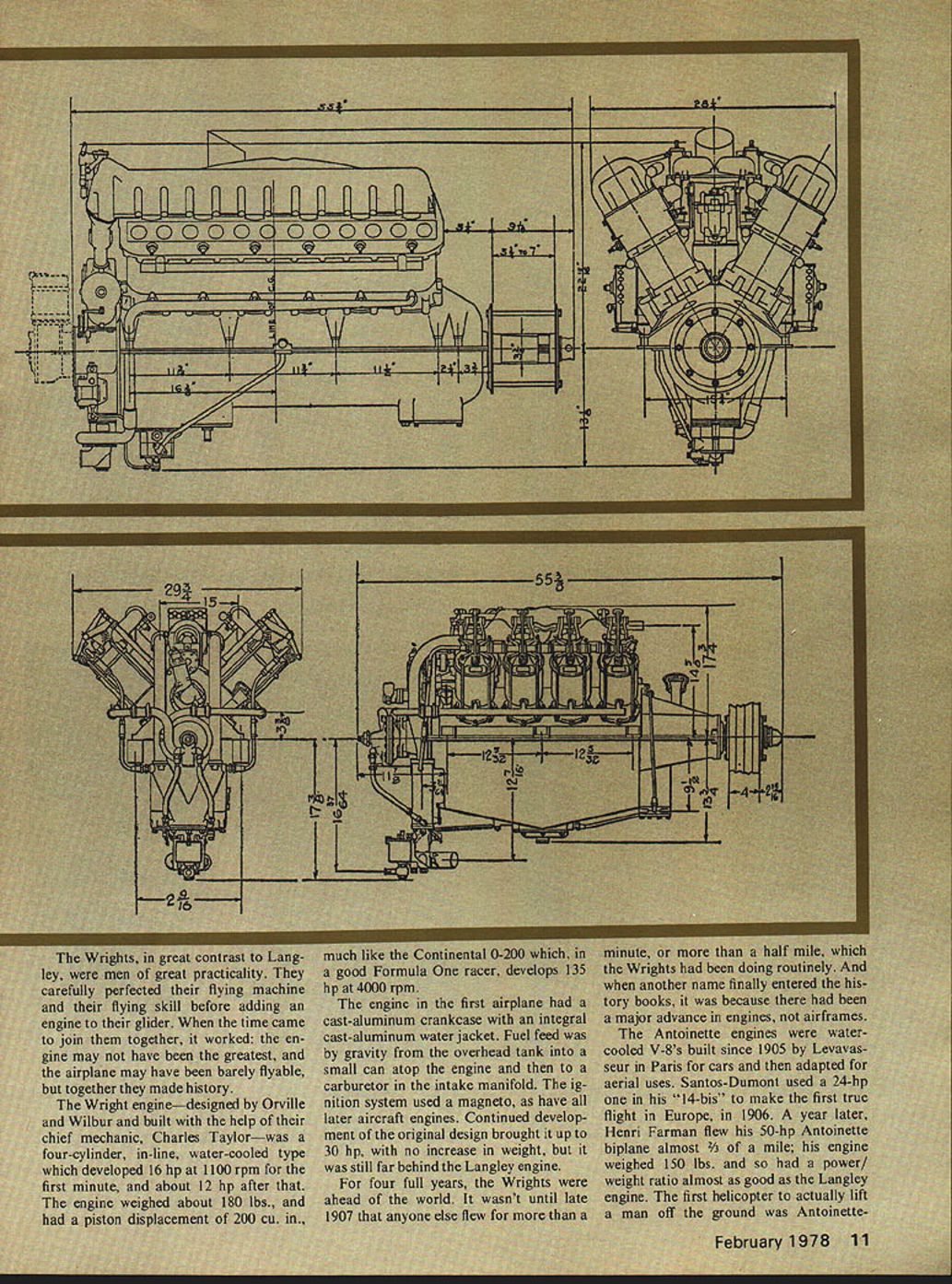
Once the Liberty had shown itself to be a first-class engine, Curtiss got into the game and produced a whole series of cast-aluminum powerplants, all of them V-12's with four valves per cylinder. The first of these to gain fame was the D-12, used in the Curtiss P-1 and Boeing PW-9 pursuits, and then in the Curtiss R-6 and R-8 Army racers.
In the R-6 the D-12 set world speed records of 223 mph and then 237 mph in 1922, to be broken the following year by the R-8 at 259 mph and finally 267 mph. Perhaps the finest use of the D-12 was in Steve Wittman's big "Bonzo," a custom-built Thompson Trophy Racer which once hit 325 mph in level flight.
The screaming D-12 led directly to the Curtiss V-1400 with which Jimmy Doolittle won the 1925 Schneider Trophy Race for seaplanes at 233 mph. While the final development of the D-12 was the V-1570 Conqueror, used in the classic Curtiss P-6 Hawk pursuit of 1932, and as late as 1935 in the Consolidated P-30. Once cooling water had been replaced by glycol, the Conqueror shone.
In its non-racing form, the D-12 produced 325 hp at 1800 rpm. It had a bore of 4½", stroke of 6", displacement of 1145 cu. in. and weight of 700 lbs. As modified for competition, it put out as much as 500 hp, but of course required considerably more maintenance.
Construction of the D-12 was similar to the Wright-built Hispano-Suiza, with cylinders of aluminum rather than the more common steel, which had been used in the European Hissos.
Through much of the history of airplane engines, the liquid-cooled in-line engine has been the darling of airframe designers, as well as fans. It looks like a powerful aircraft engine should look, and it can be packed into a small, sleekly-shaped cowl-ing. Yet it has long been true that the less glamorous-looking radial has really done the work. While arguments will go on forever about which is better, it must be admitted that the radial was better developed, and putting out more power for more different uses when the turbine finally passed the piston era. It is simpler and lighter, lacking the awkward and often annoying radiator and plumbing of the liquid-cooled engine.
The beginning of important American radial engines was the late 1920's, when the Wright J-5 Whirlwind came into being. Developed out of the smaller Lawrance J-1, it went into production in 1926 and was soon chosen for some of the best-known flying machines of the day. In particular, it played a very large part in the success of Lindbergh's historic flight from New York to Paris in 1927 by running smoothly for 33½ hours.
The first Ford Tri-motor airliners used Whirlwinds, as did the early Lockheed Vega, Pitcairn Mailwing and others. The radial worked well, not only in the U.S.A., but in Europe as well, and so major parts of the aeronautical industry decided to concentrate on them, and to put less effort and money into trying to perfect liquid-cooled in-lines. The lower weight and reduced maintenance were at first partly cancelled out by the greater drag of the radial, but when NACA developed its clean, round cowling, it became possible to build radial-engined planes that were as fast as their in-line brothers. This is still being demonstrated at the Reno Air Races, where Bearcats have won twice as many races as Mustangs.
The Wright J-5 (or R-790) won the prestigious Collier Trophy for its makers in 1927 and soon led to the R-975 used in some Beech Staggerwings and the predecessor of the AT-6, the R-1820 Cyclone used in the B-25, and finally the R-3350 used in the B-29 and Constellation. The original J-5 had a bore of 4½", stroke of 5½", weight of 508 lbs., compression ratio of 5.2 to 1, and developed its 200 hp at 1800 rpm.
Along with the immensely popular in-line and radial engines of the 1920's and 1930's were some considerably less well known and, in some cases, radical designs which nevertheless made their own contributions to the history of devices that make propellers go around and airplanes go forward. These include barrel and cam engines, and sleeve-valve designs; the latter was a British speciality and Bristol engines of the type were used in thousands of RAF bombers.
One style of piston engine which has long been used in road vehicles, but which had only brief success in airplanes, was the diesel. After considerable experience in German dirigibles, they were tried in airplanes by Packard, which built one good enough to set a non-refueling duration record of 84½ hours. But it was the Germans who brought the diesel to its greatest point.
The Junkers Jumo 6-cylinder, vertically-opposed, water-cooled diesel was used to some extent in pre-war airliners, but attracted more attention when powering the Ju-86P high-altitude spy plane during the early days of World War II. It took a special model of the Spitfire to climb above 40,000 feet where the oil-burner had been working unmolested. But that was the end of the line for the compression-ignition engine in airplanes, for the high-compression gasoline engine had passed it by. The Jumo, without supercharging, developed 750 hp at 1800 rpm and weighed 1650 lbs. With supercharging, it put out 1200 hp at 3000 rpm.
There were other piston engines developed during this period which played major roles in the story of aircraft propulsion. And even today, when the gas turbine seems so dominant, there are tens of thousands being built by Continental and Lycoming each year. But the dozen herein described seem to have played the most vital roles in the progress of power from a few rattling horsepower to thousands of smooth, dependable horses that made airplanes useful.
Transcribed from original scans by AI. Minor OCR errors may remain.

