
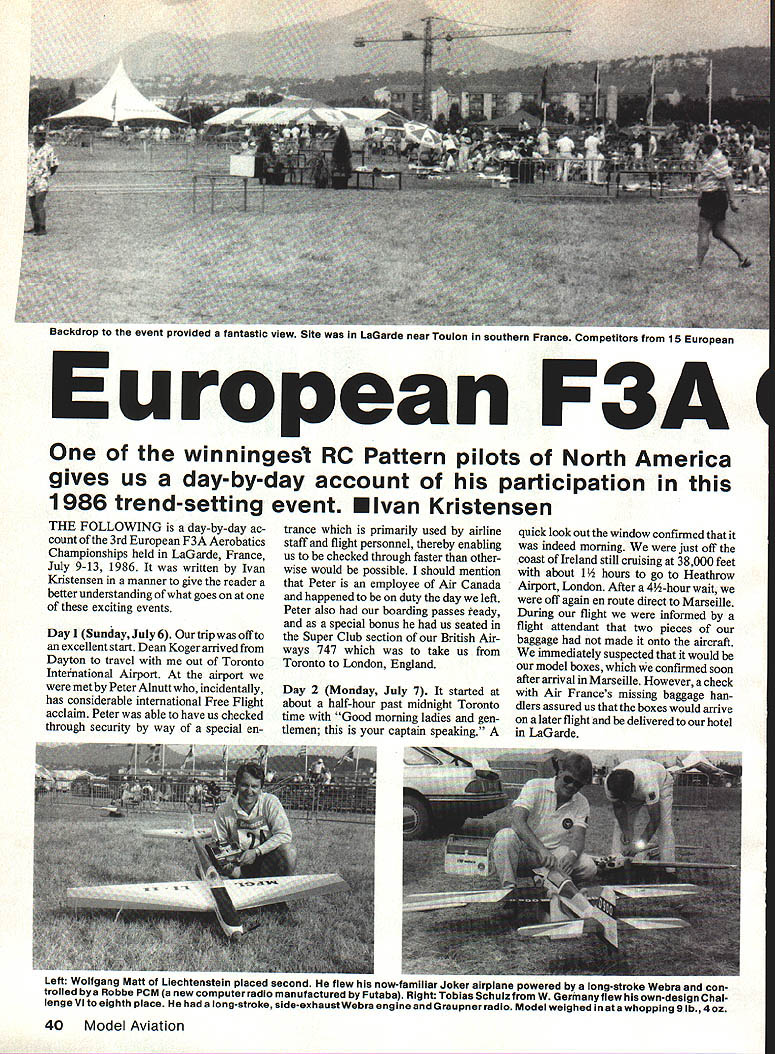
European F3A Championships
One of the winningest RC Pattern pilots of North America gives a day-by-day account of his participation in this 1986 trend-setting event. By Ivan Kristensen
Day 1 (Sunday, July 6)
Our trip was off to an excellent start. Dean Koger arrived from Dayton to travel with me out of Toronto International Airport. At the airport we were met by Peter Alnutt, who, incidentally, has considerable international Free Flight acclaim. Peter was able to have us checked through security by way of a special entrance primarily used by airline staff and flight personnel, enabling us to be checked through faster than would otherwise be possible. I should mention that Peter is an employee of Air Canada and happened to be on duty the day we left. Peter also had our boarding passes ready, and as a special bonus he had us seated in the Super Club section of our British Airways 747 which was to take us from Toronto to London, England.
Day 2 (Monday, July 7)
It started at about a half-hour past midnight Toronto time with "Good morning ladies and gentlemen; this is your captain speaking." A quick look out the window confirmed that it was indeed morning. We were just off the coast of Ireland, still cruising at 38,000 feet with about 1 1/2 hours to go to Heathrow Airport, London. After a 4 1/2-hour wait, we were off again en route direct to Marseille. During our flight we were informed by a flight attendant that two pieces of our baggage had not made it onto the aircraft. We immediately suspected that it would be our model boxes, which we confirmed soon after arrival in Marseille. However, a check with Air France's missing baggage handlers assured us that the boxes would arrive on a later flight and be delivered to our hotel in La Garde.
Day 3 (Tuesday, July 8)
I awoke to a beautiful day; the skies over southern France were filled with sunshine and warm temperatures in the 30°C area. First task was to see that our model boxes had arrived. Hotel personnel informed us to contact Air France on behalf of the boxes left at the airport and that they should be arriving at 7:30. Sure enough, at 10:00 a.m. the boxes were delivered in good order. Off to the flying site we went. Due to European custom, the flier goes up at the time he is able to have a practice flight. Today everything went well. We went back to the hotel to get ready for the official welcome at City Hall scheduled to begin at 1800 hours.
Team members and supporters from the participating nations—18 total: 15 European countries plus China, USA and Canada—gathered in the parking lot in front of City Hall. La Garde marched to City Hall headed by a marching band, a group of young baton twirlers and a team of young boys and girls carrying the sign with the name of each country. In the square at City Hall the teams halted; a memorial wreath was laid at the town community center. There were refreshments and presentations.
At 10:00 p.m. team managers were required to attend a briefing. As a participant from Canada, I attended the meeting primarily for information to clarify the new rules regarding box measuring and noise: 3 m = 98 dB rather than 105 dB. Also, scoring by sound judges during flight—new FM rules. Scoring by sound judges works like this: if the majority of the judging panel agrees the model was quieter, an average of five points (K-1) will be added to the total flight score per counting judge. If the judging panel agrees the model was louder, five points will be deducted. If no consensus can be established, then it will be deemed average and no change to the flight score will take place.
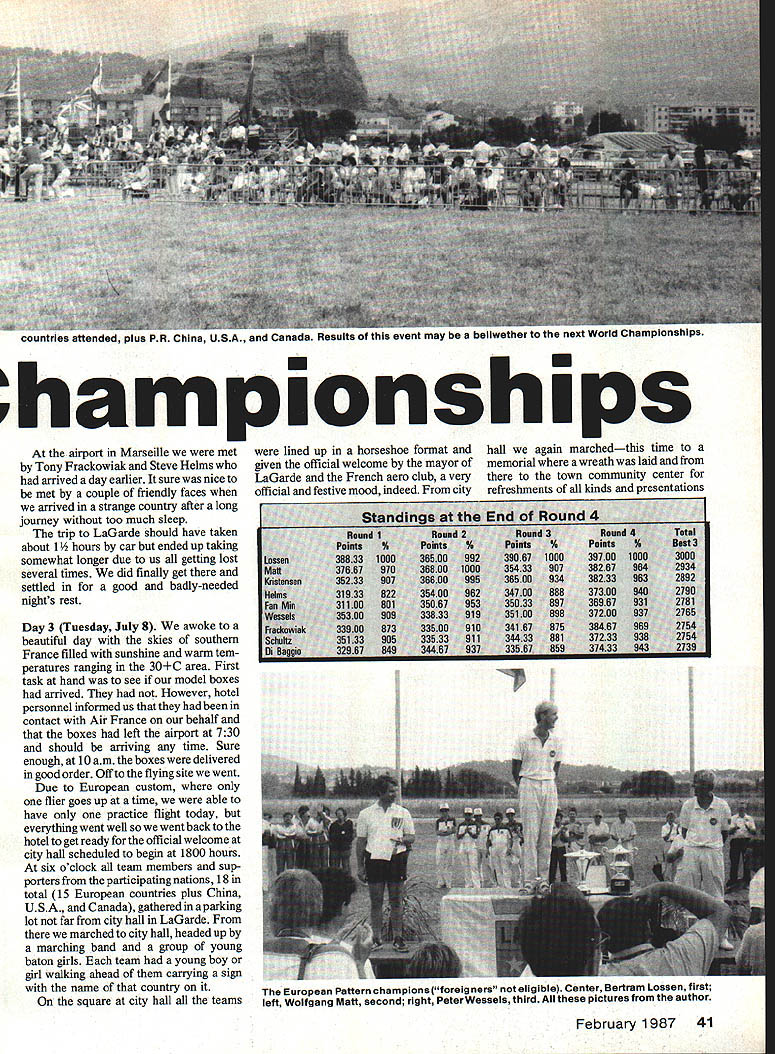
Standings at the End of Round 4
- Lossen — Round 1: 388.33 (1000); Round 2: 365.00 (992); Round 3: 390.67 (1000); Round 4: 397.00 (1000); Best 3 Total: 3000
- Matt — Round 1: 376.67 (970); Round 2: 368.00 (1000); Round 3: 354.33 (907); Round 4: 382.67 (1000); Best 3 Total: 2934
- Kristensen — Round 1: 352.33 (907); Round 2: 366.00 (998); Round 3: 365.00 (934); Round 4: 382.33 (963); Best 3 Total: 2892
- Helms — Round 1: 319.33 (822); Round 2: 354.00 (962); Round 3: 347.00 (888); Round 4: 370.00 (940); Best 3 Total: 2790
- Fan Min — Round 1: 311.00 (801); Round 2: 350.67 (953); Round 3: 350.33 (887); Round 4: 369.67 (937); Best 3 Total: 2781
- Wessels — Round 1: 353.00 (909); Round 2: 338.33 (919); Round 3: 351.00 (899); Round 4: 372.00 (937); Best 3 Total: 2756
- Frackowiak — Round 1: 353.00 (873); Round 2: 333.00 (911); Round 3: 341.67 (875); Round 4: 382.00 (937); Best 3 Total: 2746
- Schulz — Round 1: 351.33 (905); Round 2: 335.33 (911); Round 3: 323.33 (840); Round 4: 337.67 (849); Best 3 Total: 2739
- Di Baggio — Round 1: 329.67 (849); Round 2: 344.67 (937); Round 3: 335.67 (837); Round 4: 374.33 (943); Best 3 Total: 2739
Day 4 (Wednesday, July 9)
Another beautiful day again with temperatures in the low 30s. Today was set aside for official practice and processing. Each team was allotted a 30-minute time slot which was strictly adhered to. Also, sound equipment was made available during that time period to check the models.
The American team was first off at eight o'clock, and everything went well. Sound ranged from 94 dB for Steve Helms, 95 for Tony Frackowiak, and 97 for Dean Koger.
I was among the last to fly at about five o'clock in the afternoon. A quick sound check showed 92 dB, well below the maximum of 98. My practice flight was not particularly good, as the wind had picked up quite a bit during the day.
We all observed Wolfgang Matt's flight closely. With Hanno Pretner not being in attendance, Matt was considered the one to beat based on his 2nd-place finish in Flevohof at the World Championships in 1985. So far the organization has seemed quite good, although the meals have left quite a bit to be desired.
Day 5 (Thursday, July 10)
Today the actual competition got underway precisely at 7 a.m. The judges were ready, and the pilots were waiting with anticipation. The day started out with the wind calm and cool temperatures. Steve Helms was second up and posted a disappointing score of 319, only 59%, after a respectable flight with only minor faults here and there. Matt was 8th to fly and posted a 377, which was to remain the high score for most of the round until Bertram Lossen of Germany came up with a 388 (high flight for Round 1). Tony and Dean both scored 339, and yours truly, 352.
Standings after Round 1: 1. Lossen, 388; 2. Matt, 377; 3. Wessels, 353; 4. Liu Aykang, 353; 5. Kristensen, 352; 6. Frackowiak, 339; 7. Koger, 339; 8. Helms, 319.
Round 2 started at four o'clock. By this time the wind had picked up considerably and temperatures were hovering around 30°C.
Dean Koger was 6th up and did not realize until he was airborne that several of his trims had been moved on his transmitter. Worse yet, the direction of his snap switch had somehow been moved from a positive snap to a negative snap. The result was a zero for that maneuver—not because a negative snap is illegal but because it startled him to see the aircraft pitch negatively during the snap, causing him to immediately let go, only completing part of the rotation and finishing with aileron. Scoring only 288, Dean hoped this to be his throwaway flight.
We again had the opportunity to watch Wolfgang Matt of Liechtenstein fly. I felt that this flight was not as good as his first one. A check with the scoreboard confirmed this. Matt's 368 gave everyone relief that there might be a chance to catch up.
During the second round a rather humorous incident took place. Just prior to Matt's flight, Tony Frackowiak had reason to leave the spectator stand to get something from the rental car he and Steve were sharing, only to find when he got there that the doors were locked and Steve had the key. The windows had been left rolled down far enough for Tony to attempt to stick his arm through to open the door from the inside. However, Tony had two problems. The first was that he could not open the car door from the inside, and the second was that he was unable to remove his arm from the window. This resulted in a rather loud call to Steve, who was still sitting in the stands, to come and bail him out. Sorry, Tony, this was just too funny for me to pass up, but I won't tell about how you managed to lose over $1,000,000 U.S. in cash and how it ended up in an outside garbage bin in the hotel parking lot.
Day 6 (Friday, July 11)
Today we would finish Round 2 and fly the complete third round. The temperature was slightly cooler than the previous days, winds were light, and the flying conditions were near ideal.
Lossen was first to fly among the top five. He flew an excellent flight, and I was afraid to check the scoreboard. To my surprise he only got 365, three less than Matt's second-round score from the previous day, and 23 short of his first round. This left the door open for me to move closer to the winners.
My flight went quite well. The wind was a little bit stronger than earlier and slightly cross but still near ideal. I had only minor faults here and there, and the result was a 366, one point ahead of Lossen and three points behind Matt.
These scores, I would like to mention, are still quite low by standards we have grown accustomed to in the U.S. and Canada. The top score of Round 2 was 368/540 = 68%. My score was enough to take me from fifth to third place with Wessels and Schulz of Germany in 4th and 5th. Steve Helms scored 347 and moved into 6th. Tony with 335 was in 7th, and due to his bad luck, Dean had dropped to 18th place. However, with two more rounds to go, a lot can happen.
Round 3 got underway at around 10:15 with the wind starting to pick up and swinging from easterly to southwesterly, bringing with it a cooler temperature from the Mediterranean Sea. This was to turn out to be Matt's bad-luck round. Apparently something went wrong with his electric starter, and he thought that his engine was malfunctioning. Therefore, due to fear of his 3-minute starting time running out, he went to his backup model. I did not see the flight but was told that he flopped a stall turn and generally performed poorly, scoring only 354.
Lossen, on the other hand, had a super performance and posted the round high with a 391, including a five-point bonus for below-average sound level. Again I managed to get second high score with a 365, maintaining my 3rd place after Round 3.
Peter Wessels of Germany got a 351, and Helms, Koger, and Ken Binks of England all posted 347. Tony was the last man to fly at about 7:30. He attempted to bring his flight in closer and speed up his roll rate. This resulted in a rather untidy flight with noticeable changes in altitude and headings. His score was a disappointing 342 but about right.
Day 7 (Saturday, July 12)
Round 4 and the last day for qualifying flights started out with gray skies and the threat of stormy conditions late in the day. Temperatures were much cooler, and there was no sun. The first half of the round was scheduled between eight and 11 with the second half not starting until 4 p.m. This situation worried me a little, as I was not to fly until the second half.
The flying conditions for the first half were almost perfect with only a light, steady wind and no sun. Matt was 5th man to fly and managed what I thought to be a mediocre performance. His score of 383 was slightly higher than we had seen for similar flights so far, but judges have a tendency to loosen up toward the end of a contest.
Steve flew shortly afterward and came up with his highest score of the contest at 373. This should be good enough to get him in the flyoff. Dean Koger again had some bad luck. He had been having problems with his YS engine loading up while sitting on the runway idling in preparation for takeoff. This happened again during the takeoff roll. Tony had to chase the plane down the runway and accidentally kicked one elevator half, bending it down approximately 4 in. This created a very bad trim condition and was to plague Dean throughout his flight. Dean's score for the fourth round was quite low at only 332, which meant that he would not be able to make the flyoff. It would be worth mentioning that had it not been for all his problems, he was very likely to have made the flyoff. His flying was generally very good.
The second half of the 4th round got underway at precisely four o'clock. Tony was first to fly and put in his best flight so far with a 385, well within striking distance of a flyoff spot, although several unknown factors could come into play, such as Lossen's flight (yet to come). If he scored very high, then the effect of Tony's score would be minimized by normalizing. Also Di Baggio and Bertalozzi of Italy were in a position to knock both Steve and Tony out of the flyoff, as the way they were going to determine the flyoff positions was, of course, to select the top five European competitors and also include those non-Europeans who had placed ahead of any of the top five Europeans.
Now well into the last half of the fourth round, the storm did not materialize, although the wind was slightly stronger by the time I flew but not really enough to make a difference. I also posted my highest score with a 382. Helms got 373, and Lossen, who flew near the end in quite a strong wind, came up with a 397. Ken Binks, whom we thought might make the flyoff, got only a 356 and did not make the cut.
Day 8 (Sunday, July 13)
I am not sure why but I woke up at 5:40 a.m. Unable to go back to sleep, I got up and went out to the field to get in a couple of practice flights. The flyoff was not to start until 10:00 a.m., so no one was around. It was during these flights that I realized my elevator servo was going bad, so I had a quick trip back to the hotel to change it and to have a shower in time for the flyoff to start.
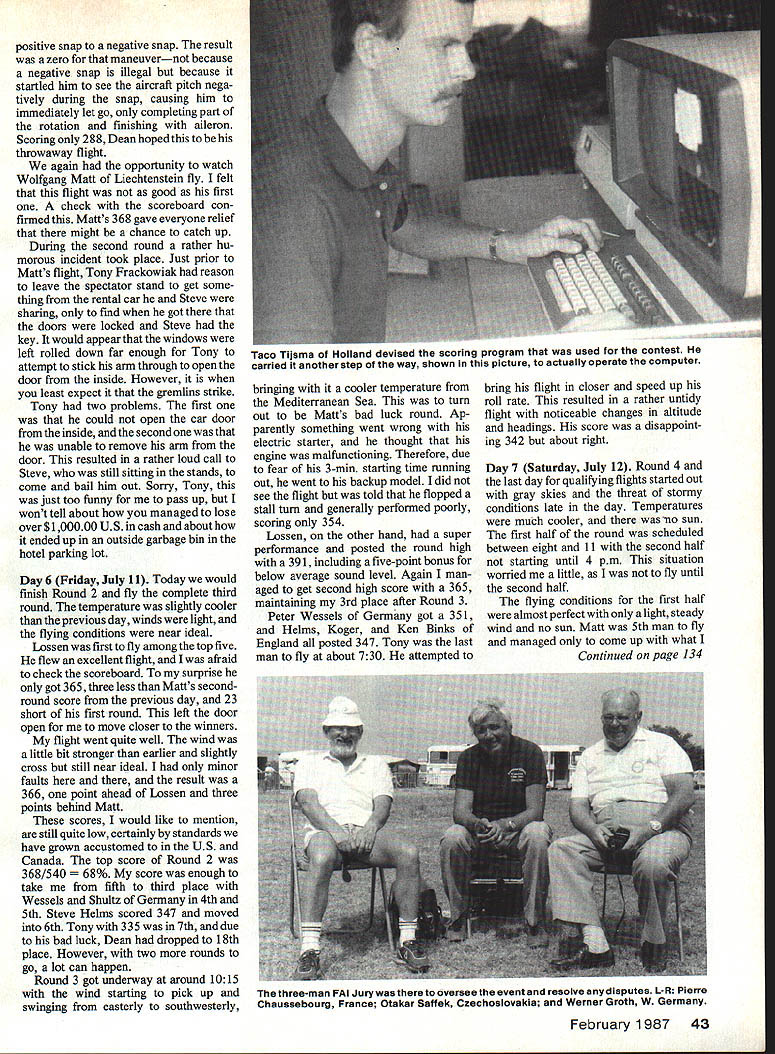
Lossen was first off, as he had qualified in first place. He put on an absolutely magic performance and got 402. Matt was next and posted a 396. Steve Helms and I shared third spot with 375, and Fan Min and Wessels were not far behind with 373 and 372, respectively. Lossen's 402 score made him a sure winner of the contest—well deserved, I might add.
Flyoff Round 2
If there was one thing that impressed me at this contest, it would be the way in which the organizers were able to consistently get officials, judges, and pilots together and get things started on time. At precisely three o'clock the second round was underway. Starting order was reversed with the Europeans flying first. Lossen again proved that he belonged on top with a 397, which meant that he had topped the leaderboard in all rounds of the meet except Round 2, where he was 3rd behind Matt and myself. Matt's score of the second flyoff round dropped back to a 381, and my own improved to 383 (that elevator servo had definitely been giving me trouble), so no changes took place among the top three.
The bad weather predicted earlier for the afternoon was threatening all of the second half of the flyoff. In fact there was a real possibility that my flight would be rained out, as I was the very last pilot to fly in the contest. Somehow it managed to hold off just long enough for me to wrap up the contest with one of my finest flyoff performances ever. Had it not been for an early recovery of the spin, the flight might have been the top of the round. Anyway, Lossen was too far ahead for anyone to catch him, so I was happy with 383.
Not 10 minutes after the completion of my flight, the rain poured down with thunder and lightning, but it only lasted about half an hour. It was really too bad for the organizers that we got the thundershower because a lot of spectators had gathered to watch the flyoff. Many of them left and as a result missed the flying demonstration by the Italians, which was very good, and the prize-giving ceremony.
The organizers had done a really good job of promoting the event in the local community through radio, TV, newspapers, and with large billboard-type signs all over town. Several large party tents were set up with tables and chairs. A concession selling beer, soft drinks, hot dogs, etc., was doing brisk business. The local Volvo dealership had a tent showing off its latest models, and even a kiddie car ride was set up. This gives you an idea of the effort the Europeans put into an event of this magnitude.
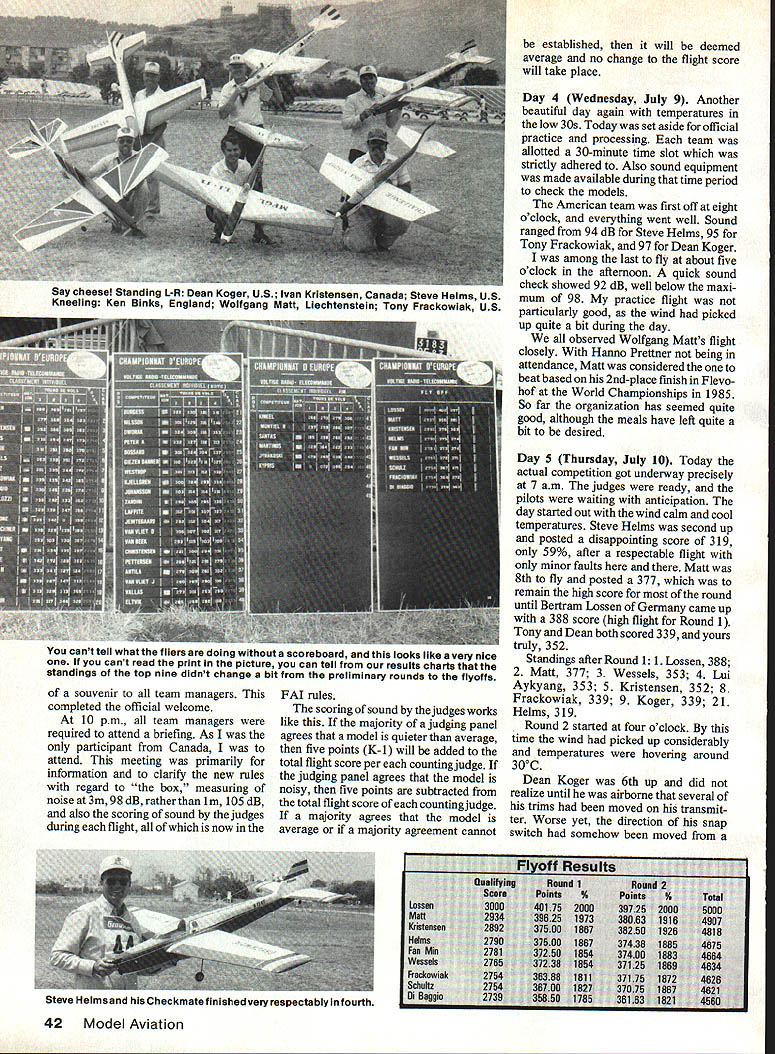
The prize-giving ceremony was very nice, indeed, with flag raising and playing of the appropriate national anthems for the winners from Europe. It was understood from the beginning that those of us not from Europe would not be eligible to become European Champion, so the Americans, Chinese, and myself from Canada received a medal as a token of our participation in the 3rd European Championship, 1986, in La Garde.
As always, no contest of this magnitude is complete without a closing banquet. At 8:30 p.m., all participants gathered at a shirt-and-tie affair in the town civic center with the mayor, organizers, and other dignitaries. A most enjoyable time was had by all with plenty of camaraderie and paper airplanes sending messages back and forth between tables.
The party broke up shortly before midnight, none too soon as Dean and I had a 6:30 a.m. flight. The international airport at Marseille is approximately 1 1/2 hours by car from our hotel in La Garde, which meant that we had to get up at 3 a.m. with only three hours of sleep to start our journey homeward. Needless to say, it was a couple of exhausted guys who arrived in Toronto some 20 hours later. We had four-hour layovers in both Paris and London on our return trip.
The model boxes were checked straight through from Marseille with a minimum amount of hassle and at no cost. They were sitting on the floor in the baggage claim area in Toronto waiting for us when we got through passport control.
So ended our trip to the 3rd European Championships. We can truly say that it was a most enjoyable experience and extremely informative in many areas. Now we have all the ingredients necessary for an all-out effort for the World Championships to be held in the fall of 1987 in France. See you all there.
Transcribed from original scans by AI. Minor OCR errors may remain.

