
F1B Technicalities
In sequential order, our author takes another look at the 1983 F1B (Wakefield Rubber) World Championships with emphasis on the unique ideas and models that he saw. — Martyn Cowley
Double Champion
The highly competitive sport-model flying at FAI World Championship level makes consecutive winners a rare breed. Since the Wakefield Cup was initiated in 1928 only two individuals had previously won consecutive titles: America's Joe Ehrhardt (1930–31) and Finland's Arne Ellilä (F1B, 1949–50). Only in F1A glider (started 1946) was there another consecutive winner—Rudi Lindner of Germany (1954–55). No one has managed the feat in F1C power.
All the more remarkable, then, that Germany's Lothar Döring joined this select group at Goulburn, Australia, 1983. Lothar's performance was outstanding for several reasons: the field was much stronger than in early years; rules have been refined to limit raw performance; models are more technologically challenging; and the weather in Spain (1981) and Australia (1983) was very adverse.
Lothar attended Goulburn as the defending champion and was allotted a pole and the full time of a round to himself. Compared with the three team members usually present on other poles, that might seem an advantage, but Lothar had to work alone—preparing models, spotting thermals and retrieving. With windy, wet conditions, defending his title was a major task.
Lothar's competition style is thoroughly individualistic: advance preparation of models and equipment allows him to concentrate on his instruments. He used two twin thermistor wind‑recording machines—one unit placed about 50 yards upwind and the other at the pole—to help spot conditions. This made three consecutive World Champions (including Itzhak Ben‑Itzhak at Taft, CA in 1979) who used similar devices. At the December 1983 CIAM meeting a proposal was tabled to ban such equipment at future events; such a ban would alter the emphasis of Wakefield flying, which is increasingly a meteorological as well as aerodynamic challenge.
As top places are often separated by only seconds, it might be worth considering inviting the top three from one World Championship back to the next to defend their places—and to keep the individual winner company on a lonely pole.
Lothar's Espada 80/1 design was already well publicised; it was selected by the National Free Flight Society as one of the Ten Models of the Year in 1982.
Anselmo Zeri and the scramble
The fight for the remaining places at Goulburn produced an exciting finish, with half a dozen fliers in contention until the last flights. Holland's Anselmo Zeri scored consistent maxes after an early second‑round 247 and earned second place by keeping his head after an early mistake.
Anselmo described the conditions: "The kind of weather we found for the F1B contest was not unlike that we are used to in northern Europe. I don't mean it was easy—just frightening!" His confident mental approach was vital. Many competitors were psychologically affected by the high wind and the likely damage to models; to compete effectively at WC level you must be mentally prepared to concentrate under adverse conditions.
Model details and tactics:
- Anselmo's opening-round model used a Benedek B63566 airfoil with a thickened upper surface and relatively few warps.
- He used an auto‑rudder triggered at 3 seconds, with VIT following 1 second later.
- His models featured an electric retrieval buzzer—unusual for a Wakefield—weighing 9 g and running for 15 hours.
- His best model was damaged on landing in the very windy fourth round; he then used an older reliable model for the last flights.
- Strategy: change wooden motors every 15 minutes while waiting for a final flight; be cautious about launching until conditions are right. Peter DeBoer assisted Anselmo at the line.
New ideas
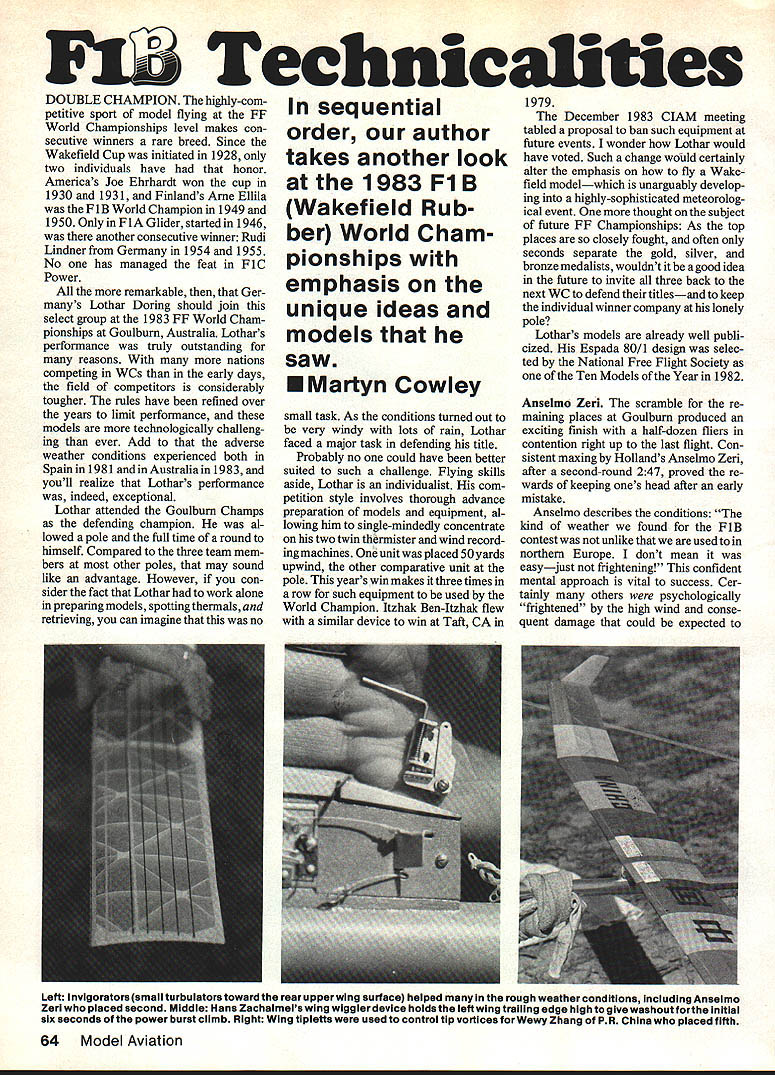
Many teams experimented with "invigorators"—a series of turbulators positioned toward the rear of the wing upper surface in addition to a conventional leading-edge turbulator. The concept (introduced to modelers by Martin Pressnell in the 1982 NFFS Symposium report) aims to control the vortex bubble that forms near the upper surface leading edge, helping to produce higher section lift coefficients before stall.
In practice:
- Little benefit has been seen in still‑air times, but invigorators yield noticeable improvement in stability and stall recovery, giving better performance in rough conditions.
- Typical implementation: thin graphic‑arts tape (about 0.006 in thick and 0.030 in wide) positioned at 5% chord as a turbulator, and at 40, 50, 60, 70 and 80% chord as invigorators.
- These were used primarily by the Dutch F1A and F1B teams (notably Anselmo Zeri).
- Alternative method: Paul Sahi used 0.3 mm nylon monofilament spanwise over ribs before covering on his F1A glider to achieve a similar effect.
Solid wings
Like Lothar's Espada, Britain's Ivan Taylor used solid balsa wings on his high aspect‑ratio Thin Liz. Ivan finished 11th but demonstrated that solid wings can cope well with rough, wet weather despite their slender appearance.
Construction notes from Ivan:
- Solid wings need good, light wood but are not excessively difficult to build.
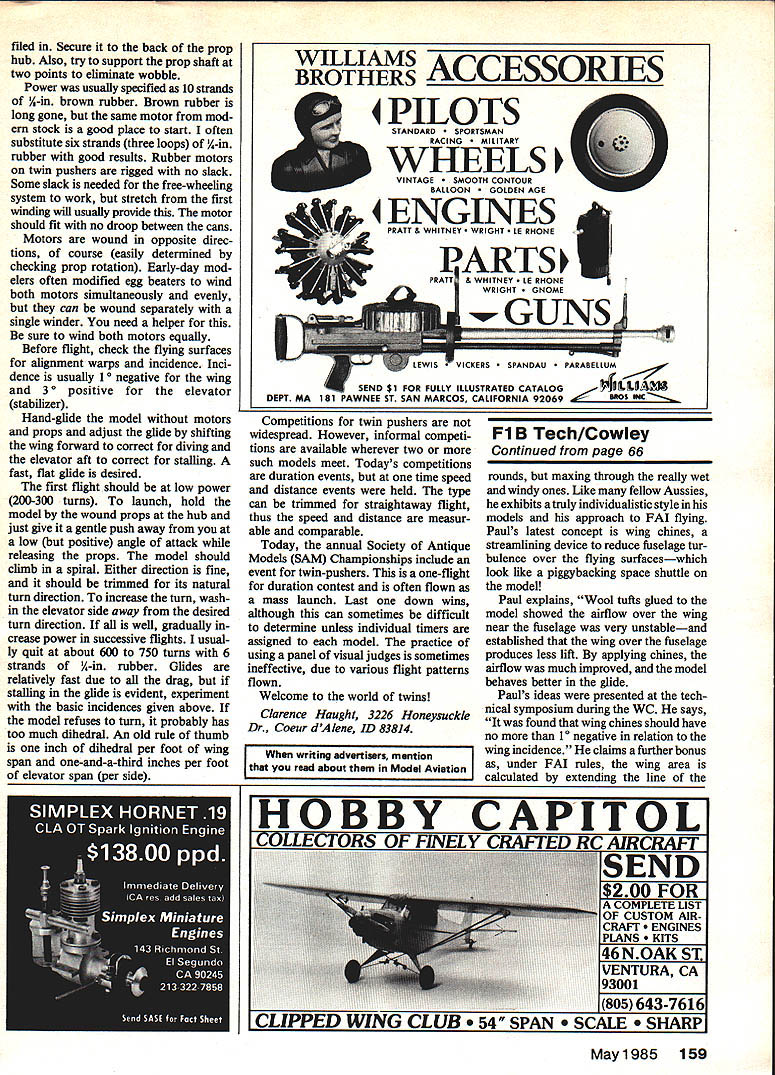
- Planks are cut and glued so that very little wood needs removing from the underside.
- Shape with a sanding block and coarse wet‑and‑dry paper, finish with finer grades.
- Use lightweight fibreglass cloth (about 3/4 oz per sq yd).
- Center panels were treated with Tufkote (a two‑part polyurethane varnish) for adhesion.
Benefits: solid balsa wings resist getting wet better than tissue‑covered wings, and damage (broken tips, etc.) can be repaired quickly with cyanoacrylate glue—an advantage in wet championships.
New rubber
Once again, popular Wakefield rubber (Pirelli) has gone out of production—rumored to be gone for good. The Japanese team used a new supply manufactured in Japan by Dunlop (originally for golf balls). It remains to be seen what rubber other Dunlop plants might produce.
Current favorite suppliers:
- Ed Dolby’s FAI Model Supply (P.O. Box 3957, Torrance, CA 90510) has gained popularity as quality improved.
- George Schroedter (Champion Model Products, 6808 Carmen Ct., La Verne, CA 91750) now markets contest‑grade rubber similar to FAI Model Supply’s but a few thousandths of an inch thinner, offering fliers more choice when making motors.
Wake‑Up
George Schroedter also made an impression by making the U.S. team and competing in Australia with a kit design he markets: the Champion Wake‑Up. It is one of the best serious Wakefield competition kits available, reflecting the time and care George puts into each kit. The Wake‑Up easily achieved 4‑minute still‑air maxes at Taft during the Team Finals.
Gadgets
There was an increasing trend to use timer‑operated VITs to control the initial power burst (up to about 4 seconds). Benefits:
- Allows trimming with a more forward CG, enabling greater wing incidence for the remaining climb and glide.
- Can improve stability in rough, windy weather.
Examples and variations:
- The Chinese had models with 6–7 second VIT movements.
- VIT cams varied in shape to give quick or slow tail lift, or stepped movement.
- Hans Zachalmel used a wing‑twist mechanism allowing the left panel to be washed out during climb, returning to a flat wing for glide.
Positive prop stop
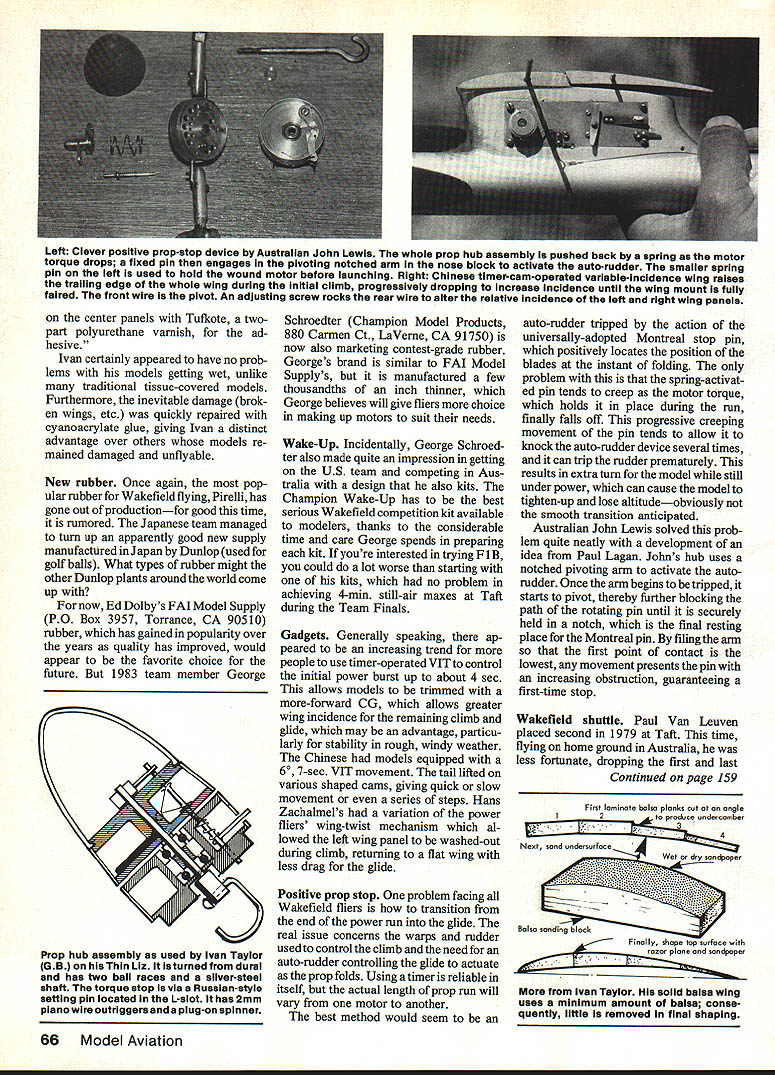
Transitioning from power run to glide is a critical problem. The issues are warps and rudder control for climb, and the need for an auto‑rudder to actuate as the prop folds. Timers are reliable, but prop run length varies with each motor. The most consistent method is an auto‑rudder tripped by the Montreal stop pin, which positively locates blade position at folding.
Problem: the spring‑actuated Montreal pin tends to creep as motor torque falls, and this creeping can let the pin knock the auto‑rudder several times, tripping the rudder prematurely. That can cause extra turn under power, tightening the model and losing altitude.
Solution (John Lewis, Australia):
- John developed a hub using a notched pivoting arm (inspired by Paul Hogan).
- As the arm is tripped it begins to pivot, blocking the rotating pin's path until the pin is securely held in a notch—the final resting place.
- By arranging that the first contact point is the lowest, any movement presents the pin with increasing obstruction, guaranteeing a positive first‑time stop.
Wakefield shuttle
Paul Van Leuven (second at Taft in 1979) had less luck at Goulburn, dropping the first and last rounds but maxing the very wet and windy ones. Paul experiments with streamlining devices to reduce fuselage turbulence over the flying surfaces—his fuselage treatment looks a bit like a piggybacked space shuttle.
Findings and advice:
- Wool tufts glued to the model showed unstable airflow over the wing near the fuselage and that the wing over the fuselage produced less lift.
- Adding chines improved airflow and glide behaviour.
- Presentation at the WC technical symposium recommended that wing chines should have no more than 1° negative relative to wing incidence.
- An additional bonus under FAI rules: wing area is calculated by extending the wing line to the fuselage, so chines can affect measured area.
Miscellaneous notes (construction and equipment)
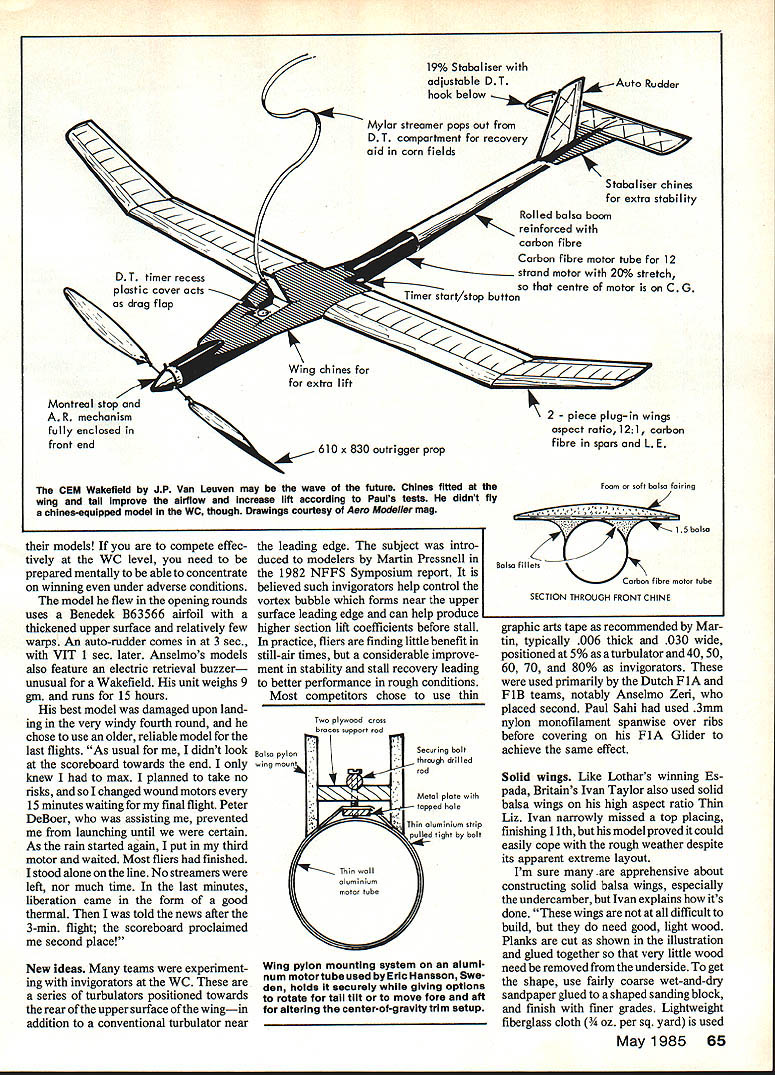
Common features and trends observed at Goulburn:
- Rolled balsa booms and lightweight stabilisers (around 19%).
- Adjustable DT (dethermaliser) compartments; DT compartments used as recovery aids and reinforced with carbon fibre for field use.
- Auto‑rudder hooks beneath Mylar streamers that pop out on landing.
- Carbon fibre motor tubes, 12‑strand motors, typical 20% stretch motor preloads.
- Timer recesses and button‑centre motor CG covers used as timer start/stop actuators.
- Wing chines for extra lift and improved flow near the fuselage.
- Montreal stop mechanisms enclosed at the front end for protection.
- Outrigger prop models (e.g., 610 × 830 size) can compete effectively at World Championship level.
- Mental preparation and concentration remain as important as technical advances when flying under adverse conditions.
Transcribed from original scans by AI. Minor OCR errors may remain.

