
F1C Technicalities
Silvano Lustrati — 1983 World Champion
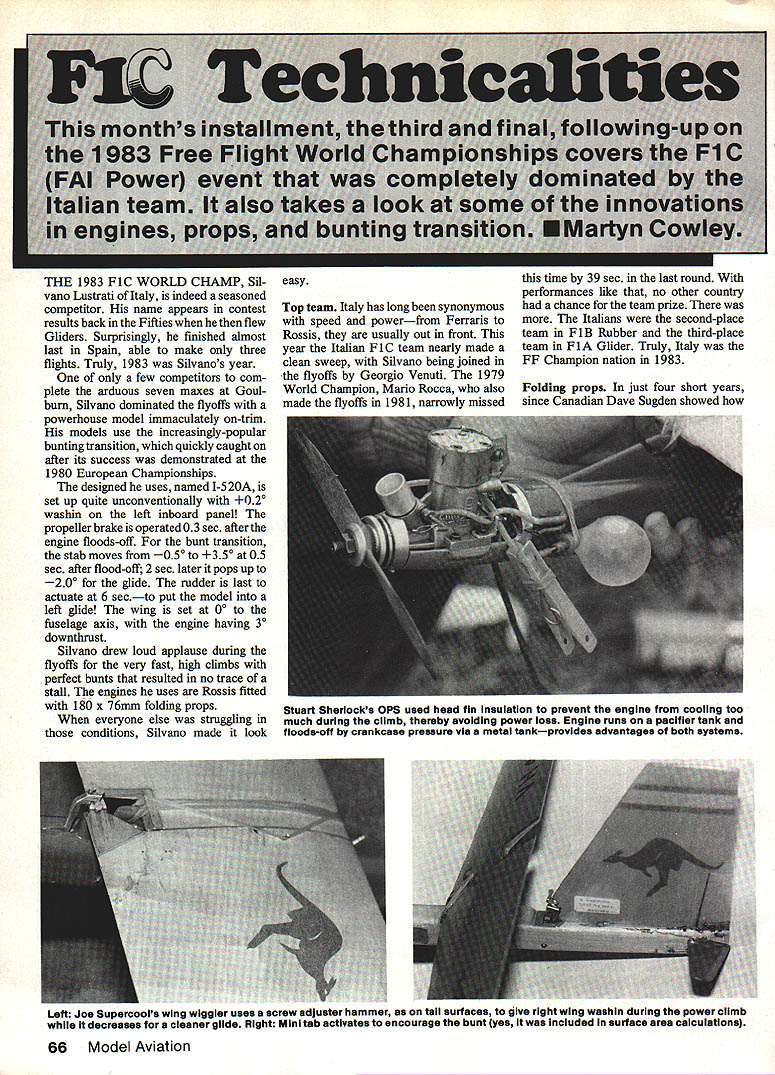
Silvano Lustrati of Italy won the 1983 F1C World Championship. A seasoned competitor whose name appears in contest results back to the 1950s (then flying gliders), Silvano struggled in Spain but excelled at Goulburn. He was one of only a few competitors to complete seven maxes and he dominated the flyoffs with a powerhouse model that was immaculately trimmed.
His models employ the now-popular bunt transition. The design he used, the I-520A, has an unconventional setup:
- +0.2° wash-in on the left inboard wing panel.
- Propeller brake operated 0.3 seconds after the engine floods off.
- Stab transition: from −0.5° to +3.5° at 0.5 seconds after flood-off; 2 seconds later it moves to −2.0° for the glide.
- Rudder actuates last at about 6 seconds to place the model into a left glide.
- Wing set at 0° to the fuselage axis; engine set with about 3° downthrust.
Silvano drew loud applause for very fast, high climbs with perfect bunts showing no signs of stall. He used Rossi engines fitted with 180 × 76 mm folding props.
Italy — top team
Italy nearly swept the F1C event in 1983. In addition to Silvano Lustrati, Giorgio Venuti joined the flyoffs, and former World Champion Mario Rocca narrowly missed qualification by 39 seconds in the last round. Italy also finished second as a team in F1B Rubber and third as a team in F1A Glider — making Italy the dominant F1 nation that year.
Folding props
Folding props, introduced widely after demonstrations a few years earlier, had become standard equipment by 1983. Benefits include:
- Improved glide performance (marginal but measurable).
- Reduced risk of damage to prop blades on landing, especially for brittle carbon-fiber blades.
- Greater consistency of climb performance by avoiding changes in climb pattern when replacement props are used.
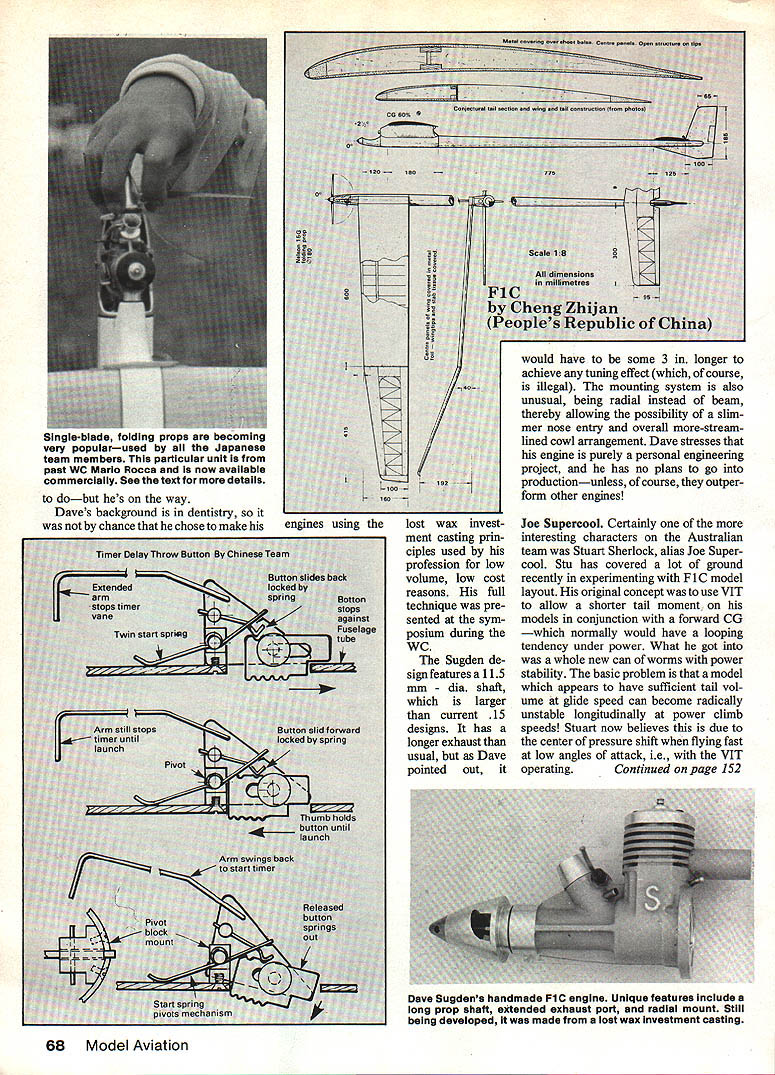
One development was single-blade folding props. Experiments by Mario Rocca showed effective single-blade folders need a larger diameter (about 200 mm). Advantages and disadvantages:
- Advantage: the single blade operates in less disturbed air.
- Disadvantage: larger diameter increases tip speed, approaching sonic levels.
Mario Rocca now offers single-blade props and a custom balancing rig. Prices and contact:
- Single blade: about $9.00.
- Blade + balancer, spinner, counterweight, etc.: about $45.00 plus postage.
- Mario Rocca, 44020 Rovereto, Ferrarese, Italy.
New engines and equipment
The Nelson .15G (Henry Nelson) saw a major uptake in 1983. By the WC about half the fliers had at least one Nelson-equipped model; the strong Chinese team used Nelsons and maintained a full-house score until late in the contest. Choice of engine remains important — ultimate power still appears to depend on the particular engine (Rossi or otherwise).
Dave Sugden introduced his own new engines at the event, though he kept them boxed, citing further development work needed. Noteworthy features of the Sugden design:
- Manufactured using lost-wax investment-casting techniques.
- 11.5 mm diameter crankshaft (larger than many .15 designs).
- Longer exhaust than usual (would have to be ~3 in. longer to tune, which would be illegal).
- Radial mounting system instead of conventional beam mounting, enabling a slimmer nose and more streamlined cowl.
Dave presented his full technique at the symposium and stressed the project was a personal engineering effort with no production plans unless performance warrants it.
Joe Supercool (Stuart Sherlock) — experiments and gadgets
Stuart Sherlock (aka Joe Supercool) was a notable character on the Australian team, experimenting widely with F1C layouts. His early concept used VIT (variable incidence tail) to allow a shorter tail moment with a forward CG, but he discovered power-climb behavior can be radically different from glide behavior. A model that has sufficient tail volume at glide speed can become longitudinally unstable at high climb speeds due to center-of-pressure shifts when flying fast at low angles of attack.
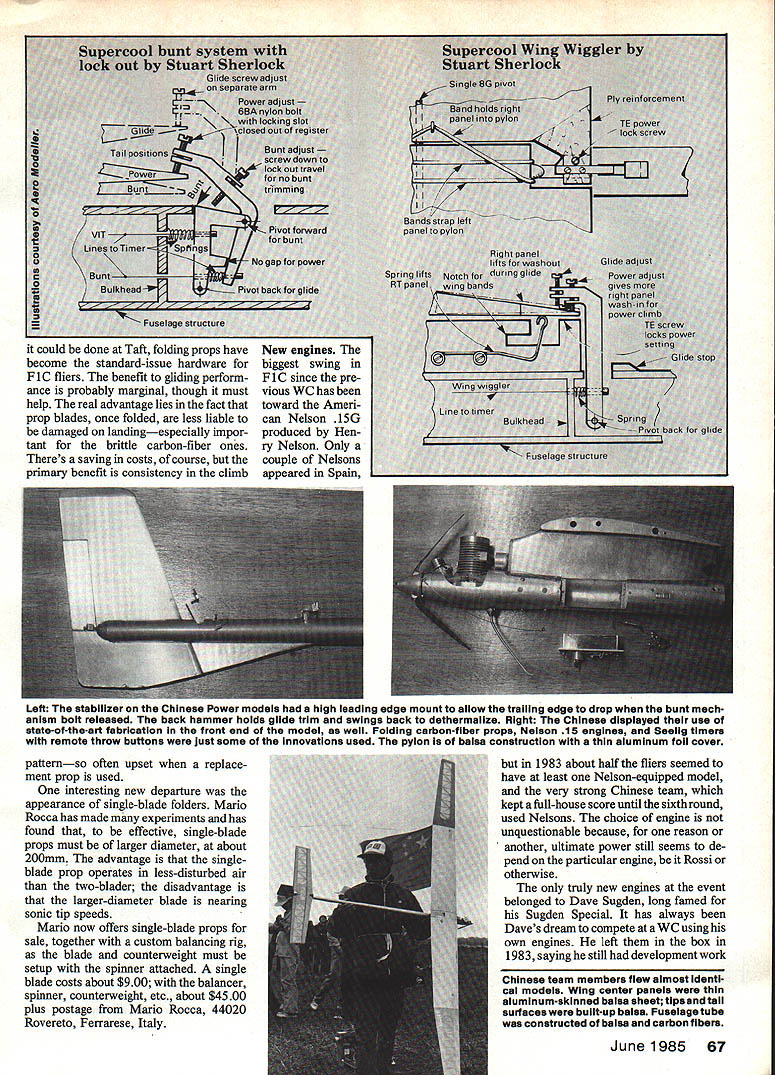
At Goulburn his models were highly instrumented and gadget-laden, including:
- VIT
- Auto-rudder
- Wing wiggler (adjustable)
- Bunt mechanism
A late 64-second failure in the last round cost him a high placing. Subsequent experiments extended the moment arm from 600 mm to 860 mm with marked improvement in climb stability; he planned a 1,000 mm version and considered dispensing with VIT if that proved stable.
Stuart also manufactured fiberglass/carbon props patterned after the Chinese blades. Order info:
- Small-size fiberglass/carbon props: $6.00 each.
- Postage & packing: $6.00.
- Joe Supercool, P.O. Box 40, Kingswood, 2750 NSW, Australia.
Chinese team and models
The Chinese team showed dramatic improvement since their first recent FF WC in 1979. At Goulburn their F1C team was among the best-equipped and their models were state-of-the-art. Features included:
- Carbon-fiber–reinforced wing construction with thin aluminum-foil–surfaced sheet balsa covering.
- Wing tips not sheeted to save weight at the extremities.
- Fuselage tubes constructed of balsa and carbon fibers.
- Nelson .15 engines with folding carbon-fiber blades.
- All models employed bunt transitions.
The Chinese went 15 straight maxes before disappointing finishes in the last two rounds; if calmer weather holds in future events, they are expected to be strong contenders.
New materials
Composite construction is gaining momentum despite slow acceptance by traditional competitors. Pre-cured carbon-fiber laminates are now readily available and offer excellent strength-to-weight and stiffness-to-weight ratios.
Boron filament offers even higher strength-to-weight benefits but can be a health hazard if small fragments embed in the skin; users should take appropriate precautions.
Transcribed from original scans by AI. Minor OCR errors may remain.

