
F2A Speed World Champs
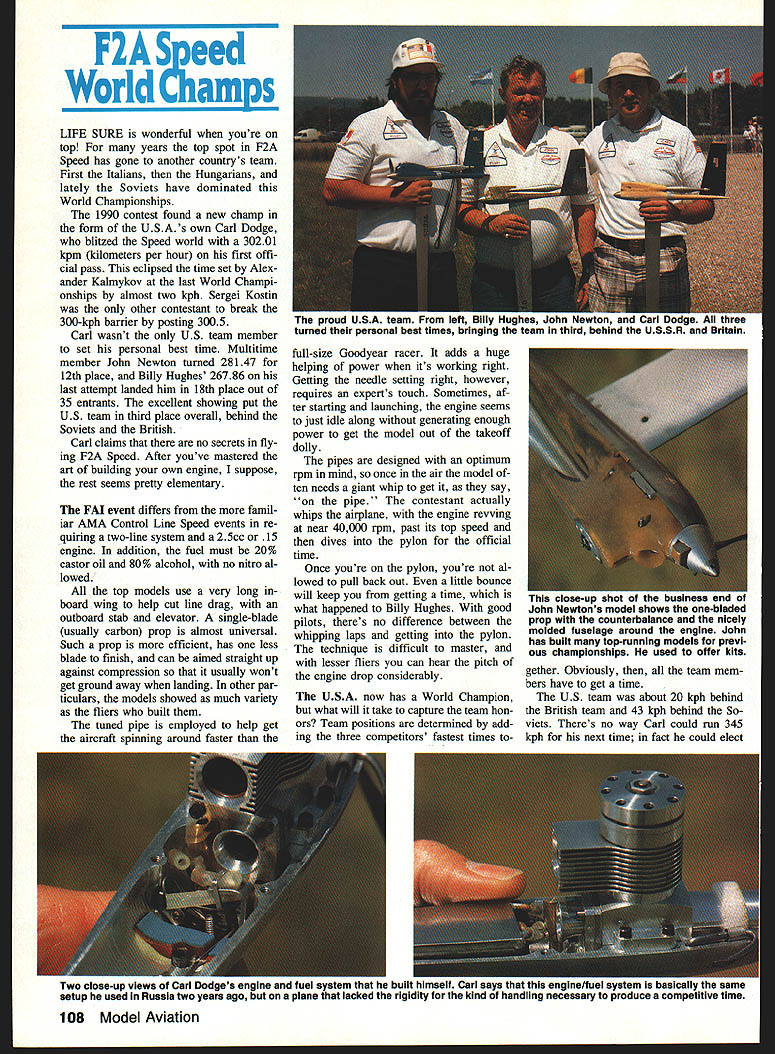
LIFE SURE is wonderful when you're on top! For many years the top spot in F2A Speed had gone to other countries: first the Italians, then the Hungarians, and lately the Soviets. The 1990 contest, however, found a new champion in the U.S.A.'s Carl Dodge.
1990 Results — Highlights
- Carl Dodge (USA): 302.01 kph on his first official pass — a new World Championship mark, almost 2 kph better than Alexander Kalmykov's previous time.
- Sergei Kostin: 300.50 kph — the only other competitor to break 300 kph.
- John Newton (USA): 281.47 kph — 12th place (personal best).
- Billy Hughes (USA): 267.86 kph on his last attempt — 18th place out of 35 entrants.
- Team standings: USA finished 3rd overall, behind the Soviets and Great Britain.
Rules and Equipment
- Event differences from AMA Control Line Speed:
- Two-line system required.
- Engine displacement: 2.5 cc (.15) maximum.
- Fuel: 20% castor oil, 80% alcohol; nitro prohibited.
- Common model features:
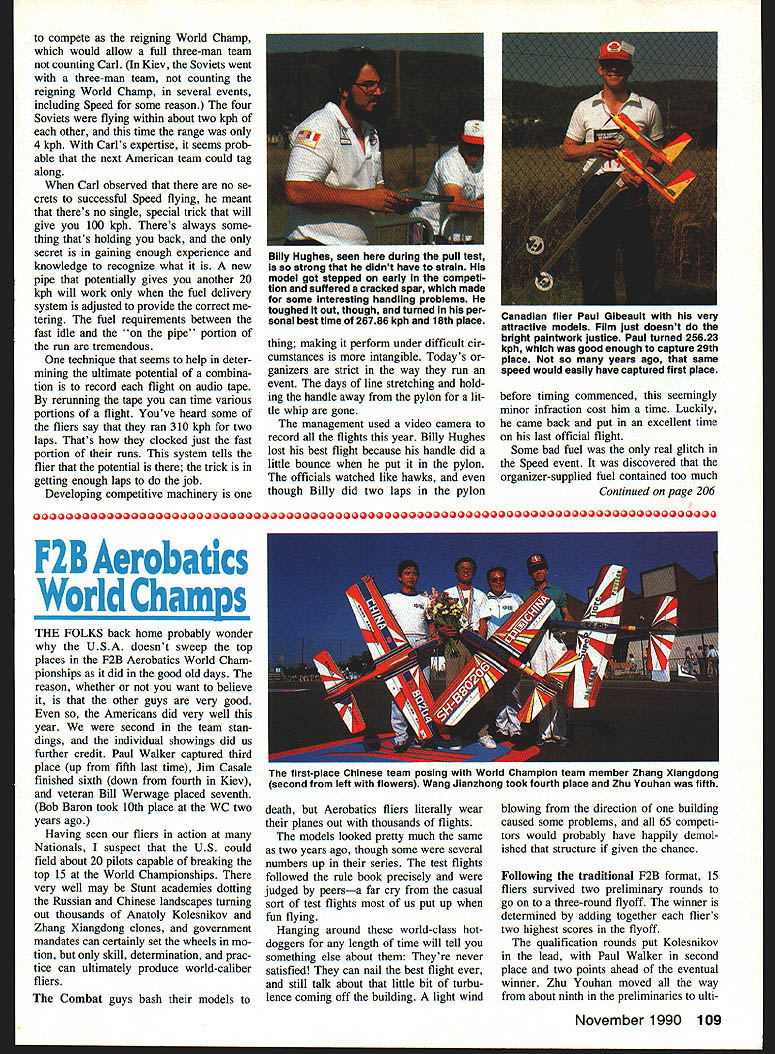
- Very long inboard wing (to reduce line drag).
- Outboard stabilizer and elevator.
- Single-blade prop (usually carbon): more efficient, fewer blades to finish, can be aimed against compression so it usually isn't ground away on landing.
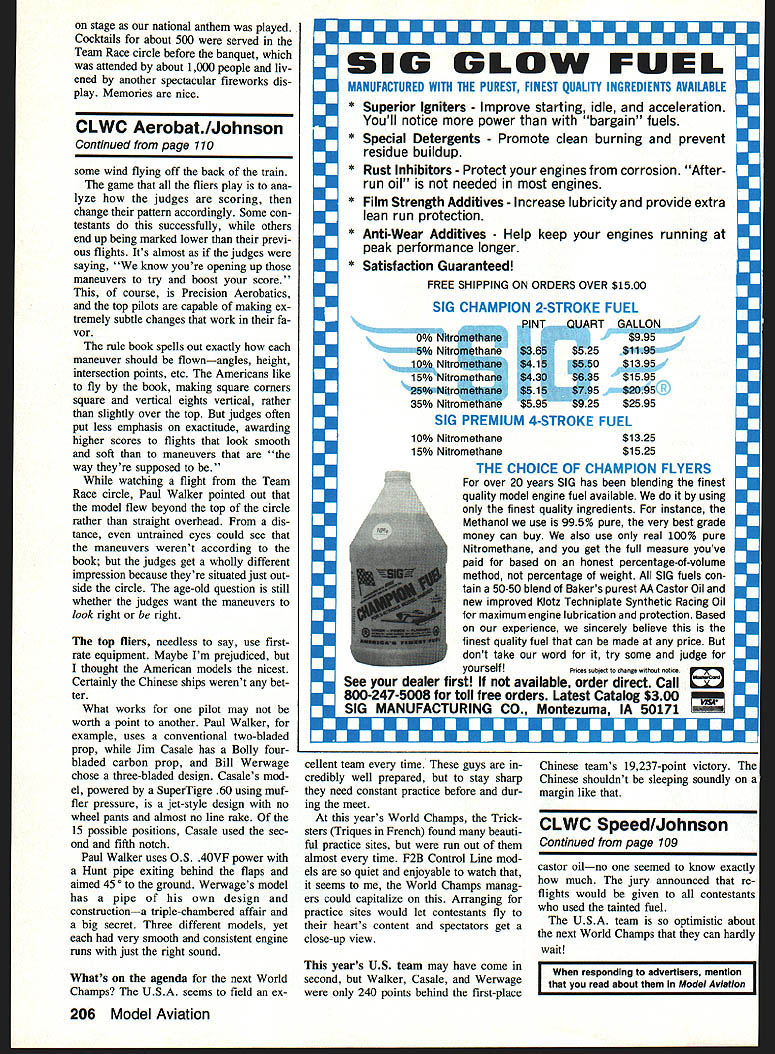
- Tuned exhaust pipe to extract extra power at its design RPM.
Engine, Pipe and Tuning
The tuned pipe, when working properly, adds a huge power boost. Pipes are designed for an optimum RPM, so correct needle settings and fuel metering are critical. Common issues:
- Improper needle settings can make the engine barely idle after takeoff, preventing the model from clearing the launch dolly.
- Once airborne, the model often needs a "giant whip" to get "on the pipe": the contestant whips the airplane while the engine revs near 40,000 rpm, pushing it past top speed and then diving into the pylon for the official time.
- The whipping technique is difficult to master; skilled pilots make the whipping laps and pylon entry indistinguishable, while less experienced pilots can be heard as the engine pitch drops.
Competition Technique and Scoring
- Once on the pylon, a pilot is not allowed to pull back out. Even a small bounce of the handle in the pylon will invalidate the run (this happened to Billy Hughes on one flight). Officials strictly enforce the rule.
- Team positions are determined by adding the three competitors' fastest times together. The USA was about 20 kph behind Britain and 43 kph behind the Soviets in combined speeds.
- The reigning World Champion may be excluded from the team score, allowing a nation to field three other scorers; the Soviets used such a tactic in Kiev.
Testing, Measurement and Preparation
- One valuable technique is to record flights on audio tape and time different portions. Some fliers claim speeds like "310 kph for two laps" by timing only the fast portion of a run. Audio (and video) analysis helps identify potential and shows where extra laps or better pipe tuning are needed.
- Developing competitive machinery is hard; making it perform reliably under contest conditions is even harder. Experience and incremental adjustments are the only "secret" — there is no single trick that gives dramatic gains.
Event Management and Issues
- Organizers were strict: video cameras recorded all flights and officials watched closely for infractions.
- A fuel problem was discovered: organizer-supplied fuel contained too much castor oil (exact amount unknown). The jury announced recourse for contestants who had used the tainted fuel.
Observations
Carl Dodge says there are no secrets to successful F2A Speed flying — only many small, solvable issues. A new pipe can potentially add 20 kph, but only if the fuel delivery and metering are adjusted to match the demands between fast idle and "on the pipe." With Carl's expertise and the improvements already seen, the next American team looks capable of closing the gap with the Soviets and British.
Transcribed from original scans by AI. Minor OCR errors may remain.

