
F2C Team Race World Champs
Overview
Here's an event that seems designed to frustrate the dedicated modeler. The object appears simple: race against two other competitors using a .15-size engine and an airplane that meets specified surface-area and fuselage cross-section minimums. The idea is a model scaled up enough in width and height to accommodate a real pilot and provide a little forward visibility. Over the years a flying‑wing–style design has evolved; in many cases an ultrathin airfoil meets the rules, giving just enough lift, minimum drag and maximum allowable fuel capacity—7 cc (about 1/4 oz).
Aircraft, engines, and tuning
- Maximum fuel capacity: 7 cc.
- Typical design: flying‑wing or ultrathin airfoil to minimize drag and meet rule minima.
- Engine choice: diesel engines are the universal choice for the event.
- Performance tradeoffs:
- High compression produces power.
- Lean mixture improves range.
- The wrong combination of compression and mixture can generate excessive heat and cause engine failure (terms like “meltdown” and “cookup” are common).
Tuning must aim for maximum power and top efficiency; getting high speed helps the engine run in a stable, non‑marginal setting. Running for long range competes with heat management.
Race format and strategy
- Heats and semifinals: 100 laps each.
- Final: 200 laps.
- With a typical range of about 33 laps plus glide per tank, a 100‑lap race requires two pit stops; the 200‑lap final requires three pit stops or more.
- Strategy focuses first on speed, then on mileage and heat control.
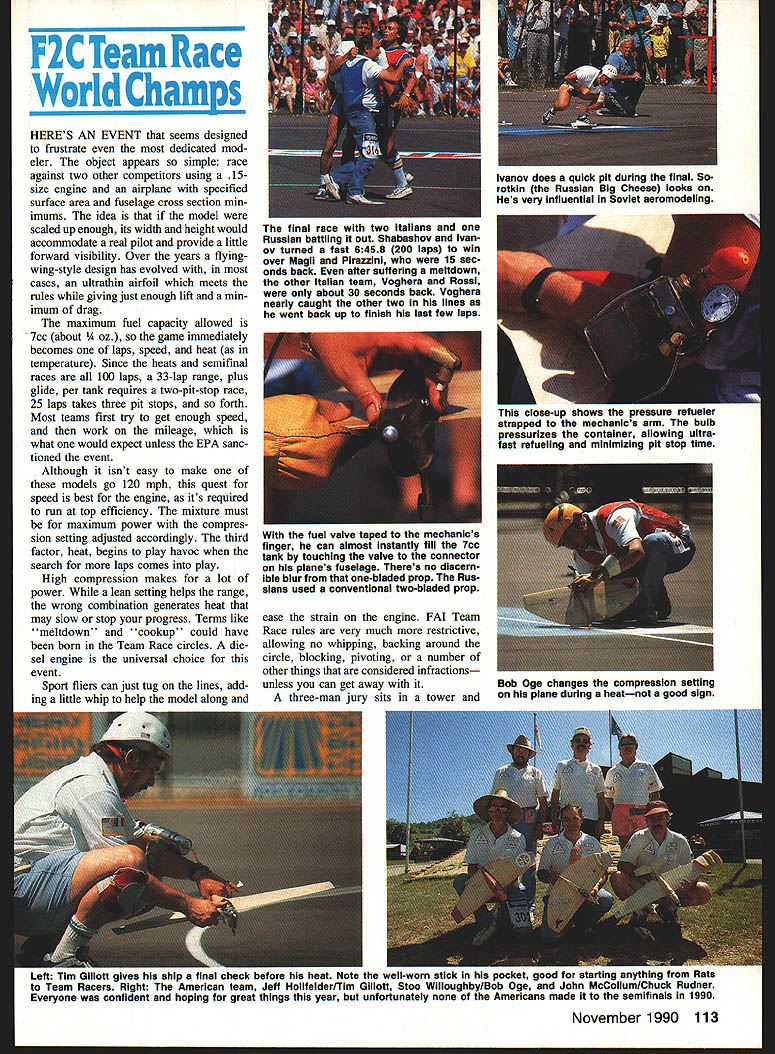
Pit technique is critical: fast refueling (pressure refuelers with a bulb) and taped fuel valves allowing near‑instant filling of the 7 cc tank minimize pit time. Some teams use one‑bladed props (notably some Soviet teams) versus conventional two‑blade props.
Rules and penalties
- FAI Team Race rules are restrictive. Forbidden actions include:
- Whipping the lines (sport fliers may tug/whip, but FAI forbids it)
- Backing around the circle
- Blocking
- Pivoting
- Other maneuvers deemed infractions
- Jury: a three‑person jury sits in a tower and monitors pilots and pitmen.
- Teams may receive two warnings; the third foul leads to disqualification.
- Warnings and occasional disqualifications are a consistent feature of top events.
Notable incidents and history
- 1976 Holland meet: the jury was merciless in the morning session, disqualifying many contestants. Complaints and an unruly afternoon session followed. One memorable case involved Paul Bugi, who whipped extensively for about 10 hot laps; a yellow warning light in the jury tower failed to come on, and the next day the jury was replaced. In later years the jury has become more consistent, though still strict.
- Weather can upset even the best preparations. One event saw a sudden change in conditions at race start: taped air inlets used to keep engines hot had to be opened, starting procedures changed, and lap counts fell. Many teams found that settings that worked in practice failed in the race.
- Finals example: Shabashov and Ivanov (Soviet team) won a 200‑lap final in 6:45.8. Magli and Pirazzini (Italy) finished about 15 seconds back after suffering a meltdown. Voghera and Rossi (Italy) were roughly 30 seconds behind; in the closing laps Voghera nearly caught the leaders when a line came back up and eased engine strain.
- Recent American results:
- In one championship the U.S. team finished 11th among teams from 18 countries.
- In 1990 the Americans missed the semifinals.
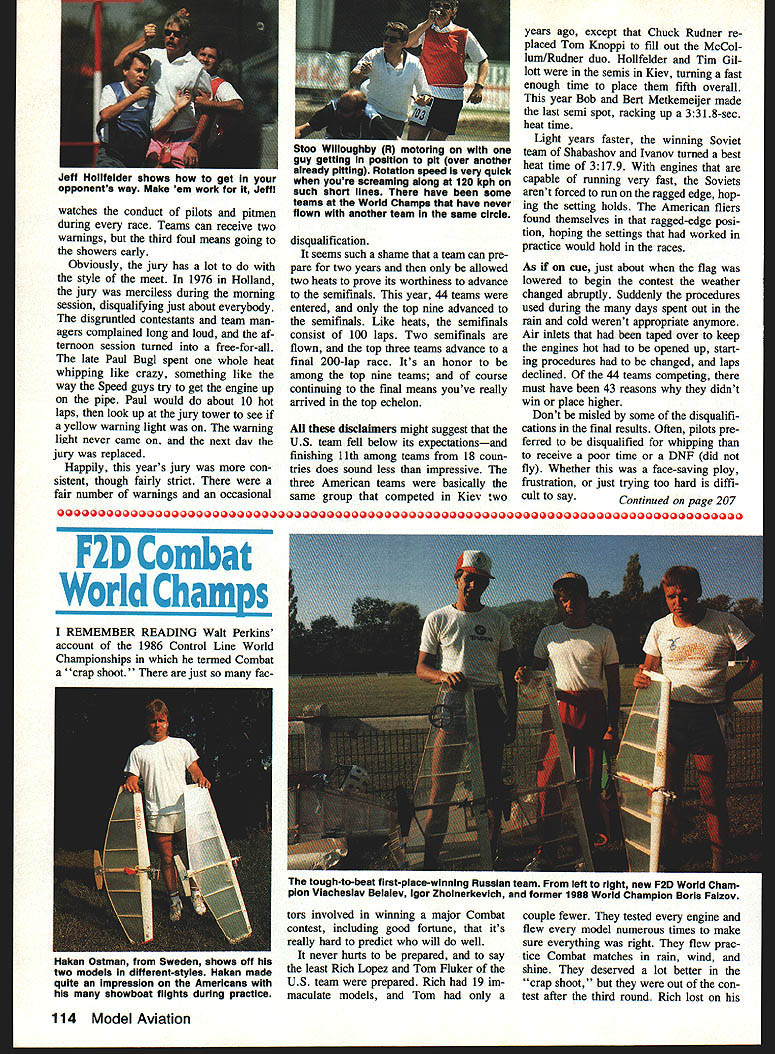
- U.S. teams have sometimes had lineup changes (for example, Chuck Rudner replacing Tom Knopp to team with McCollum).
Pit crew practice and equipment
- Pressure refuelers with a squeeze bulb allow ultra‑fast refueling and reduce pit stop time.
- Mechanics often tape the fuel valve to a finger so the refueler can be applied almost instantly to the plane’s connector.
- Quick compression changes and last‑minute checks are part of the routine between heats.
Final notes
F2C Team Race rewards precision in design, tuning, pit work, and discipline under pressure. Fast engines that can be tuned conservatively for stability, efficient pit crews, and strict adherence to FAI rules are the hallmarks of championship teams.
Transcribed from original scans by AI. Minor OCR errors may remain.

