
F2D Combat World Champs
I remember reading Walt Perkins' account of the 1986 Control Line World Championships in which he termed Combat a "crap shoot." There are just so many factors involved in winning a major Combat contest — including good fortune — that it's really hard to predict who will do well.
U.S. team preparation
The U.S. team arrived well prepared. Key members:
- Rich Lopez — brought 19 immaculate models, tested every engine, and flew each model numerous times.
- Tom Fluker — nearly as many models as Rich; also tested engines and practiced extensively.
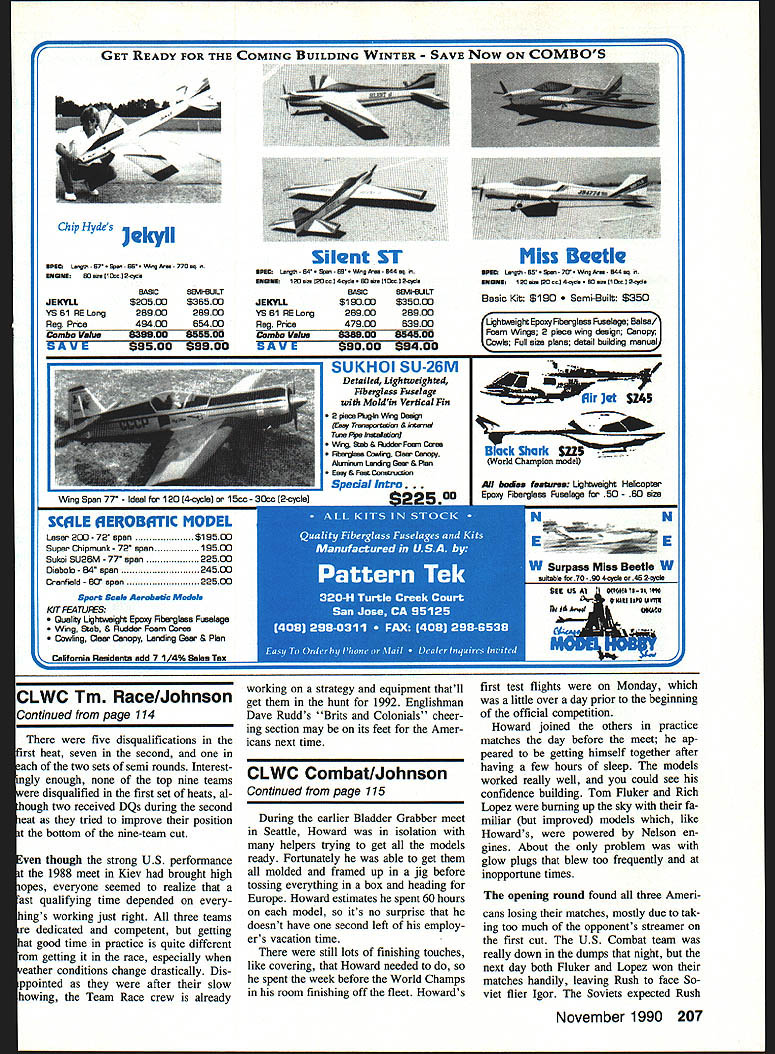
- Howard Rush — spent over six months developing high‑tech models using carbon fiber, Kevlar, foam, and a carbon‑fiber minipipe. About two months before the meet he had to decide whether to continue with the new designs or revert to his standard "Rush Puppies"; he chose the new tech and later regretted that decision.
They flew practice Combat matches in rain, wind, and shine. Despite their preparation, luck did not favor them: both Rich and Tom were eliminated by the third round. Rich lost on his second model; Tom had some help from his pitman. A recurring joke among the Flukers was that they had removed the "cyanide tablets" from the pit box—humorously implying how tense the situation could be.
Contest format
- 44 teams entered.
- Heats were used to select the top nine teams to advance to the semifinals.
- Semifinals: two heats of 100 laps each; the top three teams from the semifinals advanced to the final.
- Final: a 200‑lap race.
Advancing to the top nine and on to the final is a major honor — it means you've arrived in the top echelon of the sport.
Weather, engines, and reliability
Several factors affected results beyond pilot skill:
- Many Soviet engines were capable of running very fast and consistently. Soviet fliers generally did not have to run the ragged edge of tuning; their settings would hold in the races.
- American fliers often had to run at the ragged edge, hoping that settings that worked in practice would hold during contest flights.
- As contests were about to begin the weather sometimes changed abruptly. Procedures used during cold, rainy practice sessions (for example, taping air inlets to keep engines hot) had to be reversed for warmer conditions; starting procedures changed and lap speeds frequently declined.
- With 44 teams competing, there were many small reasons — mechanical, tactical, or luck‑based — for teams not to place higher.
Don't be misled by disqualifications in the final results. Often pilots preferred to be disqualified rather than take a poor time (DNF) after being whipped; whether that was a face‑saving ploy, frustration, or simply trying too hard is difficult to say.
Tactics and aircraft design
Combat tactics varied by model design and national style:
- Soviet‑style models tended to be rugged, fast, and suited to aggressive tactics. If you could remove an opponent's entire streamer early, you could then go after the opponent's aircraft and create long delays on the ground.
- A massy, durable model could scrub off speed in contact and be used defensively. If a flier using a Soviet‑style model had a big lead after removing a streamer, he could "whack" the opponent’s spare and often end the match decisively.
- This style can seem brutal and unsportsmanlike to those who favor fragile, highly optimized models. But in high‑level Combat, fragile models can be turned into confetti by aggressive opponents.
- British star Mike Whillance picked up the nickname "Whacker Whillance" for his aggressive style.
Many competitors used Soviet "kits." For example, second‑place finisher Mervyn Jones used kits he had acquired in Leningrad and fitted rear‑intake Nelson engines, compromising the leading‑edge spar to balance the model correctly. The combination of robust design and appropriate tactics often gave Soviet designs the percentages on their side.
Results and highlights
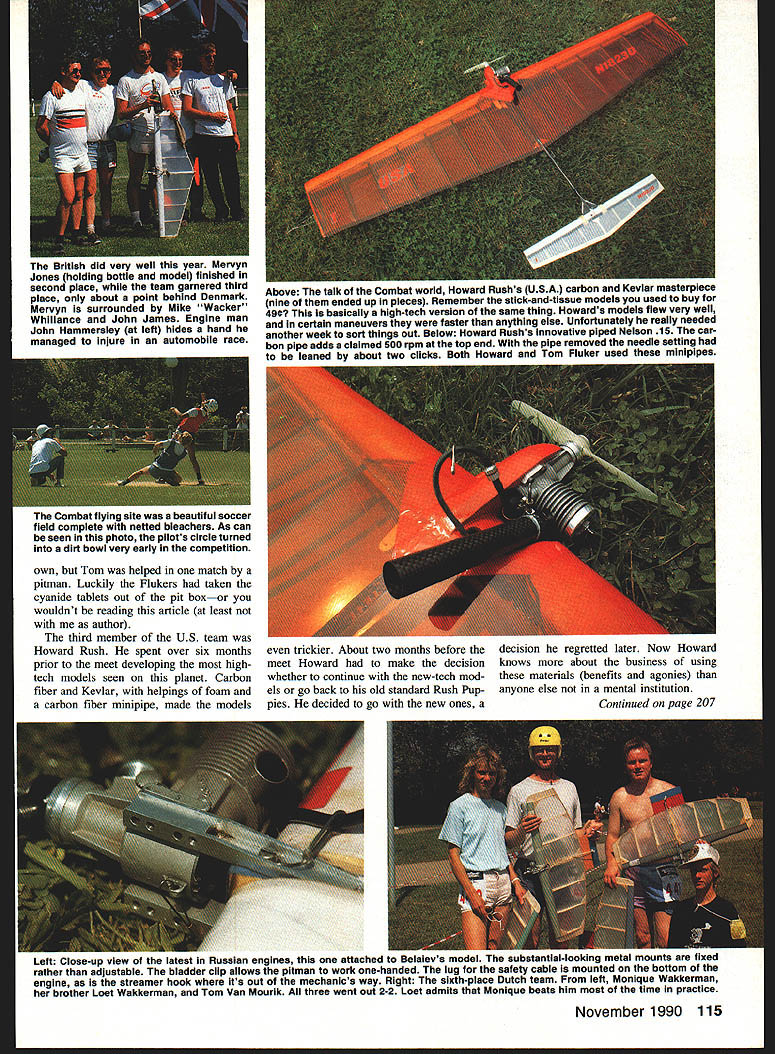
- The winning Soviet team included Viacheslav Beiaiev (the new F2D World Champion), Igor Zhovnerkevich, and former champion Boris Faizov.
- Other Soviet fliers also turned impressive times: one Soviet pairing (Shabashov and Ivanov) recorded the best heat time at 31.79 seconds.
- The British did very well overall. Mervyn Jones finished second individually; his team placed third, about a point behind Denmark. Team members mentioned around the contest included Mike Wacker and engine man John Hammerley. Mervyn managed to injure his hand in an unrelated automobile incident but still performed strongly.
- Outstanding fliers from other countries also showed top form: Henning Forbech and Bjarne Schou from Denmark, Håkan Östman from Sweden, and Roland Förstner from Germany were among the notable names. The Soviets showed the greatest depth of talent, but many European teams were extremely strong.
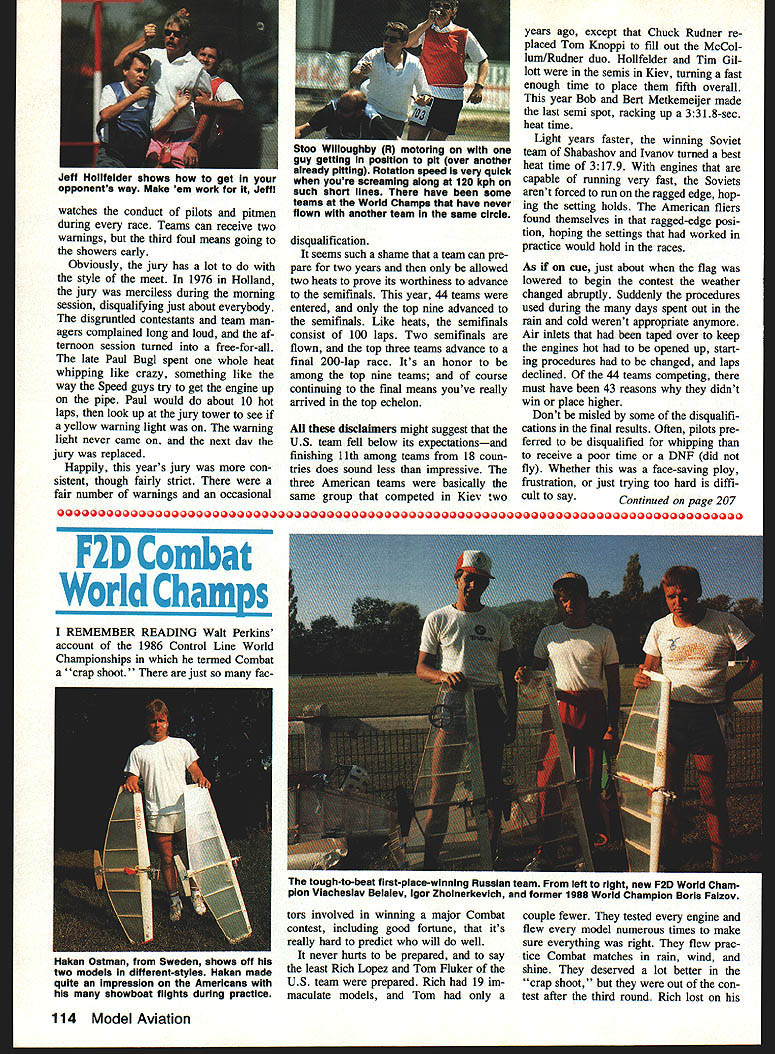
The Combat flying site was a beautiful soccer field with netted bleachers; the pilots' circle turned into a dirt bowl early in the competition. Pilots often showboated during practice, and there were many memorable moments and photographs.
Match drama and closing thoughts
Elimination matches can drag on and produce dramatic upsets. The eventual winner, Viacheslav Beiaiev, probably deserved the title more than anyone else on the field. Mervyn Jones had particularly bad luck in his match with Beiaiev: after an exchange of cuts and kills, Jones would have won by flying around and getting air time, but he suffered two models crashing on their own because the control horn came loose while airborne.
Predicting the next World Champion? Not a chance — Combat is a "crap shoot." Preparation helps, but so do luck, conditions, tactics, and reliability.
Transcribed from original scans by AI. Minor OCR errors may remain.

