
F3A Aerobatics: World Champs
By Paul Verger
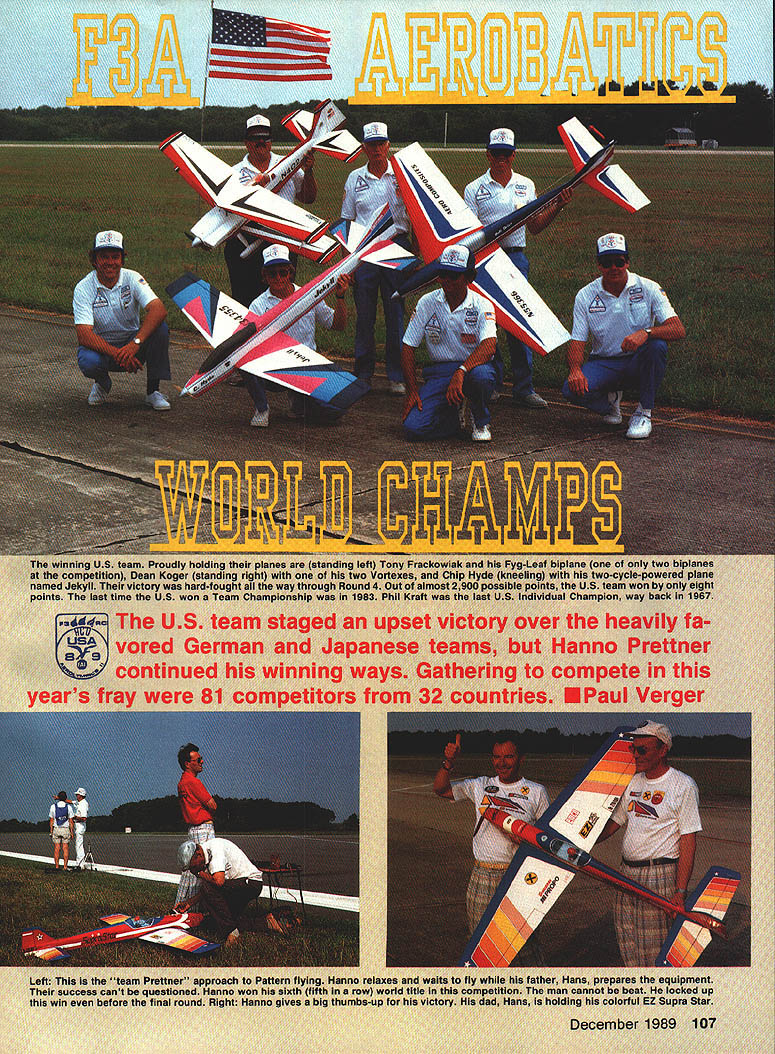
The U.S. team staged an upset victory over the heavily favored German and Japanese teams, while Hanno Prettner continued his winning ways. A total of 81 competitors from 32 countries gathered to compete.
Background: turnaround patterns and the U.S. response
It seems the U.S.A. has been out of step with the rest of the RC aerobatics world ever since the advent of the turnaround pattern. At the last non-turnaround F3A World Championships, held in Pensacola, FL in 1983, teams were similar in style and the U.S.A. was right in sync with the world.
At the first turnaround World Championships in 1985, the U.S. team discovered the judges favored a fast, loud, and wide-open style—very different from the quiet, box-honoring turnaround the Americans preferred. In 1987 the U.S. prepared for a wide-open pattern but judges favored a low-and-slow approach instead, penalizing flights beyond about 160 meters.
By the 1989 F3A World Championships the U.S. team had finished second-guessing and fielded pilots ready for any style.
U.S. team and equipment
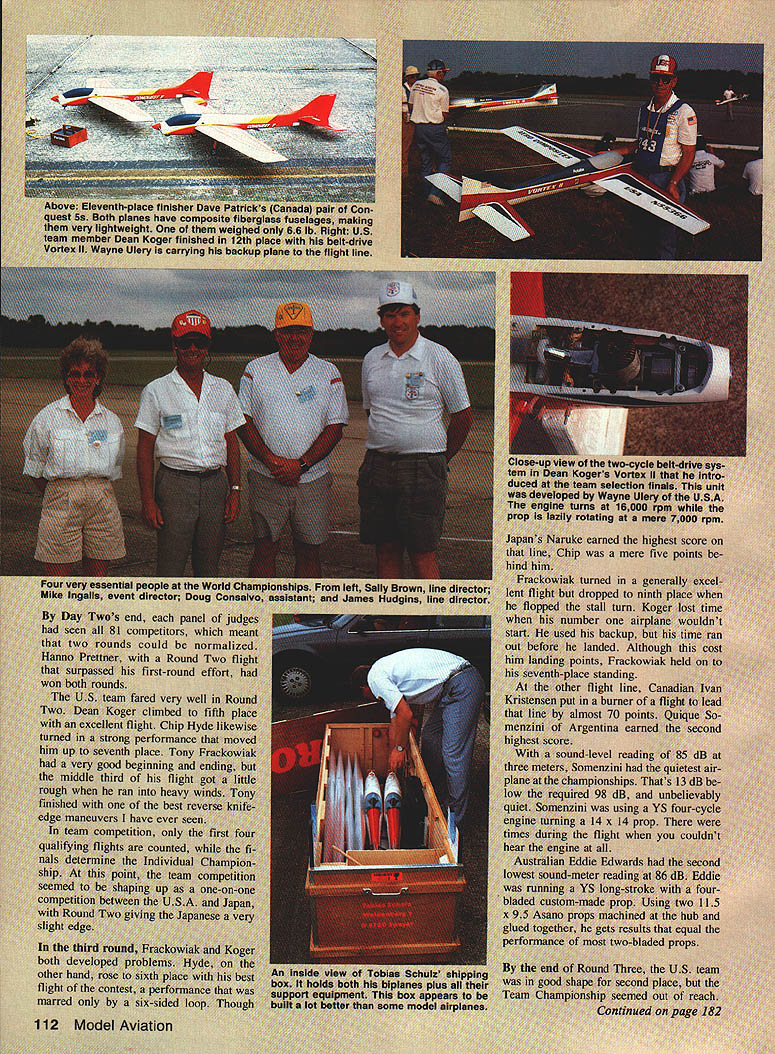
- Dean Koger: A second-timer on the team (first flew in 1979), flying a very powerful belt-drive unit. Suited to a larger pattern around 175 meters but flexible for smaller patterns.
- Tony Frackowiak: Four-time U.S. team member flying a true biplane. His close-in, crisp style and smaller maneuvers served him well; he won the U.S. team selection finals.
- Chip Hyde: A second-timer flying a conventional two-cycle-powered monoplane. His airplane allowed flexibility for smaller patterns; his natural style leans toward close-in, modest-sized maneuvers.
Practice and flying styles
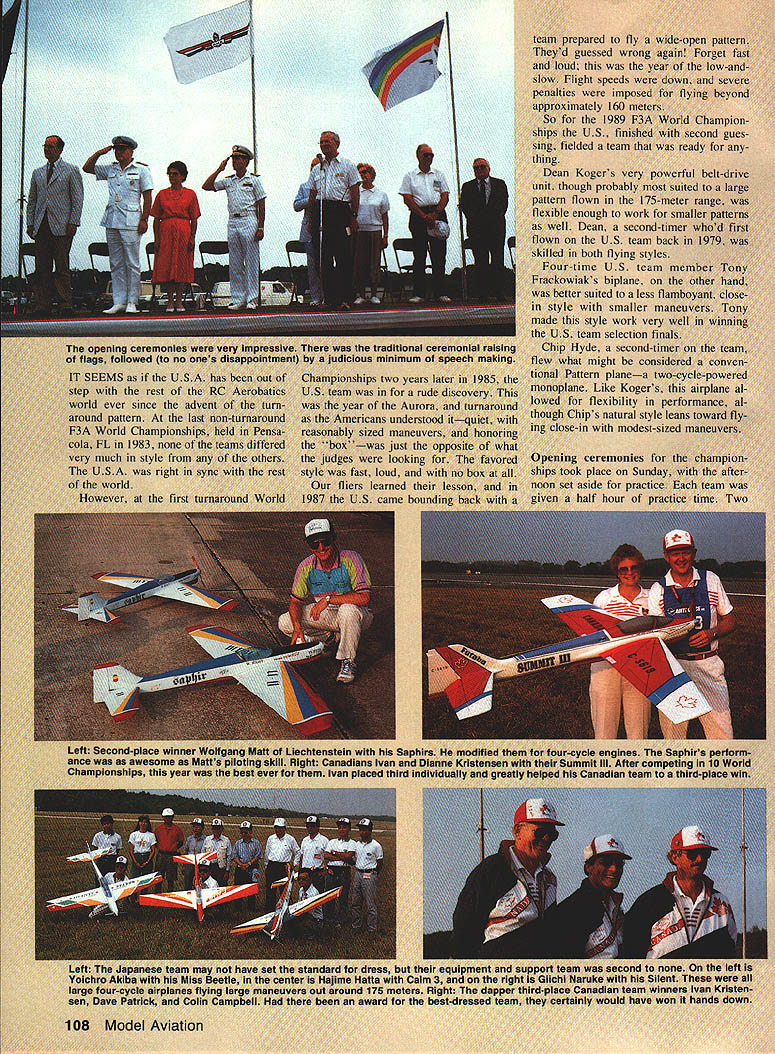
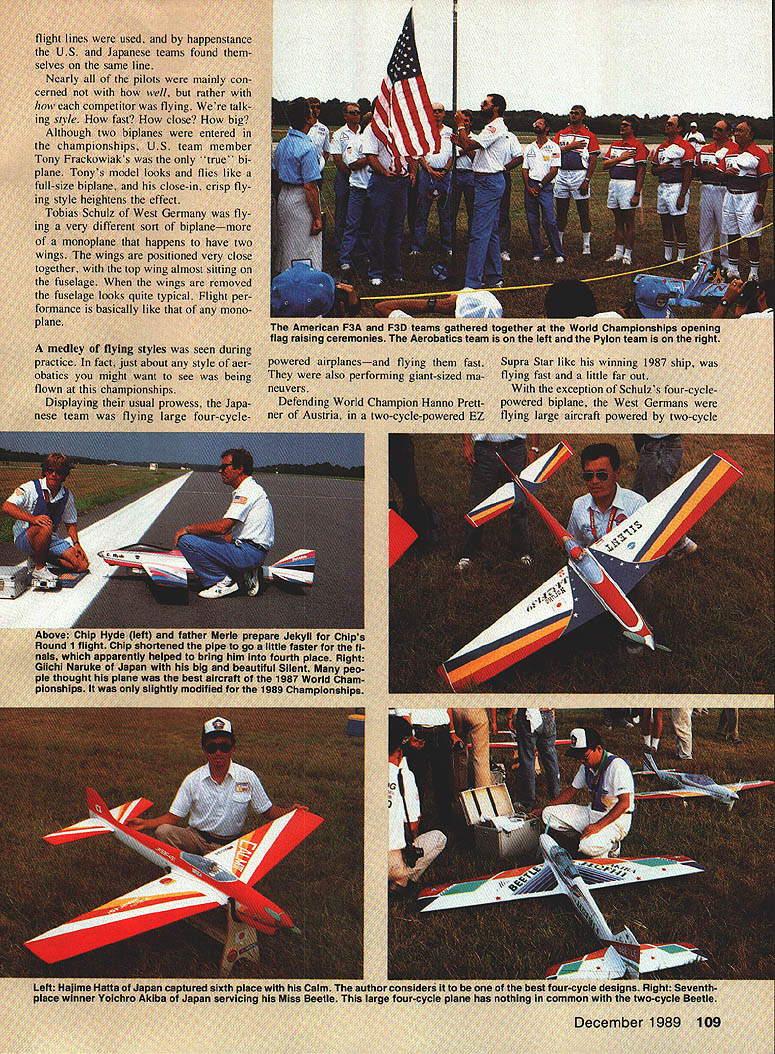
Opening ceremonies were on Sunday, with the afternoon set aside for practice. Each team had a half-hour of practice time. Flight lines were used; by chance the U.S. and Japanese teams were on the same line.
Nearly all pilots were watching style—how fast, how close, how big. A medley of styles appeared during practice:
- Tony Frackowiak’s biplane looked and flew like a full-size biplane, emphasizing close-in, crisp flying.
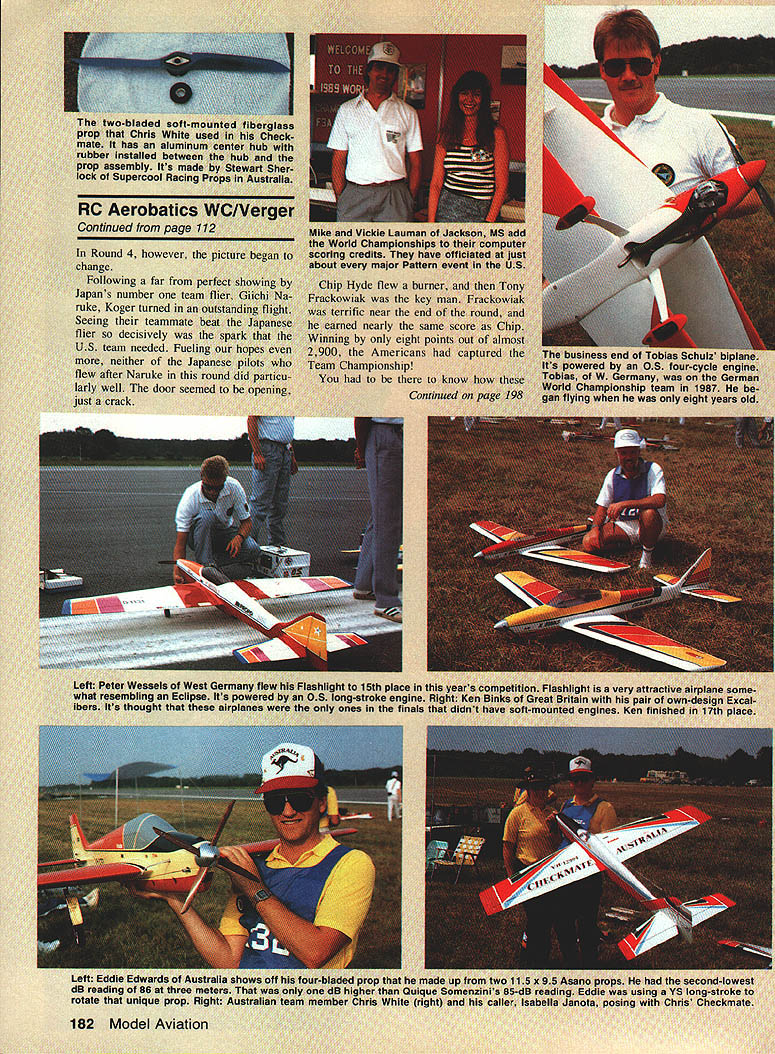
- Tobias Schulz of West Germany flew a biplane that behaved more like a monoplane—the wings were close together and top wing nearly sat on the fuselage.
- The Japanese team flew large, four-cycle-powered airplanes fast, performing giant-sized maneuvers.
- Defending champion Hanno Prettner (Austria) flew a two-cycle-powered EZ Supra Star similar to his 1987 ship—fast and a little far out.
- West Germans, except Schulz’s four-cycle biplane, flew large aircraft powered by two-cycle engines.
Rounds 1–3: early competition
Round 1 produced several excellent flights, but results were not yet conclusive because judging panels had seen only one of two lines; normalization awaited completion of both lines.
- Prettner led the field, flying at 175–200 meters; his aircraft sounded quiet at a distance.
- Tony Frackowiak earned the best U.S. flight in Round 1 (seventh place), though the author felt he should have scored higher.
- Dean Koger had a solid flight (ninth), slightly hurt by getting too close near the end.
- Chip Hyde’s performance was marred by unusually strong wind gusts.
- Japanese fliers placed third, fourth, and eighth in Round 1; West Germans and Canadians also looked strong.
By Day Two’s end each judging panel had seen all 81 competitors, allowing normalization of two rounds. Prettner won both rounds, improving in Round Two.
- Dean Koger climbed to fifth after an excellent Round Two.
- Chip Hyde moved into seventh.
- Tony Frackowiak had a strong start and finish in Round Two but struggled in the middle with heavy winds; he finished with an outstanding reverse knife-edge.
In team scoring, only the first four qualifying flights count; finals determine the individual World Championship. After two rounds the team competition appeared to be a U.S.A. vs. Japan duel, with Japan holding a slight edge.
In Round Three, Frackowiak and Koger had problems while Hyde produced his best flight of the contest, moving to sixth despite a six-sided loop error. Naruke (Japan) earned the highest score on that line; Chip was five points behind.
At the other line, Canadian Ivan Kristensen led by almost 70 points with a standout flight; Quique Somenzini (Argentina) posted the second-highest score.
Sound readings:
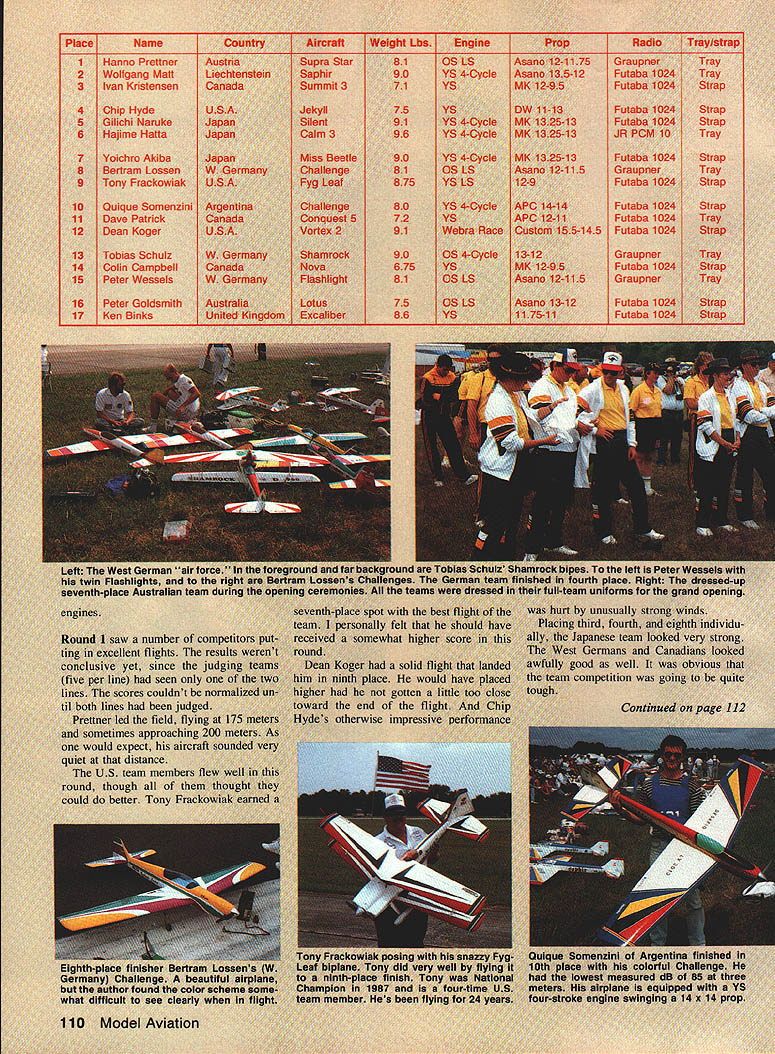
- Quique Somenzini: 85 dB at three meters—the quietest airplane at the championships (13 dB below the required 98 dB). He used a YS four-cycle engine with a 14 x 14 prop; sometimes the engine was inaudible.
- Eddie Edwards (Australia): 86 dB, running a YS long-stroke engine with a four-bladed custom prop (two 11.5 x 9.5 Aazon props machined at the hub and glued together).
By the end of Round Three the U.S. was in good shape for second place, but the Team Championship looked out of reach.
Round 4 and the U.S. team victory
Round 4 changed the picture. After a poor showing by Japan’s number-one flier Giichi Naruke, Dean Koger turned in an outstanding flight. Seeing their teammate beat the Japanese flier decisively energized the U.S. team. Subsequent Japanese pilots in that round did not perform well.
Chip Hyde flew a burner, and Tony Frackowiak delivered a terrific finish, earning nearly the same score as Chip. By a margin of only eight points out of almost 2,900, the Americans captured the Team Championship.
Closing the F3A individual finals
Friday was set aside as a practice day (a judges/staff day off) and to allow competitors to sightsee. Louis Levine of GP Aircraft organized a trade show at the headquarters hotel Friday night. Several manufacturers and distributors displayed products.
With the team competition complete, the top 17 scorers advanced to the individual finals. In the finals everyone seemed sluggish—possibly nerves or wind. Dean Koger suffered his first flameout in years, putting pressure on him for the remaining rounds. Even Hanno Prettner won the first final round by only a small margin.
After Round 1, Chip and Merle Hyde adjusted Chip’s prop and shortened the pipe to increase vertical speed. The change worked—Chip moved up and ousted Naruke from the number four slot.
There was little movement in the final standings. Hanno Prettner had locked up the win before the last round; Wolfgang Matt moved up to take second from Ivan Kristensen.
Results and observations
- Hanno Prettner won the individual World Championship—his sixth world title and fifth in a row.
- In the top 10 placings, there were five two-cycle and five four-cycle powered airplanes. In the top three, first and third places were two-cycle powered.
- Four-cycles impressed with power and performance, but two-cycles also performed quietly and powerfully. Placings did not appear to be determined by engine type.
- The dominant flying style at the championships favored fairly high speed and large maneuvers at about 160–180 meters. That said, pilots flying at about 150 meters with less speed and slightly smaller maneuvers could score equally well. Judges scored flights between 140 and 180 meters without downgrading or giving unwritten bonuses for being very close.
- The judges’ open-minded approach allowed pilots to express individual style rather than forcing a single mold—an encouraging trend.
The author praised the U.S. team—Koger, Hyde, and Frackowiak—for hard work and gumption. Each flew better than at team selection finals, and the hard work paid off.
The next F3A World Championships will be held in Italy in 1991. Start practicing!
---
Pylon Racing (F3D): World Champs
The final heats and the flyoff
You had to be there to know how these were really racing, and it wouldn't be finalized until the last heat. Bruce de Chastel was in good shape but couldn't afford mistakes—one little cut would drop him from the top three. Shadel couldn't push too hard because he already had two cut scores. Richmond also had two bad scores (a poor engine run and a zero).
Dub Jett was in the driver's seat. His worst score so far was 1:17.6; he could double cut without much harm, so the others waited for him to push. In Round 10 he did cut once, scoring 1:20.0 with penalty; as it was his worst score, it was dropped and an earlier dropped score of 1:17.4 was reinstated.
The final day started clear with a pleasant breeze. Bruce de Chastel, in the fourth heat, aimed to pressure the Americans but turned in 1:17.3 when he needed about 1:13 to challenge for gold (he had recorded such a time in Round 9). Richmond followed with 1:17.4 (no improvement). Jett posted 1:16.6, keeping him in contention. Shadel recorded 1:18.6. Standings after Round 11:
- Shadel: 6832 points
- Bruce de Chastel: 6844
- Jett: 6870
- Richmond: 6931
- Hover: 7026
De Chastel made a big leap in the team standings: the U.S. still led overall, Australia moved to second, the U.K. third.
Round 12 tightened the race. Shadel ran his best under pressure with 1:14.3. Jett followed with 1:14.0. Richmond posted 1:14.9. De Chastel was slightly off with 1:16.6.
After scoring, there was a dead tie for second place between de Chastel and Jett—both with 7610 points. Shadel was World Champion for the second time with 7575 points, winning by 3.5 seconds over the pair. (When he won in Australia two years earlier his margin was only 0.8 seconds.)
A one-heat flyoff was needed for second place. Because de Chastel and Jett were on the same frequency, one changed after a coin flip (Jett lost and changed). They agreed on a racehorse start—taking off together and turning a lap together. Jett hugged very tight on the second lap with de Chastel on his tail. On the third turn de Chastel suddenly dove into the ground, destroying his plane and any chance at second. He indicated the plane was in the ground before he knew why; he could only conclude either the other plane was too fast or there was turbulence. Racing at pylon height leaves no room for error.
Final standings (top 10, individual)
- 1st: Dave Shadel — 7575 points (World Champion)
- 2nd: Dub Jett — 7610
- 3rd: Bruce de Chastel — 7610
- 4th: Bruce Richmond (USA)
- 5th: Gary Hover (USA)
- 6th: Zdenek Hnizdil (Czechoslovakia)
- 7th: Jan Hajek (Australia)
- 8th: Nobuyuki Chujo (Japan)
- 9th: Ernst Watschcek (Austria)
- 10th: Jaroslav Danes (Czechoslovakia)
Team championship (pylon)
- 1st: United States — 2323.0 points
- 2nd: Australia — 2474.7 points
- 3rd: Japan — 2627.0 points
Closing and anecdotes
At the closing ceremonies the author had the privilege of hanging medals around the winners' necks. A few champagne squirts marked the end of competition.
There were aggravations—expected given the intensity—but also memorable moments. The Belgians, for example, endured every possible mishap yet never lost their composure. Individually, Al Baker (Canada) had a rough time with eight zeros out of 12 rounds and two lost planes. As a team the Belgians were a sight: zeros for every reason, yet they were having fun. One afternoon all three Belgian pilots were in porta-johns, each holding the door open with his airplane in his lap while the team manager took pictures—symbolic of their luck. The next day they were changing a flat tire on their rental car, still in good spirits. Moments like those made the author’s work as Pylon director worthwhile.
The starter (the author’s wife Karen) and the author were already talking about the next event in Italy in 1991. Start saving those pennies!
Transcribed from original scans by AI. Minor OCR errors may remain.

