
F3A Judging School
Background
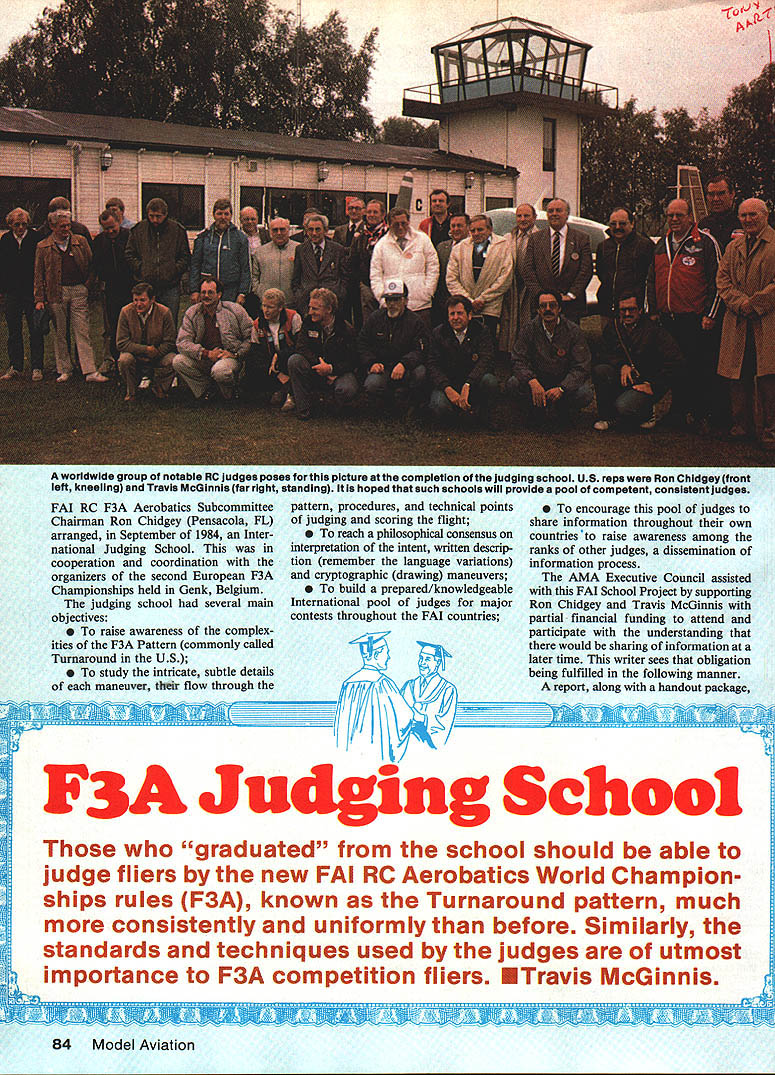
FAI RC F3A Aerobatics Subcommittee Chairman Ron Chidgey (Pensacola, FL) arranged, in September 1984, an International Judging School in cooperation with the organizers of the second European F3A Championships held in Genk, Belgium. The judging school took place in the conference rooms of Hangelhof Recreation Center, Genk. Thirty-five participants representing about 18 FAI countries attended.
The AMA Executive Council assisted with the FAI school project by partially funding Ron Chidgey and Travis McGinnis to attend and participate, with the understanding that information would be shared afterwards.
Objectives
The judging school had several main objectives:
- Raise awareness of the complexities of the F3A pattern (commonly called “turnaround” in the U.S.).
- Study the intricate, subtle details of each maneuver, their flow through the pattern, procedures, and technical points of judging and scoring the flight.
- Reach a philosophical consensus on interpretation of intent, written descriptions (accounting for language variations) and cryptographic (drawing) maneuvers.
- Build a prepared, knowledgeable international pool of judges for major contests throughout FAI countries.
- Encourage judges to share information within their own countries to raise awareness and disseminate best practices.
Materials and Distribution
Handout packages were prepared and distributed to council members. These included:
- Large 8-1/2 × 11-inch drawings of F3A maneuvers suitable for slides and overhead projection transparencies.
- An outline for conducting judge-training sessions.
- Written descriptions of maneuvers and judging standards/techniques presented at the FAI session.
A report and the handout package were presented at the October 1984 AMA Executive Council meeting. District vice-presidents have copies available for those wishing to conduct judge training classes. Because the document set is substantial, interested persons were asked to send $2–$3 to assist with copying and postage.
Organization and Thanks
Prior to the school, considerable organizational work ensured that housing, meals, facilities, and registration went smoothly. Much credit is due to Mrs. Gerda Michiels, secretary of the European Championships. The USPJA provided “Love a Judge” pins for participants; more pins were ordered and sent to those who missed out. Thanks for the pins go to USPJA President Howard Crispin and to Suzi Stream.
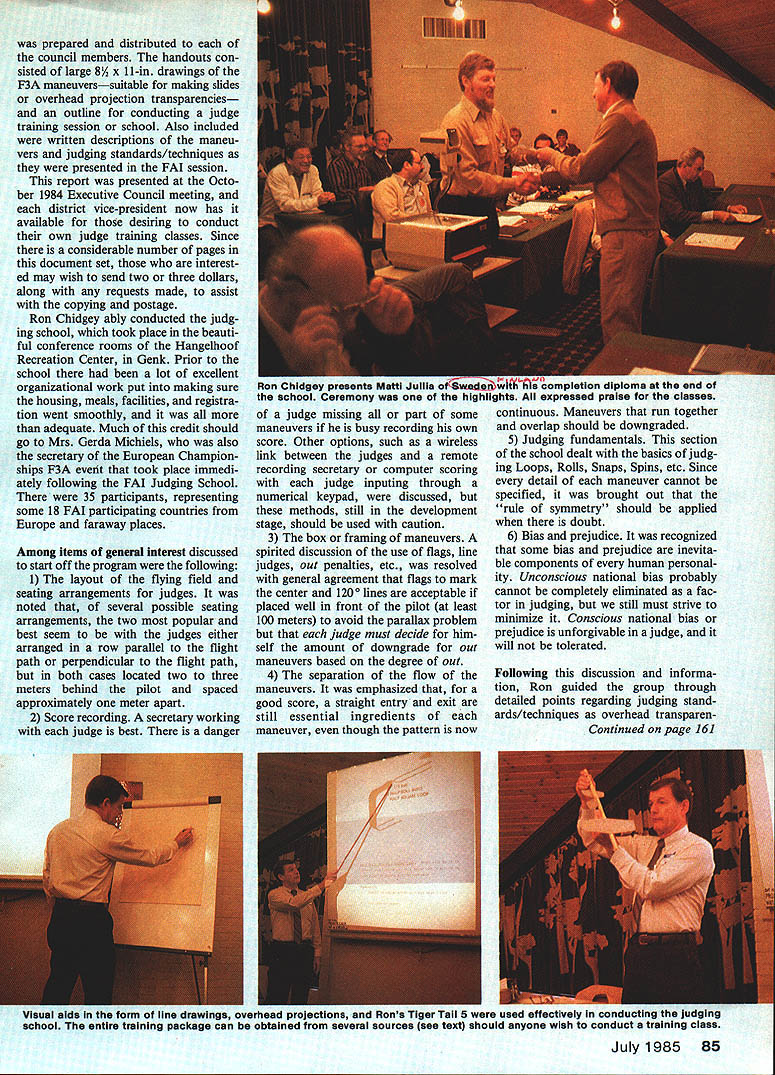
A formal presentation of completion diplomas was made by Ron Chidgey at the end of the school.
General discussion topics and recommendations
- Layout of the flying field and seating arrangements for judges
- Two popular arrangements: judges in a row parallel to the flight path, or judges arranged perpendicular to the flight path.
- In both cases, judges should be located 2–3 meters behind the pilot and spaced approximately 1 meter apart.
- Score recording
- A dedicated recording secretary working for the judges is preferred to avoid judges missing parts of maneuvers while recording.
- Other options discussed: wireless links to a remote recording secretary or computer scoring with judge input via numeric keypad. These methods are still developing and should be used with caution.
- Box framing of maneuvers
- Flags to mark the center line are acceptable; flags should be placed well in front of the pilot (at least 100 meters) to avoid parallax problems.
- The judge must decide the degree of downgrade for an out-of-box maneuver based on how far out it is.
- Separation and flow of maneuvers
- Good score depends on straight entries/exits and overall flow; maneuvers that run together or overlap should be downgraded.
- Judging fundamentals
- Basics of judging loops, rolls, snaps, spins, etc., were reviewed.
- Since detailed form of each maneuver cannot be fully specified, apply the rule of symmetry in case of doubt.
- Bias and prejudice
- Some unconscious bias may be inevitable, but judges must strive to minimize it.
- Conscious national bias or prejudice is unacceptable and will not be tolerated.
Maneuver clarifications and specific judging points
- Track vs. attitude during vertical maneuvers
- Track is most important. In wind, attitude must be adjusted so the plane’s track matches the intended maneuver; the vertical up- or down-path should remain vertical as viewed.
- Stall Turn
- A Stall Turn must be an actual stall pivot, not flown over the top. The nose should exchange places with the tail, with the vertical down-path as near the vertical up-path as possible.
- Ribbon drawings and vertical stalls
- Some ribbon drawings in the rule book depicting vertical stalls are not technically correct because they suggest flying over the top rather than pivoting about the yaw axis. Pivoting around the yaw axis scores highest.
- Outside loops
- Excessive straight flight following a half roll can effectively create two maneuvers from one and should be downgraded.
- Top Hat
- The Top Hat is a square maneuver: vertical and horizontal legs should be equal in length.
- Top Hat with four rolls
- This is a wind-correction maneuver. The length of the top is the pilot’s option, but it should be long enough to establish straight, level inverted flight.
- Six-Sided Loop
- The angles are 60° (not 45°); 60° angles appear quite steep.
- Double Immelmann
- The straight flight on top should not be prolonged and is now defined as being equal to the diameter of the half loops.
- Two Rolls in Opposite Direction
- The pause between the rolls should be very brief—just long enough for the judge to observe it if the wings stop level.
- Inverted Three-Turn Spin
- The spin should end with an established vertical down-line as rotation stops. A fully stalled rotation scores highest; rotating on aileron alone should be downgraded.
Training methods
- It is highly desirable during pilot and judge training to use large drawings or overhead projection so maneuvers can be dissected part-by-part and fully discussed.
Closing
Copies of the drawings and materials will be available through the USPJA Newsletter (Points) and via the AMA district vice-presidents. Additional pins and diplomas were distributed as noted above.
Transcribed from original scans by AI. Minor OCR errors may remain.

