
F3A Pattern World Championships
Tony Stillman
The USA F3A team, with reigning World Champion Chip Hyde, left Chicago on September 12, 1993, and headed for Regensburg, Germany. Several Regensburg Model Club members met us at the airport, helped us find our hotel, and took us to the local flying field, which they had reserved as a practice site for us.
Practice in Regensburg
The practice site was very nice. The runway hard surface was about 100 meters long and six meters wide, with grass all around. It was in the middle of a farm area that provided wide-open flying. They had even installed box poles for us.
Since club members were not allowed to fly during the week, we had the place to ourselves. This allowed ample time to adjust engines and aircraft to Europe's lower temperatures. Everyone had lots of time to practice, and it paid off during the contest.
The club also made their soft-drink–stocked clubhouse available to us. I would like to thank the club and Stephan Fink and Peter Lessner for taking such good care of us.
We practiced from Monday through Thursday and left on Thursday afternoon for Austria. Before we left, the club members had a cookout in our honor at the field clubhouse. A very tasty meal was served, and we felt right at home with our new friends.
Contest site and schedule
Upon arrival in Austria, we checked into the hotel and then proceeded to the contest site. This field is in the village of Notch (situated in a picturesque valley) and is used as a glider tow field: all grass, about 800 meters long and 100 meters wide.
Two flying sites were set up—one at each end of the runway. I learned a lot about what can happen at a World Championship; I had preconceived ideas about what a World Championship site should be like. The team was not impressed with the site.
- Site one seemed OK.
- Site two was very different: the pilots faced a mountain when flying, and the background was rather dark. Many felt it would make the models hard to see. This did prove to be a problem.
Site one had a better background to fly against, but the left-hand box pole could not be located 150 meters out, as per the rule book. It was placed at 80 meters and the judges were instructed to judge that end much softer.
Another surprise was due to the large turnout in F3D. We were sharing our site with Pylon; they were to start flying at 7 a.m. and we were to start flying at 11 a.m. Because there were so many F3D pilots, Pylon needed more time than originally scheduled.
F3A had a Friday "rain day" which management elected to remove and use for the pylon. The schedule was reshuffled so the pylon would start on Monday; this allowed Pylon two rounds on Monday and two rounds per day thereafter, and the start time was changed from 11 a.m. to 10 a.m. for the rest of the week. The change gave us enough time to finish the day's flying, but the removal of the rain day later proved to cause problems for the finals.
Opening ceremonies and additional practice
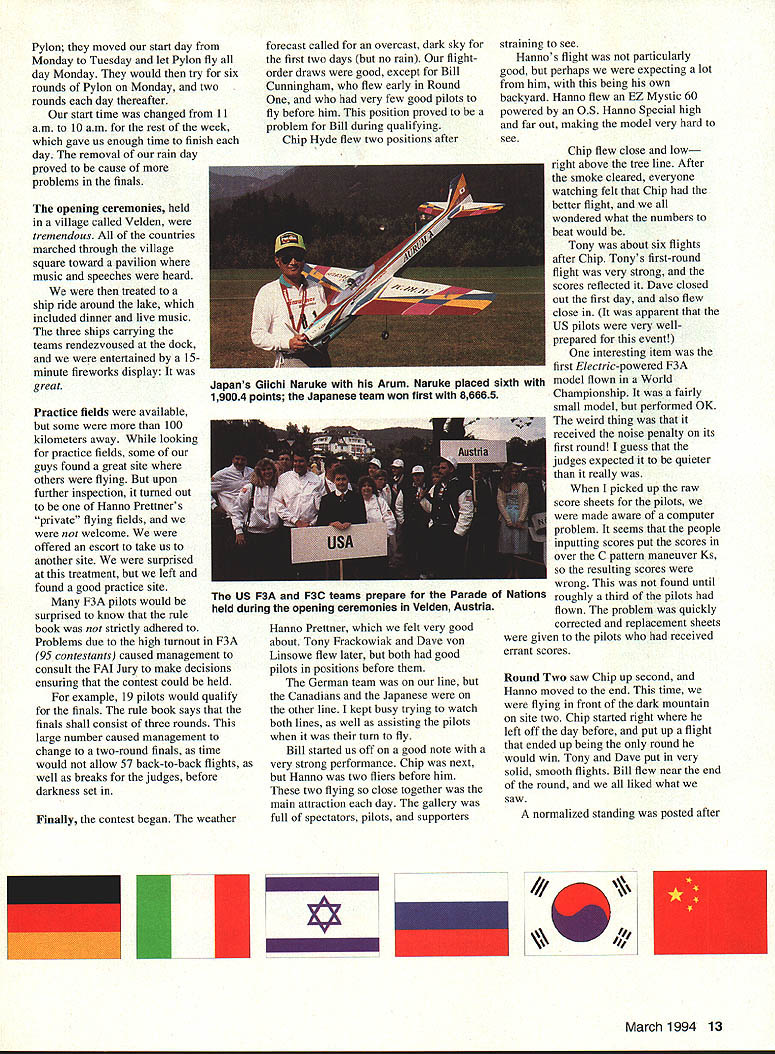
The opening ceremonies were held in the village called Velden. Teams from many countries marched through the village square toward the pavilion. Music and speeches were heard, and we were treated to a ship ride around the lake that included dinner and live music. Three ships carrying teams rendezvoused at the dock and were entertained, and there was a 15-minute fireworks display.
Practice fields were available some 100 kilometers away. While looking for practice fields, some of us found excellent sites; others discovered the private flying fields of Hanno Prettner. Hanno welcomed us and offered to escort us to another site, and we were surprised and pleased by the treatment.
Rules, turnout, and contest format
F3A pilots would be surprised to know how strictly the rule book is adhered to. Problems due to the high turnout—95 contestants—caused management to consult the FAI Jury to make decisions that would ensure the contest could be held. For example, 19 pilots would have qualified for the finals; the rule book says finals shall consist of three rounds. This large number caused management to change to two-round finals so the time would allow 57 back-to-back flights as well as breaks for the judges before darkness set.
Finally the contest began. The weather forecast called for overcast, dark skies the first two days but no rain. The flight-order draws were generally good, although some early positions proved difficult for top pilots. The first rounds provided strong performances and set the tone for an intense and closely contested championship.
The US team and flight order
Our flight-order draws were generally good, except for Bill Cunningham, who flew early in Round One and had very few good pilots to fly before him. This position proved to be a problem for Bill during qualifying. Chip Hyde flew two positions after Hanno Prettner, which we felt very good about. Tony Frackowiak and Dave von Linsowe flew later and both had good pilots in positions before them.
The German team was on our line, but the Canadians and the Japanese were on the other line. I kept busy trying to watch both lines, as well as assisting the pilots when it was their turn to fly.
Bill started us off on a good note with a very strong performance. Chip was next, but Hanno was two fliers before him. These two flying so close together was the main attraction each day. The gallery was full of spectators, pilots, and supporters straining to see.
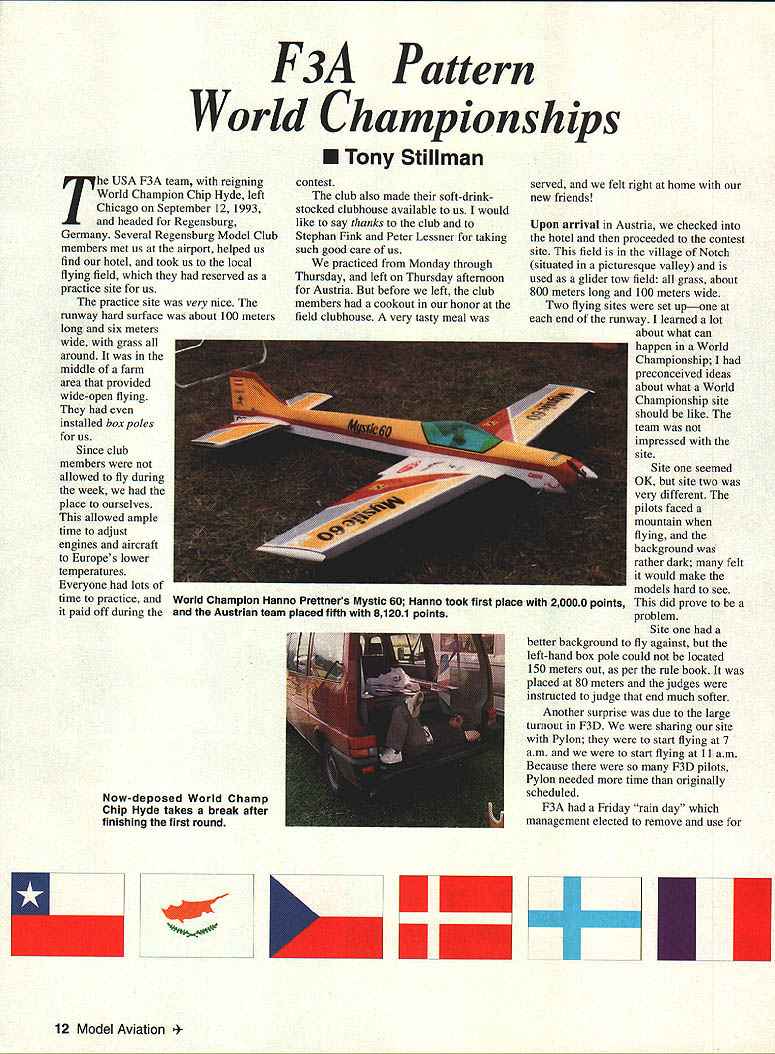
Hanno's flight was not particularly good, but perhaps we were expecting a lot from him, this being his own backyard. Hanno flew an EZ Mystic 60 powered by an O.S. Hanno Special high and far out, making the model very hard to see.
Chip flew close and low—right above the tree line. After the smoke cleared, everyone watching felt that Chip had the better flight, and we all wondered what the numbers would be.
Tony was about six flights after Chip. Tony's first-round flight was very strong, and the scores reflected it. Dave closed out the first day, and also flew close-in. It was apparent that the US pilots were very well prepared for this event.
One interesting item was the first electric-powered F3A model flown in a World Championship. It was a fairly small model, but performed OK. The weird thing was that it received the noise penalty on its first round — I guess the judges expected it to be quieter than it really was.
Scoring hiccup and rounds two through four
When I picked up the raw score sheets for the pilots, we were made aware of a computer problem. It seems that the people inputting scores put the C-pattern maneuver Ks, so the resulting scores were wrong. This was not found until roughly a third of the pilots had flown. The problem was quickly corrected and replacement sheets were given to the pilots who had received errant scores.
Round Two saw Chip up second, and Hanno moved to the end. This time, we were flying in front of the dark mountain on site two. Chip started right where he left off the day before and put up a flight that ended up being the only round he would win. Tony and Dave put in very solid, smooth flights. Bill flew near the end of the round, and we all liked what we saw.
A normalized standing was posted after Round Two. The judge set we flew in front of during Round One was the harder of the two sets, and overnight they eased up some. The higher set also changed; they got tougher. The result was that the Germans and Japanese blew out Chip's and Hanno's scores on Round One.
The surprise was that Hanno had outscored Chip, but he was in fourth place and Chip was in fifth. Wolfgang Matt had won the round, with Hatta and Akiba of Japan in second and third. Chip won Round Two, with Hanno in second, Wolfgang in third, Hatta in fourth, and Tony in fifth. The Japanese looked unbeatable as a team at this point, but we pushed on.
It was really hard to find a trend in styles for the best scores. All types of styles were seen: very close-in two- and four-stroke models with varying speed ranges, as well as models that flew far out and up. Some models were really too small to be flown this far out, but many of each style received good points.
The weather cleared for Rounds Three and Four, and we flew in some clear sky. Everyone continued to perform very well, but we couldn't seem to catch the Japanese.
After Round Four, Chip was first, Wolfgang second, and Hanno third. Wolfgang had won two rounds, and Hanno and Chip had each won one.
Bill just couldn't get a good score; in Round Four he put his best flight up, but it received his lowest score. Dave and Tony were in the top 10, but the Japanese were all close together at the top.
Finals and controversy
When the finals started on Saturday, I learned why the Japanese were so unbeatable: the Japanese judge had given all 10s to the Japanese pilots. His reasoning was that he was "unable to judge his countrymen fairly, so 10s were given to be thrown out." Needless to say, the judge was removed from the line and replaced with an alternate judge for the finals. However, the damage was already done, and the Japanese had won the team event, with the US in second and Canada in third. I was told that the Japanese would not be allowed to send a judge to the next F3A World Championships, which would be in Japan.
The weather report called for rain during the finals (remember: we lost our rain day). We started at 9 a.m. The draw resulted in the top three qualifiers flying consecutively. The first round saw our guys step everything up a notch.
Tony started at a high clip for the US. Chip was scheduled to fly just before Hanno, and directly after Wolfgang. Chip had his game face on and flew a dynamite flight. Hanno flew much better than earlier in the week, but still not quite as well as Chip. Bill's draw was to fly right after Hanno, which helped Bill's confidence; his scores improved with each flight.
Tony kept putting in quality flights, but Dave had trouble; his engine quit during the start of the Figure M. He was pretty down, but soon put it behind him and was looking forward to Round Two.
The second round of the finals started after lunch. Before Round Two started, scores were posted. Hanno had beaten Chip by a wide margin. We were expecting it to be close—due to what had happened earlier in the week—but this was ridiculous! Hanno flew well in the second round, but with a few more mistakes. It didn't seem to matter to the judges. Chip was upset about the scores, but still flew well during the last round.
Wolfgang flew second in Round Two, followed by Chip, Hanno, and Bill. All flew in good weather, and Bill's scores continued to improve. I wondered how Bill would have finished if he had flown behind Hanno all week.
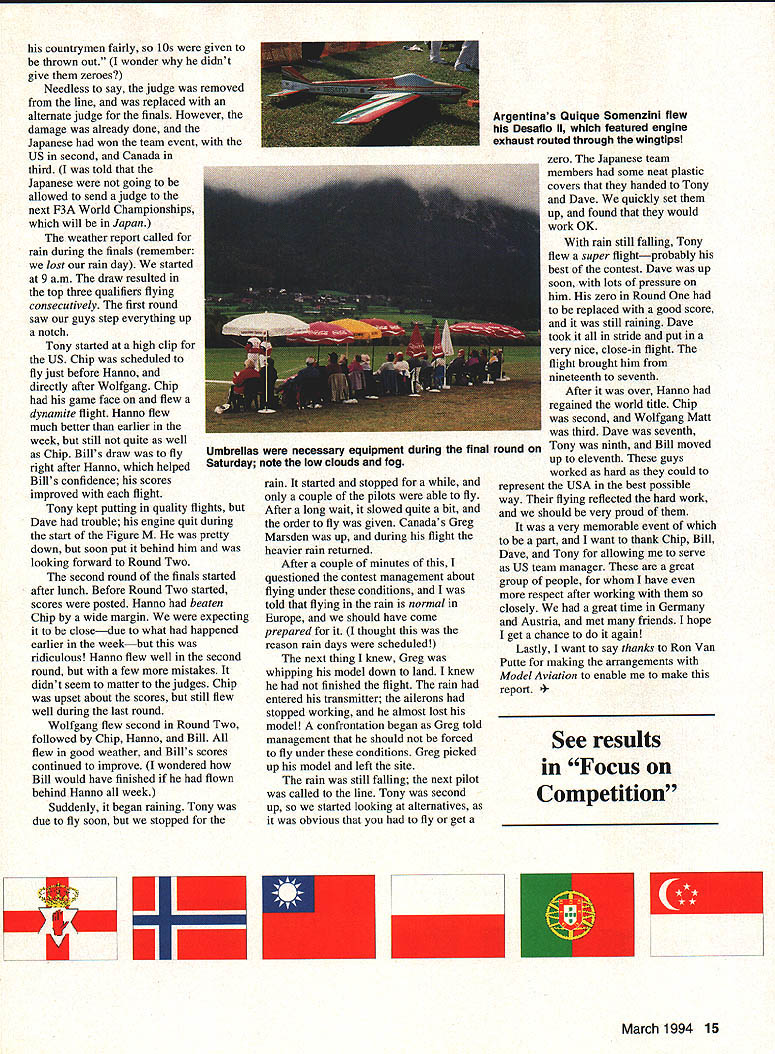
Suddenly, it began raining. Tony was due to fly soon, so we stopped for the rain. It started and stopped for a while, and only a couple of the pilots were able to fly. After a long wait, the rain slowed quite a bit, and the order to fly was given. Canada's Greg Marsden was up, and during his flight the heavier rain returned.
I questioned contest management about flying under these conditions, and I was told that flying in the rain is normal in Europe and we should have come prepared for it. I thought this was the reason rain days were scheduled.
During Greg's flight the rain had entered his transmitter; the ailerons stopped working and he almost lost his model. Greg told management that he should not be forced to fly under these conditions, picked up his model, and left the site.
The rain was still falling; the next pilot was called to the line. Tony was second up, so we started looking at alternatives, as it was obvious that you had to fly or get a zero. The Japanese team members had some neat plastic covers that they handed to Tony and Dave. We quickly set them up and found that they would work OK.
With rain still falling, Tony flew a super flight—probably his best of the contest. Dave was up soon, with lots of pressure on him. His zero in Round One had to be replaced with a good score, and it was still raining. Dave took it all in stride and put in a very nice, close-in flight. The flight brought him from nineteenth to seventh.
Results and thanks
After it was over, Hanno had regained the world title. Chip was second, and Wolfgang Matt was third. Dave was seventh, Tony was ninth, and Bill moved up to eleventh. These guys worked as hard as they could to represent the USA in the best possible way. Their flying reflected the hard work, and we should be very proud of them.
It was a very memorable event of which to be a part, and I want to thank Chip, Bill, Dave, and Tony for allowing me to serve as US team manager. These are a great group of people, for whom I have even more respect after working with them so closely. We had a great time in Germany and Austria, and met many friends. I hope I get a chance to do it again!
Lastly, I want to say thanks to Ron Van Putte for making the arrangements with Model Aviation to enable me to make this report.
US team
- Chip Hyde (reigning World Champion)
- Bill Cunningham
- Tony Frackowiak
- Dave von Linsowe
Transcribed from original scans by AI. Minor OCR errors may remain.

