
F3B Soaring World Champs
Overview and site
Held near Paris, France in 1989, this seventh biennial "Olympics" of RC model soaring attracted 56 contestants from 19 countries. In this extremely tough, world-class competition—where Europeans traditionally dominate and nothing is given away—the U.S. team finished fifth, up from seventh in 1987. The stated U.S. goal: reach the top three in 1991.
The championships were hosted by France August 14–19 on the grounds of Melun Villaroche Airfield, about 30 km southeast of Paris. The French organizers were sensitive to the fliers’ needs: full-size airport operations continued, but airport officials agreed to halt overflying traffic whenever it posed a threat of frequency interference with the models.
Nineteen countries and 56 individuals competed. The entry list was down from 1987; Argentina, Australia, Finland, New Zealand, Sweden, and Canada did not participate.
Contest preparations were thorough and the site was generally excellent except for one problem: the recently harvested wheat field was covered with straw and pocked with furrows and ruts. Fast landings could cause models to slide past the touchdown spot, the ruts made hauling winches difficult, and the loose soil turned muddy in rain.
Weather was mostly sunny and hot, marred only by high winds on Tuesday and a rain-and-lightning storm around midday Wednesday. Tuesday’s wind approached the FAI limit of 12 m/s (about 28 mph), but flying continued. Otherwise conditions were excellent, with good cyclic thermal activity generated by sunny days and large nearby farm fields.
The official program noted that the United States had withdrawn an earlier offer to host the championships; France organized the event in less than ten months rather than having a year without a world competition. Competition Director Francis Caraux and his organizers did a fine job; Caraux had team and competitor experience from 1987.
Winners and team standings
- Individual top finishers:
- Nic Wright (Great Britain) — World Champion
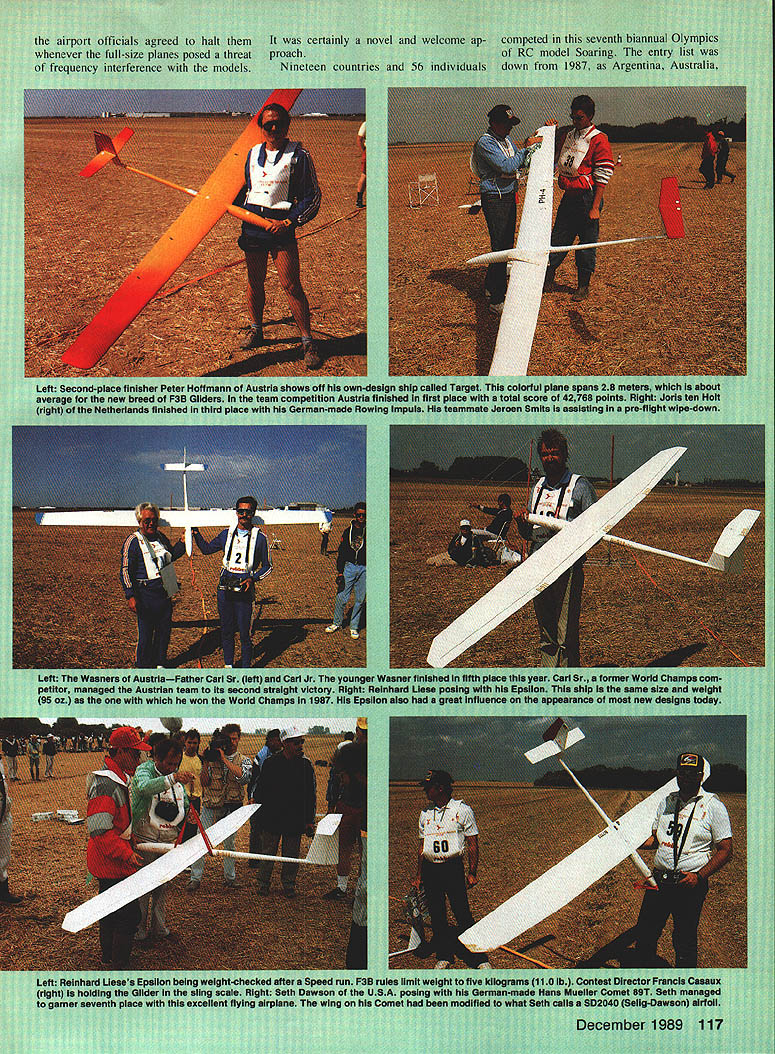
- Peter Hoffmann (Austria)
- Joris ten Holt (Netherlands)
- Carl Wasner, Jr. (Austria)
- Reinhard Liese (West Germany)
- U.S. individual results:
- Seth Dawson — 7th
- Larry Jolly — 10th
- Rich Spicer — 31st
- Team standings:
- Austria
- Netherlands
- West Germany
- Great Britain
- United States
Two-time world champion Rolf Decker served as team manager for the West German delegation; this was the first championships in which he served in a noncompeting capacity.
Nic Wright and the British team
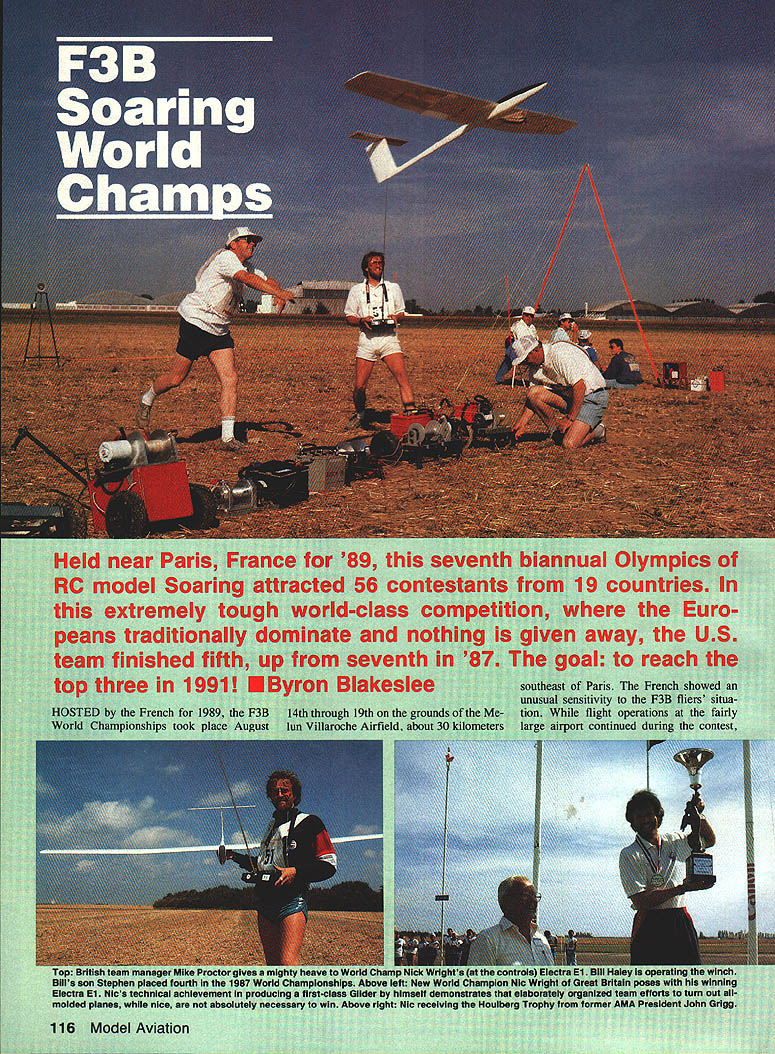
Nic Wright became the first Briton to capture the individual F3B World Championship. Wright designs and builds all his planes and winches. As one of only about eight active F3B fliers in England, he lacks frequent contest experience at home. To practice speed and distance tasks, he recruits clubmates to call turns and he gets fast-flying practice as an active slope racer—he had won the Viking Cup F3F two years running.
Wright’s fellow team members—Dave Worrall, Stew Blanchard, and team manager Mike Proctor—are highly experienced pilots and worked effectively together. Wright’s technical achievement in producing a first-class plane largely on his own demonstrates that elaborately organized team production isn’t absolutely necessary to win. Asked about the secret of his success, Wright said simply: “Dedication.”
How F3B works — format and scoring
The FAI designation F3B covers radio-controlled thermal soaring competitions. Contest flying is divided into three tasks: duration, distance, and speed. A round consists of one of each task. At the World Championships six rounds were flown across six days; each contestant’s lowest round was dropped and the five remaining rounds counted.
Sheer stamina is a factor: six rounds in six days with one dropped.
#### Duration
- Working time: 9 minutes to accomplish a 6-minute precision flight.
- Landing bonus: 100 points for landing within 1 meter of a designated spot.
- Scoring: 1 point is lost per second under or over six minutes; 5 points per meter (up to 15 m) are lost for missing the spot.
- Maximum raw points example: 360 (6 minutes = 360 seconds) + 100 landing = 460.
- At Melun, duration was flown in groups of eight. Task points were normalized to the group winner’s total and multiplied by 1,000 (man-on-man group scoring to minimize weather variation effects).
Pilots may relaunch within working time as often as desired. Strategies vary: some launch immediately and allow time for relaunches; others wait and piggyback on early launchers’ lift. Typically top fliers consistently get six minutes and high landing scores, so duration usually produces few separations among leaders.
Suggestions to increase difficulty include lengthening the time or changing to a “percentage slot” format where every second of working time matters.
#### Distance
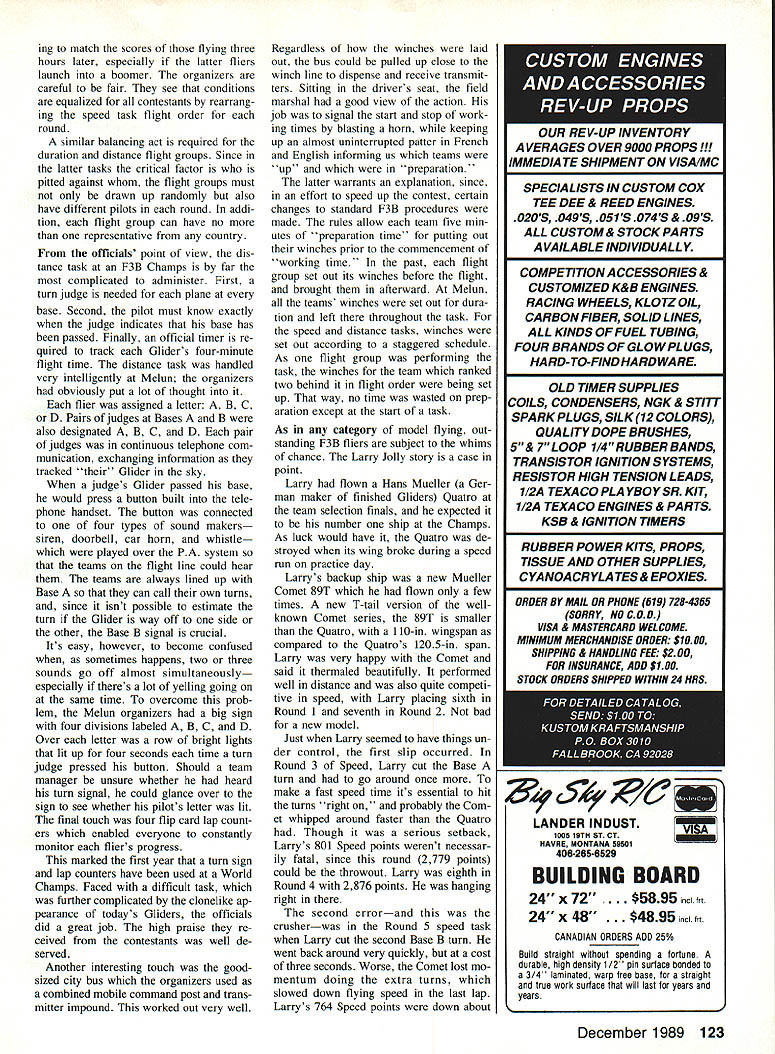
- Working time: 7 minutes to complete a 4-minute flight around a 150-meter course defined by Base A and Base B.
- A lap = one length from Base A to B or B to A.
- No limit on relaunches; relaunching and entering the course with at least 4 minutes remaining gives a new 4-minute flight.
- Flown in groups of four; the pilot with the most laps scores 1,000 points and others are normalized accordingly.
Typical strategy is to launch immediately to test the air and then either continue for four minutes or land and relaunch if conditions are poor. Teams employ tactics—landing and relaunching to shake off piggybackers. Distance is the most critical task because a large lap differential can cost many points quickly.
Example highlight: Wright recorded 26 laps in Round 1—averaging nearly 37 mph—demonstrating the intensity of high-level distance flying.
#### Speed
- Working time: 5 minutes to make a single attempt covering four laps of the 150-meter course as fast as possible.
- Pilots fly one at a time and enter the course from behind Base A toward Base B.
- Each attempt includes two Base B turns and one Base A turn; the run is down, back, down, back.
- Safety: the speed run must be on the far side of the course away from winches, contestants, and spectators; crossing the safety line is an automatic zero.
- Timing: the best time in the contest (Reinhard Liese, Round 1) was 17.5 seconds and earned 1,000 points; others’ scores are scaled by dividing the winner’s time into the competitor’s time and multiplying by 1,000.
Pilots often make practice dashes and relaunch if needed, which strains helpers because winch lines must be managed. Timing of flights matters—light conditions and time of day can affect performance.
Equipment, radios, and design trends
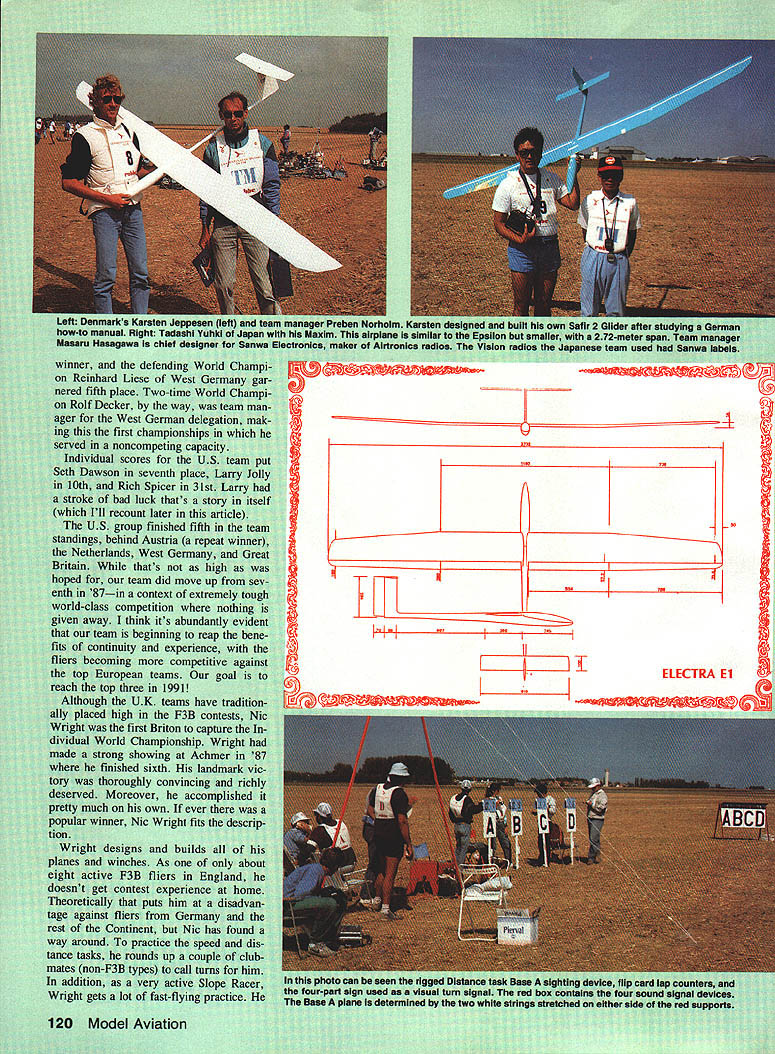
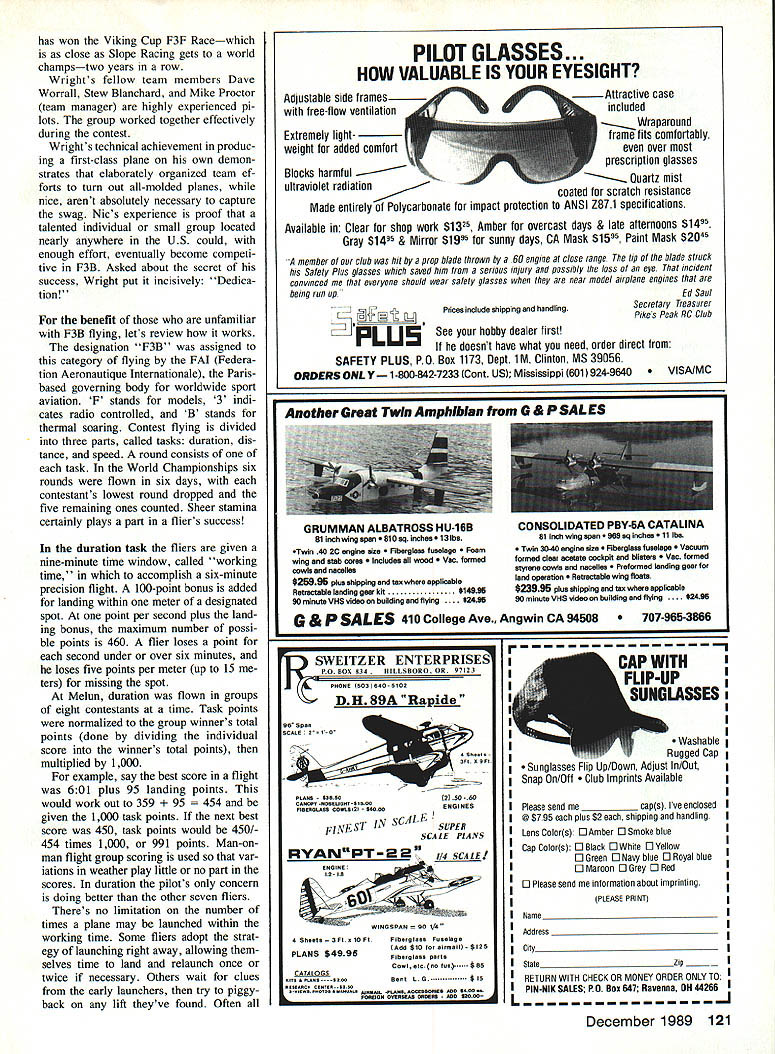
- Radios: all pilots used computer-type radios for mixing and presets. Popular sets included the Multiplex 3030, Graupner MC-18 (made by JR), and Airtronics Vision. The Japanese used sets labeled Sanwa.
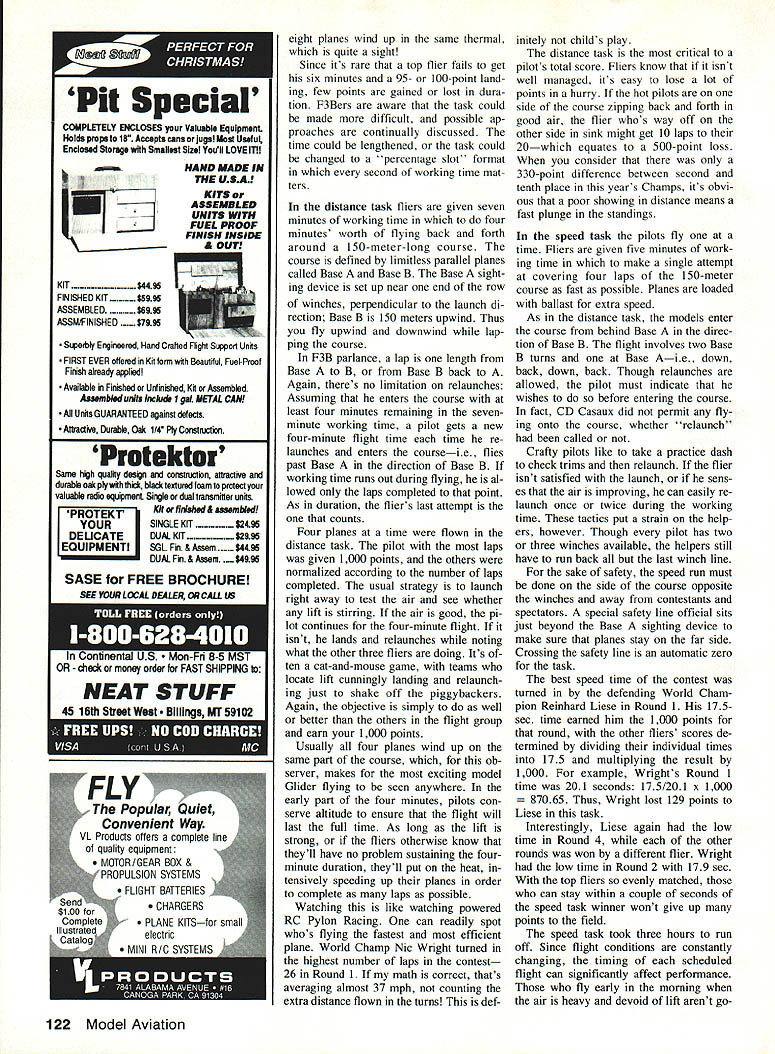
- Winches and materials: a trend toward smaller, lighter gliders was noticeable; average span was about 115 in. Nic Wright’s Electra E1 had a 108-in span and weighed 88 oz—smaller and lighter than many previous designs. Wright used an RG-14A-derived thin section (reduced to 7.0% thickness with 1.4% camber) for speed and a thinned section for his speed wing. He used all-carbon-fiber wing skins and carbon spars—materials costs were five times higher than his previous model.
- Commercial gliders: the new winch rules have made commercially built F3B gliders competitive. Models by Hans Mueller (e.g., Quatro, Comet 89T), Rowing Impuls, and Czech designs (Jewel, Eclipse, Ellipsis) were widely seen. Many pilots are opting to buy top-quality planes and invest time in practice.
The Larry Jolly story (U.S. misfortune)
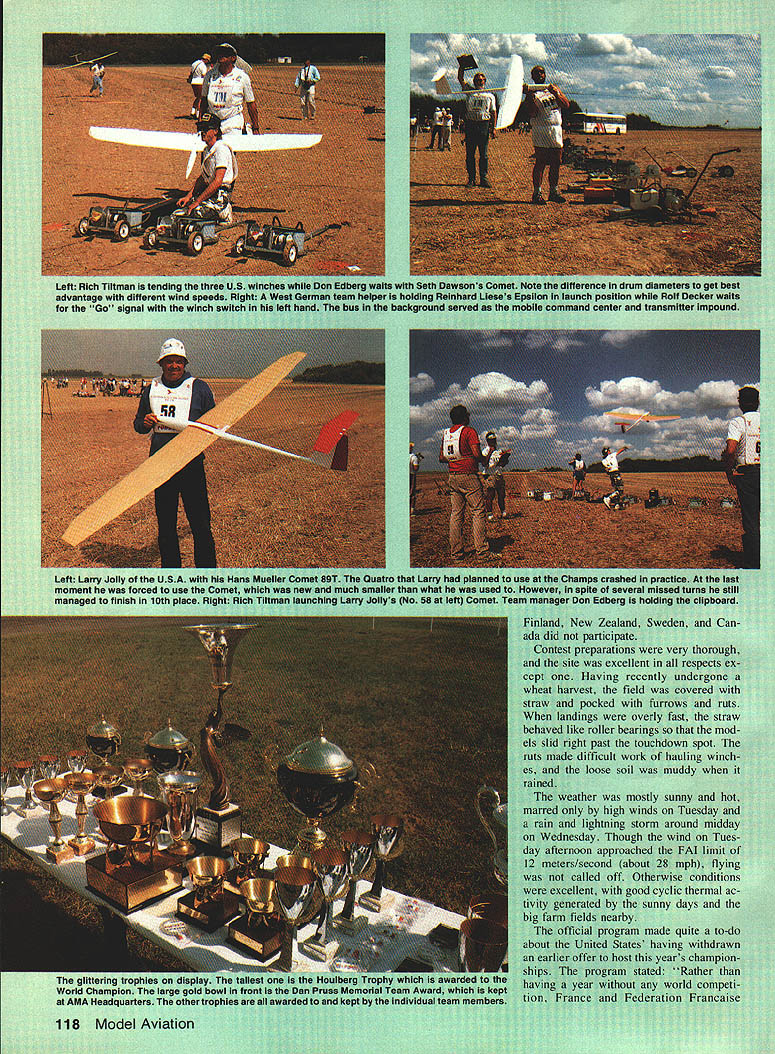
Larry Jolly expected to fly a Hans Mueller Quatro as his primary ship, but the Quatro’s wing broke during a practice speed run and the model was destroyed. His backup was a new Mueller Comet 89T (T-tail, 110-in wingspan vs. Quatro’s 120.5 in) that he had flown only a few times. The Comet thermaled well and was competitive in distance and speed—Larry placed 6th in Round 1 and 7th in Round 2.
However, in Round 3 of speed Larry cut the Base A turn and had to go around, costing time and points (801 speed points). Round 5 brought a second error: he cut the second Base B turn, went around quickly but lost about three seconds and momentum, scoring 764 speed points. He repeated the same cut in Round 6, scoring 750. The smaller Comet’s size fooled him on judging the turns by eye; what appeared to be correct turns were off by feet. Had he earned roughly 400 more speed points overall, he likely would have placed second in the contest. Larry averaged 994 in duration, 990 in distance, and 821 in speed.
The lesson: select one proven design and stick with it through the two-year world-champs cycle, and practice speed runs extensively.
Seth Dawson and Rich Spicer
- Seth Dawson had an excellent contest but was felled by speed events. He received a zero for crossing the safety line in Round 2, despite scoring 1,000 in duration and distance that round. Dawson averaged 956 in duration, 1,000 in distance, and 882 in speed (not including the zero). He flew a Mueller Comet with an SD2048 (Selig-Dawson) airfoil, thinned to 8.6% thickness with 1.8% camber—performance similar to the RG-15 section popular in F3B.
- Rich Spicer dropped more than expected from his 20th place in 1987. He averaged 990 in duration and 823 in speed, but distance hurt him: only one 1,000 lap and an average of 781 in distance cost him places.
Winch rule changes and effects
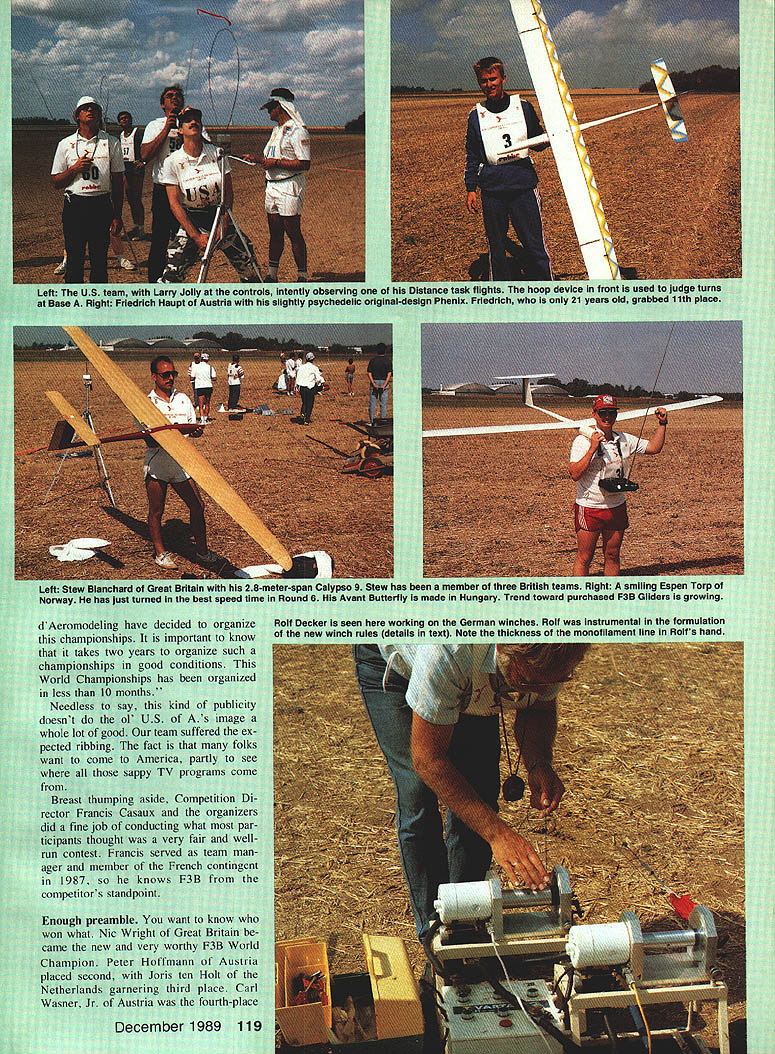
Until 1988, winch motors had no formal restriction and power escalated into a "winch war" with motors of 4–5 kW and launch heights beyond 200 m. To limit this trend, Rolf Decker proposed a motor/battery combination to limit power, and CIAM adopted a restriction on motor internal resistance of 15 milliohms (with physical size limits for batteries).
A standardized stalled-condition tester was designed to measure motor internal resistance. The Bosch motor Decker evaluated at 15 milliohms tested as 12 milliohms on the new equipment, but CIAM refused to lower the limit to 12 milliohms.
The new 15-milliohm winches performed surprisingly well at the Champs: launches averaged only about 100–200 ft lower than before, and speeds dropped only a second or two. The most positive effect was narrowing launch-height differentials between teams.
Monofilament line elasticity remains important: standard technique stretches the line before cutting slack, producing a slingshot effect. However, the new winches lack the G-force snap of the old powerful motors, reducing zoom heights, especially with side, off, or tail winds.
Typical lines:
- No-wind: 1.2–1.3 mm diameter (125-lb test)
- Wind: 1.5 mm (200-lb test)
Drum diameters vary with wind: perhaps 2.5 in. in wind and 3 in. for windless conditions; most drums were 7–9 in. wide.
Teams used external resistance to bring total system resistance up to legal values. The Belgians famously added 12 milliohms of external resistance to their 1987 winches, theorizing resistor heating increased motor resistance—though results were mixed. Organizers tested and sealed winches to prevent tampering.
Contest finish, awards, and banquet
By Saturday morning’s speed task it was clear Nic Wright would be champion; the final day focused on jockeying for individual and team places. Flying ended by 2:00 p.m. A champagne victory party was held in the British tent.
At 4:00 p.m. teams assembled under their flags for the awards ceremony with speeches and Olympic-style platform presentations. The Saturday evening banquet was a French highlight: teams were driven in buses to Paris, boarded a glass-topped cruise liner on the Seine, and enjoyed a scenic dinner cruise with views of the Eiffel Tower illuminated for the bicentennial commemoration.
Management and future championships
The American team was managed by Don Edberg with helpers Richard Tittmann and Steve Lewis. Steve Lewis had been a pilot on the 1987 team when Seth Dawson was a helper.
The 1991 F3B World Championships will be held near Arnhem, the Netherlands. Any fliers who want to make the U.S. team would do well to begin intensive practice now.
A technical review of the 1989 champs, including inside technical detail, was promised in an upcoming issue of Model Aviation by Terry Edmonds, the new U.S. representative to the CIAM F3B Subcommittee. Terry, like several other savvy pilots, found commercially made gliders—such as the Czech Ellipsis—an attractive option at the championships.
Transcribed from original scans by AI. Minor OCR errors may remain.

