
F3B Technicalities
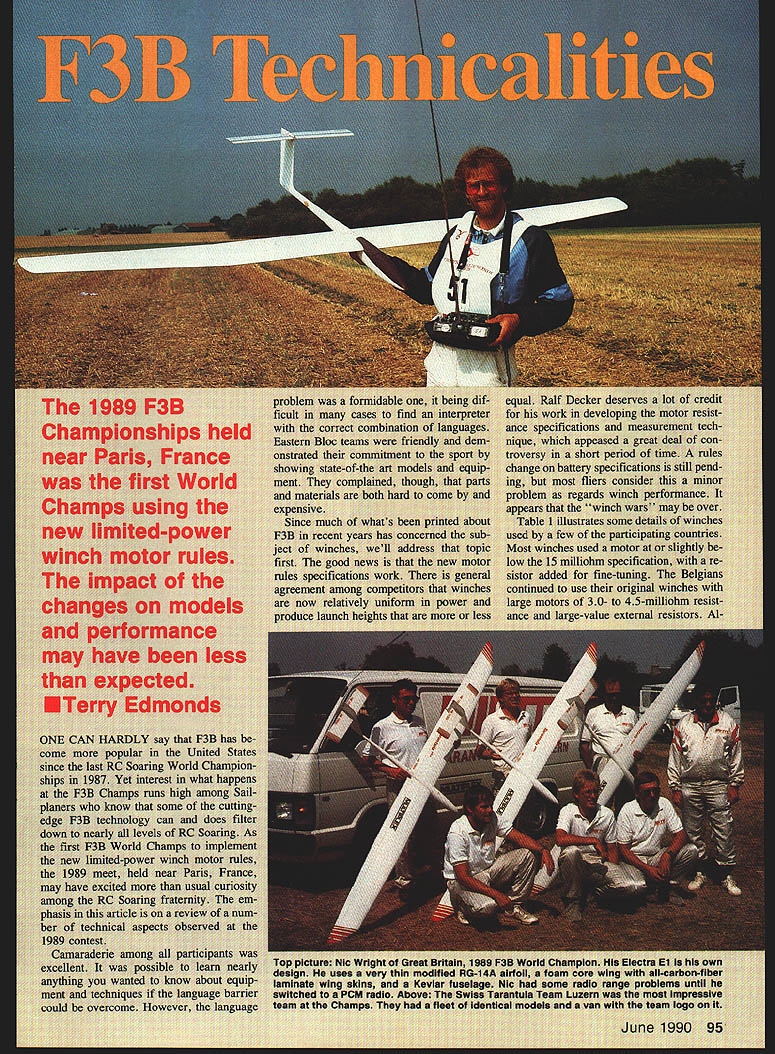
The 1989 F3B World Championships, held near Paris, France, were the first World Champs to use the new limited-power winch motor rules. The impact of the changes on models and performance was perhaps less than expected, but the meet offered many technical observations of interest to RC soaring enthusiasts.
Camaraderie and language barriers
Camaraderie among participants was excellent. It was possible to learn nearly anything about equipment and techniques if the language barrier could be overcome. The language problem was formidable at times, as interpreters with the right combination of languages were not always available. Eastern Bloc teams were friendly and showed state-of-the-art models and equipment, but they noted that parts and materials are hard to obtain and expensive.
Winch rules and performance
The new motor rules worked. Competitors generally agreed that winches are now relatively uniform in power and produce launch heights that are more or less equal. Ralf Decker received credit for developing the motor resistance specifications and the measurement technique, which settled much controversy quickly. A rules change on battery specifications was still pending, but most fliers considered that a minor issue regarding winch performance. It appears the "winch wars" may be over.
Most winches used motors at or slightly below the 15 milliohm specification, often with a resistor added for fine-tuning. The Belgians continued to use larger motors (3.0–4.5 milliohm) with large external resistors. Bert Herzog of Belgium argued that a large motor with a resistor might have a slight edge because the larger motor heats up less quickly and therefore maintains power longer; not everyone agreed.
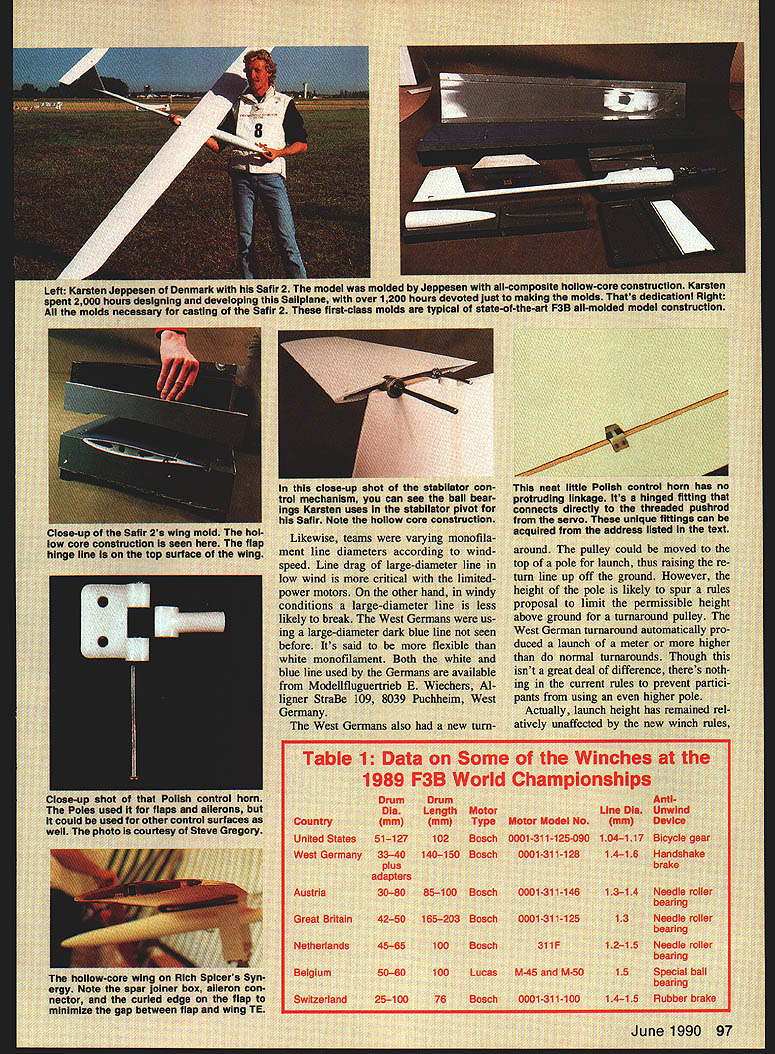
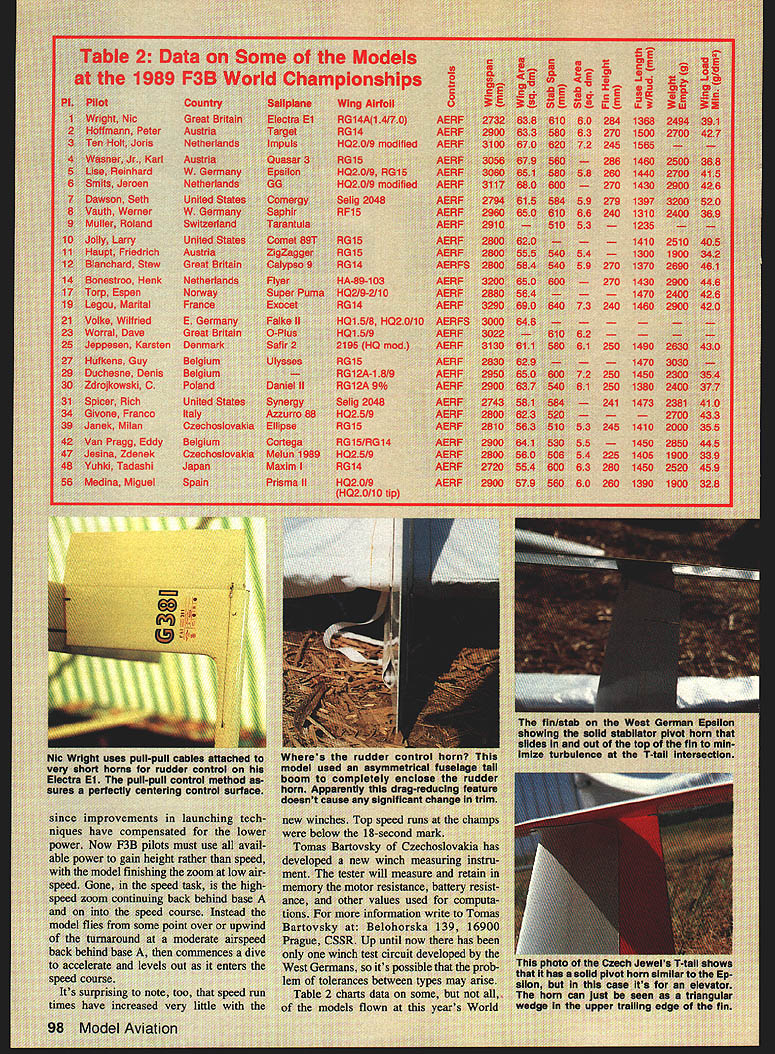
Table data on winches and on models were collected at the event but are omitted here.
Winch hardware and launch techniques
- Many teams varied drum diameters to control power vs. speed in different wind conditions.
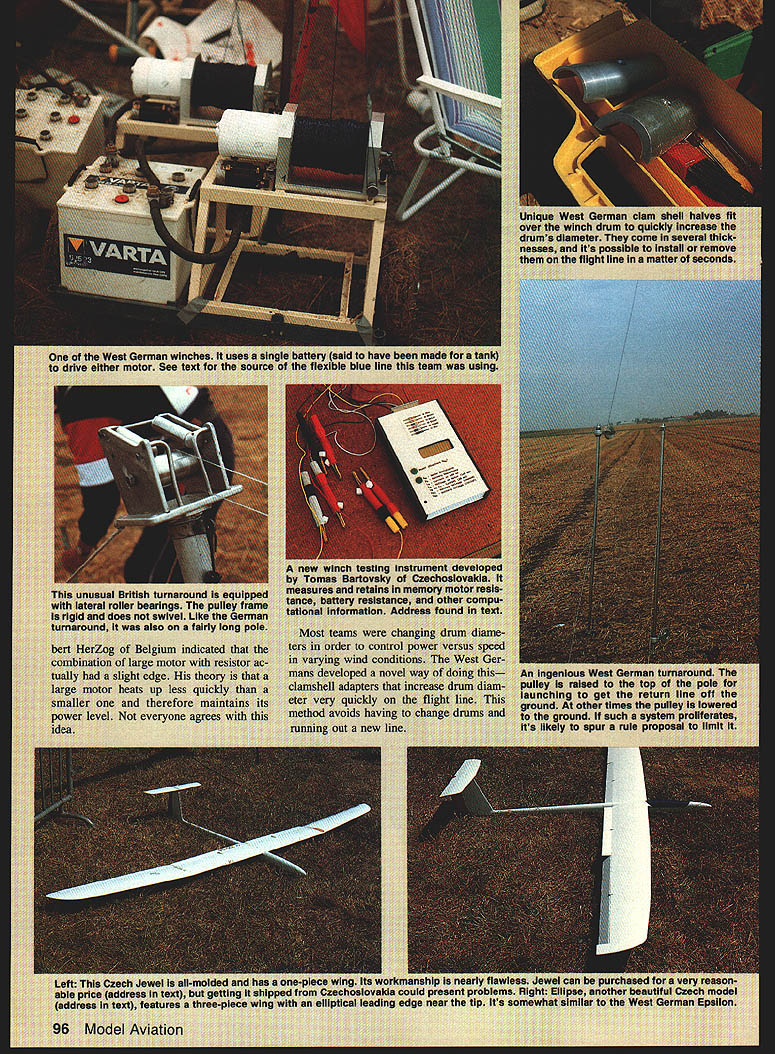
- The West Germans developed clamshell adapters to increase drum diameter quickly on the flight line, avoiding the need to change drums and re-run line.
- West Germans also introduced a new turnaround: a pulley that could be moved to the top of a pole for launch, raising the return line off the ground. This produced roughly an extra meter of launch height and may prompt a rules proposal limiting turnaround-pulley height above ground.
Despite the lower-power winches, launch height remained relatively unaffected because improved launching techniques compensated for reduced power. Pilots now use available power to gain height rather than speed, finishing the zoom at low airspeed. In the speed task, the model typically flies from some point over or upwind of the turnaround at a moderate airspeed back behind Base A, then dives to accelerate and levels out as it enters the speed course. Top speed runs at the Champs were under the 18-second mark.
Line diameters
Teams varied monofilament line diameters with wind speed. Line drag of large-diameter line in low wind is more critical with limited-power motors, but in windy conditions a large line is less likely to break. The West Germans used a large-diameter dark-blue line said to be more flexible than white monofilament. Both white and blue lines used by the Germans are available from Modellflugträger E. Wiechers, Allinger Straße 109, 8039 Puchheim, West Germany.
Winch measuring instrument
Tomas Bartovsky (Czechoslovakia) developed a new winch tester that measures and retains motor resistance, battery resistance, and other values used for computations. For more information: Tomas Bartovsky, Belohorská 139, 16900 Prague, CSSR. Up to that time there had been only one winch test circuit developed by the West Germans, so issues of tolerances between types might arise.
Models, airfoils, and construction trends
Several trends were notable:
- Thin airfoils are in fashion for world-class F3B designs. Nic Wright (Great Britain), the new World F3B Champion, flew the Electra E1 with a very thin modified RG-14A airfoil, all-carbon-fiber-laminate wing skins, and a Kevlar fuselage. An unmodified RG-14 is 8.5% thickness with 1.7% camber; Nic trimmed it to 7.0% thickness with 1.4% camber and believes an even thinner section is possible given modern composite construction and limited winch power.
- Rolf Girsberger’s series of airfoils were popular at the Champs.
- A number of competitors adjusted model size slightly, indicating fine-tuning to the standardized winch power.
- Molded one-piece and multi-piece wings were seen. All-molded wings offer high quality but are time-consuming and costly to develop and difficult to modify; their prices (several hundred dollars upward) reflect development costs.
Notable models and availability:
- Electra E1 (Nic Wright, Great Britain): thin modified RG-14A, carbon-fiber laminate wing skins, Kevlar fuselage. Early radio-range problems from carbon were solved by switching to a PCM radio.
- Comet 89T (Hans Mueller): Hans Mueller’s new Comet 89T performed very well—Larry Jolly had several impressive flights and topped many distance rounds. The Comet 89T is commercially available from Tragflachenbau Hans Mueller, Seidenrother Straße 12, D-6497 Steinau a.d. Str., West Germany. Mueller will build the 89T with longer wings on special order if desired.
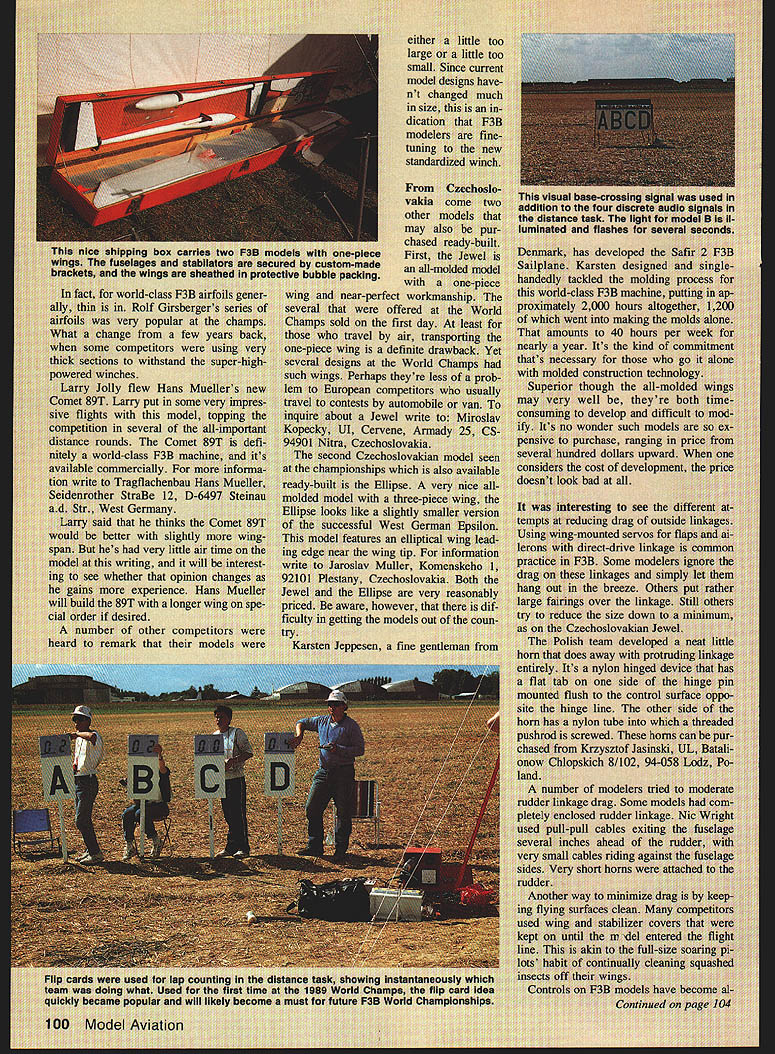
- Jewel (Miroslav Kopecky, Czechoslovakia): an all-molded, one-piece wing model with excellent workmanship. Available from Miroslav Kopecky, OJ, Cervenec, Armady 25, CS-94901 Nitra, Czechoslovakia. One-piece wings can be awkward for air travel.
- Ellipse (Jaroslav Muller, Czechoslovakia): an all-molded model with a three-piece wing, resembling a slightly smaller West German Epsilon. Available from Jaroslav Muller, Komenskeho 1, 92101 Piestany, Czechoslovakia. Both Jewel and Ellipse were reasonably priced but could be difficult to export.
- Safir 2 (Karsten Jeppesen, Denmark): a molded F3B sailplane developed by Jeppesen, who put roughly 2,000 hours into the project (1,200 hours on molds alone), illustrating the commitment required for molded construction.
Drag reduction and linkage techniques
Efforts to reduce drag from outside linkages were widespread:
- Wing-mounted servos with direct-drive linkage for flaps and ailerons are common.
- Some modelers use long fairings over linkages; others minimize size or enclose linkages entirely.
- The Polish team developed a nylon hinged horn that eliminates protruding linkage: a flat tab on one side of the hinge pin mounts flush to the control surface; the other side has a nylon tube into which a threaded pushrod screws. These horns are available from Krzysztof Jasinski, UL, Batalionow Chlopskich 8/102, 94-058 Lodz, Poland.
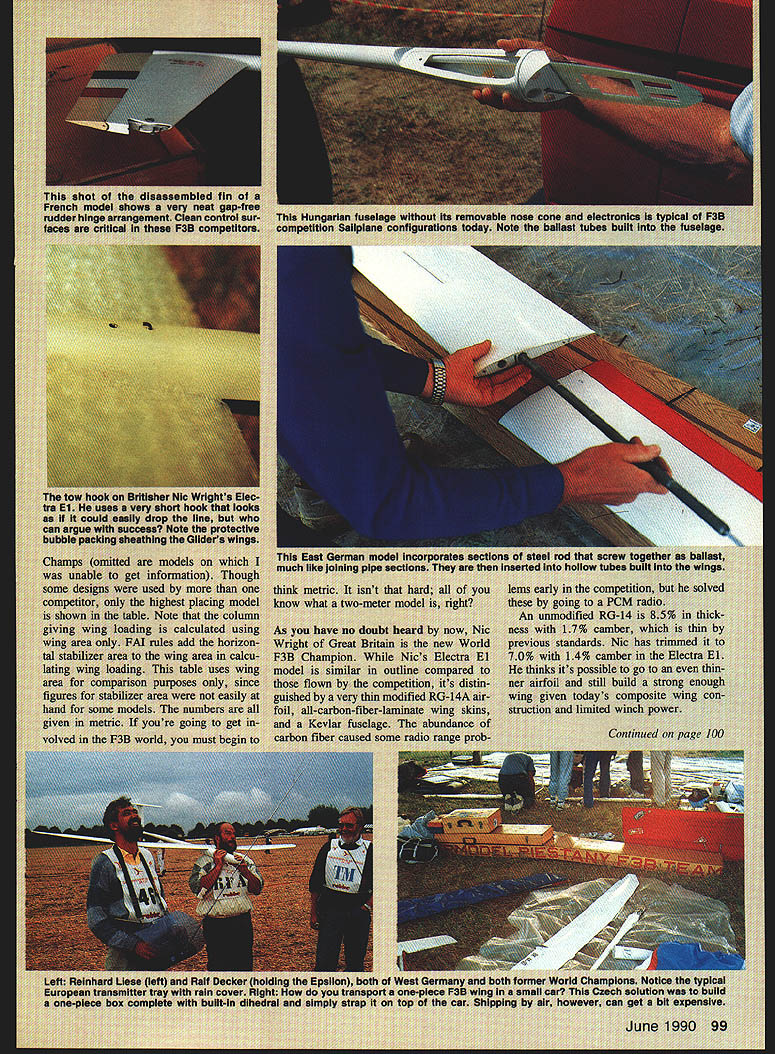
- Nic Wright used pull-pull cables exiting the fuselage several inches ahead of the rudder, with very small cables running against the fuselage sides and very short rudder horns.
- Many competitors kept wings and stabilizers covered until the model reached the flight line to keep flying surfaces clean and minimize drag—akin to full-size soaring pilots cleaning insect residue off wings.
Controls, radios, and stick modes
Controls have become almost unified:
- Nearly all models used ailerons, elevator, rudder, and flaps; very few used additional spoilers.
- Computer radios are now essential for mixing and camber-changing functions. Most pilots used a crow configuration (called "butterfly" in Europe) for landing.
- Transmitter styles differed by region: Europeans commonly used a tray and neckstrap (facilitating neat rain covers); Americans often used hand-held transmitters.
- Stick mode showed cultural variation: Mode II was popular in America, while many Europeans used Mode I. Some pilots used nonstandard stick configurations.
Outline design comparison of the top five models
- Three models had straight-dihedral wings; two had three-piece flat center sections.
- Four models had straight trailing edges and tapered leading edges; one had the reverse.
- Three models had stepped-taper wings; two had straight taper.
- Only the Epsilon had a Schuemann-like wing planform.
- Three models had T-tails; two had conventional tails.
- Four models had slab-tip nose cones; one had a canopy for radio access.
No single outline dominated; designers mixed different features and components based on differing views of what works best, making the class diverse and interesting.
Event organization and safety measures
The French Aero Club organized the championships well and introduced several useful ideas:
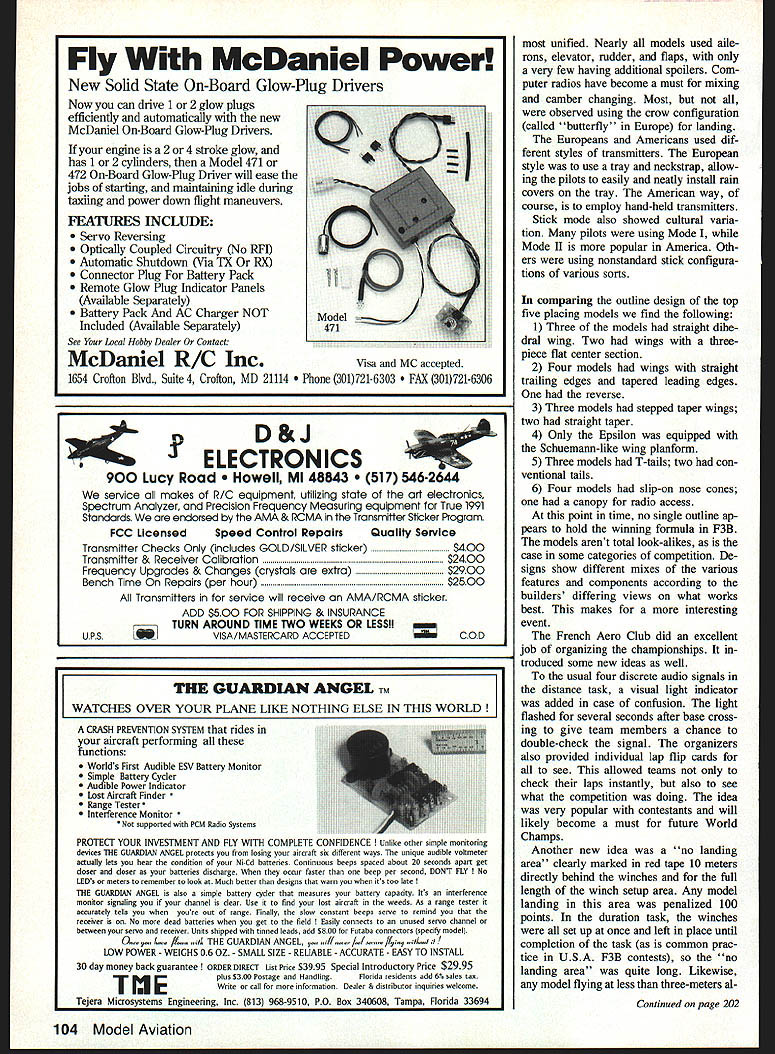
- A visual light indicator was added to the usual four discrete audio signals in the distance task. The light flashed several seconds after base crossing so team members could double-check the signal.
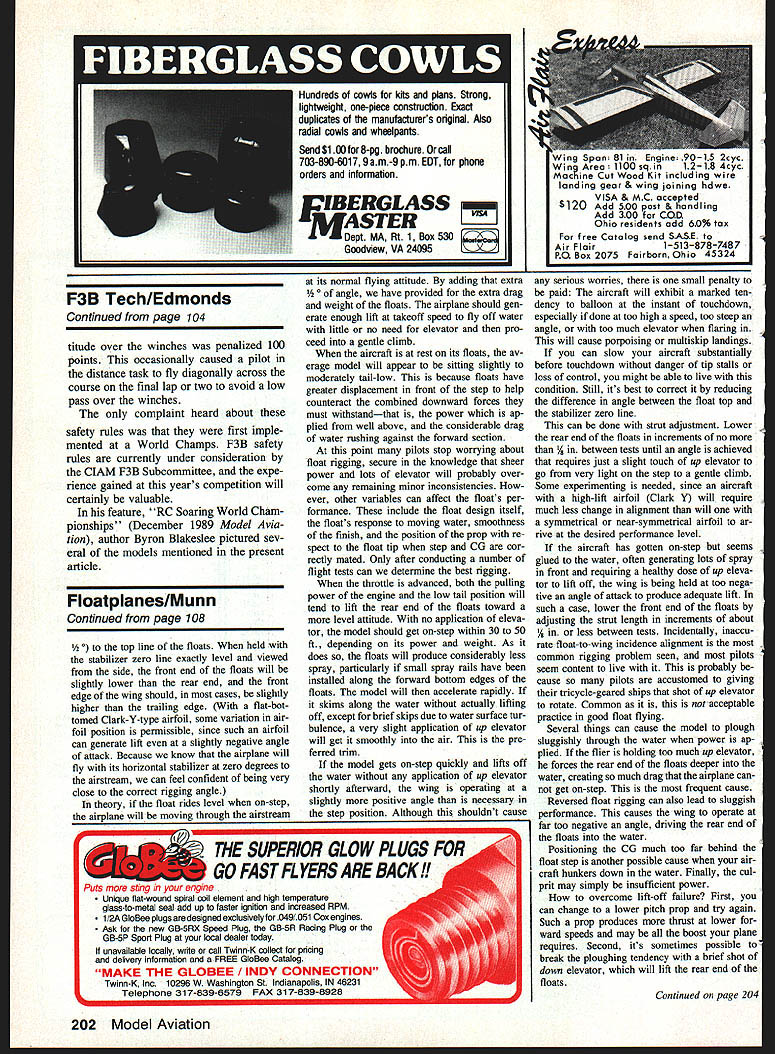
- Individual lap slip cards were produced for all to see, allowing teams to check laps instantly and observe competitors’ lap counts. This feature was popular and likely to become standard.
- A "no landing area" was marked in red tape 10 meters directly behind the winches and for the full length of the winch setup area; any model landing there incurred a 100-point penalty. During the duration task, winches were set up and left in place until completion (a common U.S. practice). Any model flying under three meters altitude over the winches was also penalized 100 points. These safety rules sometimes forced pilots in the distance task to fly diagonally on final laps to avoid low passes over the winches.
- Some contestants complained these safety rules were introduced first at a World Champs; F3B safety rules were under consideration by the CIAM F3B Subcommittee and the Champs’ experience would be valuable.
Closing note
For further reading and images of several models mentioned here, see Byron Blakeslee’s feature "RC Soaring World Championships" (Model Aviation, December 1989).
Transcribed from original scans by AI. Minor OCR errors may remain.

