
F3C Heli World Champs
Helicopters — their technology and their pilots — are getting better every year. At the 1989 F3C World Championships the Japanese team dominated with organization, discipline, and professional preparation. Forty-one pilots representing 19 countries showcased the latest techniques and tested their skills in an impressive contest.
Venue and event overview
- Event: Third edition of the F3C World Championships (1989) held at Fentress Naval Auxiliary Landing Field, near Virginia Beach, VA.
- Layout: Helicopter contest held on trimmed grass at the end of an auxiliary runway; F3D RC Pylon and F3A RC Pattern contests located along the concrete runway for easy access between events.
- Conditions: Sunny, temperatures in the 80s, relative humidity about 60%. Wind averaged 10–17 mph during the competition; mostly calm evenings. No rain for eight days straight. Final award ceremony held at sunset on a calm evening.
AerOlympics support and logistics
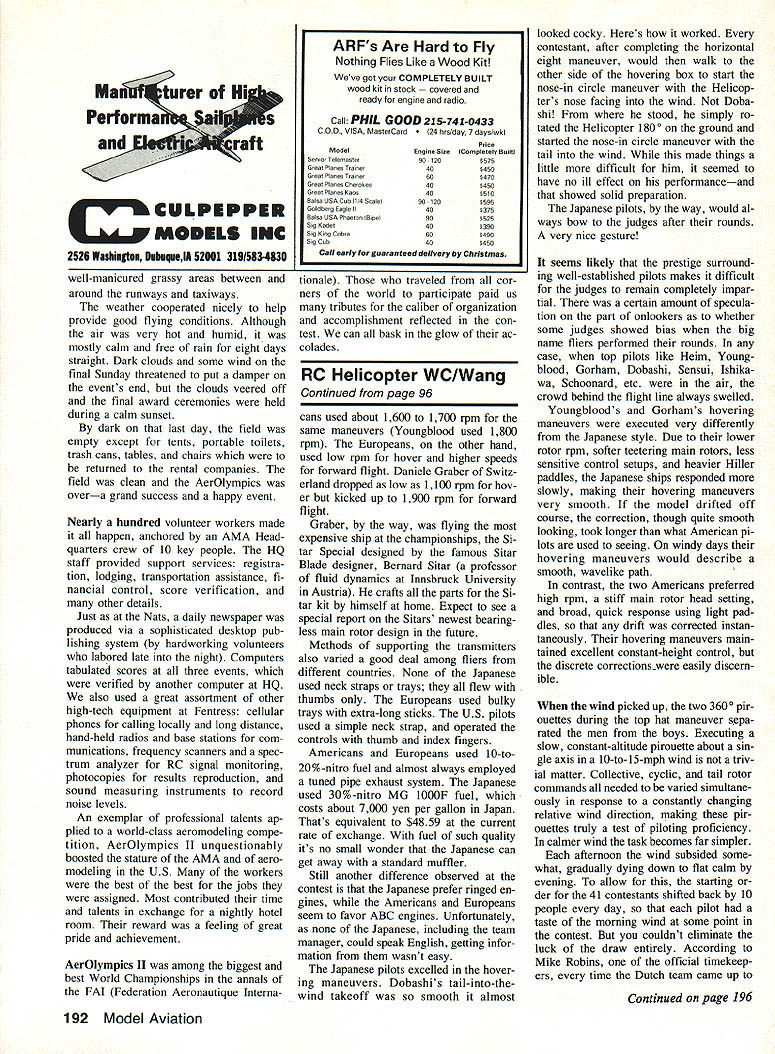
The event was run professionally and efficiently, anchored by nearly 100 volunteers and an AMA Headquarters crew of about 10 key people. Services and equipment provided included:
- Registration, lodging, transportation assistance, financial control, and score verification.
- Communications and electronics: cellular phones, hand-held radios and base stations, frequency scanners, and a spectrum analyzer for RC signal monitoring.
- Score processing: computers tabulated scores for three events and a separate computer verified results.
- Daily publication: an eight-page daily news release titled "F3C Flight Line" produced by desktop publishing and distributed to all competitors.
- Other services: photocopiers for results, sound-measuring instruments, and free ice water at the helicopter tent.
All transmitters were impounded until about 20 minutes before each round. Pilots were called individually to pick up transmitters, bring helicopters to the ready area, and immediately after each round received computer printouts of scores and updated rankings. Thanks to careful frequency management and prearranged flying sequences, no radio interference problems occurred despite simultaneous events.
Participants and teams
- Total contestants: 41 pilots from 19 countries.
- Typical team composition: three pilots, three callers, and one team manager per country (varied by country).
- Japanese team: unusually large entourage (at least 10 people) including pilots, callers, mechanics, team manager and factory representatives; heavily organized and disciplined.
- U.S. team: pilots Tom Dooley, Tim Schoonard, and Robert Gorham; team manager Cliff Hart. Curtis Youngblood attended separately to defend his 1987 World Champion title.
- British team: less manufacturer support; pilots often self-funded travel and expenses.
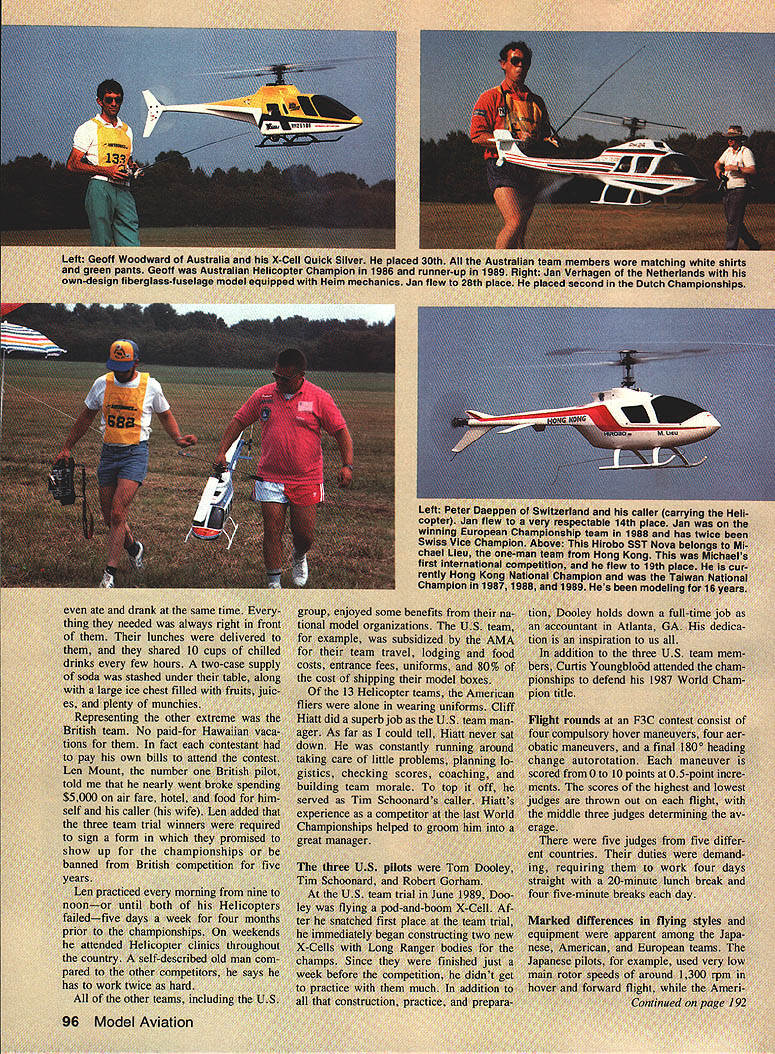
- Notable non-U.S competitors: Daniele Graber (Switzerland), Shigeto Taya (Japan — first World Champion), Edward Heim, Len Mount (Great Britain), Kari Parokka (Finland).
Team preparation and support
- Japanese preparation: extensive, factory-backed training including a month of practice in Hawaii sponsored by manufacturers. Private modelers in Japan organized and financed selection trials before manufacturers provided heavy backing for the selected pilots.
- U.S. support: AMA subsidized team travel, lodging, food costs, entrance fees, uniforms, and most shipping costs for model boxes.
- Volunteers: many workers contributed time and talents, often rewarded with hotel rooms and the pride of contributing to a world-class event.
Competition format and scoring
- Schedule: contest began each day at 10:00 a.m. and ran to about 6:00 p.m.; one flight round per pilot per day.
- Timing: pilots allowed five minutes for engine start and checkout, and ten minutes for the flight to complete nine maneuvers.
- Maneuvers per round: four compulsory hover maneuvers, four aerobatic maneuvers, and a final 180° heading-change autorotation.
- Scoring: each maneuver scored 0 to 10 points in 0.5-point increments by five judges from five different countries. The highest and lowest judge scores were thrown out; the middle three judges determined the average.
- Judges’ workload: judges worked four days straight with a 20-minute lunch break and four five-minute breaks each day.
Equipment, setup, and techniques
- Rotor RPM strategies:
- Japanese pilots tended to use lower rotor RPM in hover (around 1,100–1,300 rpm) and relatively lower RPM in forward flight compared with Americans.
- Americans typically used about 1,600–1,700 rpm for hover and forward flight; Curtis Youngblood used about 1,800 rpm.
- Europeans often used low RPM in hover and higher RPM in forward flight; Daniele Graber ranged from ~1,100 rpm (hover) to ~1,900 rpm (forward).
- Engines and fuel:
- Americans and Europeans commonly used 10–20% nitro fuels and tuned-pipe exhaust systems.
- Japanese used 30% MG 1000F fuel (reported at about 7,000 yen per gallon — equivalent to roughly $48.59 at the time) and often ran standard mufflers.
- Japanese pilots tended to prefer ringed engines; Americans and Europeans often used ABC engines.
- Transmitter support:
- Japanese pilots generally used trays and flew with thumbs on the sticks (no neck straps).
- Europeans used bulky trays with extra-long sticks.
- U.S. pilots used simple neck straps and trays, operating with thumb and index finger.
- Control systems and anti-slop measures:
- Push-pull control setups (dual pushrods to bellcranks) were used on several high-end machines (e.g., Curtis Youngblood’s GMP Competitor and Shigeta Taya’s machines) to minimize slop and servo loads.
- Fuselages and airframes:
- Most contestants used fiberglass fuselages; about half used the Bell Jet Ranger shape.
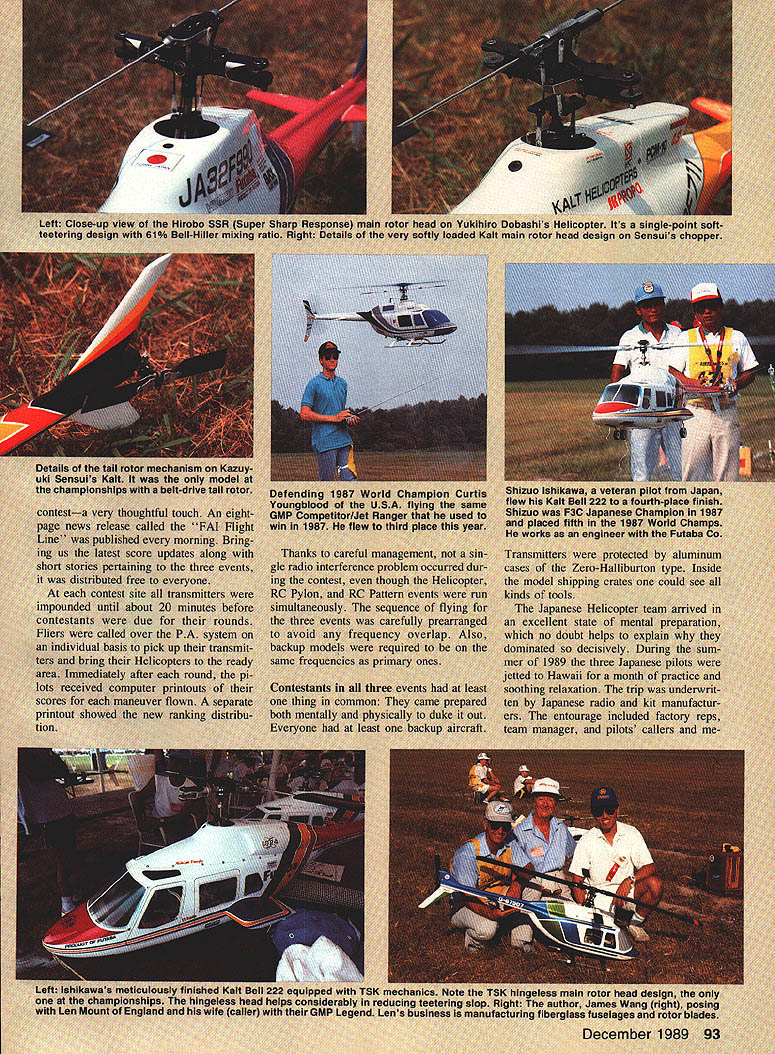
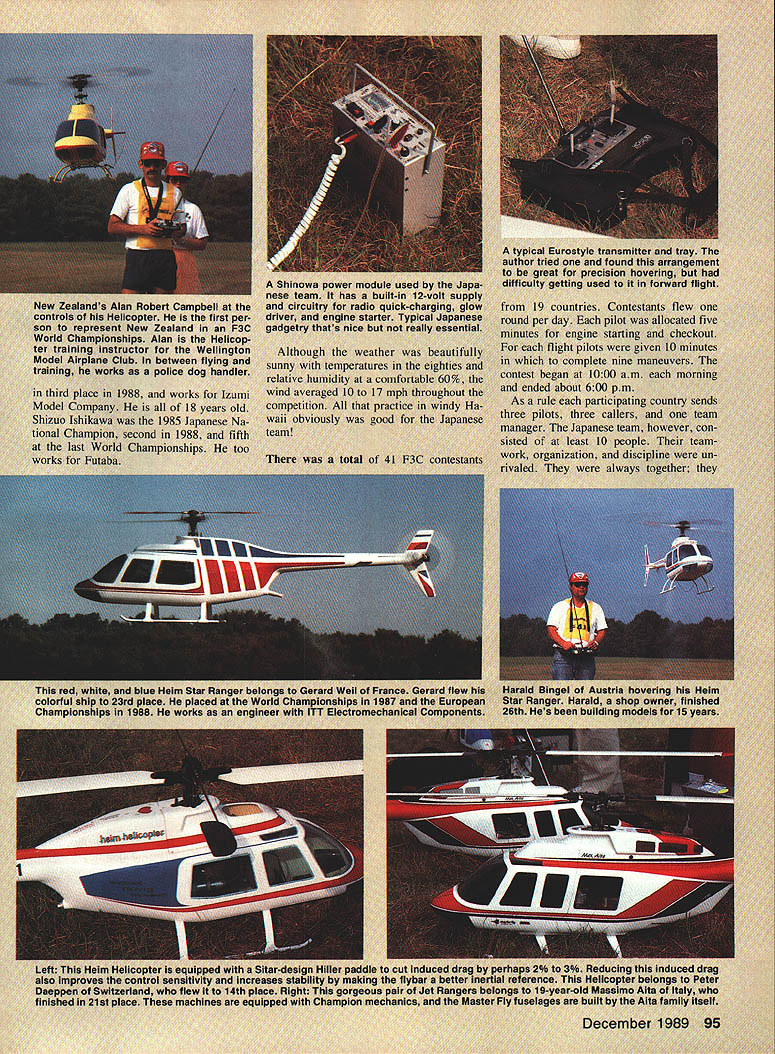
- Other fuselages included Quick Silver (Australian team), Heim’s Lockheed 286 banana-shape, Bell 222 with retractable gear (Ishikawa), and a pod-and-boom Schluter Champion (Kari Parokka, Finland).
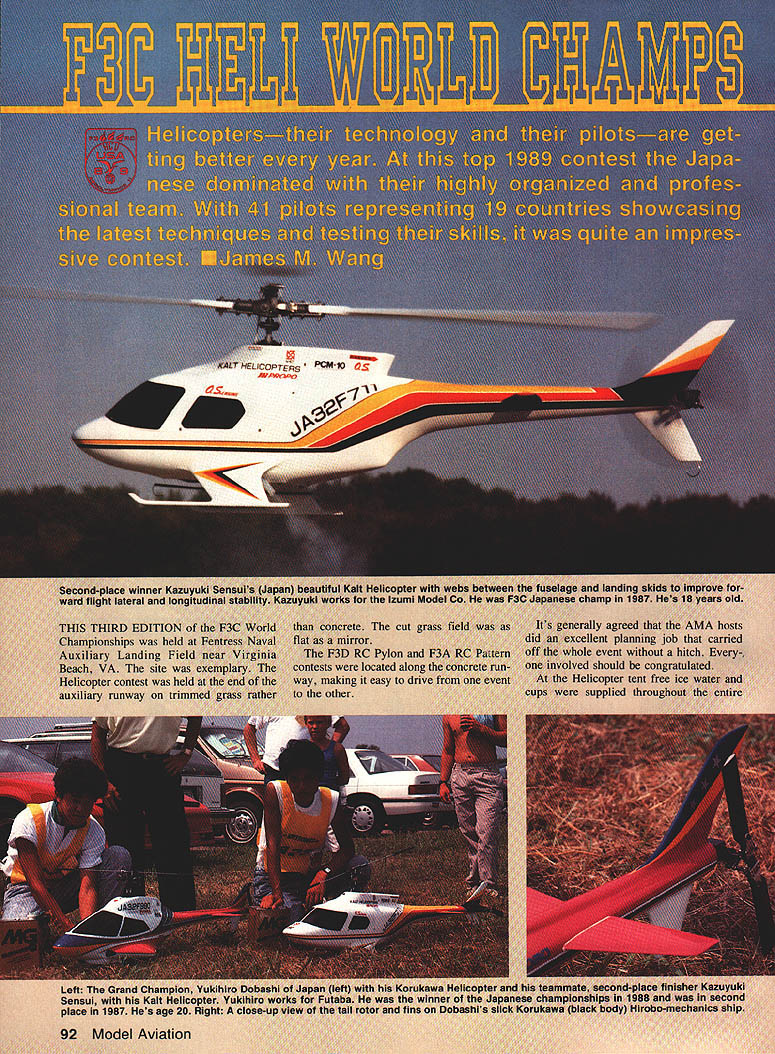
- Sensui and Dobashi used exotic fiberglass shells with finlike structures for improved straight-line flight; Korukawa fuselage cost cited around 126,000 yen (~$874 prepainted shell).
- Notable kit and blade design:
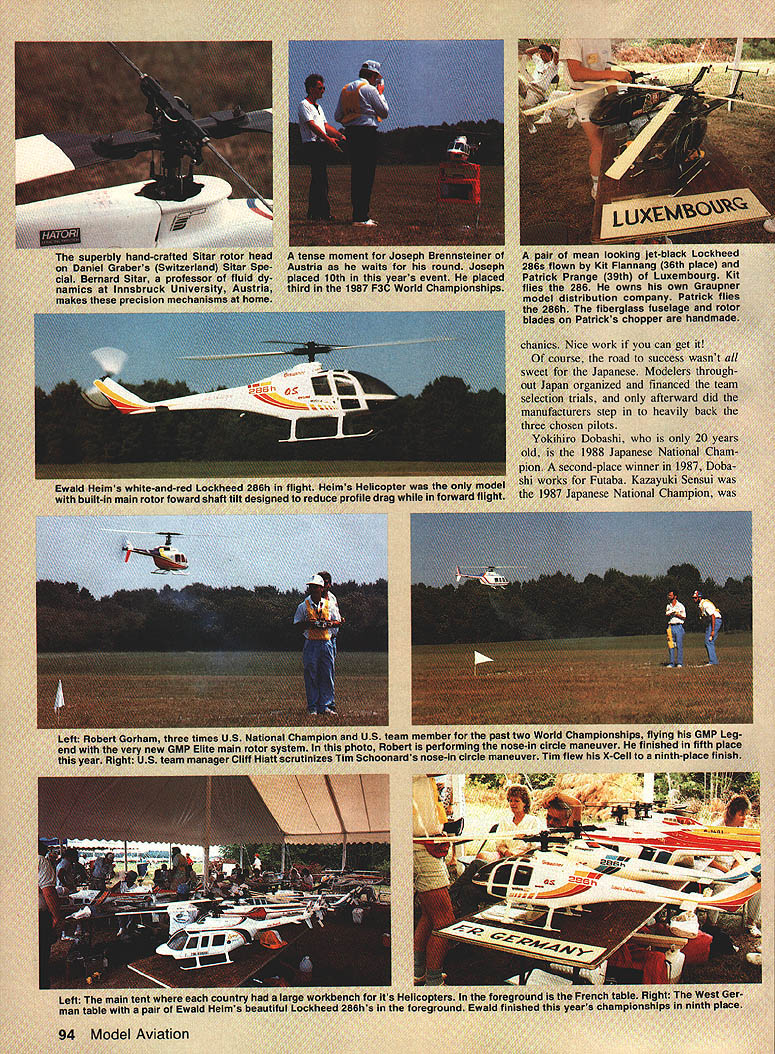
- Bernard Sitar (Innsbruck University) designers and crafts the Sitar Special kit parts himself; Daniele Graber flew a Sitar Special and achieved top results. Sitar’s bearingless main-rotor design was noted as of interest for future reporting.
Notable pilots and performances
- Daniele Graber (Switzerland): flew the expensive Sitar Special and won by exploiting wide RPM ranges and sophisticated flying technique.
- Japanese team members:
- Yokihiro Dobashi (20 years old): 1988 Japanese National Champion and a second-place finisher in 1987; noted for smooth tail-into-the-wind takeoffs and meticulous preparation.
- Shizuo Ishikawa: veteran pilot and engineer with Futaba; finished fourth at this event and had strong showings in previous years.
- Kazayuki Sensui: 1987 Japanese National Champion and key team member.
- U.S. pilots:
- Curtis Youngblood: defending 1987 World Champion attending to defend his title.
- Tom Dooley: U.S. team member who built two new X-Cells for the championships while working full time as an accountant.
- Tim Schoonard and Robert Gorham: solid U.S. team performances; Cliff Hart served effectively as team manager for the U.S. team.
- British pilot Len Mount: practiced intensively, largely self-funded, and faced stiff competition and personal financial strain.
Flight dynamics, maneuvers, and judging observations
- Hovering style contrasts:
- Japanese helicopters with lower RPM and softer teetering rotors produced very smooth, slower-response hovering maneuvers—corrections were less abrupt and appeared smooth but took longer to settle.
- American setups used higher RPM, stiffer rotor heads, and light paddles producing quick, discrete corrections and instantaneous response.
- Wind and start-order management:
- Wind had a significant effect on precision maneuvers, especially pirouettes and the top-hat 360° pirouettes. To share morning-wind exposure, starting order shifted back by 10 pilots each day so each competitor experienced some morning-wind conditions.
- Difficult maneuvers:
- Rolling stall turn: requires strong penetration and a high center-of-gravity near the main rotor for best performance, though that configuration can hurt hovering stability. Several contestants struggled to maintain a straight vertical climb.
- 540° tail turn: some pilots undershot this maneuver, flying conservatively.
- In-flight adjustments:
- Some pilots used in-flight needle-valve adjustments to lean or richen engines during high-load aerobatics to avoid engine sag or stalling.
- Judging impartiality:
- Spectators speculated about possible bias toward well-known pilots; big-name performances often drew larger crowds behind the flight line.
Final impressions and conclusion
With a panoply of aircraft, techniques, and equipment, the third F3C World Championships was a fascinating and professionally run event. AerOlympics II undeniably boosted the stature of AMA aeromodeling and showcased world-class organization and volunteer effort. The Japanese team earned admiration for its professionalism and preparation; the Americans earned respect for dedication and teamwork. The sport is progressing rapidly — helicopters, radios, engines, and accessories improved year by year — and it seems likely F3C maneuvers will grow more complex in coming years.
Teams from around the world came together for a week of competition and camaraderie. With the high level of competition witnessed in 1989, many looked forward to the next championships (scheduled for 1991 in Italy) with hopes of bringing home top honors.
Transcribed from original scans by AI. Minor OCR errors may remain.

