
F3C Helicopter World Championships
By Chuck Wildey
Setting and atmosphere
In an unprecedented performance, the U.S. F3C team successfully defended its world championship. Curtis Youngblood of Bryan, Texas, is the new individual World Champion (and the first two-time champion), defeating Kazuyuki Sensui of Japan in a close battle.
The event was held at Velden/Wörthersee, Austria — the heart of Carinthia. The location was ideal: many of us watched the competition from our hotel balconies with a full end perspective, and breathtaking mountain scenery provided a dramatic backdrop.
Opening ceremonies
The opening ceremonies took place in the scenic town of Velden on the Wörthersee. F3A, F3C, and F3D representatives from 37 nations gathered at the Kurpark. We were led through the streets by people dressed in traditional garb holding placards identifying each country.
At the Kurpark the official opening ceremony began. Several dignitaries made speeches, culminating with Dr. George Breiner, head of Austria's aeromodelling department. We were treated to an evening dinner cruise around the Wörthersee. As we headed back to Velden, the boats drifted silently and a fireworks display marked the official start of the "games."
Entries and organization
This was the largest turnout of pilots and nations for a F3C World Championships to date: 64 pilots representing 27 nations. Because of the field size, splitting rounds was a distinct possibility. With cooperative weather and well-prepared Austrian organizers, the contest ran smoothly.
Team managers' meetings were held each evening at 8 p.m., attended by all Team Managers, the Jury, Contest Directors, and judges (pilots were excluded per FAI guidelines). Meetings began with a roll call and focused on logistics; due to the large entry the organizers stressed the need to start promptly at 7 a.m., which everyone accepted.
Accommodations and radio control
Contestants and organizers stayed at the conveniently located Hotel Pachernighof. Meetings were held in a small dining room outside the main dining area. The accommodations were very good, and the staff were exceptionally friendly and helpful.
Transmitters had to be impounded daily by 6:45 a.m., and competition began at 7 a.m. The impound was manned by a friendly Austrian couple, and a spectrum analyzer ensured all transmitters were operating on the proper frequency.
Our flight draws were evenly spaced through the day; our typical slots were roughly 8:30 a.m., 1 p.m., and 5:30 p.m.
Competition summary: preliminary rounds
Day One
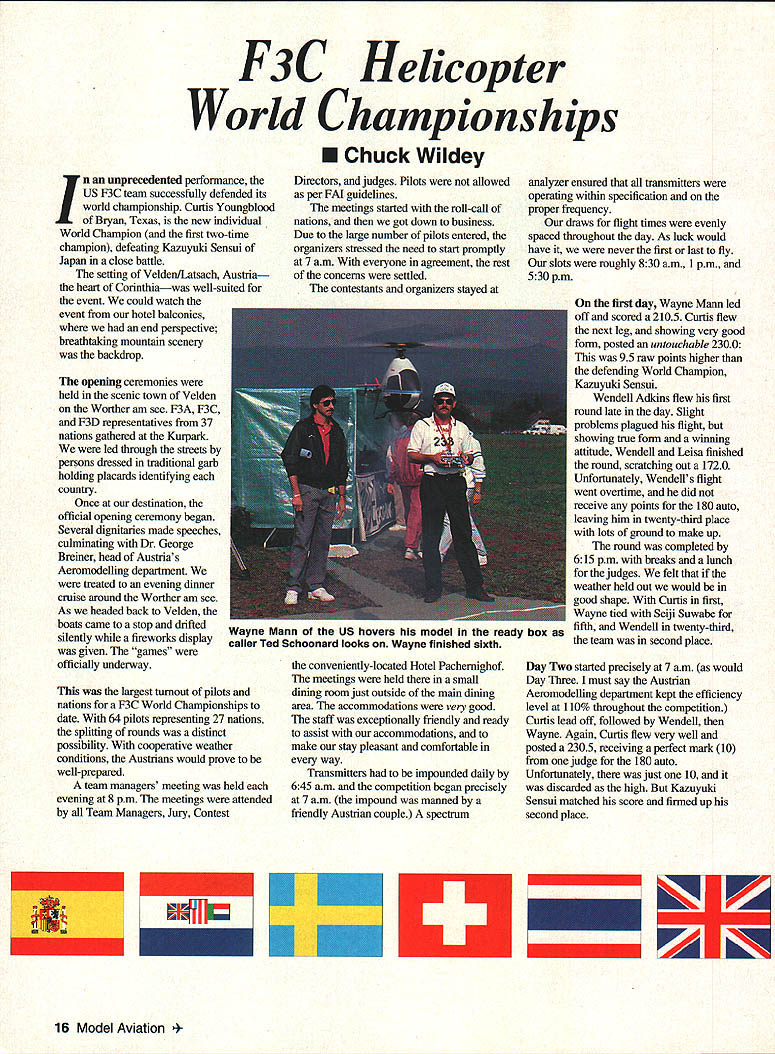
- Wayne Mann led off and scored 2105.
- Curtis Youngblood flew next and posted a dominating 2300, 9.5 raw points higher than defending World Champion Kazuyuki Sensui.
- Wendell Adkins flew late and, despite problems, finished with a 1720. His flight went overtime so he did not receive points for the 180 auto, leaving him in 23rd place with ground to make up.
- By the end of Day One the round finished by 6:15 p.m. With Curtis in first, Wayne tied Seiji Suwabe for fifth, and Wendell in 23rd, the U.S. team sat in second place.
Day Two
- Competition again started at 7 a.m. Curtis led off, followed by Wendell then Wayne.
- Curtis flew very well and posted 2305, receiving one perfect 10 for the 180 auto (one judge). That 10 was the high and later discarded. Kazuyuki Sensui matched Curtis’s score and secured second place.
- Wendell moved up to 11th with a 1965. Wayne scored 2140 and slipped to sixth. Seiji Suwabe posted 2165.
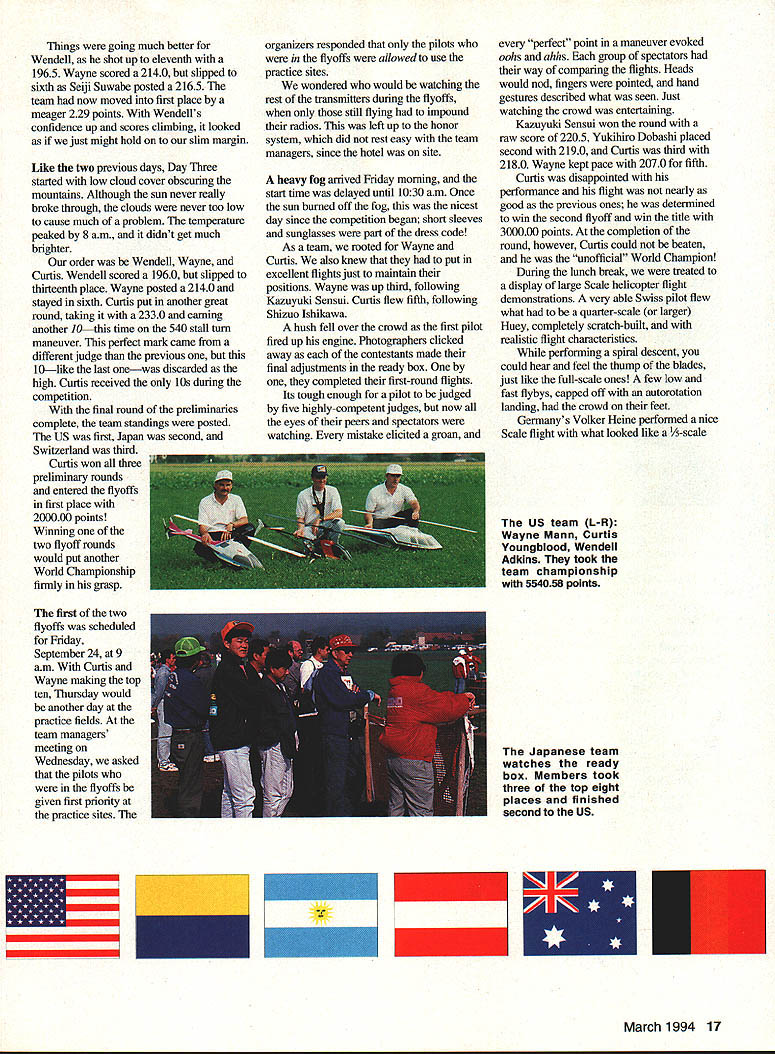
- The team moved into first place by a narrow margin of 229 points.
Day Three
- Low cloud cover again obscured the mountains, but conditions were usable.
- Order: Wendell, Wayne, Curtis. Wendell scored 1960 and fell to 13th. Wayne posted 2140 and stayed sixth.
- Curtis delivered another excellent round with a 2330, earning another 10 (a perfect mark on a 540 stall turn maneuver); one of the 10s was discarded as the high.
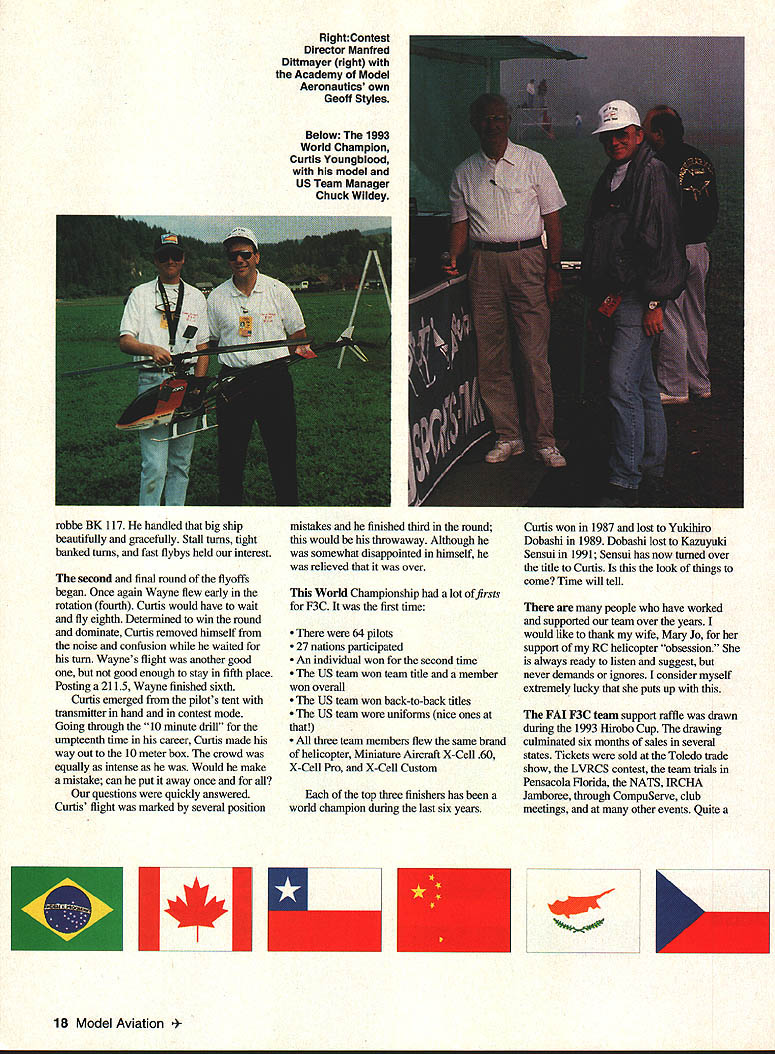
- Preliminary rounds concluded with team standings: U.S. first, Japan second, Switzerland third.
- Curtis won three preliminary rounds and entered the flyoffs in first place with 2000.00 points.
Flyoffs
The first flyoff was scheduled for Friday, September 24, at 9 a.m. (later delayed). Curtis and Wayne both made the top ten, so Thursday was reserved for practice. At the team managers’ meeting on Wednesday we asked that flyoff pilots get priority at the practice sites; the organizers agreed and allowed only those pilots in the flyoffs to use the practice fields.
There was concern about who would watch the impounded transmitters during the flyoffs when only active pilots had to impound radios. This was left to the honor system, which unsettled some team managers since the hotel was on site.
A heavy fog on Friday delayed the start until 10:30 a.m. Once it cleared, conditions became the best since the competition began — warm and sunny. Wayne and Curtis were both cheered on by the team. Wayne flew third in the rotation, Curtis fifth in the first flyoff.
First flyoff round
- The crowd hushed as each pilot prepared in the ready box. Every mistake drew groans and every excellent maneuver applause.
- Kazuyuki Sensui won the round with a raw score of 220.5.
- Yukihiro Dobashi was second with 219.0.
- Curtis was third with 218.0.
- Wayne posted 207.0 and placed fifth.
Curtis was disappointed with his first flyoff performance and aimed to win the second flyoff to secure the title with a combined 3000.00 points.
During lunch we were treated to large-scale helicopter demonstrations:
- A Swiss pilot flew what appeared to be a quarter-scale (or larger) Huey, scratch-built and with realistic flight characteristics — powerful blade thumps, low fast flybys, and a convincing autorotation landing.
- Germany’s Volker Heine performed a scale flight with what looked like a 1/5-scale Robbe BK 117, handling the large model with graceful stall turns, tight banked turns, and fast flybys.
Second and final flyoff round
- Wayne flew early in the rotation (fourth) and posted 211.5, finishing sixth.
- Curtis waited until eighth. After mental preparation and the usual preflight drill, he flew a solid round. Although he had several position mistakes and finished third in the round (this became his throwaway), his combined scores made him unbeatable in the final tally.
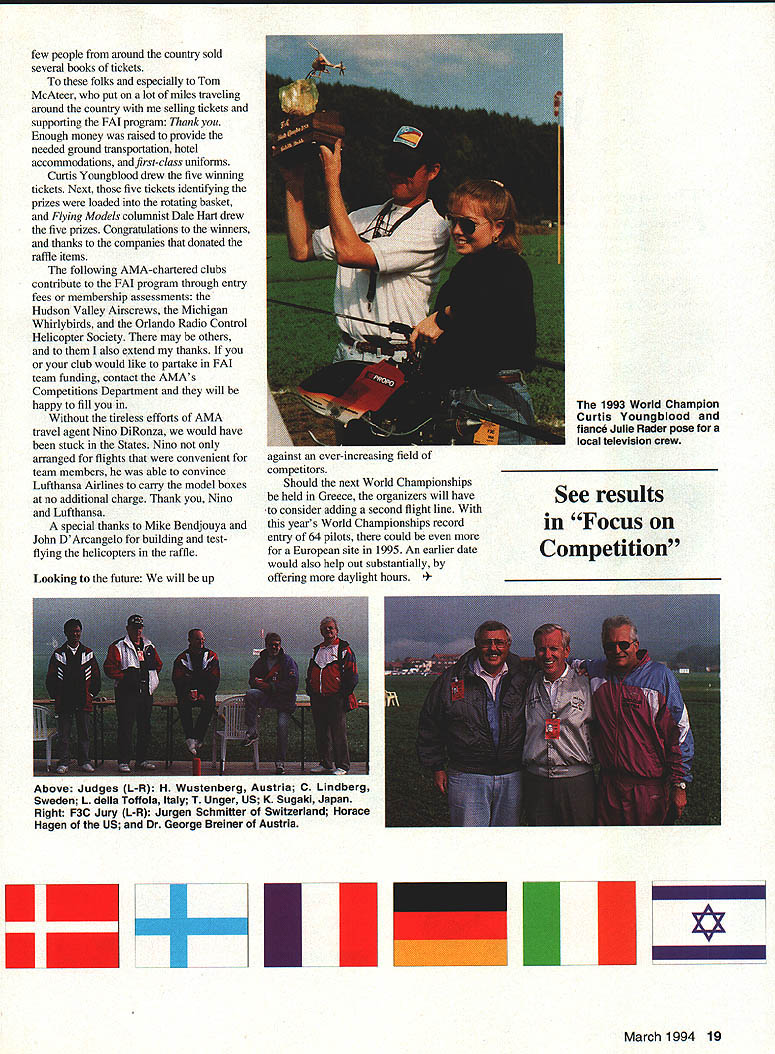
- Curtis Youngblood emerged as the (unofficial) World Champion.
Firsts and notable records
This World Championship featured many firsts for F3C:
- 64 pilots — the largest field to date
- 27 nations participating
- The first time an individual won the world title twice
- The U.S. team won the team title while also having a member win overall
- The U.S. team won back-to-back titles
- The U.S. team wore coordinated uniforms
- All three U.S. team members flew the same brand of helicopter: Miniature Aircraft X-Cell 60, X-Cell Pro, and X-Cell Custom
Each of the top three finishers had been a world champion during the last six years: Curtis won in 1987, lost to Yukihiro Dobashi in 1989; Dobashi lost to Kazuyuki Sensui in 1991; Sensui now handed the title to Curtis.
Team support, raffle, and acknowledgments
Many people have supported the team over the years. I’d like to thank my wife Mary Jo for her support of my RC helicopter “obsession.” She always listens, suggests, and is supportive.
The FAI F3C team support raffle was drawn during the 1993 Hirobo Cup, culminating six months of sales across several events (Toledo trade show, LVRCS contest, team trials in Pensacola, the NATS, IRCHA Jamboree), CompuServe, club meetings, and more. Many people sold multiple books of tickets.
Special thanks to Tom McAteer, who traveled widely selling tickets and supporting the FAI program. Enough money was raised to provide ground transportation, hotel accommodations, and first-class uniforms.
Curtis Youngblood drew the five winning tickets. Those five tickets identifying the prizes were then loaded into the rotating basket, and Flying Models columnist Dale Hart drew the five prizes. Congratulations to the winners, and thanks to the companies that donated raffle items.
The following AMA-chartered clubs contributed to the FAI program through entry fees or membership assessments: Hudson Valley Airscrews, Michigan Whirlibirds, and the Orlando Radio Control Helicopter Society. There may be others; to them I also extend my thanks. If you or your club would like to help fund the FAI team, contact the AMA Competitions Department.
Without the tireless efforts of AMA travel agent Nino DiRonza we would have been stuck in the States. Nino arranged convenient flights and convinced Lufthansa to carry the model boxes at no additional charge. Thank you, Nino and Lufthansa.
Special thanks also to Mike Bendjouya and John D'Arcareglo for building and test-flying the helicopters used in the raffle.
Looking to the future
We will face an ever-increasing field of competitors. If the next World Championships are held in Greece, organizers should consider adding a second flight line. With this year’s record entry of 64 pilots, a European site in 1995 could draw even more competitors. An earlier date would help by providing more daylight hours.
Transcribed from original scans by AI. Minor OCR errors may remain.

