
F3D PYLON WORLD CHAMPS
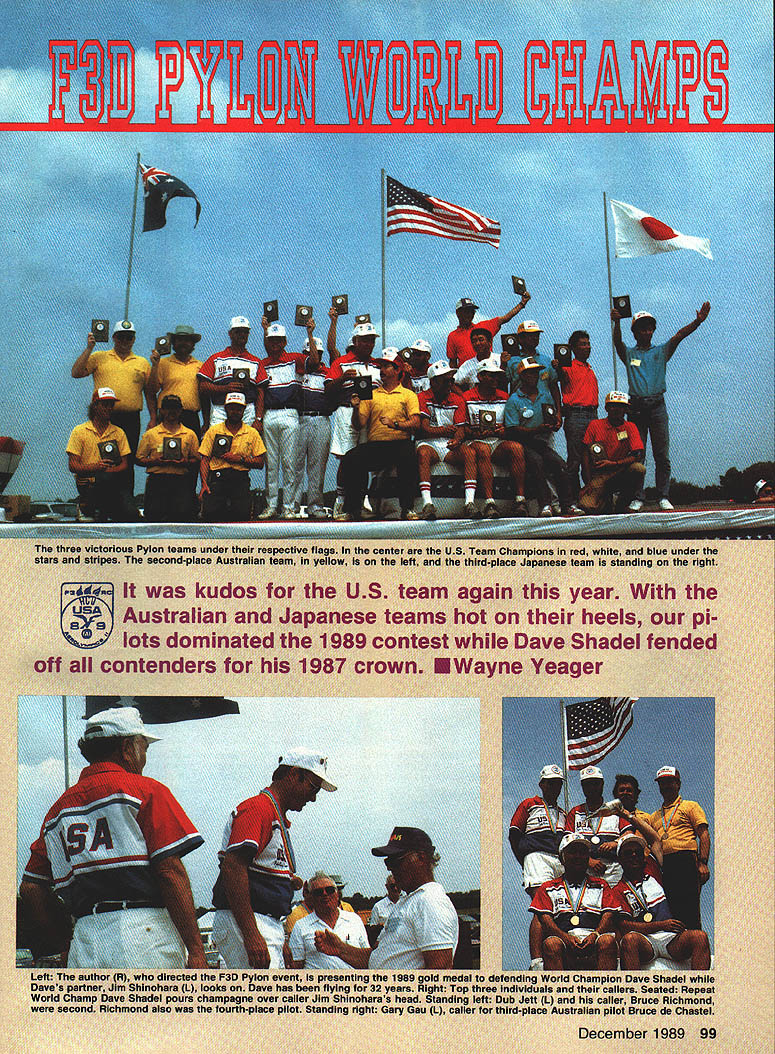
It was kudos for the U.S. team again this year. With the Australian and Japanese teams hot on their heels, our pilots dominated the 1989 contest while Dave Shadel fended off all contenders to claim his second F3D World Championship. — Wayne Yeager
The challenge of becoming World Champion
The difficulties encountered on the way to becoming World Champion are many and varied. Primary requirements include superb flying skills, perfect prop choice and needle-valve settings, a good plane, steady thumbs, and a lot of luck. Added to all that, the would-be champ needs to know how to stay out of other fliers' airspace and avoid obstructions—pylons and, above all, terra firma.
Get all these things working for you, and maybe you've got a shot. Repeat wins are rare—unless, that is, you are Hanno Prettner or Dave Shadel. F3A aerobatics virtuoso Hanno Prettner is so formidable he seems like a machine. Dave Shadel, whose name keeps cropping up at the top of racing results, has proven he may be the bionic model of a champion. Not only is Shadel the best in Formula 1, he is now F3D Pylon Racing World Champion twice over. That's impressive, especially since 1989 was only the third F3D World Championships.
Event overview
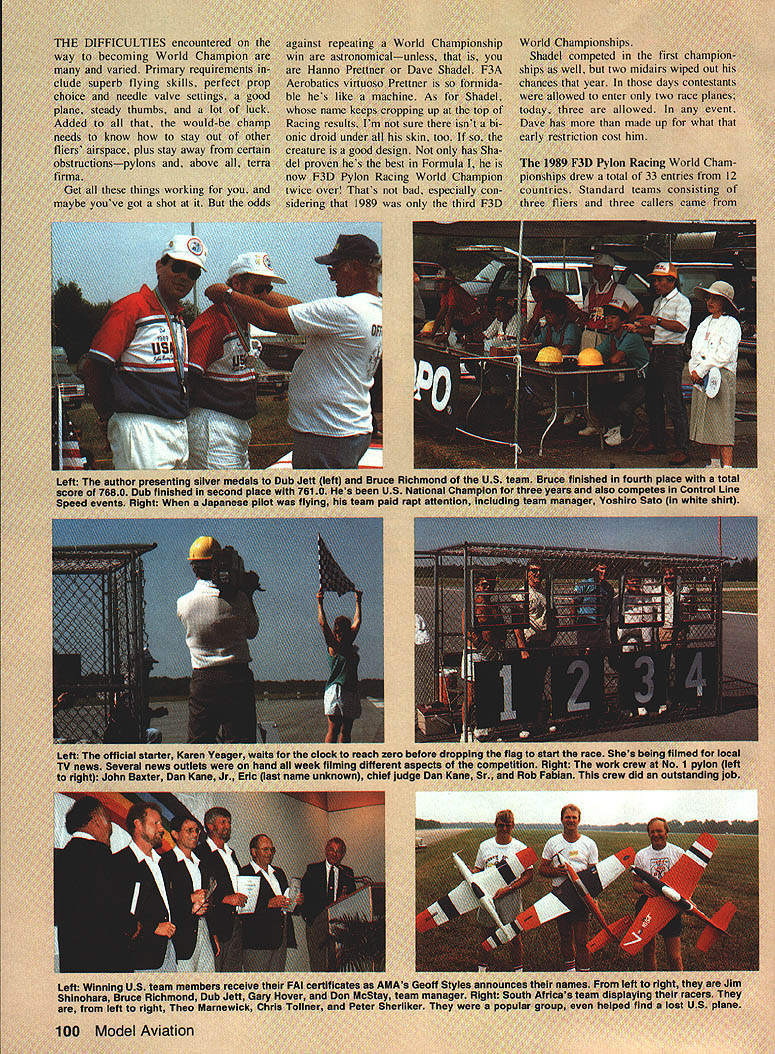
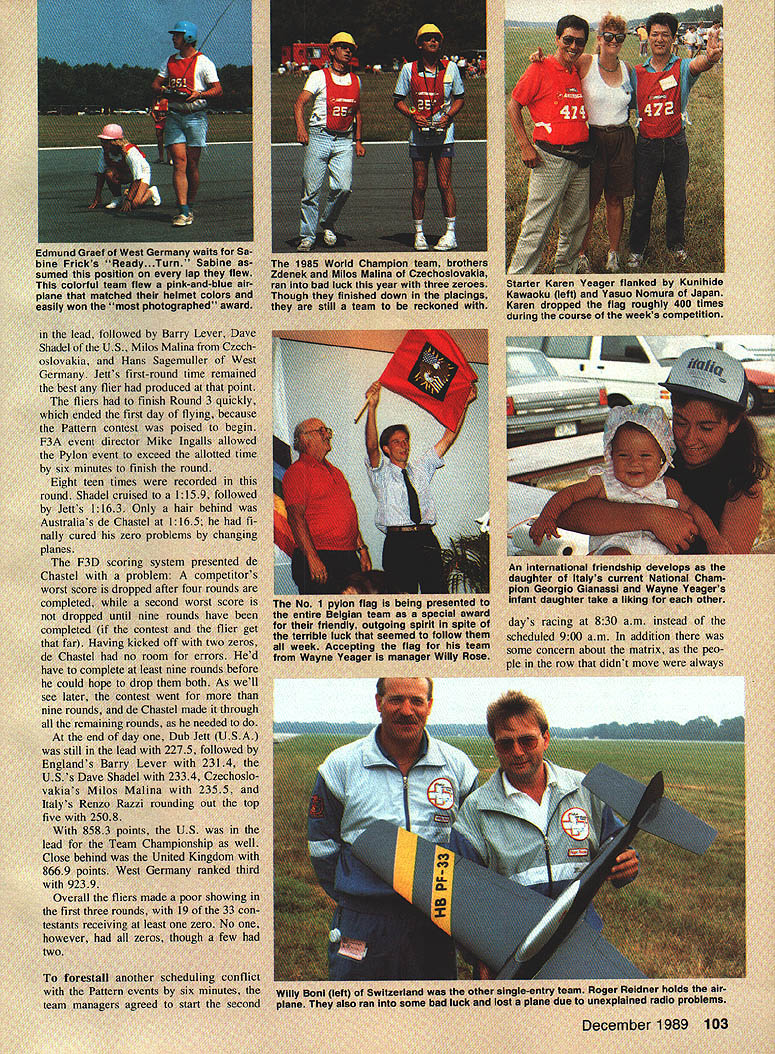
The 1989 F3D Pylon Racing World Championships drew 33 entries from 12 countries. Standard teams (three fliers and three callers) came from:
- Australia
- Austria
- Belgium
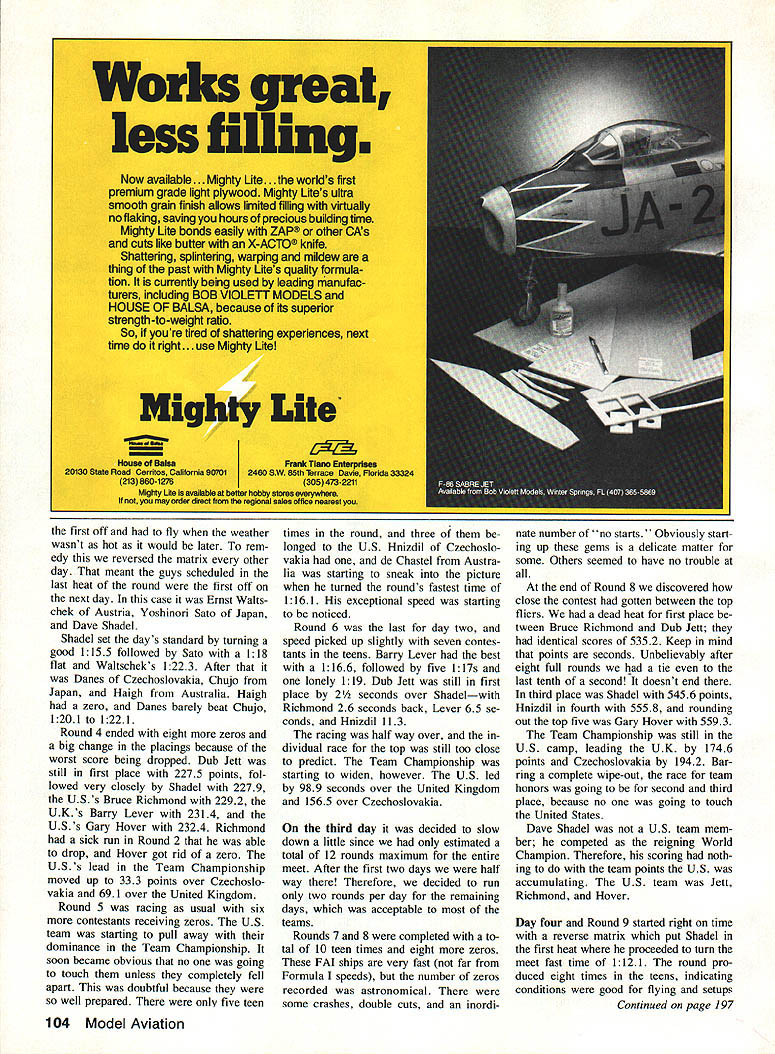
- Czechoslovakia
- Denmark
- France
- Germany
- Great Britain
- Japan
- The Netherlands
- South Africa
- United States
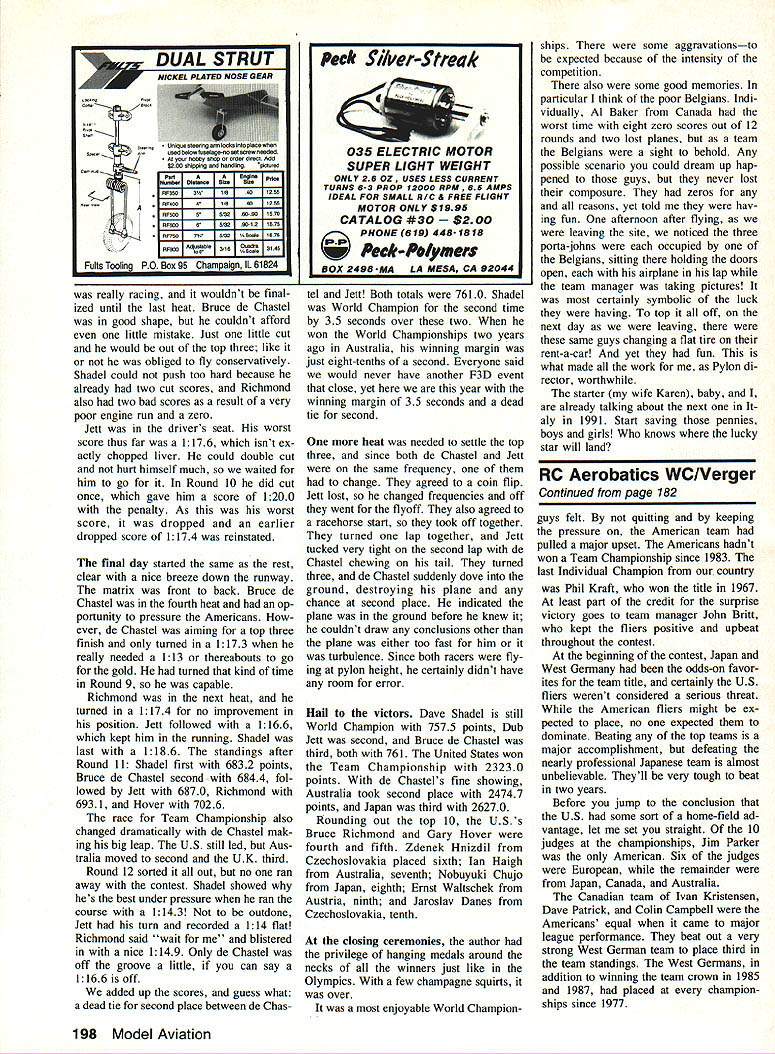
Switzerland and Italy sent single-entry teams at various stages; overall representation included South Africa, Italy, Canada, Switzerland and West Germany among others.
Pylon racing was scheduled between 9 a.m. and noon each day, with afternoons devoted to Pattern and Helicopter events. Sunday and Monday were set aside for practice. The matrix included three heats of three planes and six four-plane heats; racing began Tuesday morning.
Early rounds and conditions
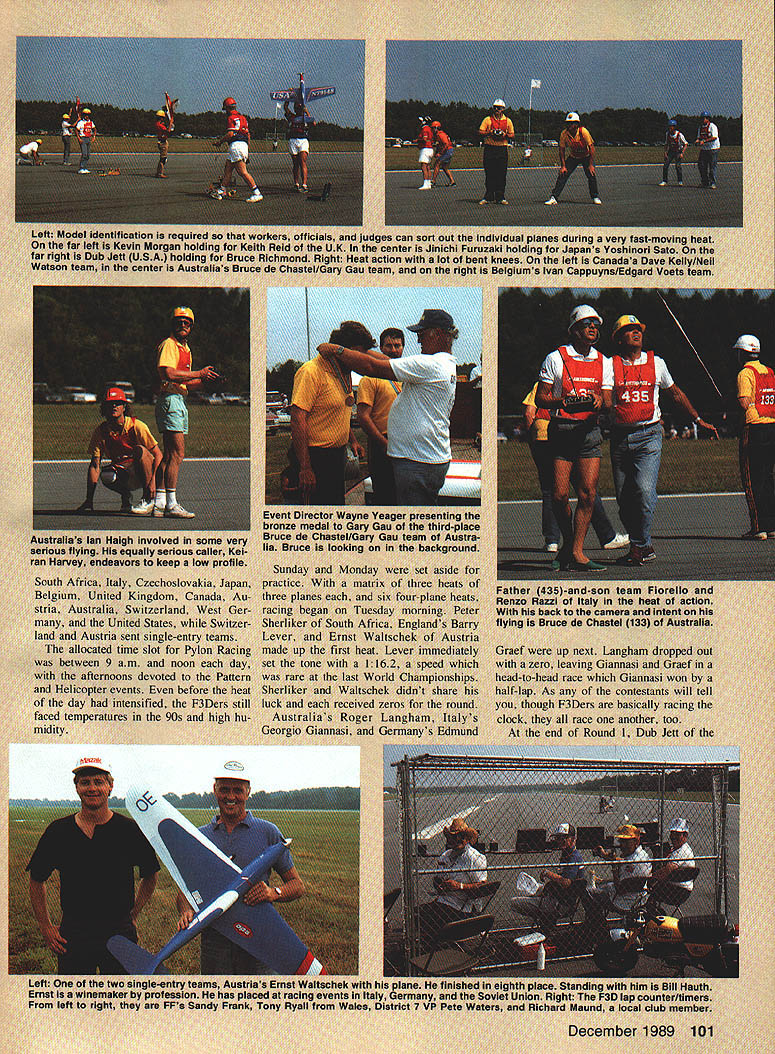
First off, the weather wasn't hot initially — which would later change — and organizers used a reversed matrix every other day so those scheduled last one day would go first the next. In one heat Ernst Waltschek (Austria), Yoshinori Sato (Japan), and Dave Shadel (U.S.) flew together. Shadel set the day's standard with a 1:15.5, followed by Sato at 1:18.0 and Waltschek at 1:22.3. After them came the Danes, Nobuyuki Chujo (Japan), and Jan Haigh (Australia); Haigh scored a zero, and the Danes narrowly beat Chujo with 1:20.1 to 1:22.1.
Round 4 ended with eight zeros. Because the worst score was dropped, placings shifted. Dub Jett held first place with 535.2 points, followed very closely by Dave Shadel with 535.6, Bruce Richmond (U.S.) with 535.2 (tied earlier), Barry Lever (U.K.) and Gary Hover (U.S.). Richmond was able to drop a sick run in Round 2; Hover also dropped a zero. The U.S. lead in the Team Championship grew to a comfortable margin over Czechoslovakia and the United Kingdom.
Middle rounds — momentum builds
Round 5 saw many zeros again. The U.S. team began to pull ahead; their team dominance soon became obvious as they were well prepared and consistent. As rounds continued, Zdenek Hnizdil (Czechoslovakia), Bruce de Chastel (Australia) and others began to sneak into contention. A fastest time of 1:16.1 in one round drew attention for its exceptional speed.
By Round 6 speeds picked up slightly with seven contestants in the teens. Barry Lever posted the best of 1:16.6 followed by several 1:17s and a single 1:19. Dub Jett still held first individually, a few seconds ahead of Shadel, with Richmond and Lever trailing. The Team Championship widened: the U.S. led by 989 seconds over the United Kingdom and 1,565 over Czechoslovakia.
After two days (about halfway through the estimated 12-round meet), organizers slowed the schedule to two rounds per day for the remaining days — a plan acceptable to the teams.
Rounds 7 and 8 produced ten teen times and eight more zeros. FAI ships were very fast and the number of zeros was high due to crashes, double cuts and no-starts. After Round 8 the contest at the top was exceptionally close, with a dead heat for first between Bruce Richmond and Dub Jett (identical scores).
Late rounds — drama and records
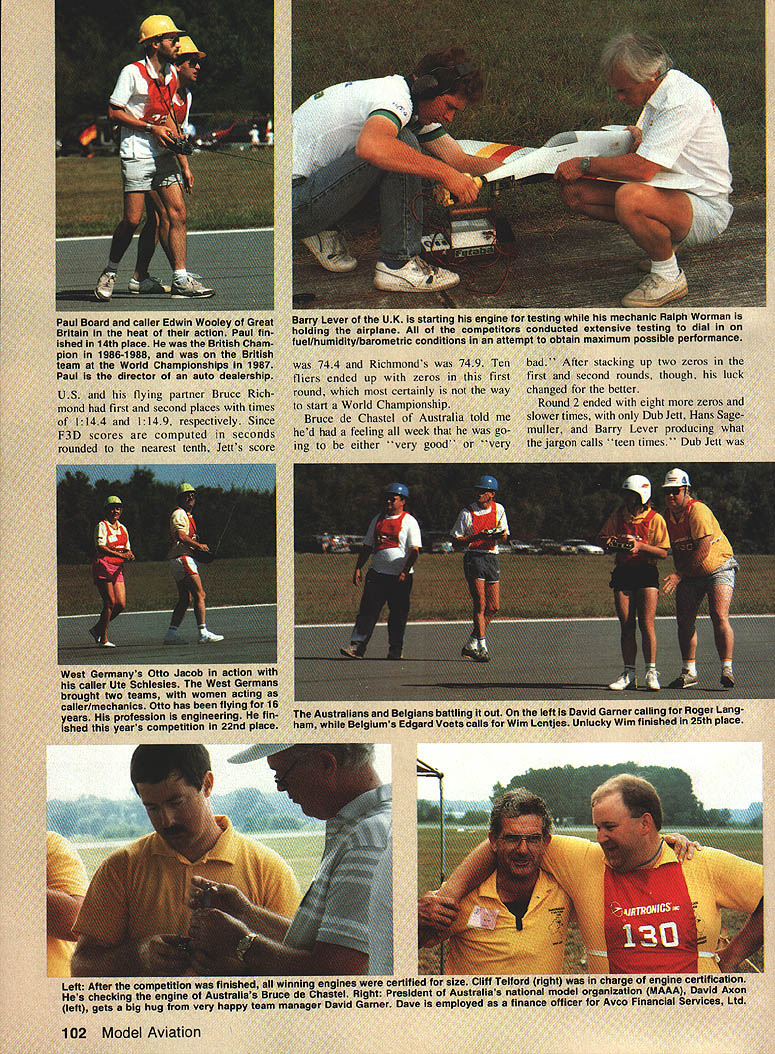
Round 9 began with a reverse matrix and excellent conditions. Shadel turned the meet's fastest time of 1:12.1, then improved on it later with a new world-record 1:11.3 after fitting a new tuned pipe. Round 9 also allowed dropping each contestant's second-worst score, which dramatically reshuffled the standings.
Bruce de Chastel, who had begun the meet with two zeros, was able to drop both and vaulted from 17th after Round 8 to the top after Round 9 with 532.9 points. He was followed closely by Dub Jett (533.0) and Dave Shadel (533.3) — only four-tenths of a point separating the top three. Richmond and Hover were close behind.
It was still anyone's race and would not be decided until the final heats. De Chastel needed near-perfect flying to hold onto the lead. Shadel already had two cut scores and could not push recklessly; Richmond had also suffered bad scores due to an engine run and a zero. Jett, with a relatively good worst score, could afford to take more risks.
In Round 10 Jett cut once and scored 1:20.0 with the penalty; since it became his worst, it was dropped and an earlier dropped score was reinstated. Competition remained tight.
Final rounds and flyoff
The final day began with clear conditions and a front-to-back matrix. De Chastel, in the fourth heat, could not produce the very fast time needed for gold and posted 1:17.3. Richmond followed with 1:17.4, Jett 1:16.6, and Shadel 1:18.6 in that sequence. After Round 11 the standings were:
- Shadel — 683.2 points
- Bruce de Chastel — 684.4
- Dub Jett — 687.0
- Bruce Richmond — 693.1
- Gary Hover — 702.6
Round 12 left the contest tightly locked. Shadel ran 1:14.31; Jett recorded 1:14.14; Richmond 1:14.9; de Chastel 1:16.6. After totaling scores there was a dead tie for second place between de Chastel and Jett at 761.0 points. Shadel won the World Championship by 3.5 seconds over those two. A flyoff was required to settle second and third.
De Chastel and Jett agreed to a coin flip to decide frequencies for the flyoff. Jett lost the flip and changed. They started together; on the second lap Jett tucked tight with de Chastel closely behind. On the third lap de Chastel suddenly dove into the ground, destroying his plane and his chance at second. He reported the plane hit before he could react; possible causes included speed or turbulence at pylon height, leaving no room for error.
Results
- Dave Shadel (USA) — World Champion, 757.5 points
- Dub Jett — 761.0 points
- Bruce de Chastel (AUS) — 761.0 points (crash in flyoff)
Team results:
- United States — 2323.0 points
- Australia — 2474.7 points
- Japan — 2627.0 points
Top 10 individual finishers:
- Dave Shadel (USA) — 757.5
- Dub Jett — 761.0
- Bruce de Chastel (AUS) — 761.0
- Bruce Richmond (USA)
- Gary Hover (USA)
- Zdenek Hnizdil (Czechoslovakia)
- Jan Haigh (Australia)
- Nobuyuki Chujo (Japan)
- Ernst Waltschek (Austria)
- Jaroslav Danes (Czechoslovakia)
Notable individual notes:
- Al Baker (Canada) had the toughest outing, recording eight zero scores out of 12 rounds and losing two planes.
- The U.S. team (Jett, Richmond, Hover) dominated the Team Championship; Dave Shadel competed as the reigning World Champion and was not on the U.S. team roster.
Closing impressions and anecdotes
At the closing ceremonies the author had the privilege of hanging medals around the winners' necks, Olympic-style, followed by a few champagne squirts. The event was enjoyable despite the inevitable aggravations that come with intense competition.
A memorable scene involved the Belgian team: despite suffering every possible mishap, they kept their composure and sense of fun. One afternoon all three Belgians sat in the portable toilets, each holding the door open while cradling his airplane for a photo — a perfect symbol of their luck that week. The next day they were cheerfully changing a flat tire on their van. Moments like that made the hard work of the Pylon director worthwhile.
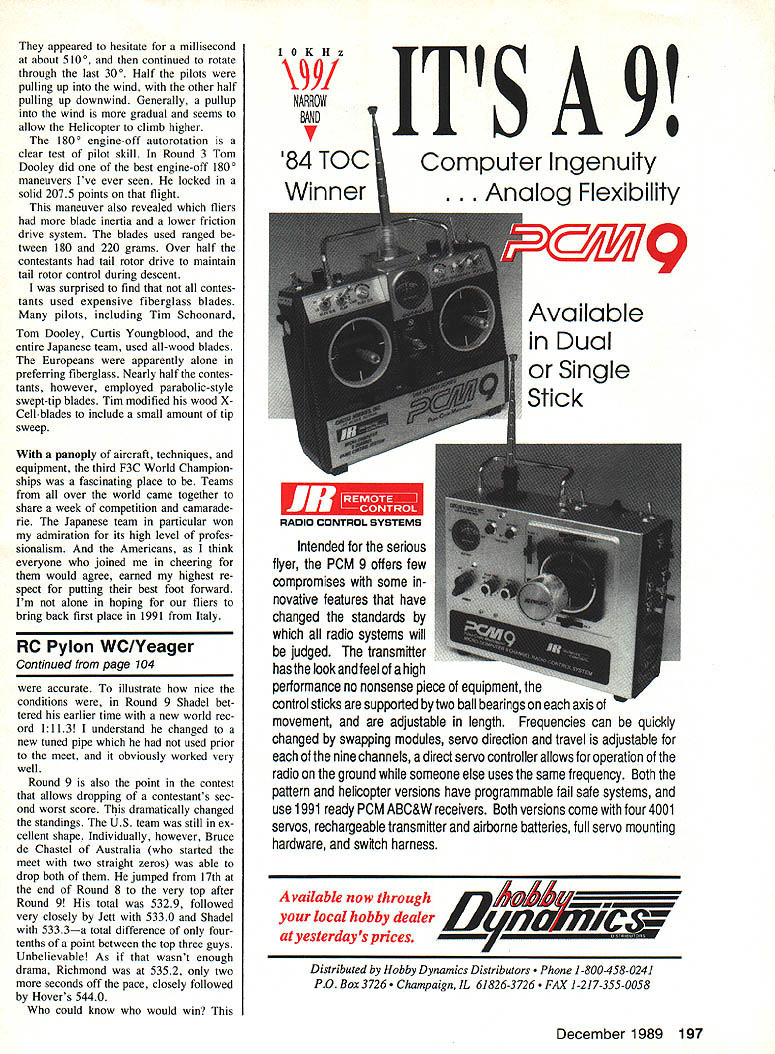
The starter (my wife Karen), our baby, and I are already talking about the next World Championships in Italy in 1991. Start saving those pennies, boys and girls — who knows where the lucky start will land?
Transcribed from original scans by AI. Minor OCR errors may remain.

