
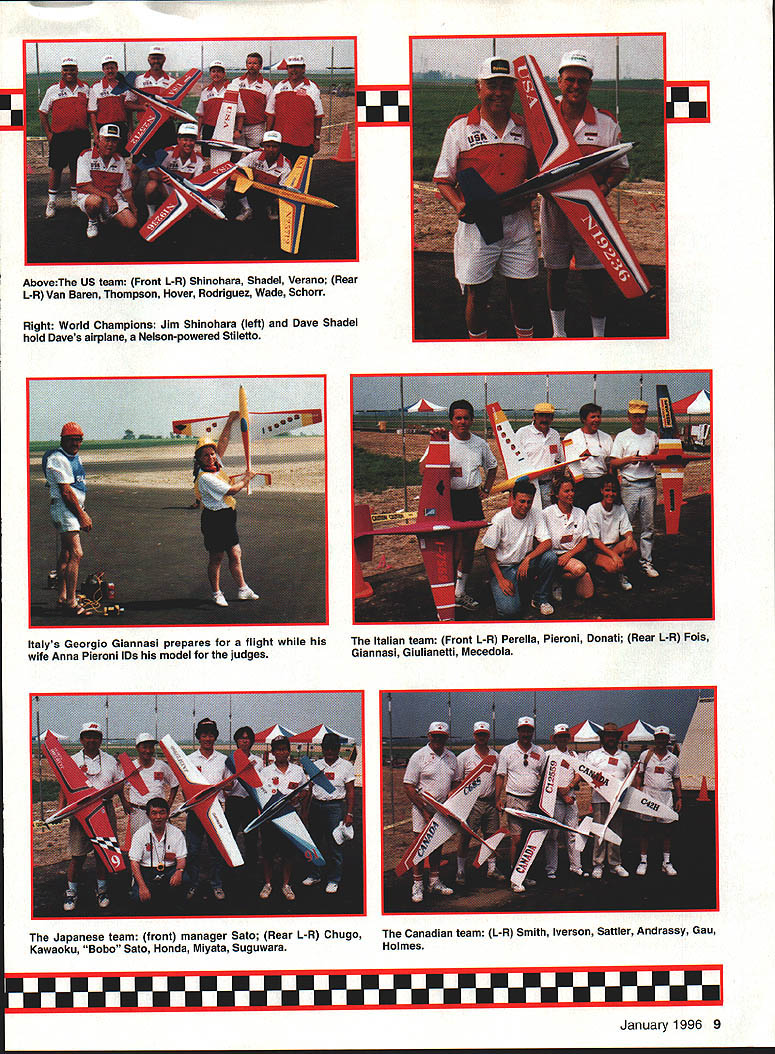
F3D World Championships
Wayne Yeager
Overview
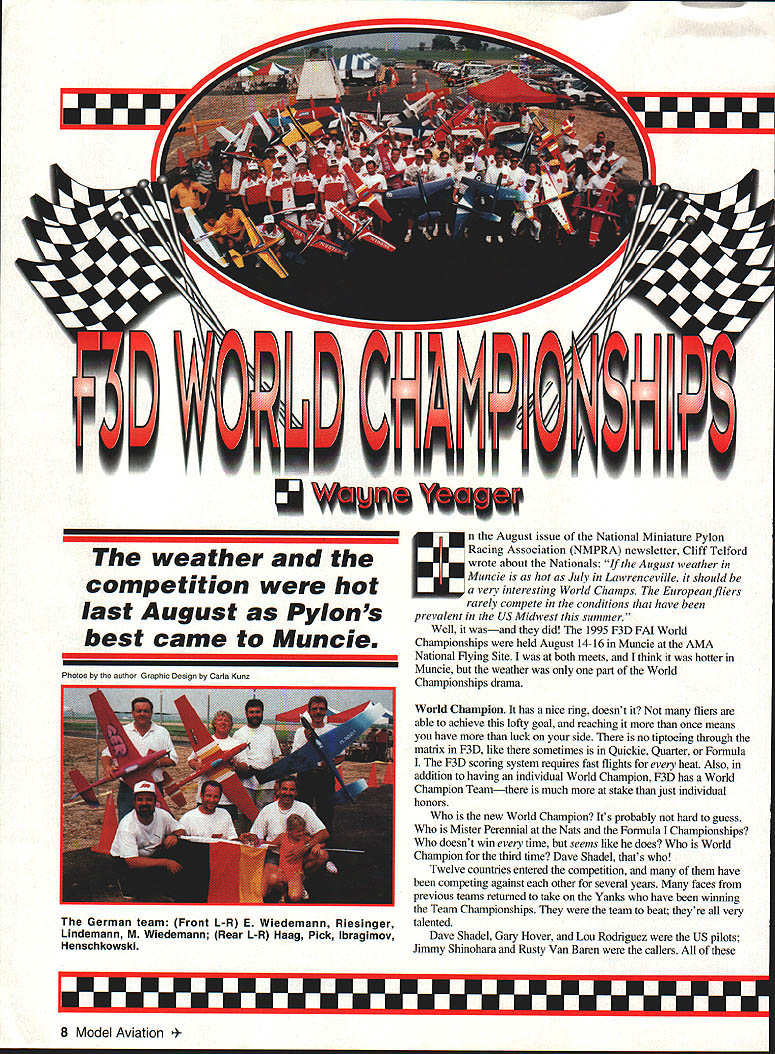
The weather—and the competition—were hot last August as pylon's best came to Muncie. The 1995 F3D FAI World Championships were held August 14–16 at the AMA National Flying Site. The heat was only one part of the drama; the competition demanded fast, consistent flying, and the F3D scoring system rewards speed in every heat. In F3D there is both an individual World Champion and a World Champion Team, so much more than individual honors were at stake.
Who became the new World Champion? Dave Shadel—World Champion for the third time.
Twelve countries entered the meet, most fielding three-pilot teams (the Netherlands sent only two). The U.S. team was Dave Shadel, Gary Hover, and Lou Rodriguez, with Jimmy Shinohara and Rusty Van Baren as callers.
Since 1987 U.S. team members had repeated as World Champion four straight times. The U.S. had gotten faster due to improved equipment: best times had fallen from about 1:18 to 1:06–1:07, roughly a second per lap. But the rest of the world had made huge gains as well—especially in equipment. Many teams used American-made engines or close clones, and engine interchangeability was becoming common.
Teams and Equipment
- Engines:
- 12 competitors flew Rossis (some modified by Ranjit Phelan)
- 10 used Nelsons
- 8 used IRs (made by Ravil Ibragimov)
- 2 used MVVSs
- 2 used MBs
- 1 used an O.S.
- 1 used a Termik
- Airframes included:
- Tsunamis, Mustangs, Stilettos, Kaze Killers, Heinkels, Folkerts
- A Nomo, a Mustil, an Orlov Special, and a Monk Magic
The Germans ran IRs built by Ravil Ibragimov; these engines performed very well and were close to Nelsons in capability. The Germans were as fast as any Americans—the main difference was how close they chose to fly to the poles.
Competition format and scoring
- 12 countries (36 competitors) formed a 4 × 9 matrix so every scheduled heat had four airplanes.
- The only allowable frequencies were the Nats frequencies; JR and Futaba provided receivers and crystals so international teams could change to the required frequencies without issue.
- Official practice was held Saturday; opening ceremonies and processing were Sunday. The contest began Monday morning.
- Planned schedule: originally six rounds Monday, six Tuesday, four Wednesday (16 rounds total). After discussions, teams agreed to fly six rounds on Day One, five on Day Two, and five on the final day—still 16 rounds total.
- In FAI scoring, time is converted to seconds and counted as points (1:10 = 70 points). The lowest total points wins.
- A cut adds 10% to the score (e.g., 70 becomes 77).
- A zero (no-finish, disqualification, etc.) adds 200 points.
- After four rounds, each flier may drop his worst score; after nine rounds, he may drop his second-worst. These throwaways can dramatically affect standings.
Richard Verano set a world record of 1:06.40 (breaking Dub Jett’s 1:06.60), later backing it up with several low 1:07s.
Round summaries
#### Rounds 1–4 (Day One)
- Opening ceremonies featured FAI Vice President Pierre Chaussade, Don Lowe (AMA), and the mayor of Muncie. The newly completed Stage Center runways were dedicated; Don Lowe cut the ribbon by flying through it.
- Processing that afternoon completed the measurement, engine marking, and pipe checks for about 108 airplanes. The meet started promptly the next morning.
- Early heats illustrated the nature of FAI racing: racers compete against the clock and times are calculated from the moment each airplane is flagged off the line, so the last-off can still win a heat.
- After nine heats in the first round the individual leaders were:
- Manfred Pick (Germany) — 69.03
- Gary Hover (USA) — 69.41
- Richard Verano (defending champion) — 69.45
- Ranjit Phelan (Australia) — 69.91
- Alan Lawrie (UK) — 70.09
- Rounding out the top ten included Chris Callow (Australia), Yoshinori Sato (Japan), Dave Shadel (USA), Robbert van den Bosch (Netherlands), and Zdenek Hnizdil (Czech Republic).
- Team-wise the U.S. led after Round One with 220.64 points, followed closely by Australia (223.70) and Germany (224.72).
- By the end of Round Two Richard Verano had moved into first with 135.85 points. Ranjit Phelan recorded a zero in Round Two and fell to 26th, though his score would recover after the four-round drop.
- Round Three was run in rising heat. After the round the top individual totals were Verano (203.24), Pick (210.67), Shadel (212.24), Hover (213.56), and Thomas Lindemann (216.37). The U.S. team held first; Germany was second.
- Round Four saw the U.S. falter: Rodriguez recorded a zero and Hover cut a pylon. These were counted as worst scores and thus dropped after four rounds, so the U.S. retained the lead over Germany. Several teams took zeros that shuffled the team standings (Canada moved into fifth).
#### Rounds 5–6 (End of Day One)
- Round Five was flown in the worst heat of the day; shade became critical for workers and competitors. After Round Five standings were largely unchanged.
- Round Six finished around 4:30 p.m. The U.S. suffered when Rodriguez recorded a second no-finish; because he had already used his throwaway, this zero had to count. As a result, the U.S. team dropped from first to fourth. Germany moved into the lead, followed by Australia and the Czech Republic. Lou Rodriguez had two zeros after six rounds and faced tremendous pressure to stay clean for the remaining rounds.
#### Rounds 7–11 (Day Two)
- The second day started at 9 a.m. with calm skies. Rounds Seven and Eight produced no major standing changes.
- Round Nine was pivotal due to the second-worst-score drop. Milos Malina jumped into fifth individually; the U.S. team returned to first place, followed by Germany, Australia, the Czech Republic, and Italy.
- Verano remained the leader but his margin over Shadel narrowed. Robbert van den Bosch was climbing the standings, showing great straightaway speed.
- After Round Eleven, with intense heat wearing everyone down, the team managers opted to fly five rounds on Day Two and five on the final day (rather than six and four) to ease the load.
#### Final rounds (Rounds 12–16)
- The final day started an hour earlier to beat the heat. Lou Rodriguez suffered another no-finish that had to count, which dropped the U.S. team behind Germany and others.
- Individual lead changed several times:
- Shadel moved ahead of Verano at one point because Verano had accumulated cut times and at least one zero; Verano later reclaimed the lead in Round 13 with a 67.10 to Shadel's 70.88.
- Ranjit Phelan recorded a third zero and fell out of contention individually; this also hurt the Australian team.
- Round 14 saw Verano record a second zero (dropped as his second-worst), and Shadel took a 68.56, expanding his lead slightly.
- Round 15 proved decisive: Shadel turned in 69.59 to Verano’s 71.95—enough for Shadel to secure the championship.
- Dave Shadel completed 15 rounds without a zero; he had only one cut for the entire meet (in Round One). He sat out Round 16, which would have been dropped in favor of an earlier throwaway anyway.
- Final top individuals:
- Dave Shadel (USA) — World Champion
- Richard Verano — second (only 9.6 seconds behind Shadel after 15 scoring rounds)
- Thomas Lindemann (Germany)
- Robbert van den Bosch (Netherlands)
- Milos Malina (Czech Republic)
- Final team standings:
- Germany — Team Champion
- United States
- Czech Republic
- Australia
- Italy
After the contest
The final tasks were engine measurement, worker appreciation, and closing ceremonies. The top three individual winners received medals and the U.S. national anthem was played. When the top three teams took the stand the German team sprayed champagne and their national anthem was played. Team managers lowered their countries’ flags to the FAI theme and the meet was declared closed.
The awards banquet that night featured appreciation awards to many who made the meet a success: AMA staff (Steve Kalt, Greg Chartrand, Teresa McKee, Liz Helms), Paul Page, starter Karen Yeager (honored for a decade of work), Horizon Hobbies and Futaba, Northwest Model Distributors, and Rich’s—Brew-Dickey and Randy Ritt (who donated and worked on the fuel).
Team managers and winners gave short remarks; Adolf Klein (Czech team manager) invited everyone to Prague in 1997. The emotional highlight was Dave Shadel and his teammates receiving their trophies. Shadel praised Verano, saying the winner should have been Verano—Verano had been slightly faster at times but had recorded cuts and zeros. Shadel’s consistency and traffic-handling made him the champion. His times varied only 4.06 seconds from his highest (1:11.69) to his lowest (1:07.63) across the meet.
After the banquet competitors and guests collected autographs, exchanged hugs, and said goodbye—many new friendships were made around the world, perhaps never to meet again.
Transcribed from original scans by AI. Minor OCR errors may remain.

