
The Fabulous X‑Wind
Sometimes a design concept has to wait for technology to catch up. With future advances in RC autopilots, flying this innovative, .90 FS–powered model could one day be as easy as driving a car.
Aerial oddity?
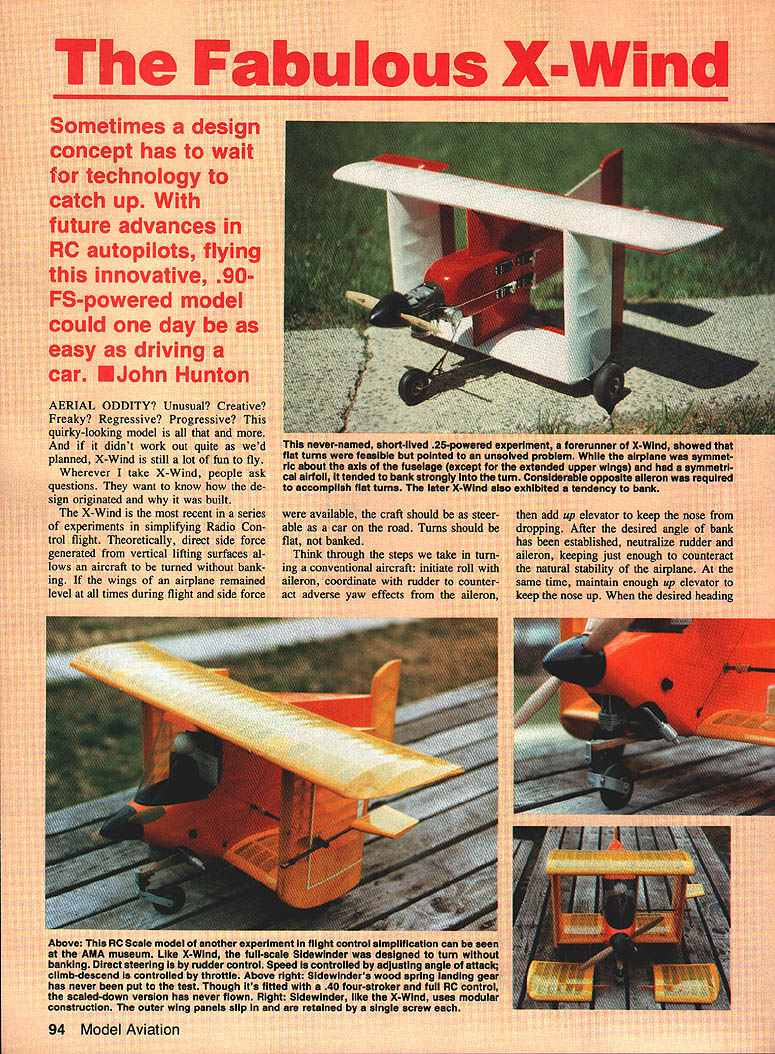
Unusual? Creative? Freaky? Regressive? Progressive? The X‑Wind is all that and more. If it didn't work out quite as we'd planned, X‑Wind is still a lot of fun to fly. Wherever I take X‑Wind, people ask questions about how the design originated and why it was built.
The X‑Wind is the most recent in a series of experiments in simplifying radio control flight. Theoretically, direct side force generated from vertical lifting surfaces allows an aircraft to be turned without banking. If the wings of an airplane remain level at all times during flight and side force is available, the craft should be as steerable as a car on the road—turns would be flat, not banked.
Think through the conventional steps in turning an aircraft:
- Initiate roll with aileron.
- Coordinate with rudder to counteract adverse yaw from the aileron.
- Add up elevator to keep the nose from dropping.
- When the desired bank angle is reached, neutralize aileron and rudder (keeping just enough to counteract the airplane's stability) and maintain up elevator.
- To return to level flight, apply opposite aileron and rudder, relax up elevator, then neutralize controls when the wings are level.
No wonder it takes so long to master RC flying.
Now think about turning a vehicle: side force is available. Turn the steering mechanism until the desired heading is attained, then neutralize. That's it. You've turned the car. Or an airplane as easily as a fish in water—did you ever see a fish bank to turn? Which method of turning is easier to understand and accomplish?
Historical experiments with side force
Use of side force in aeronautics goes back decades. Notable examples:
- Early 1970s: Ryan Navion trials (reported in Air Progress, January 1974) mounted parts of a Schweitzer glider wing near the Navion's center of gravity. Vertically oriented wings were actively controlled to cancel crosswind effects during landings.
- F‑16 experiments: Vertical/horizontal lifting surfaces were used to generate side force for what was called translated flight. When mounted near the center of gravity, these lifting surfaces allowed the plane to be translated without conventional banking. See AIAA Papers No. 72‑94, 74‑70 and 77‑1119.
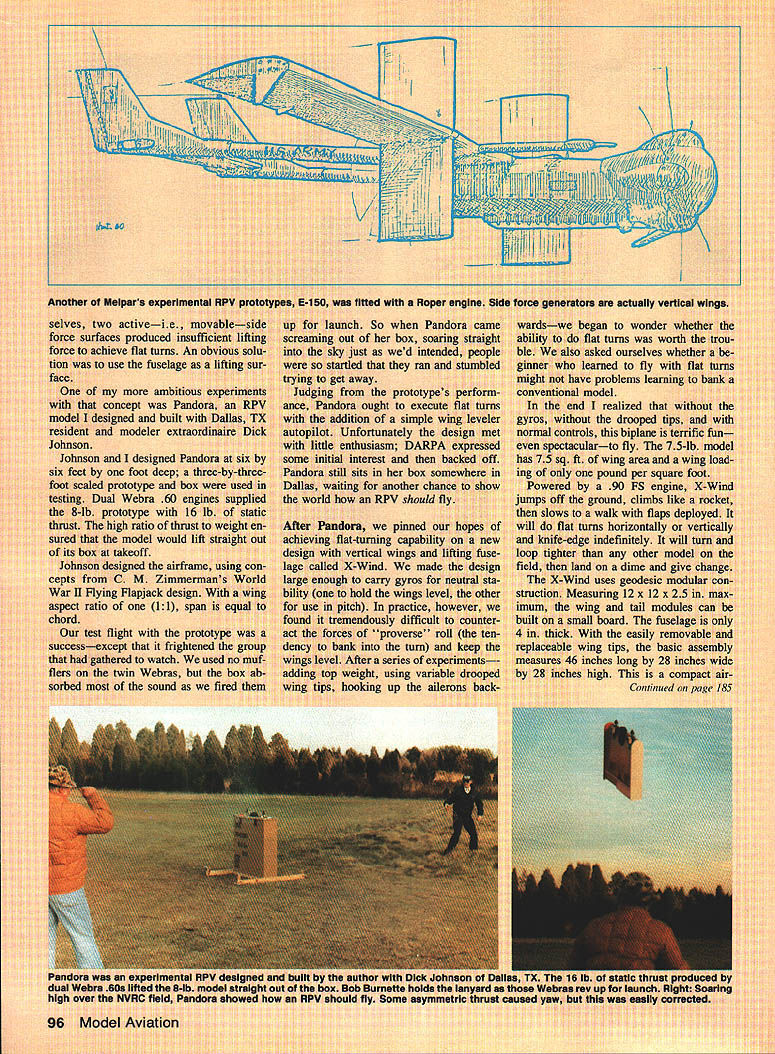
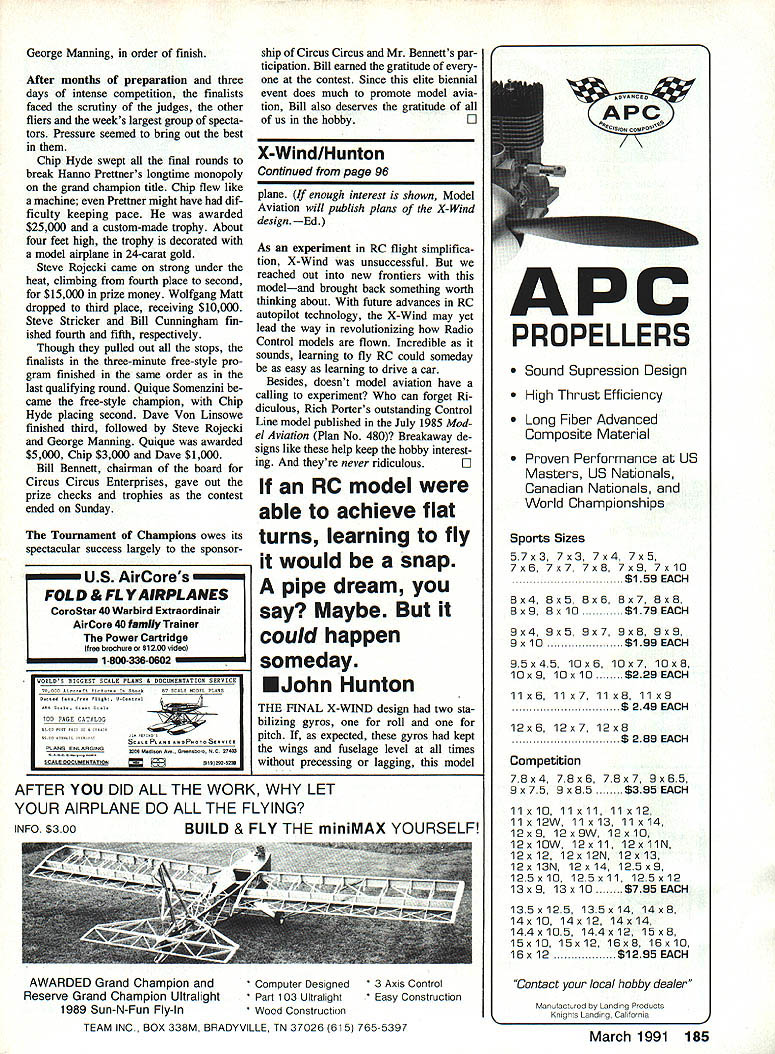
- 1970s RPV work: Melpar Corporation (a division of E‑Systems) and the USAF Flight Dynamics Laboratory, with Don Lowe, developed side‑force techniques for terminal guidance of RPVs (remotely piloted vehicles). Melpar built several prototypes and showed dramatic improvement in terminal accuracy; engineers also saw potential for simplifying RPV autopilots. Melpar left the business before the approach was fully tested, though some researchers continued home and lab experiments.
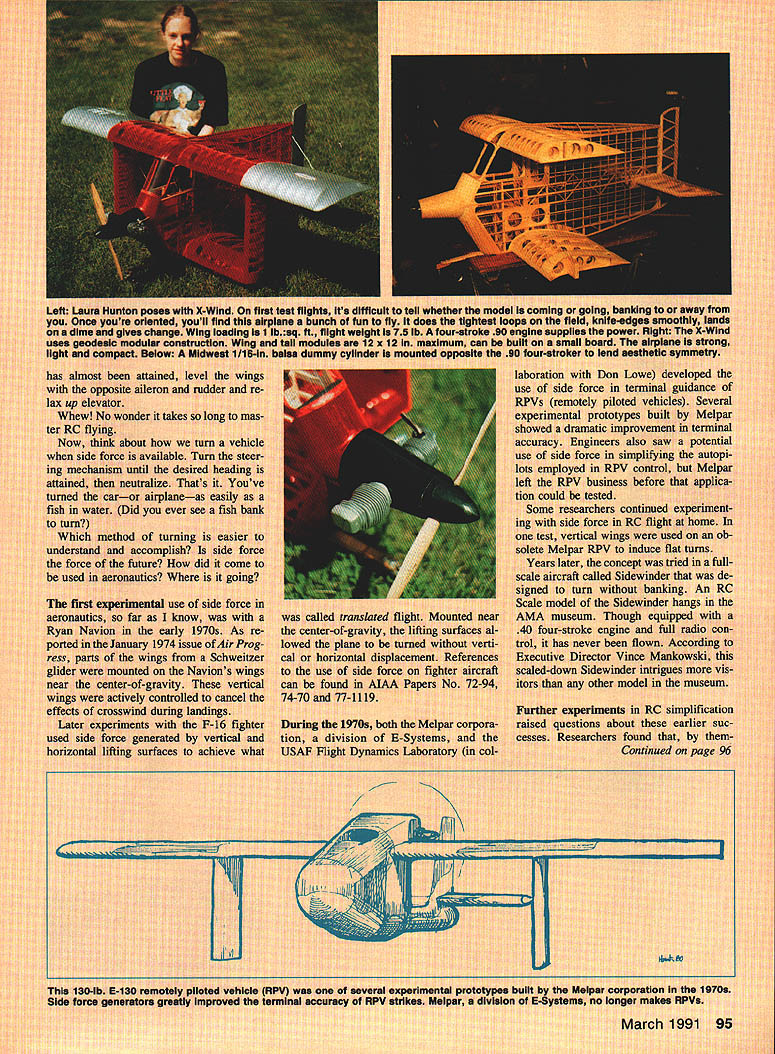
- Sidewinder: A full‑scale aircraft designed to turn without banking inspired an RC scale model that hangs in the AMA museum. Although equipped with a .40 four‑stroke engine and full radio control, it has never flown; the scaled Sidewinder continues to intrigue visitors.
Further experiments raised questions: two movable side‑force surfaces by themselves produced insufficient lateral lift to achieve reliable flat turns. An obvious solution was to use the fuselage as an additional lifting surface.
Pandora — an ambitious experiment
One ambitious experiment was Pandora, an RPV model designed and built with Dallas modeler Dick Johnson.
- Dimensions: designed at 6 x 6 x 1 ft; a 3 x 3 ft scaled prototype was used in testing.
- Power: dual Webra .60 engines provided 16 lb of static thrust to lift an 8 lb prototype right out of its box.
- Design influence: Johnson used concepts from C. M. Zimmerman's World War II Flying Flapjack—Pandora had a wing aspect ratio of 1:1 (span equal to chord).
Prototype testing succeeded spectacularly, launching straight out of its box and climbing as intended. The lack of mufflers startled spectators—the takeoff noise and explosive launch sent people running. Performance indicated Pandora could execute flat turns with a simple wing‑leveler autopilot. Despite some initial interest (DARPA included), the project never advanced; Pandora still sits in her box somewhere in Dallas.
The X‑Wind project
After Pandora, we focused on achieving flat‑turn capability with a new design called X‑Wind, featuring vertical wings and a lifting fuselage. The design was large enough to carry gyros for neutral stability—one gyro to hold the wings level and another for pitch stabilization.
In practice, keeping the wings level proved tremendously difficult due to "proverse" roll (the tendency to bank into the turn). After a series of experiments—adding top weight, using variable drooped wingtips, and even reversing aileron hookups—we questioned whether flat‑turn capability was worth the trouble. We also wondered whether a beginner who learned on a flat‑turning model would have trouble transitioning to conventional banked flight.
In the end, I realized that without the gyros and drooped tips, and with normal controls, this biplane is terrific—even spectacular—to fly.
Key X‑Wind characteristics:
- Weight and area: 7.5 lb model with 7.5 sq ft wing area (wing loading = 1 lb/sq ft).
- Powerplant: .90 FS engine; the model jumps off the ground and climbs aggressively, then slows to a walk with flaps deployed.
- Flight capabilities: can perform flat turns horizontally or vertically, fly knife‑edge indefinitely, turn and loop tighter than most models, and land with minimal space.
- Construction: geodesic modular construction; wing and tail modules are small (maximum 12 x 12 x 2.5 in) and can be built on a small board. The fuselage is only 4 in thick. With removable wing tips, the basic assembly measures 36 in long x 28 in wide x 28 in high—a very compact airplane.
- Plans: (If enough interest is shown, Model Aviation may publish plans of the X‑Wind design. —Ed.)
As an experiment in RC flight simplification, X‑Wind was unsuccessful in fully achieving flat turns without significant stabilization aids. But the project explored new frontiers and produced a highly enjoyable model that suggests future possibilities. With advances in RC autopilot technology, the X‑Wind concept may yet revolutionize how radio‑control models are flown—learning to fly RC could someday be as easy as learning to drive a car.
The role of experimentation
Model aviation has a calling to experiment. Breakaway designs keep the hobby interesting—think of Rich Porter's outstanding Control Line model "Ridiculous" (Model Aviation, July 1985, Plan No. 480). Designs like X‑Wind may seem odd, but they push boundaries and provoke useful thought. If an RC model could achieve practical flat turns, learning to fly would be much easier. It may be a pipe dream, but it could happen someday.
— John Hunton
A fictional dialogue (how learning might change)
ACT I BEGINNER: Hello. Can I fly my new RC trainer here? INSTRUCTOR: Have you flown it before? BEGINNER: No. INSTRUCTOR: Sorry. You'll need many hours of dual instruction before you can fly your trainer by yourself. BEGINNER: Is it really that hard to fly? INSTRUCTOR: Yep. Take a basic turn, for example:
- You input aileron in the direction of the turn.
- Add up elevator to compensate for lost lift as the lift vector tilts.
- Add rudder to compensate for adverse yaw.
- Good fliers add a little power for the extra drag.
- Neutralize aileron when the proper bank angle is established and continue the turn.
- To come out: apply opposite aileron and opposite rudder against proverse yaw, relax up elevator, and return controls to neutral when the wings are level.
BEGINNER: Want to buy a trainer?
ACT II (One year later) BEGINNER: Hello there. Can I fly my new Crosswind here? INSTRUCTOR: Have you flown it before? BEGINNER: No. INSTRUCTOR: Sorry, you'll need many hours of dual instruction before you can fly your model by yourself. BEGINNER: Not according to these instructions. There are just a few lines. Let me read them to you:
"Instructions on how to fly the Crosswind: To go up, pull the right stick back. To go down, push the right stick forward. To turn right, push the right stick to the right. To turn left, push the right stick to the left. To go faster, push the left stick forward. To go slower, pull the left stick back."
INSTRUCTOR: This is ridiculous. Here, let me fly it and check it out for you. BEGINNER: No, wait. There is one more instruction here. It says: "Note: The Crosswind can be flown by almost anyone. You steer it through the air just the way you steer a car on the ground. Any beginner can fly the Crosswind intuitively. An experienced RC pilot, however, will not be able to fly it without many hours of dual instruction." INSTRUCTOR: Are you saying...? BEGINNER: Yes. I'm going to solo now. Do you want me to give you some dual instruction later?
Final thought
Which method of turning is easier to understand and accomplish? Side force or conventional banking? Side force might be the force of the future.
Transcribed from original scans by AI. Minor OCR errors may remain.

