
FAC Nationals
Arrival and Registration
It was raining as the DC-10 touched down on the glistening Rochester Airport runway. Fernando Ramos and I had kept our fingers crossed for good weather ever since departing LAX for our pilgrimage to Free Flight Scale's main event, the Flying Aces "Nats," held every two years since 1978.
"It always clears up after raining at night," the car rental attendant said, offering a little homespun meteorological opinion. We weren't reassured as a lightning flash lit up the window and rolling thunder rumbled in the distance.
We had arrangements with Tom Arnold, San Diego Scale staffer, to meet in the terminal and share the rental of a station wagon. Tom had arrived about three hours earlier and had considerately picked up the wagon, pulling it up to the bustling terminal. We stuffed our luggage in the back, taking pains not to jolt the plywood boxes with their precious stick-and-tissue contents. It probably didn't make any difference since they had already been subjected to airline cargo holds.
We set out in the gloom, windshield wipers ticking off their monotonous cadence, headed for the State University of New York 30 miles to the south. The rain had stopped by the time we reached the college. Even with a campus map, thoughtfully provided by Contest Facilitator Bob Clemens, we had to bump around for a while before we located the gym, where an informal Peanut contest was just concluding. Greetings were exchanged with old friends, some we hadn't seen for a number of years. Old acquaintances were quickly renewed, and anticipation of Saturday's events began to build.
By 10 p.m. we had registered and retired to our dorm rooms. Little groups formed up and down the narrow hallways, and a happy exchange of modeling lore (and tall tales) continued well past midnight.
The Flying Field and First Day
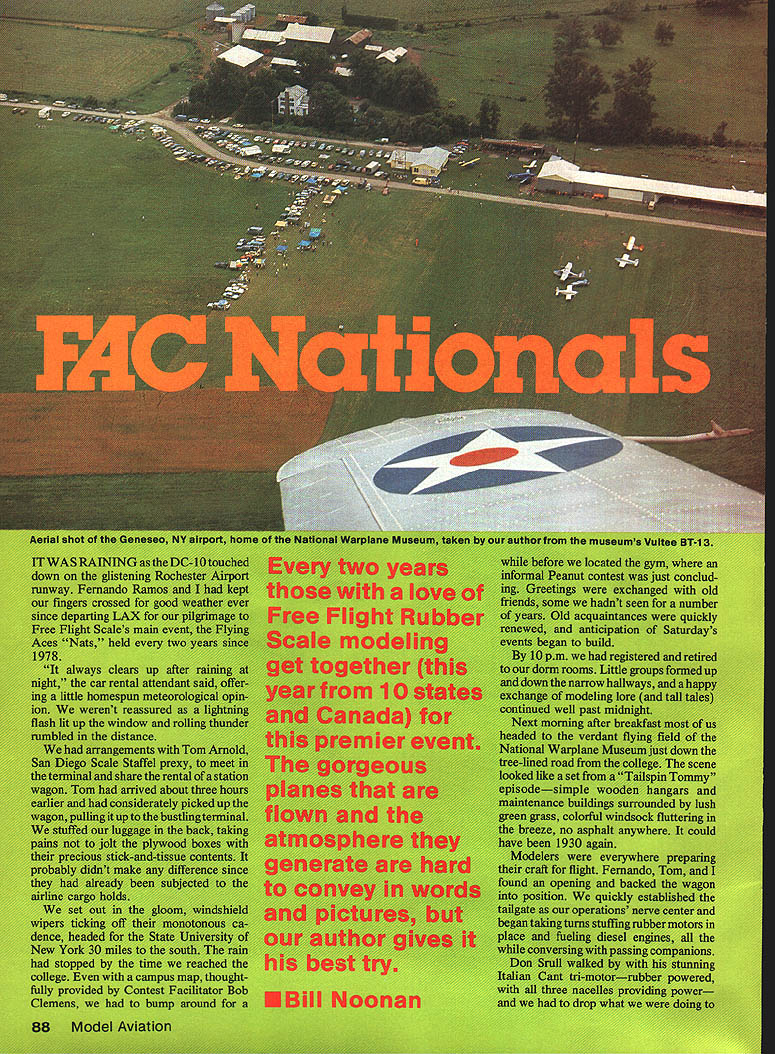
Next morning after breakfast most of us headed to the verdant flying field of the National Warplane Museum just down the tree-lined road from the college. The scene looked like a set from a "Tailspin Tommy" episode—simple wooden hangars and maintenance buildings surrounded by lush green grass, colorful windsocks fluttering in the breeze, no asphalt anywhere. It could have been 1930 again.
Modelers were everywhere preparing their craft for flight. Fernando, Tom, and I found an opening and backed the wagon into position. We quickly established the tailgate as our operations' nerve center and began taking turns stuffing rubber motors in place and fueling diesel engines, all the while conversing with passing companions.
Every two years those with a love of Free Flight Rubber Scale modeling get together (this year from 10 states and Canada) for this premier event. The gorgeous planes that are flown and the atmosphere they generate are hard to convey in words and pictures, but our author gives it his best try. — Bill Noonan
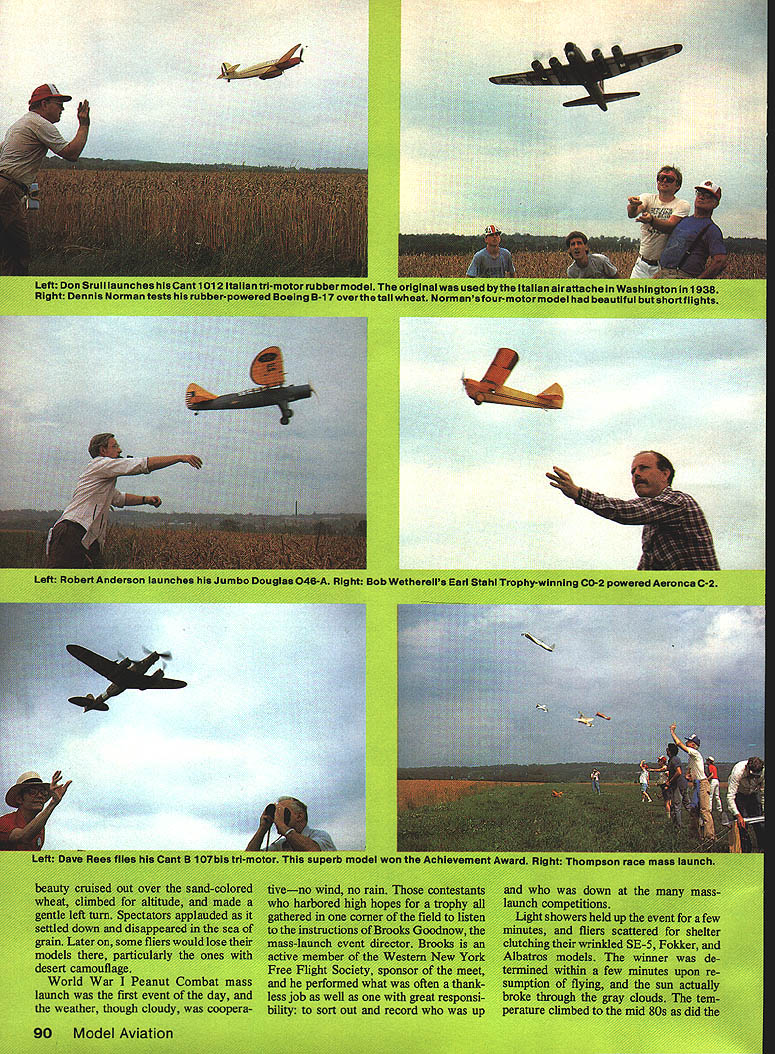
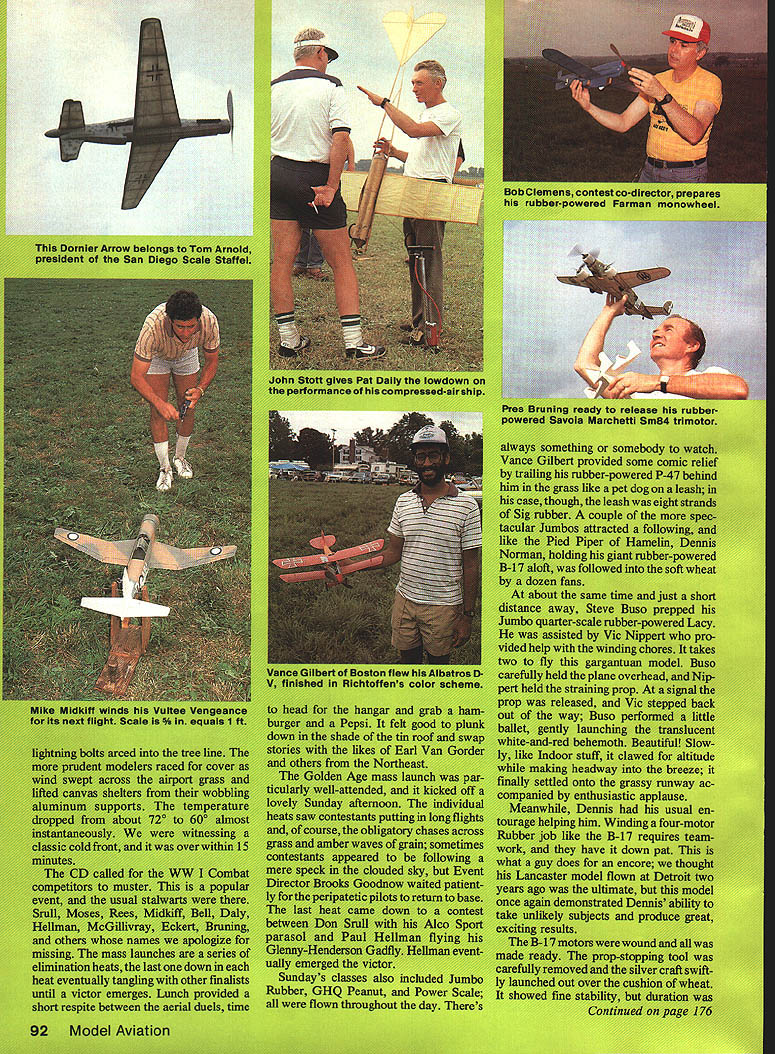
Don Snell walked by with his stunning Italian Cant tri-motor — rubber powered, with all three nacelles providing power — and we had to drop what we were doing to follow him out to the "wheat line" for a test launch. The field of grass was wrapped in a ribbon of waist-high wheat, and we had been given permission to do our testing there.
Don enlisted the help of AMA Museum Curator Furst Bowers to act as a winding stooge. The three-engined Cant requires a little more attention than conventional rubber models since each motor is wound separately. A foam-rubber "tool" acts as a prop stop and is held in place until the moment of launch. This was to be a test, so Don cranked in fewer than maximum winds. The launch was flawless; the cream-and-red Cant rose slowly, drew a close circle, then climbed steadily out of sight. Long shafts of sunlight filtered through and cast bright green ribbons across the soft grass.
A beauty cruised out over the sand-colored wheat, climbed for altitude, and made a gentle left turn. Spectators applauded as it settled down and disappeared in the sea of grain. Later on, some fliers would lose their models there, particularly the ones with desert camouflage.
Mass-Launch Events and Competitions
World War I Peanut Combat mass launch was the first event of the day, and the weather, though cloudy, was cooperative—no wind, no rain. Those contestants who harbored high hopes for a trophy all gathered in one corner of the field to listen to the instructions of Brooks Goodnow, the mass-launch event director. Brooks is an active member of the Western New York Free Flight Society, sponsor of the meet, and he performed what was often a thankless job as well as one with great responsibility: to sort out and record who was up and who was down at the many mass-launch competitions.
Light showers held up the event for a few minutes, and fliers scattered to shelter clutching their wrinkled SE-5, Fokker, and Albatros models. The winner was determined within a few minutes upon resumption of flying, and the sun actually broke through the gray clouds. The temperature climbed to the mid-80s as did the humidity.
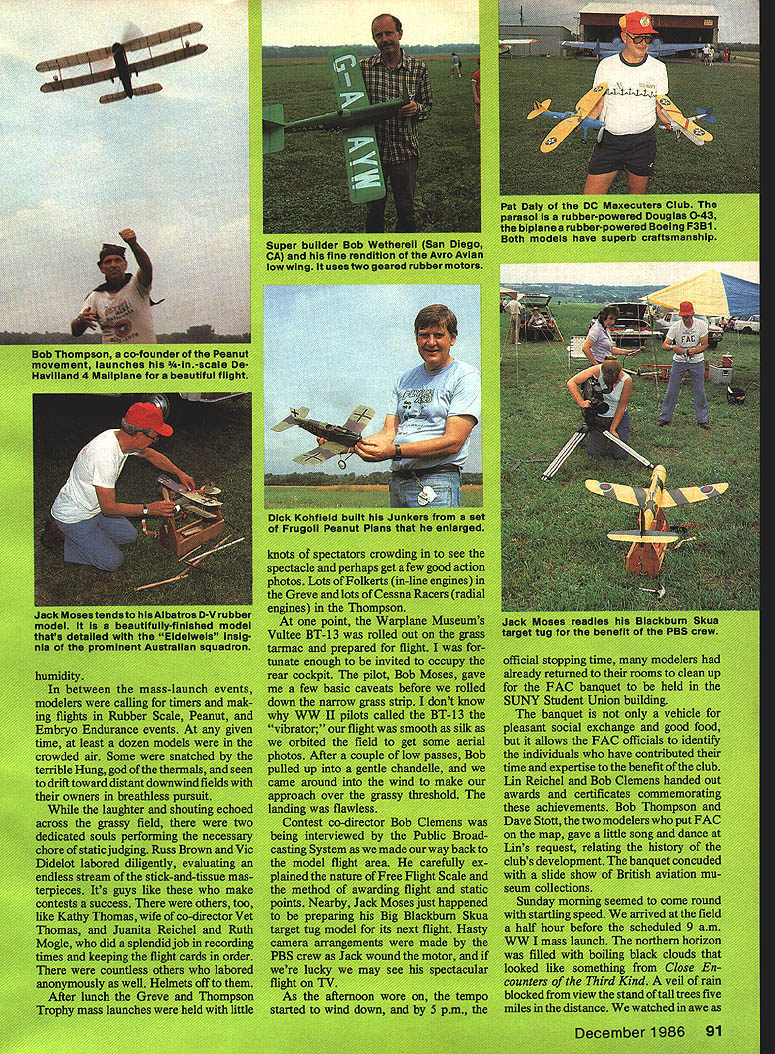
In between the mass-launch events, modelers were calling for timers and making flights in Rubber Scale, Peanut, and Embryo Endurance events. At any given time, at least a dozen models were in the crowded air. Some were snatched by the terrible Hung, god of the thermals, and sent to drift toward distant downwind fields with their owners in breathless pursuit.
After lunch the Greve and Thompson Trophy mass launches were held with little knots of spectators crowding in to see the spectacle and perhaps get a few good action photos. Lots of Folkerts (in-line engines) in the Greve and lots of Cessna Racers (radial engines) in the Thompson.
The Golden Age mass launch was particularly well-attended, and it kicked off a lovely Sunday afternoon (see Sunday Highlights). The individual heats saw contestants putting in long flights and, of course, the obligatory chases across grass and amber waves of grain; sometimes contestants appeared to be following a mere speck in the clouded sky, but Event Director Brooks Goodnow waited patiently for the parachute pilots to return to base. In one late heat Don Srull competed with his Alco Sport parasol against Paul Hellman flying his Glenny-Henderson Gadfly; Hellman eventually emerged the victor.
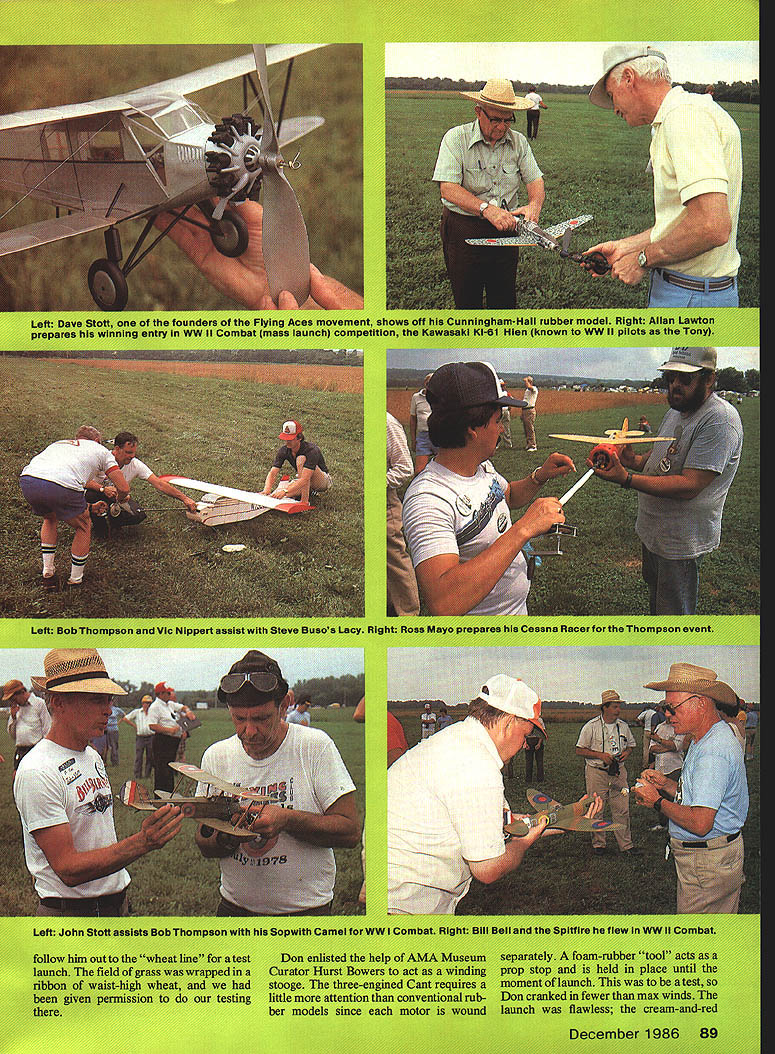
The last mass launch, WWII Combat, is always one of the most popular. At 3 p.m. Goodnow called for participants with his bullhorn. Guys came from all points carefully carrying their Thunderbolts, Hellcats, Wildcats, Mustangs, and all sorts of lesser-known designs which gained fame between 1940 and 1945. Within an hour all the heats were completed, and Allan Lawton, with his beautiful and colorful Kawasaki Ki-61 Hien, was declared the winner.
Notable Flights and Jumbo Models
At one point, the Warplane Museum's Vultee BT-13 was rolled out on the grass tarmac and prepared for flight. I was fortunate enough to be invited to occupy the rear cockpit. The pilot, Bob Moses, gave me a few basic caveats before we rolled down the narrow grass strip. I don't know why WWII pilots called the BT-13 the "vibrator"; our flight was smooth as silk as we orbited the field to get some aerial photos. After a couple of low passes, Bob pulled up into a gentle chandelle, we came around into the wind to make our approach over the grassy threshold. The landing was flawless.
Vance Gilbert provided some comic relief by trailing his rubber-powered P-47 behind him in the grass like a pet dog on a leash; in his case, though, the leash was eight strands of Sig rubber. A couple of the more spectacular Jumbos attracted a following, and, like the Pied Piper of Hamelin, Dennis Norman, holding his giant rubber-powered B-17 aloft, was followed into the soft wheat by a dozen fans.
At about the same time and just a short distance away, Steve Buso prepped his Jumbo quarter-scale rubber-powered Lacey. He was assisted by Vic Nippert who provided help with the winding chores. It takes two to fly this gargantuan model. Buso carefully held the plane overhead, and Nippert held the straining prop. At a signal the prop was released, and Vic stepped back out of the way; Buso performed a little ballet, gently launching the translucent white-and-red behemoth. Beautiful! Slowly, like indoor stuff, it arced for altitude while making headway into the breeze; it finally settled onto the grass runway accompanied by enthusiastic applause.
Dennis had his usual entourage helping him. Winding a four-motor rubber job like the B-17 requires teamwork, and they have it down pat. The B-17 motors were wound and all was made ready. The prop-stopping tool was carefully removed and the silver craft swiftly launched out over the cushion of wheat. It showed fine stability, but duration was limited. "More rubber," said Dennis, and pilot and mechanics took time out for adjustments.
Judges, Volunteers, and Support
While the laughter and shouting echoed across the grassy field, there were two dedicated souls performing the necessary chore of static judging: Russ Brown and Vic Diedelot labored diligently, evaluating an endless stream of the stick-and-tissue masterpieces. It's guys like these who make contests a success. There were others, too, like Kathy Thomas, wife of co-director Vet Thomas, and Juanita Reichel and Ruth Mogle, who did a splendid job in recording times and keeping the flight cards in order. There were countless others who labored anonymously as well. Helmets off to them.
Notable competitors and participants included:
- Srull, Moses, Rees, Midkiff, Bell, Daly, Hellman, McGillivray, Eckert, Bruning
- Don Snell, Don Srull, Paul Hellman, Allan Lawton, Dennis Norman, Steve Buso, Vic Nippert
- Contest officials and organizers: Bob Clemens (coordinator), Vet Thomas (co-director), Brooks Goodnow (mass-launch director)
The Banquet
As the afternoon wore on, the tempo started to wind down, and by 5 p.m., the official stopping time, many modelers had already returned to their rooms to clean up for the FAC banquet to be held in the SUNY Stone Union building.
The banquet is not only a vehicle for pleasant social exchange and good food, but it allows the FAC officials to identify the individuals who have contributed their time and expertise to the benefit of the club. Rickie and Bob Clemens handed out awards and certificates commemorating these achievements. Bob Thompson and Dave Stott, the two modelers who put FAC on the map, performed a little song and dance at Lin's request, to the delight of the crowd. The banquet concluded with a slide show of British aviation museum collections.
Sunday: Storms, Combat, and Final Awards
Sunday morning seemed to come round with startling speed. We arrived at the field a half hour before the scheduled 9 a.m. WW I mass launch. The northern horizon was filled with boiling black clouds that looked like something from Close Encounters of the Third Kind. A veil of rain blocked from view the stand of tall trees five miles in the distance. We watched in awe as lightning bolts arced into the tree line. The more prudent modelers raced for cover as wind swept across the aircraft grass and lifted canvas shelters from their wobbling aluminum supports. The temperature dropped from about 72° to 60° almost instantaneously. We were witnessing a classic cold front, and it was over within 15 minutes.
The CD called for the WW I Combat competitors to muster. This is a popular event, and the usual stalwarts were there. The mass launches are a series of elimination heats. The last one down in each heat eventually tangled with other finalists until a victor emerges. Lunch provided a short respite between the aerial duels, time to head for the hangar and grab a hamburger and a Pepsi. It felt good to plunk down in the shade of the tin roof and swap stories with the likes of Earl Van Gorder and others from the Northeast.
Sunday's classes also included Jumbo Rubber, GHP Peanut, and Power Scale; all were flown throughout the day. There's always something or somebody to watch.
By 6 p.m. the field officials had tabulated the scores, and Bob Clemens called the remaining modelers to the winners' circle to receive handsome Flying Aces Club award plaques. Co-director Vet Thomas handed out the plaques along with a sentimental handshake to each winner. Lavender twilight closed in on the silent field. The next day most of us would return to the present, and the two days just spent in a time warp back to the 1930s and 1940s will have been only a pleasant memory. Thanks, Flying Aces!
Transcribed from original scans by AI. Minor OCR errors may remain.

