
The Fairchild FC-2
George H. Clapp
Introduction
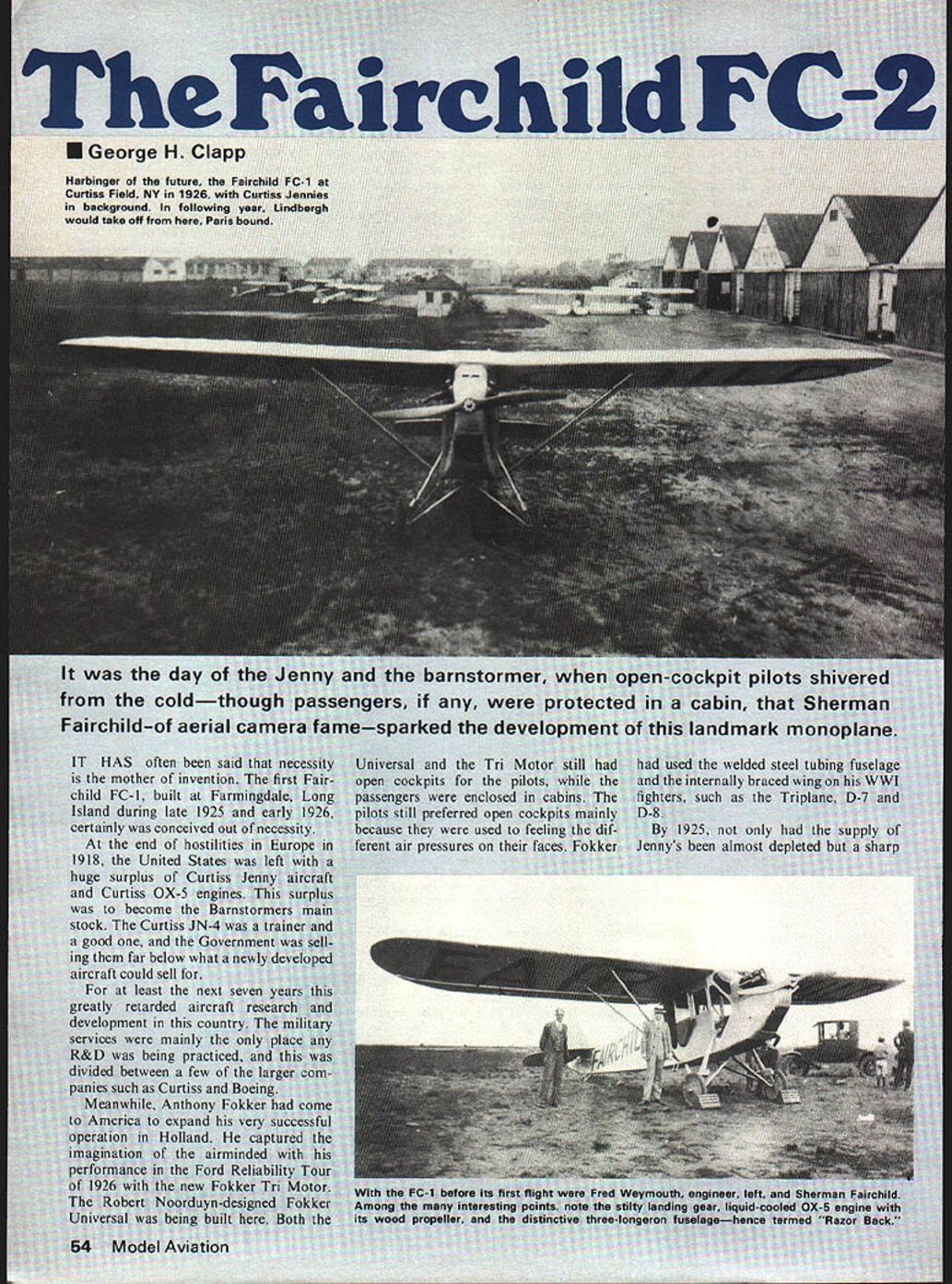
It has often been said that necessity is the mother of invention. The first Fairchild FC-1, built at Farmingdale, Long Island during late 1925 and early 1926, certainly was conceived out of necessity.
At the end of hostilities in Europe in 1918, the United States was left with a huge surplus of Curtiss Jenny aircraft and Curtiss OX-5 engines. This surplus became the barnstormers' main stock. The Curtiss JN-4 was a trainer and a good one, and the government was selling them far below what a newly developed aircraft could sell for.
For at least the next seven years this greatly retarded aircraft research and development in this country. The military services were mainly the only place any R&D was being practiced, and this was divided between a few of the larger companies such as Curtiss and Boeing.
Meanwhile, Anthony Fokker had come to America to expand his very successful operation in Holland. He captured the imagination of the air-minded with his performance in the Ford Reliability Tour of 1926 with the new Fokker Tri-Motor. The Robert Noorduyn-designed Fokker Universal was being built here. Both the Universal and the Tri-Motor still had open cockpits for the pilots, while the passengers were enclosed in cabins. Pilots preferred open cockpits mainly because they were used to feeling the different air pressures on their faces. Fokker had used welded steel tubing fuselages and internally braced wings on his WWI fighters, such as the Triplane, D-7 and D-8.
By 1925 the supply of Jennys had been largely depleted and a sharp contrast was drawn in design and methods which Fokker emphasized. Many new aircraft companies were formed. The OX-5 still powered most of these newly developed aircraft. New needs and opportunities arose.
Fairchild and Aerial Photography
Sherman M. Fairchild was the inventor of a new between-the-lens shutter for aerial cameras (developed during WWI). It was far in advance of any other aerial camera then on the market. After founding Fairchild Aerial Camera Corp. in 1920, a definite need for aerial survey was found in Canada and in 1922 Fairchild Aerial Surveys Ltd. of Canada was formed. With the development of the camera and mapping flights flown by Dick Depew for Fairchild Aerial Camera Corp., Fairchild Aerial Surveys, Inc. was organized in the United States in 1924.
In both countries the use of open-cockpit war-surplus aircraft proved to be very hard on both pilots and crews. While at Grand'Mere, Canada, one very cold day, Mr. Fairchild witnessed the landing of one of these aircraft and the crew's discomfort. After withstanding the cold as long as he could, he asked them to meet him at his hotel later.
At this meeting Mr. Fairchild suggested building a new aircraft for survey work. Mr. Ken Saunders, pilot of the Canadian operation, added his experiences to Fairchild's idea. Dick Depew and the aerial camera crews operating in the United States since 1920 added much to this concept. Depew and the crews were in near-daily contact with Sherman Fairchild. All of this input resulted in a new design built specifically for the job.
Design and Development
In 1925 the Fairchild FC-1 was designed by Norman McQueen. The mock-up of this aircraft was started in a basement in New York City. By this time it was realized the aircraft could also be built as a general utility machine, and the operation was moved to the old Sperry factory at Farmingdale, Long Island. The first flight of the FC-1 was on June 14, 1926 from Roosevelt Field.
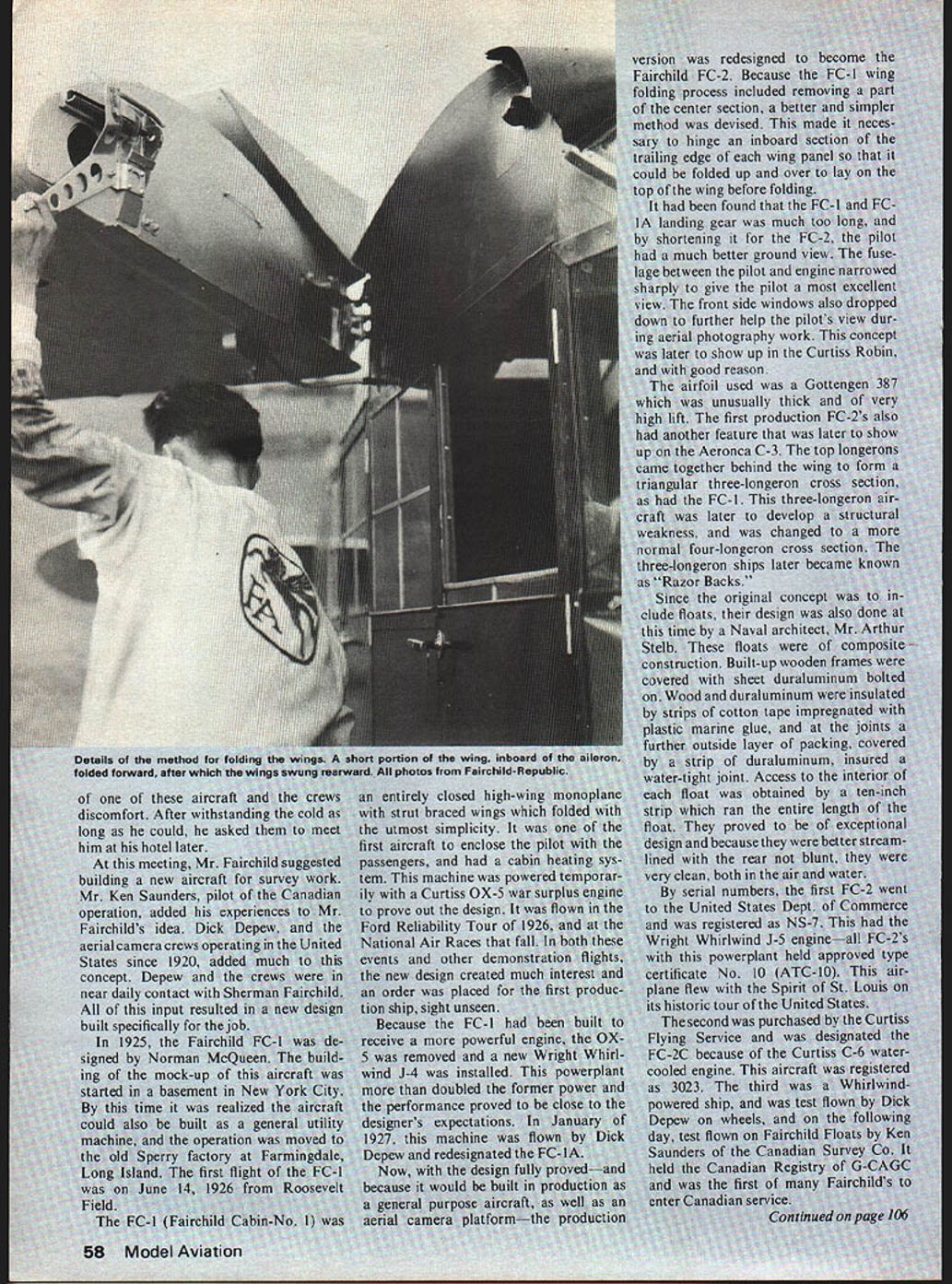
The FC-1 (Fairchild Cabin No. 1) was an entirely closed high-wing monoplane with strut-braced wings which folded with the utmost simplicity. It was one of the first aircraft to enclose the pilot with the passengers, and had a cabin heating system. This machine was temporarily powered with a Curtiss OX-5 war-surplus engine to prove out the design. It was flown in the Ford Reliability Tour of 1926 and at the National Air Races that fall. In both these events and other demonstration flights, the new design created much interest and an order was placed for the first production ship sight unseen.
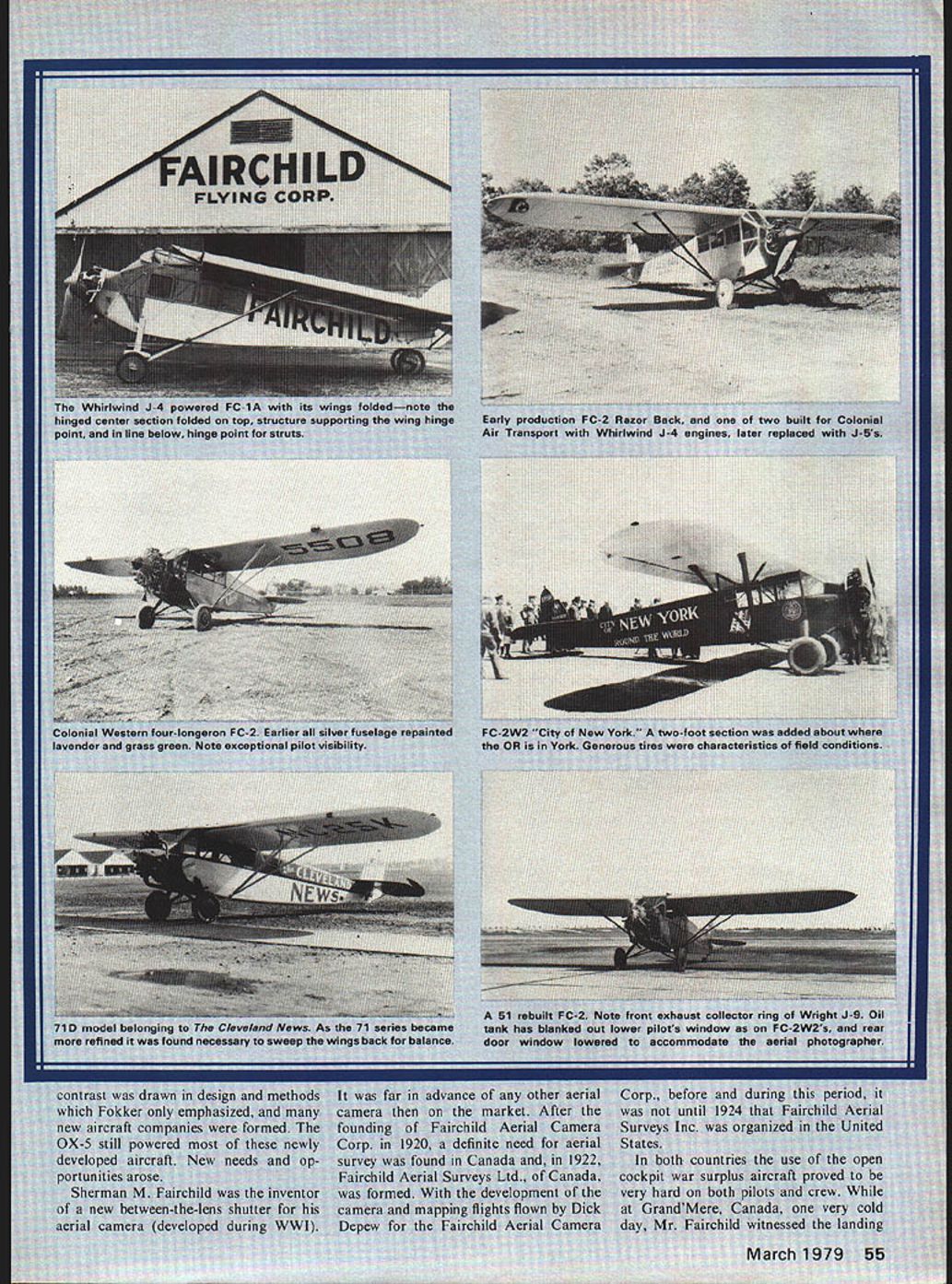
Because the FC-1 had been built to receive a more powerful engine, the OX-5 was removed and a Wright Whirlwind J-4 was installed. This powerplant more than doubled the former power and the performance proved close to the designer's expectations. In January 1927 this machine was flown by Dick Depew and redesignated the FC-1A.
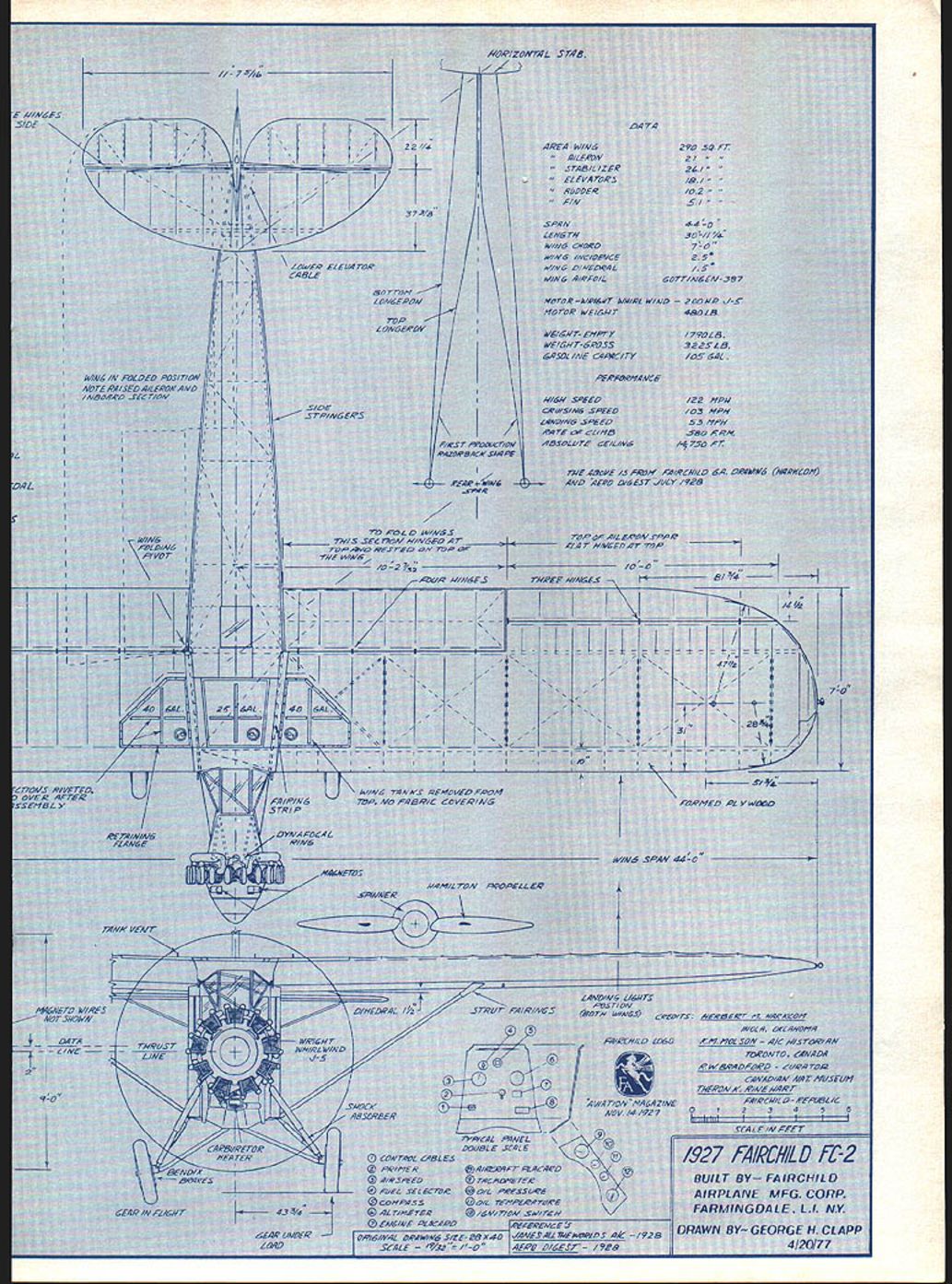
With the design proved—and because it would be built in production as a general purpose aircraft as well as an aerial camera platform—the production version was redesigned to become the Fairchild FC-2. Because the FC-1 wing folding process included removing a part of the center section, a better and simpler method was devised. This made it necessary to hinge an inboard section of the trailing edge of each wing panel so that it could be folded up and over to lay on the top of the wing before folding.
The FC-1 and FC-1A landing gear had been much too long; shortening it for the FC-2 gave the pilot a much better ground view. The fuselage between the pilot and engine narrowed sharply to give the pilot an excellent view. The front side windows also dropped down to further help the pilot's view during aerial photography work. This concept later showed up in the Curtiss Robin.
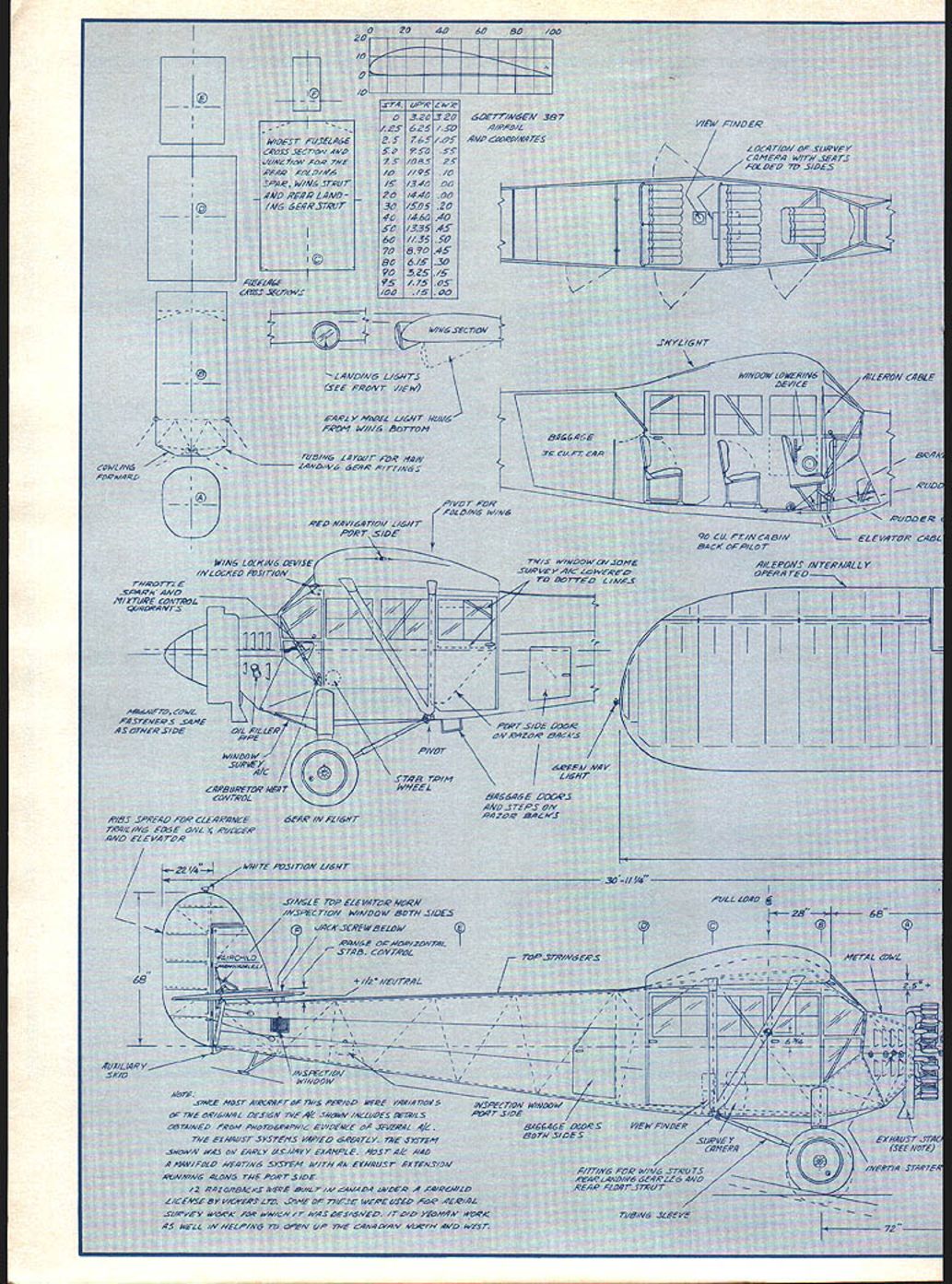
The airfoil used was a Gottingen 387 which was unusually thick and of very high lift. The first production FC-2s also had another feature later seen on the Aeronca C-3: the top longerons came together behind the wing to form a triangular three-longeron cross section (as had the FC-1). This three-longeron aircraft later developed a structural weakness and was changed to a more normal four-longeron cross section. The three-longeron ships later became known as "Razor Backs."
Note: Since most aircraft of this period were variations on original designs, the drawing shown with this article includes details obtained from photographic evidence of several aircraft. The exhaust system shown is typical of early aircraft; for example, most had a manifold housing system with an exhaust extension running along the port side.
Floats
Since the original concept included floats, their design was done by naval architect Arthur Stelb. These floats were of composite construction: built-up wooden frames covered with sheet duralumin bolted on. Wood and duralumin were insulated by strips of cotton tape impregnated with plastic marine glue, and at the joints a further outside layer of packing, covered by a strip of duralumin, ensured a watertight joint. Access to the interior of each float was obtained by a ten-inch strip running the entire length of the float. They proved to be of exceptional design and, because they were better streamlined with a tapered rear, they were very clean both in the air and on the water.
Production and Variants
By serial numbers, the first FC-2 went to the United States Department of Commerce and was registered as NS-7. This had the Wright Whirlwind J-5 engine — all FC-2s with this powerplant held Approved Type Certificate No. 10 (ATC-10). This airplane flew with the Spirit of St. Louis on its historic tour of the United States.
The second was purchased by the Curtiss Flying Service and was designated the FC-2C because of the Curtiss C-6 water-cooled engine. This aircraft was registered as 3023. The third was a Whirlwind-powered ship, test flown by Dick Depew on wheels, and the following day test flown on Fairchild floats by Ken Saunders of the Canadian Survey Co. It held the Canadian registry G-CAGC and was the first of many Fairchilds to enter Canadian service.
Fairchild test pilot Dick Depew's log gives a different test-flight sequence: according to it, the Curtiss machine first flew June 12, 1927; Fairchild Surveys of Canada aircraft on June 20; and the Department of Commerce machine on June 30. This chronology is probably most accurate.
The Fairchild history is somewhat complicated by the fact that the FC-2 was soon built in Canada under license. Canadian Vickers Ltd., of Montreal, built 12 FC-2 Razor Backs before the Fairchild license was withdrawn and Fairchild Aviation Limited of Longueuil, Quebec was formed. The first aircraft built by this new company was the early 71 series (explained later).
The FC-2 was soon followed by the Pratt & Whitney Wasp-powered FC-2W. On the prototype the wingspan was increased to 50 feet and jury struts were added to the longer wing struts. Otherwise the airframe remained basically the same. By doing this, lateral control became less effective because of extended wing-tip drag and Frise-type ailerons were installed as a correction.
Ten FC-2Ws were built after the prototype, and the second one produced was sold to Bell Telephone Laboratories. This aircraft became instrumental in the development of the air-to-ground two-way radio, so helpful to the newly forming airlines.
The FC-2W was then discontinued in favor of the FC-2W2, which was the same airframe with two feet added to the fuselage. With the success of the FC-2W2 and 71 aircraft, the company offered a rebuilding modification to update already-built FC-2 aircraft. This included converting the razorbacks to the four-longeron type, adding Frise-type ailerons for better lateral control and, if the customer wanted it, a new motor mount to take the Wright Whirlwind J-6-9 or the Pratt & Whitney Wasp Jr. of 300 hp. These aircraft were then redesignated Fairchild 51s. It is believed all 51s were remanufactured aircraft. This left some FC-2s that were not remanufactured.
There are two FC-2s in museums in the United States. A Pan American-Grace (PANAGRA) example is in the Smithsonian's Air and Space Museum. The Experimental Aircraft Association (E.A.A.) museum at Hales Corners, Wisconsin, has Herbert M. Harkcom's restored FC-2 done in American Airways, Colonial Division markings. These are the only known surviving FC-2s.
Later Fairchild Development and Legacy
Fairchild aircraft development continued in both countries. The Canadian division produced aircraft built specifically for bush-country operations, such as the Fairchild Super 71 and Model 82. In the United States the pug-nosed Model 100 Pilgrim airliner was built. With acquisition of Kreider-Reisner in Hagerstown, MD, the KR-21 open-cockpit biplanes were produced. The open-cockpit 22 and closed-cabin 24 models became well known. During WWII, the PT-19, with the Fairchild-developed Ranger engine, became the backbone of the Army Air Corps cadet program. Today Fairchild-Republic Company and other Fairchild holdings encompass many areas in aerospace.
Data
- Area, wings: 290 sq. ft.
- Ailerons: 27.1 sq. ft.
- Stabilizer: 26.1 sq. ft.
- Elevators: 18.1 sq. ft.
- Rudder: 10.2 sq. ft.
- Fin: 5.1 sq. ft.
- Span: 44' 0"
- Length: 30' 4 1/2"
- Wing chord: 7' 6"
- Wing incidence: 2.5°
- Wing dihedral: 1.5°
- Wing airfoil: Gottingen 387
- Motor: Wright J-5
- Motor weight: 480 lb
- Weight — empty: 1,790 lb
- Weight — gross: 3,225 lb
- Gasoline capacity: 105 gal
Performance
- High speed: 122 mph
- Cruising speed: 103 mph
- Landing speed: 53.5 mph
- Rate of climb: 580 fpm
- Absolute ceiling: 19,750 ft
(The above is from Fairchild G.A. drawing [unsigned] and Aero Digest, July 1928)
Research, Drawings and Photographs
The drawing that accompanies this article is the result of about 11 years of research. My first information came from the Smithsonian in Washington in 1967. After many letters of inquiry, some of which were dead ends, I came across "The Last Flight of the Oldest Fairchild" in the E.A.A. publication Sport Aviation, written by Herbert M. Harkcom of Buzzards Roost, Oklahoma. It told of his presenting his restored FC-2 to the E.A.A. museum and of the delivery flight there. I wrote to Mr. Harkcom. He answered, saying that I had asked the right guy, and that he had an original linen factory drawing of the FC-2 which he would send me a copy. Herb not only sent the drawing, but to my amazement added a series of 11 photographs and an article he had written in 1928 describing his experiences in the Fairchild.
Mr. Harkcom's FC-2 was built in 1927 as serial number 119 and was later sold to American Airways. The drawings were original production drawings and gave data not previously found in other sources. Other information came from Fairchild Aviation, Inc., Hagerstown, Md.; the National Air and Space Museum; the Canadian National Aviation Museum; Pan American Grace Airways; and the files of the Army Air Corps. The FC-2 family of aircraft was widespread in the world, serving in many countries' air services and in civil roles.
The drawing Herb sent is good scale but with outlines only and the main dimensions; it does not show any of the structure. Some of the photos are like blueprints: direct side views, etc. Photos tell it like it is (or was). Armed with this material and studying the photos carefully, I first traced the aircraft's outlines and, using proportions, added the structure. While the drawing's purpose was not to build a real aircraft from, I believe it portrays the FC-2 well. While visiting with Ken Molson on February 18, 1978, in Toronto, he put an inscription on his The Made-In-Canada Fairchilds to that effect and gave me the correct wing-tip geometry.
Anecdotes and Personalities
Herb Harkcom is a living legend. He could fly a Ford Tri-Motor while still a teenager. At 21 he was flying freight in Honduras.
Once, while skywriting over Lake Erie near Cleveland, he wrote: "I was up about 10,000 feet. I had just gotten to the letter V in Chevrolet, when the plane caught fire and the leading edge of the wing folded up into a perfect spoiler (a kind of air brake) and I knew I couldn't control it, so I turned upside down, unfastened the seat belt and fell clear. The wind carried me ashore while I watched the fabric burn off the plane and it fell into the lake."
Another time the wings folded up while he was making a firing run at targets while in the Army Air Corps. Again over water, the wind carried him inland and he landed, in fact, on the targets. He says he has a warm feeling for parachutes.
He flew for American Airlines for 36 years and has over 36,800 hours in the air (over five years). In 1977 he was elected to the Aviation Hall of Fame in Dayton, Ohio. Here he joins a glittering list of flying notables that includes the Wright Brothers, Amelia Earhart, Charles Lindbergh, Jimmy Doolittle, and others.
My model of the FC-2, registration 5508 (to be published next month), is done in the markings of Colonial Western which flew Contract Air Mail Number 20 (CAM 20) between Albany, NY and Cleveland, OH, before American Airways took over. Cy Bittner, who is also retired from American Airlines and a friend of Harkcom, says he flew 5508 during those years. I met Cy at a dinner of the Aviation Historical Society of Central New York on April 15, 1978, where my Fairchild was on display with other aviation historical items.
On many occasions I have watched him land at the old Syracuse Amboy Airport and depart for the next airmail stop. I remember a day when he was due in from the east and the ceiling was near zero with a continuous drizzle. The roar of the Whirlwind could be heard for some time before the Pitcairn Mailwing poked its nose out of the haze and circled the field to land on the all-ways (no runways) turf. To hear Cy (Shorty) Bittner relate some happenings that went on at Amboy back in the late '20s and early '30s was to recapture a part of my youth.
The years past have left an indelible imprint in my mind regarding aviation. With research it is interesting to find that these imprints are sometimes only half-truths until missing links are discovered. Because of conflicting information, this story no doubt has some errors for which the author will take full responsibility.
Photos are from the Fairchild-Republic archives unless otherwise credited.
Author's Note
Without the help of the following persons this article would not have been possible:
- Herbert M. Harkcom, Aviation Hall of Fame
- Ken Molson, author of The Made in Canada Fairchilds
- Theron K. Rinehard, Fairchild-Republic Co., author of Yesterday-Today-Tomorrow
- R. W. Bradford, Curator of Air and Space, Canadian National Museum
- Miss Catherine D. Scott, Librarian, Smithsonian Museum of Air and Space, Washington, D.C.
- Charles Messenger
- Cy Bittner
- A. Leshane Jr.
- The Aviation Historical Society of Central New York
To these people and sources of information the author wishes to express deep gratitude.
For a 28 x 40 copy of the drawing and other documentary material send 25¢ and a self-addressed, stamped business-size envelope for a list to:
George H. Clapp Box 115 Central Square, NY 13036
Illustration Credits
- 1927 Fairchild FC-2
- Built by Fairchild Airplane Mfg. Corp., Farmingdale, L.I., N.Y.
- Drawn by George H. Clapp, 4/20/77
- Scale in feet
Details of the method for folding the wings: a short portion of the wing inboard of the aileron folded forward, after which the wings swung rearward. All photos from Fairchild-Republic.
Transcribed from original scans by AI. Minor OCR errors may remain.

