
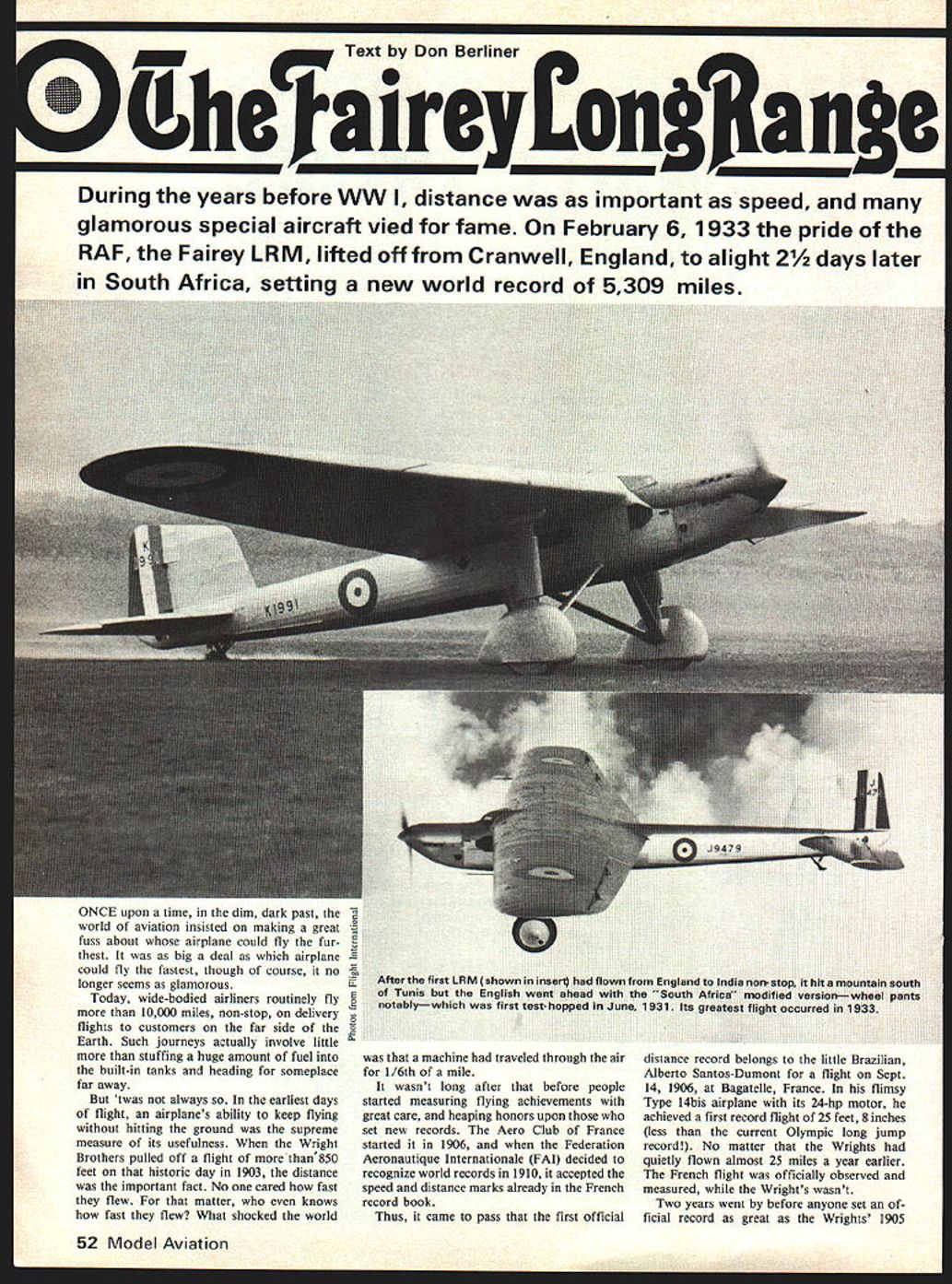
The Fairey Long Range
Text by Don Berliner
Early history of distance records
During the years before World War I, distance was often as important as speed, and many special aircraft vied for fame. In the earliest days of flight an airplane's ability to keep flying without hitting the ground was the supreme measure of usefulness. When the Wright brothers flew 850 feet on that historic day in 1903, the distance was the important fact — speed was of little concern.
Organized record keeping began in France. The Aero Club of France started documenting achievements in 1906, and when the Fédération Aéronautique Internationale (FAI) recognized world records in 1910 it accepted the French speed and distance marks already on record. Thus the first official distance record credited by the FAI belongs to the Brazilian Alberto Santos‑Dumont for his Sept. 14, 1906 flight at Bagatelle in the Type 14‑bis — a flight of 25 ft 8 in that was officially observed and measured.
Records advanced rapidly in the prewar years: the distance record changed multiple times in 1909–1911. By 1914 the record belonged to a German, Landmann, who had flown a Mercedes‑powered Albatros 1,178 miles on a closed circuit. After World War I interest revived slowly: by 1920 the mark was 1,190 miles, in 1925 it rose to 1,987 miles, and by 1926 the French had pushed it to 3,313 miles. In 1927 Clarence Chamberlin flew a Bellanca nearly 4,000 miles.
In 1927 the British Air Ministry began to consider the international prestige and technical knowledge that could be gained by a major long‑distance effort. In December 1927 an agreement was made with Fairey, Britain’s leading aircraft builder, to create a special airplane to attack the world distance record.
Design and development of the Fairey Long Range Monoplane
Fairey proposed three designs for the project:
- a biplane
- a sesquiplane (small lower wing)
- a monoplane
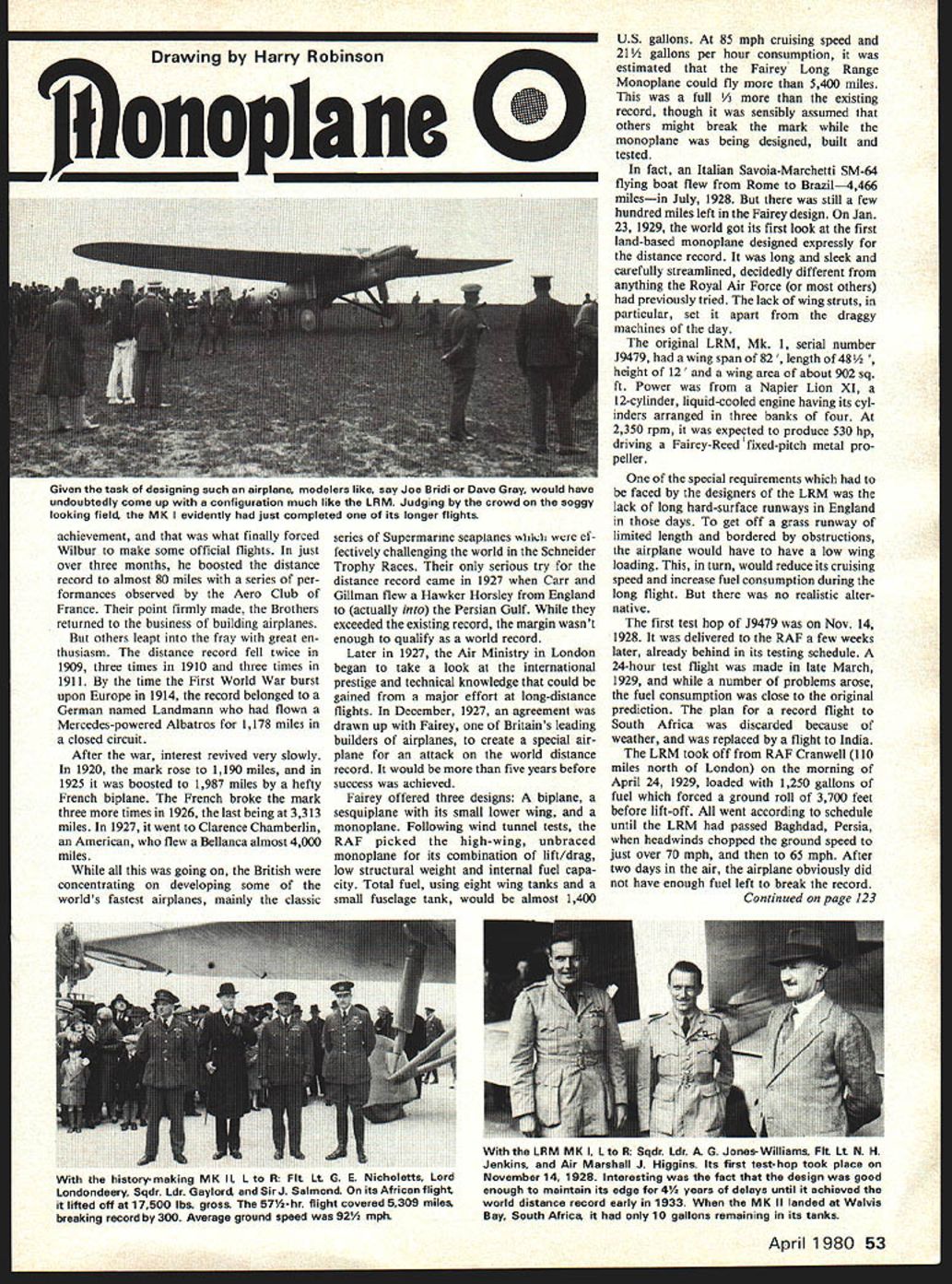
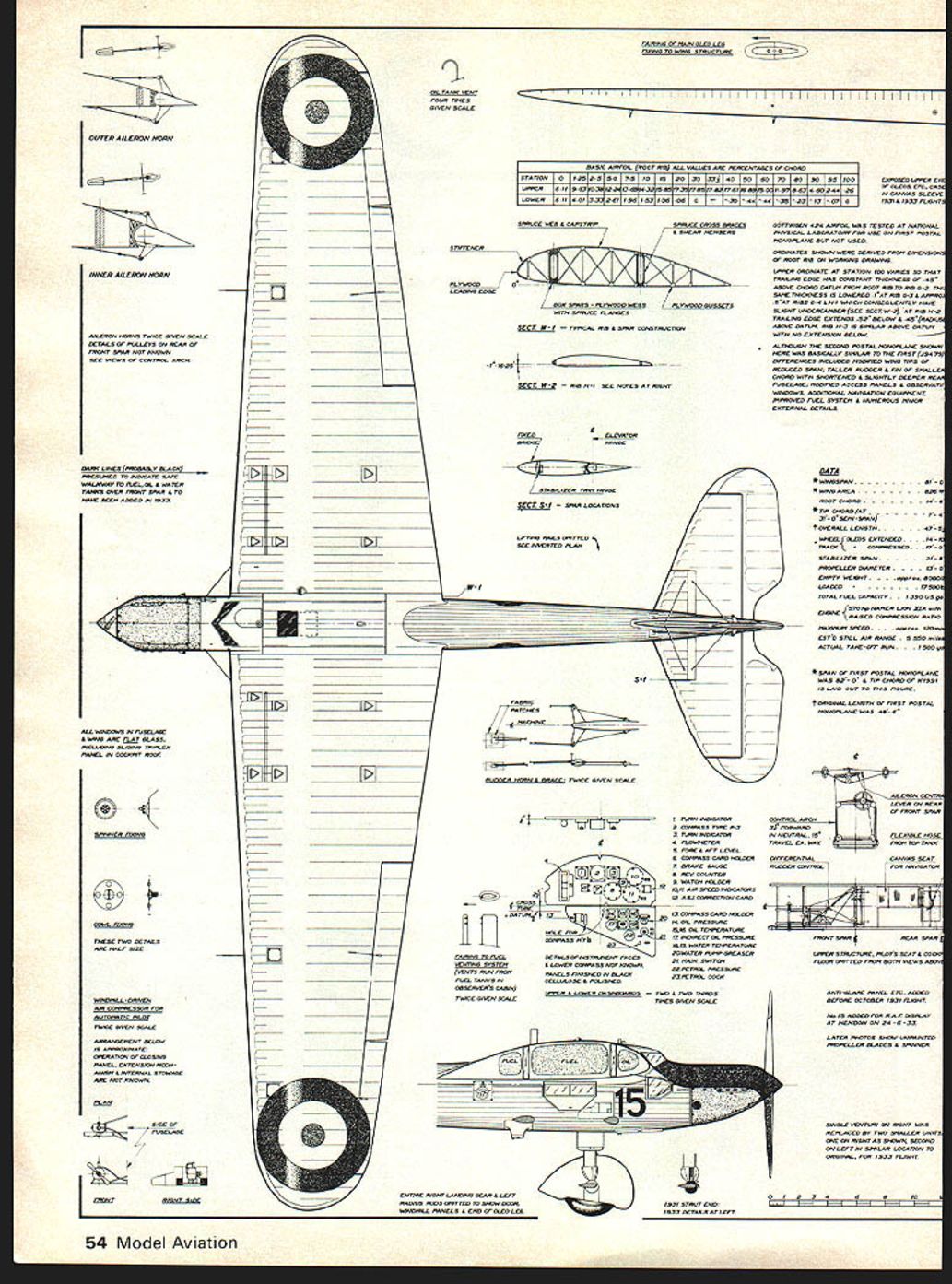
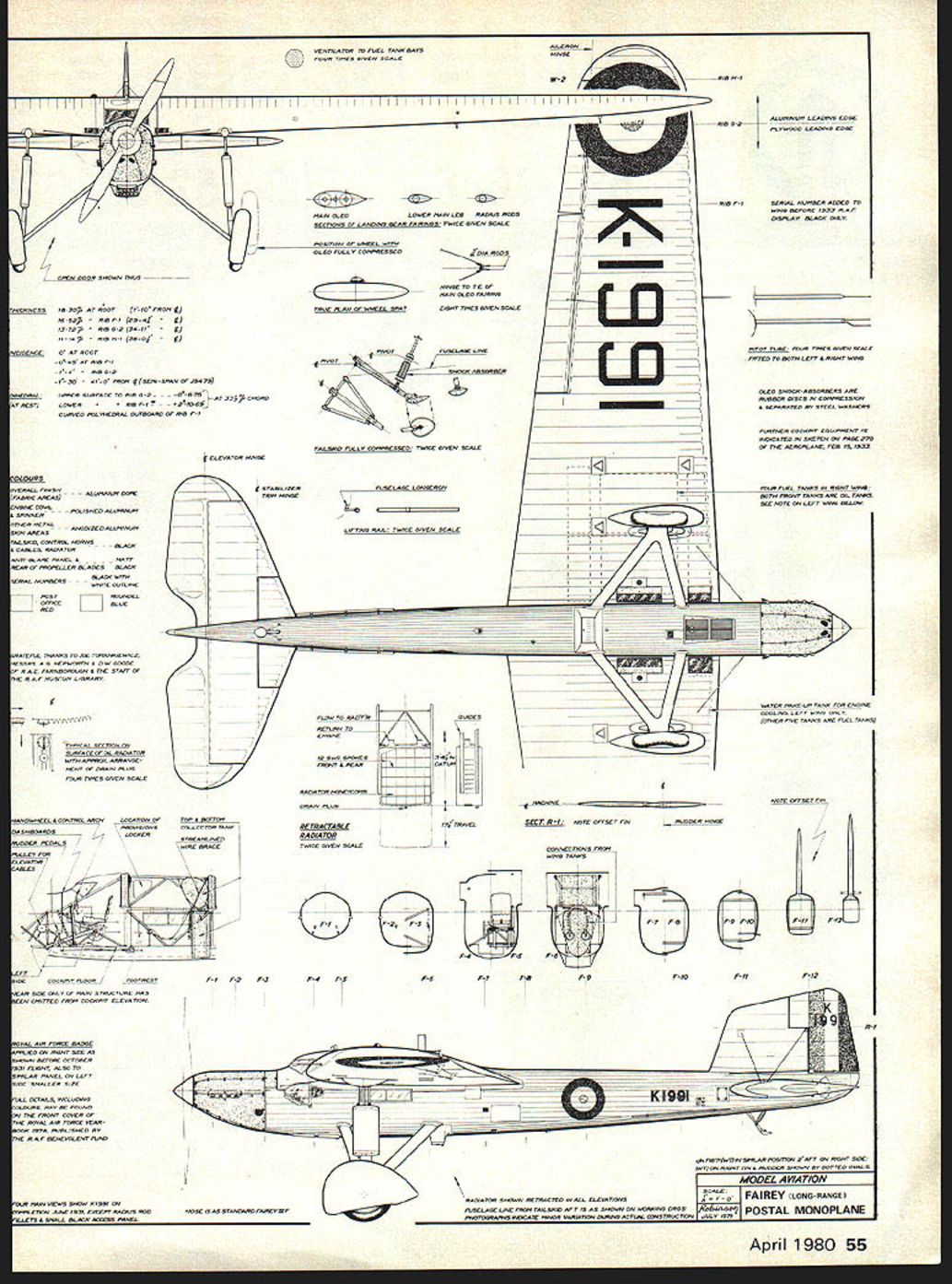
Following wind‑tunnel tests, the RAF selected a high‑wing, unbraced monoplane for its favorable lift/drag ratio, low structural weight and large internal fuel capacity. The aircraft was long, sleek and carefully streamlined, notable for its lack of wing struts.
Key design figures (LRM Mk. I, serial J9479):
- Wingspan: 82 ft
- Length: 48.5 ft
- Height: 12 ft
- Wing area: about 902 sq ft
- Engine: Napier Lion XI (12‑cylinder, three banks of four), expected 530 hp at 2,350 rpm
- Propeller: Fairey‑Reed fixed‑pitch metal propeller
- Fuel capacity: nearly 1,400 US gallons (eight wing tanks plus a small fuselage tank)
- Estimated cruise: 85 mph at 21.5 US gallons per hour, giving a theoretical range near 5,400 miles
One special design requirement was the need to operate from relatively short grass runways in England. To get off bounded grass fields the airplane needed low wing loading, which reduced cruising speed but was necessary for safe takeoff.
The first public showing of the LRM was Jan. 23, 1929 — the first land‑based monoplane designed expressly for distance.
LRM Mk. I — first flights and the Britain–India flight
The first test hop of J9479 occurred on Nov. 14, 1928; it was delivered to the RAF shortly thereafter. A 24‑hour test flight in late March 1929 showed fuel consumption close to prediction, though several problems appeared. A planned record attempt to South Africa was abandoned because of weather and replaced by a flight to India.
On April 24, 1929 the LRM took off from RAF Cranwell loaded with 1,250 gallons of fuel, requiring a ground roll of about 3,700 ft. The aircraft performed well until headwinds after Baghdad reduced groundspeed to 65–70 mph. After two days in the air it was clear the airplane did not have enough fuel remaining to break the world record. The crew elected to land at Karachi, India, with about 100 gallons of fuel left. While not a world record, the non‑stop Britain–India flight covered about 4,130 miles and demonstrated the basic soundness of the LRM concept.
Crew on that flight:
- Flt. Lt. N. H. Jenkins
- Sqn. Ldr. A. G. Jones‑Williams
The flight highlighted practical issues such as crew comfort: a lack of armrests forced the pilots to trade off every two hours instead of the planned five.
Mk. I loss and construction of Mk. II (K1991)
A second record attempt began on Dec. 16, 1929, aiming to beat the 4,975‑mile mark set by Costes and Bellonte. About 12 hours after takeoff for South Africa, the LRM Mk. I crashed into a mountainside south of Tunis; both pilots were killed and the aircraft was destroyed. The investigation cited weather and probable pilot error, and the airframe itself was given a clean bill of health.
In July 1930 the Air Ministry commissioned a second Long Range Monoplane with modest changes:
- addition of landing gear fairings
- more complete instrumentation
- a two‑axis gyro autopilot developed by the Royal Aeronautical Establishment
The new machine — LRM Mk. II, serial K1991 — first flew on June 30, 1931. RAF tests were completed in early autumn. Proving flights were made by Sqn. Ldr. O. R. Gayford and Flt. Lt. L. D. G. Bett. One proving flight from Cranwell on Oct. 27 ended in a forced landing in England in dense fog, causing damage that kept the aircraft in repairs for several months.
Tests also included the installation of the autopilot and experiments with a variable‑pitch propeller; the latter showed no particular benefit and was dropped.
The 1933 record flight (K1991)
By early February 1933 conditions — time of year, winds and the airplane — were judged favorable for a record attempt. The crew for the flight was:
- Sqn. Ldr. O. R. Gayford
- Flt. Lt. G. E. Nicholetts (Nicholetts replaced Bett, who had since passed away)
Their target was a landing deep in Southwest Africa; to set a new record they needed to fly at least 62 miles (100 km) beyond the current mark, i.e., at least 5,075 miles.
The flight
- Date/time of takeoff: 7:15 a.m., Feb. 6, 1933, from Cranwell
- Takeoff weight: about 17,500 lb; ground roll nearly one mile
- For the first 12 hours the crew averaged about 110 mph thanks to tailwinds; they crossed the Mediterranean and North Africa and by midnight were some 500 miles south of Tunis.
- On Feb. 7 they crossed the Sahara; by dusk they were over Nigerian farmland with visibility reduced by blowing sand and cumulus build‑up.
- The experimental autopilot gradually failed, increasing workload.
- Winds shifted during the night, reducing groundspeed and producing unrecognized drift; by noon Feb. 8 navigation errors left them possibly 300 miles north of their intended landfall.
- The crew resolved their navigation by flying down the west coast of Africa for the last few hours and landed at Walvis Bay at 4:40 p.m. on Feb. 8.
Results
- Great‑circle distance: 5,309 miles — about 300 miles beyond the previous record
- Total flight time: 57½ hours
- Average groundspeed: 92½ mph
- Fuel remaining on landing at Walvis Bay: about 10 gallons (≈20 minutes under ideal conditions)
- Estimated total distance flown including course deviations: ~5,400 miles
- Calculated fuel consumption on the flight: ~24 US gallons per hour
After official ceremonies at Walvis Bay, the aircraft and crew flew on to Cape Town for further celebrations, underwent minor repairs and an engine change, and then returned to Britain by staged flights, arriving at Farnborough on May 2.
Later developments and legacy
The Fairey LRM Mk. II was kept at Farnborough for at least a year. Several modification proposals were considered, including:
- replacing the Napier Lion with a Junkers Jumo IV diesel and retractable landing gear
- using a Bristol Phoenix diesel with a variable‑pitch propeller
A July 1934 estimate concluded that the changes would take about 18 months and substantial funds, and even then the extended range projected (around 7,600 miles) would be less than the eventual performances of some contemporary designs. It was decided that a completely new aircraft would be preferable; however, no new distance‑record airplane progressed beyond the drawing board for the Fairey program.
Longer distance records were soon set by other types: in late 1938 an RAF Vickers Wellesley flew 7,162 miles from Egypt to Australia to beat the previous record, and later transoceanic piston‑aircraft records continued to be set. The longest straight‑line piston‑engine airplane record remains the U.S. Navy Lockheed P2V Neptune’s Oct. 1947 flight from Perth to Columbus, Ohio — 11,236 miles.
Nevertheless, the achievement of Gayford, Nicholetts and the Fairey LRM Mk. II stands out. In an era before electronic navigation and satellite signals, two airmen flew across largely unknown territory for two and a half days and landed essentially where they intended. That accomplishment remains a proud moment in the history of long‑distance aviation.
Transcribed from original scans by AI. Minor OCR errors may remain.

