
Fairey Swordfish
Many fascinating airplanes admired by scale modelers can be found at private airports, and some rarer examples show up at big fly-ins such as the Experimental Aircraft Association's (EAA) meeting at Oshkosh, Wisconsin. The rarest examples live in museums and can usually be seen only after traveling great distances. On a trip to England I found a whole bunch of interesting airplanes—some of which have no examples in the United States and a few that are the sole remaining survivors of hundreds or thousands built years ago.
Background
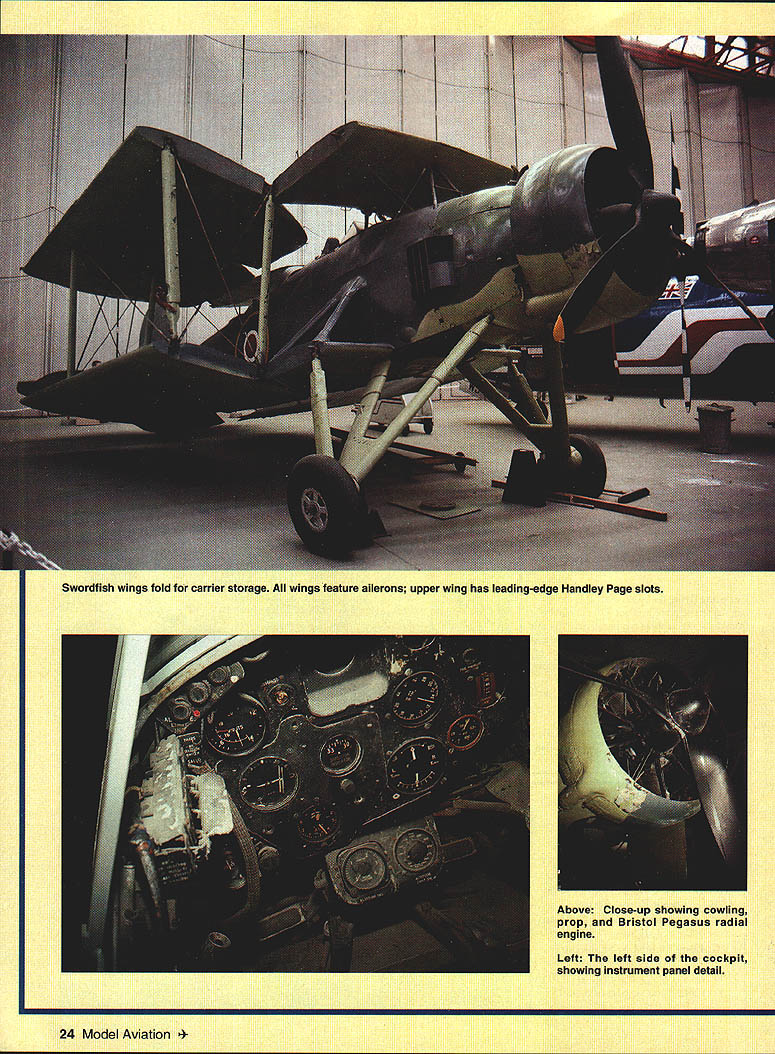
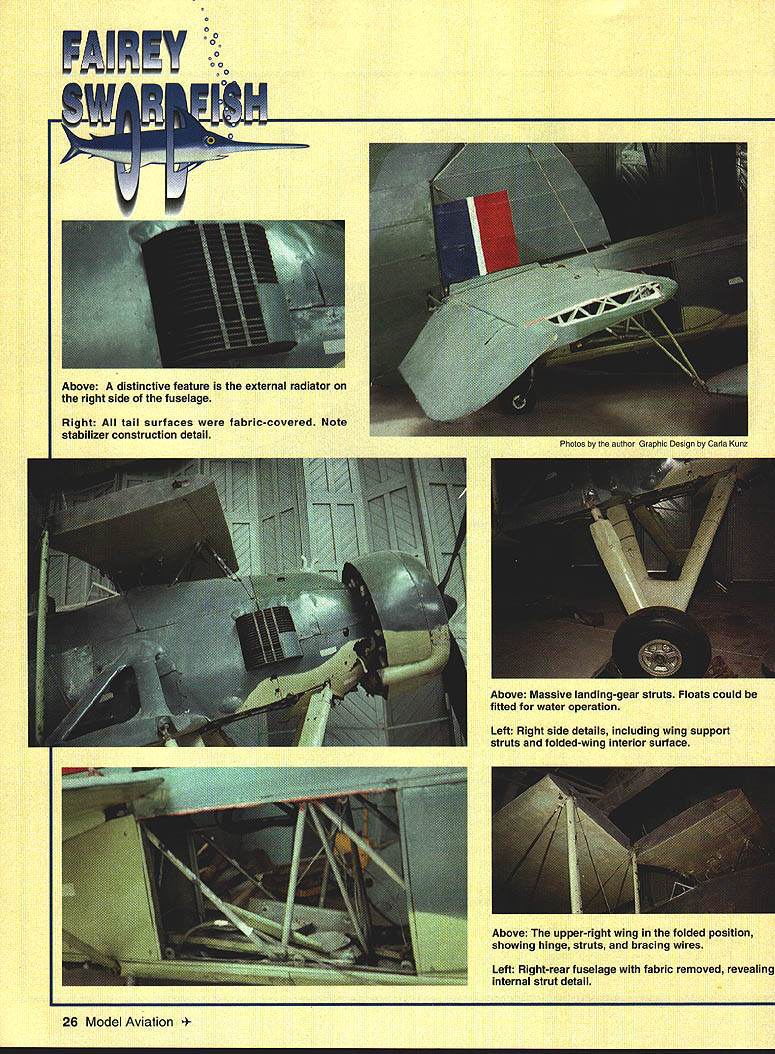
The Fairey Swordfish was already obsolete when World War II began, yet it played a surprisingly significant role in the conflict. Despite obvious handicaps—biplane configuration, many struts and bracing wires, and fixed landing gear—the Swordfish sank large amounts of enemy shipping for the Allied cause.
Notable missions
- The Swordfish's most famous mission was during the attack on the German battleship Bismarck. After the Bismarck had just sunk the Royal Navy battlecruiser Hood, a group of Swordfishes managed to cripple the battleship, preventing her escape. A flotilla of Royal Navy ships later sank the damaged Bismarck.
Development and production
- The Swordfish prototype first flew in 1934.
- Between 1934 and 1944 nearly 2,400 Swordfishes were built.
- The last Swordfishes were retired from service in 1945.
The type had unusually fine flying qualities and exceptional stability—characteristics that made it a valuable aircraft despite its antiquated appearance.
Mark III (example)
- Engine: 750 hp Bristol Pegasus seven-cylinder sleeve-valve radial engine.
- Armament:
- One fixed forward-firing machine gun.
- One swiveling machine gun operated by the gunner/radio operator.
Survivors and preservation
- Of almost 2,400 Swordfishes built, five are known to survive.
- Four are in British museums, including a flying example used by the Royal Navy at air shows.
- One is at the Canadian National Museum in Ottawa, Ontario.
- A Swordfish is awaiting restoration at the Imperial War Museum's Duxford airfield facility, about 40 miles north of London.
Transcribed from original scans by AI. Minor OCR errors may remain.

