
The Fascinating World of Ornithopters
By Kenneth B. Johnson
Since the beginning, man has attempted to emulate the flapping‑wing flight of birds and insects—sometimes with disastrous results to the people involved. So far, only in modeling has success (from modest to great) been achieved with flappers, known as ornithopters. In this article I describe some of my experiences with these unique machines.
Early indoor experiments
Too little has been written in the past few years on the development of flapping‑wing aircraft. The purpose of this article is to discuss the design concepts, experiments, and goals of one ornithopter enthusiast.
Some years ago several modelers, including myself, began building indoor models in Pittsburgh, PA. Ron Ganser is an excellent indoor builder who works for the city water department. He flew models in the 1940s, but had ceased activities to marry and raise a family. As the 1960s rolled around, Ron found himself working in a very large building that housed the water‑pumping equipment for the city. This structure was several hundred feet long with pumps on one end of the floor.
Ron invited a group to come fly models at his site on Saturday mornings. He would bring new creations and help trim and fly models to their hearts' content. We soon progressed from the novice stage to the intermediate stage. At least once during a session we found ourselves climbing a metal ladder to the ceiling and driving the crane along the tracks to dislodge trapped airplanes with a bamboo pole.
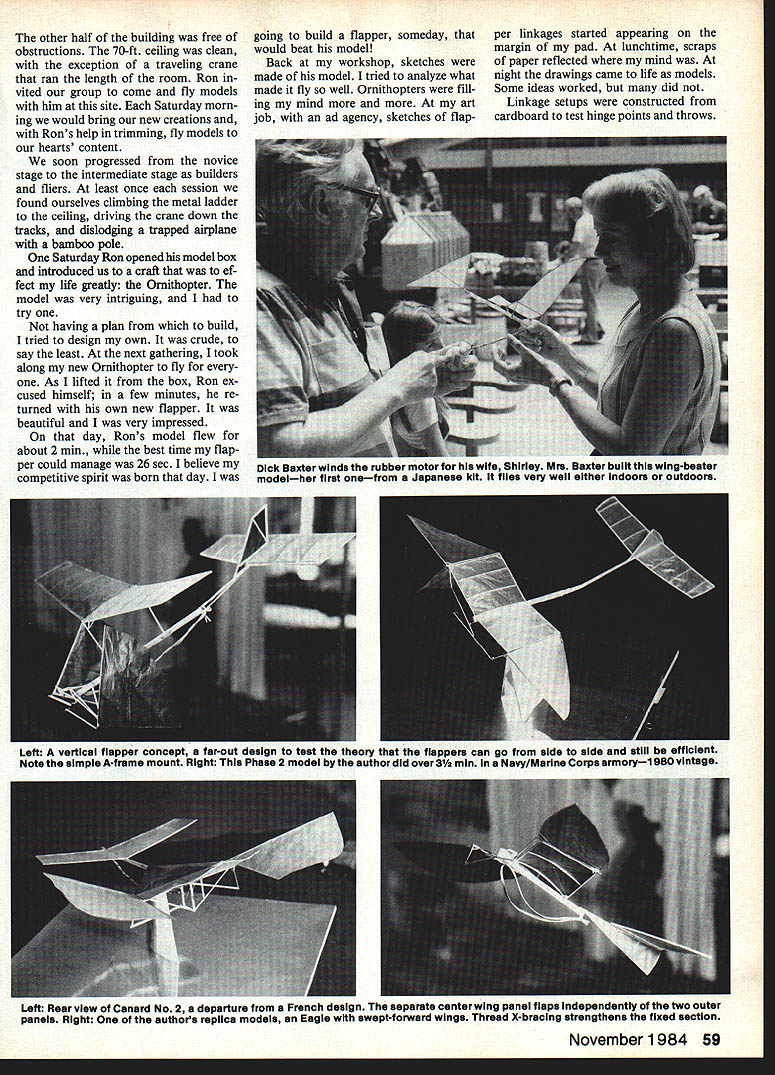
One Saturday Ron opened a model box and introduced us to a craft that affected our lives greatly. The ornithopter model was very intriguing. I tried to build one and to design my own—crude, to say the least. At the next gathering I took along my new ornithopter to fly. As I lifted the box Ron excused himself for a few minutes and returned with his own new flapper—a beautiful model. I was very impressed. Ron's model flew about 2 minutes. The best time I could manage was 26 seconds. I believe the competitive spirit was born that day; I was going to build a flapper someday that would beat that model.
Back in the workshop, sketches were made and I tried to analyze what made it fly well. Ornithopters filled my mind. More at my job at an ad agency, sketches of flapper linkages started appearing in the margins of pads and on lunchtime scraps of paper. Night drawings came to life as models. Some ideas worked, some didn't. Linkage setups were constructed of cardboard to test hinge points and throws.
As models got lighter, the times began to creep up. Airplanes were now flying over 2 minutes.
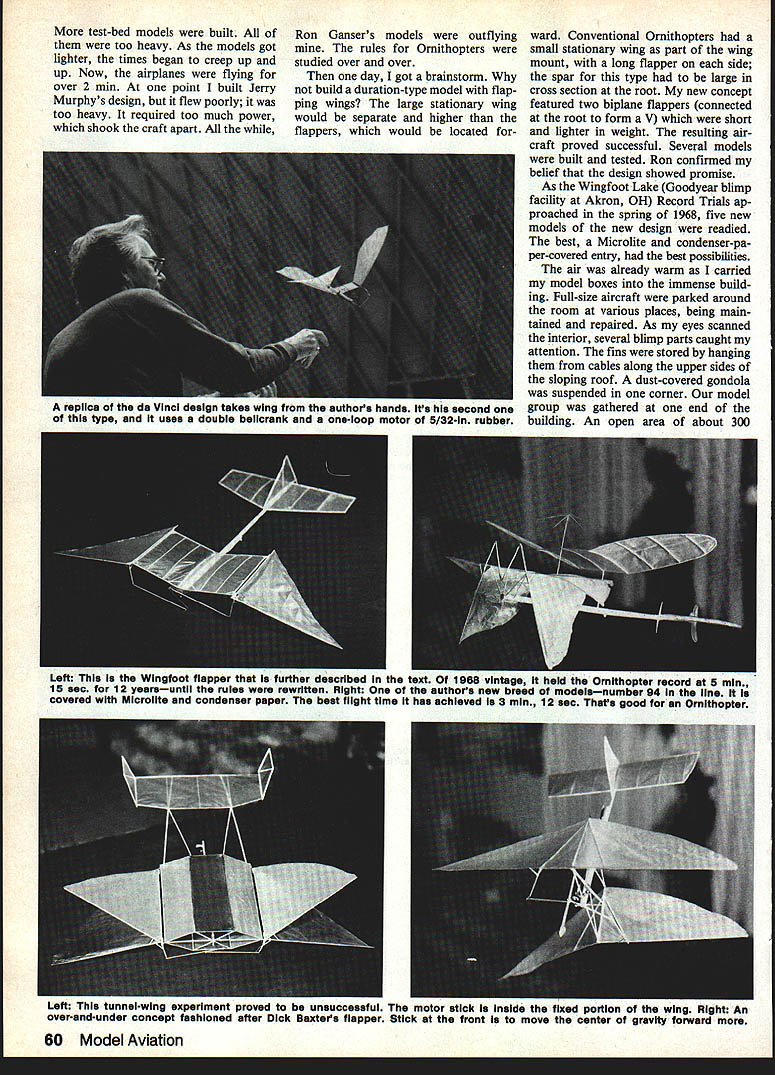
A model built to Jerry Murphy's design flew poorly—too heavy, required too much power and shook the craft apart. Ron Ganser's models were outflying the rest. Ornithopters were studied over and over. One day I got a brainstorm: build a duration‑type model with flapping wings and a large stationary wing. The stationary wing would be separate and the higher flappers would be located forward.
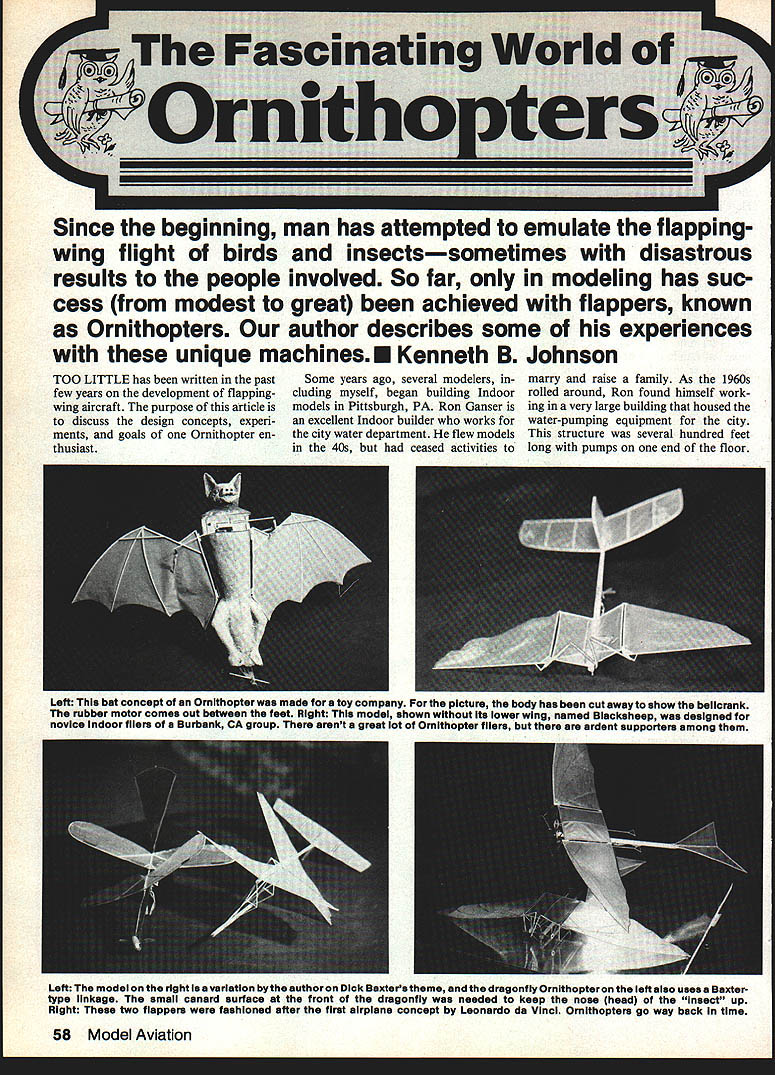
Conventional ornithopters had a small stationary wing as part of the wing mount, the long flapper on each side being spar‑type with a large cross‑section root. The new concept featured two biplane flappers connected at the root to form a V—shorter and lighter in weight. The resulting aircraft proved successful. Several models were built and tested. Ron confirmed his belief that the design showed promise.
Wingfoot Lake record trials (Akron, OH — spring 1968)
As the Wingfoot Lake (Goodyear blimp facility at Akron, OH) record trials approached in the spring of 1968, five new models of the new design were readied. The best, a Microlite and condenser‑paper‑covered entry, had the best possibilities.
The air was already warm as I carried my model boxes into the immense building. Full‑size aircraft were parked around the room at various places, being maintained and repaired. As my eyes scanned the interior, several blimp parts caught my attention. The fins were stored by hanging them from cables along the upper sides of the sloping roof. A dust‑covered gondola was suspended in one corner. Our model group was gathered at one end of the building. An open area of about 300 square feet served as our launch site. The edges of this were spotted with model boxes.
Many familiar faces caught my eye. Bob Randolph from Cleveland (the contest director) was busy making repairs on his microfilm Cabin model. Bill Hulbert from Akron was working with his FAI ship, and Jerry Skrjanc was testing an ROG model. Jerry is well known as the owner of Micro‑X, a company that sells indoor model supplies.
Down the room Edmond Smith was flying an ornithopter. As I began to test my heavier models, it was apparent that the air was getting warmer and more buoyant. At one point I noticed beads of sweat on Bob Randolph's face. He stopped patching the microfilm on his prop to mop his forehead.
Even my heavy models were posting good times. As the afternoon wore on, my times were over 3 minutes. The lightest flapper was being saved for last. The first flights on this machine showed me it had the most potential. The flapper spars were broken several times from rubber that was too powerful for the craft.
After repairs were made, Jerry Skrjanc suggested that I try some of his new Pirelli rubber. He made up a 13‑in. motor of .070 and pre‑wound it for breaking‑in. We asked for a timer, and wound the model. The model climbed to almost 70 ft. and settled into its cruise. At touchdown, the clock read 5 minutes 15 seconds. That new record for ornithopters made all the effort worthwhile. I drove back to Pittsburgh feeling very grateful to Ron Ganser. After all, it was Ron who got me started with these wonderful machines.
Several months later, at Lakewood, OH, the Category 1 record of 3 minutes 30 seconds was set with this same model, which I had named The Wingfoot. Lighter versions of this airplane were later constructed, but they exploded under full winds. This proved that the 0.050‑oz weight of the original was ideal.
Continued development and indoor rules changes
During the next few years, only a few flappers came off my building board. I again tried outdoor ornithopters with the "Flap Happy" design, which was discovered in an old magazine. It flew, but not well. I was convinced that outdoor flappers were not my thing. However, my indoor wingbeaters were flown at every contest and flying session I attended. This was my way of promoting interest in this type of machine. The delight on spectators' faces made it worthwhile, and many of my plans were given out to modelers who requested them.
Around 1980 the rules for ornithopters were rewritten. At that point the record times were erased, and everything started fresh and new. I had built about 40 flappers by then, and I decided it was time to design some new ones.
After many tries at a new design, I arrived at my current format. (The flapper count was nearing 100 models at that point.) The essence of this design is a large center fixed wing (with dihedral) and a biplane flapper at each end. A conventional Microlite‑covered tail is located aft. This model showed real promise. About 25 flappers of varying dimensions followed. Finally emerging was a size, shape, and weight that suited me.
The new ornithopter was packed up for the Record Trials at the Navy/Marine Corps Armory in Los Angeles. This Category 2 building is excellent, but the preceding five days of rain had saturated the structure with dampness, and my models were broken in the attempt to set a new mark. Later, these models flew for over 3.5 minutes under a 20‑ft ceiling. My confidence in this new design is unshaken.
Seven years ago canard flappers caught my attention, and two tail‑first models were built. The best times were under 2 minutes so this concept was discarded.
Variants, scale models, and novelty designs
Dick Baxter of Costa Mesa, CA came out recently with his first attempt at ornithopters. The machines had two wings which flapped opposite to each other. One model had the wings stacked, and the other had one wing behind the other. They flew quite well considering they were a bit heavy. I was intrigued and built five variants from Dick's designs. They are all flapping‑wing models.
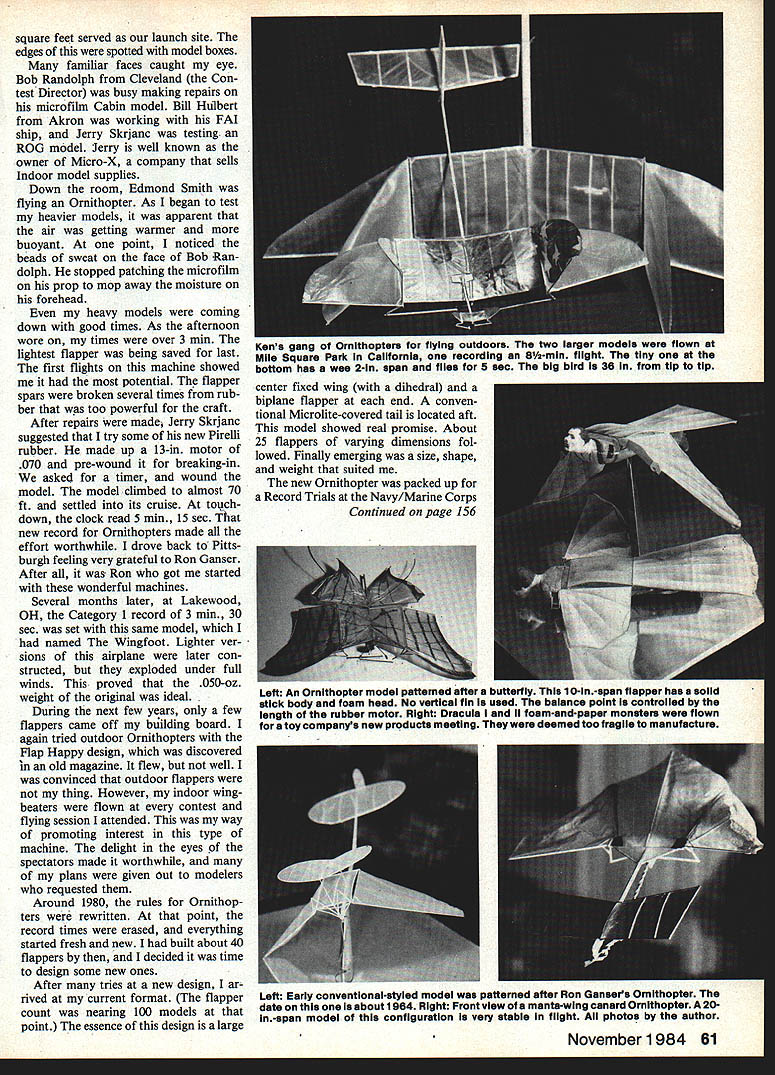
After that came the Butterfly. Bill Watson (of Gossamer Albatross fame) was seen flying a 3‑in Butterfly scale model at our Burbank High School sessions. After several attempts to build Watson's little beauty, I gave up because mine wouldn't fly. This failure bugged me for months. I finally sketched a new Butterfly that I was sure would work. The first test machine (model #121) was very successful and seven more were constructed. Textbooks on butterflies served as near three‑view references.
At one point, while employed by a major toy company, two scale models of Dracula and one of a bat were conceived. They were deemed too fragile to manufacture. The body of the Dracula figure was foam. Hollowing kept the weight down. The cape formed the flapping wings and the tail. The double bellcrank was housed inside the chest. A flapper concept was sold to another toy manufacturer for $500. Two prototypes of this flapper were built.
About 1970, in Columbus, Ohio, I was asked to come up with a full‑size replica of a chicken. My ad agency was promoting a country‑style restaurant account. A week‑long gala was held each year at the farm where the restaurant chain began. One of the attractions was a live chicken flying contest.
My fake chicken was to be a put‑on at the contest. Ken Johnson's name was entered as a bona fide contestant. On the day of the event my bird was smuggled into the area. Eight large country‑style mailboxes were constructed on a hillside. The live chickens were loaded into the back of the boxes. Then, on signal, the front door would open, and a chicken would fly out.
While my chicken was wound, future agency friends shielded the view. As the whistle blew, 100 spectators gasped as seven chickens and one look‑alike flew out over the hill. The surprised announcer disqualified my entry. As rehearsed, I loudly disagreed, and the distant sirens announced the arrival of the sheriff. A disgruntled, handcuffed Ken Johnson was pushed into the squad car and whisked off down the road, sirens screaming. The cuffs were removed and I was driven back to the area. While milling around through the crowd, some minutes later, a little old lady approached. "Don't try that stuff again next year, fellow," she stated, obviously believing the entire episode was real.
Insects have seemed like a great challenge for flappers, so I decided to try one like a dragonfly. I had seen a linkage setup on Baxter's model—the one with one flapper behind the other—that could be adapted to this end. After many sketches, the craft was built. The result was a 12‑in model of a blue dragonfly that flies in a straight line for about 30 feet. That doesn't sound like much of a distance, but try beating it, and you will see how tough it is.
Another intriguing insect is the firefly. Did you know that the glow worm is one of the few creatures in nature with flapping wings and a fixed wing? The fragile transparent flappers are protected (while the insect is not in flight) by a black wing cover. This cover has an airfoil and elliptic al tip. As the firefly prepares for flight, the wing cover hinges forward on each side and at a right angle to the body. I must try this one soon. This oddity was discovered while I was painting a picture of the insect for a strobe light account. The picture appeared in a full‑page ad for Grimes Co. of Urbana, OH.
Outdoor flights and larger models
Several of my outdoor ornithopters, of late, have had thermal flights of over 8 minutes. The design used is a variation of my latest indoor model, the difference being that the wood sizes were tripled and the motor stick/tail boom is solid balsa. I've lost two of these so far at Mile Square Park, Fountain Valley, CA. It is a thrill for me to see my flapper flying up and away in a thermal.
The latest series of models is of a canard design, sent to me by Bill Hannan. This French flapper is unique because it features a three‑member bellcrank arrangement. This apparatus moves the wings and tail independently. As the wings go down, the tail goes up. This is similar to an angle‑of‑attack changer used in a model years ago by Paul Del Gatto.
My first ornithopter of this type flew right off the board. The flapper had the wings go up as the tail goes up. This setup worked even better. A 20‑in version of this canard flies very smoothly and it's stable. Someone dubbed it the Manta Ray.
Ornithopter builders and contributors
An ornithopter builders' list must include:
- Leonardo da Vinci
- Frenchman Jobert (1872)
- Dr. Hureau de Villeneuve
- Penaud
Modern‑day builders include:
- P. H. Spenser
- Harry Graulich
- Carl Goldberg
- Ed Lidgard
- Larry Conover
- Ron Ganser
- Edmond Smith
- Walter and David Erbach
- Bill Watson
- Jerry Murphy
- Bob White
- Bob Neuser
- Lew Gitlow
- Al Rohbaugh
- Jean Andrews
- Walt Kulzer
Only the surface has been scratched in flapping‑wing aircraft. I had completed 135 machines when this was written and I plan to build at least 200. Some time ago I decided that if it flaps and flies, it's an ornithopter. One recent model has vertical flappers similar to a fish's side fins. Guess what? It flies!
A worldwide club for ornithopterologists was begun last year. You can join by sending your name and address to me.
Goals
- To have ornithopters recognized as fine art (kinetic sculpture). Recently, 25 of my flappers were featured in a one‑man art show (for one month) at Los Angeles Mission College.
- To build and fly a full‑size, man‑carrying ornithopter. Two friends (both aeronautical engineers) have offered to help in this quest. The platform is to be a variation of my indoor design.
Sources and contact
If you would like plans for an ornithopter model check these sources:
- Indoor Model Supply (an excellent indoor kit), Box C, Garberville, CA 95440
- Micro‑X‑Models (two plans by K. Johnson), P.O. Box 1063, Lorain, OH 44055
Send your comments to: Ken Johnson 16052 Tulsa St. Granada Hills, CA 91344
Transcribed from original scans by AI. Minor OCR errors may remain.

