
Fastest 3-km Racer
Don Berliner
One danger a publisher faces in buying an article from an author and then holding it in his files too long is that the information may become outdated by the time it's printed. Author Don Berliner was the first one to call the Model Aviation editorial offices and read our publisher the riot act over the "3-Kilometer Racers" article in the December 1990 issue. So we're giving him this opportunity to keep his reputation and also set the record straight.
A personal note
A guy can't even count on his friends. Between the time I wrote the article "3-Km Racers" and its publication in December 1990, Unlimited class race pilot Lyle Shelton broke the 500-mph barrier in the 3-km dash—the barrier that I had described as almost impregnable. My guess is that Lyle did it just to make me look bad.
Lyle Shelton and Rare Bear
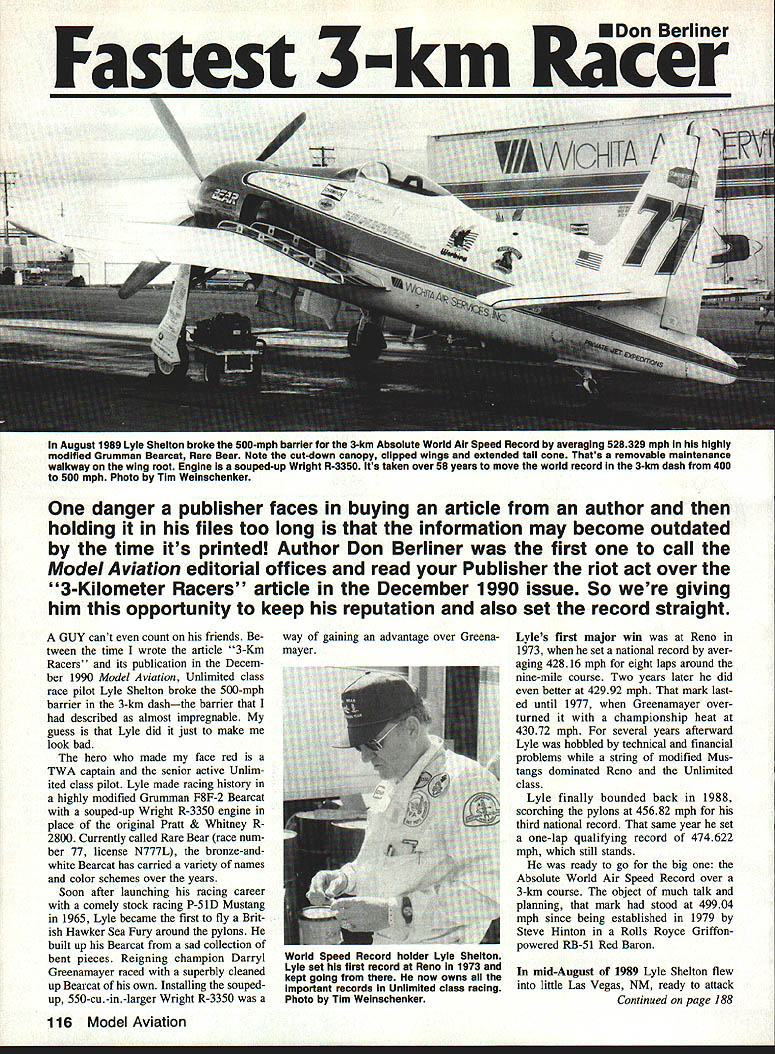
The hero who made my face red is a TWA captain and the senior active Unlimited class pilot. Lyle made racing history in a highly modified Grumman F8F-2 Bearcat with a souped-up Wright R-3350 engine in place of the original Pratt & Whitney R-2800. Currently called Rare Bear (race number 77, license N777L), the bronze-and-white Bearcat has carried a variety of names and color schemes over the years.
Soon after launching his racing career with a comely, stock racing P-51D Mustang in 1965, Lyle became the first to fly a British Hawker Sea Fury around the pylons. He built up his Bearcat from a sad collection of bent pieces. Reigning champion Darryl Greenamayer raced a superbly cleaned-up Bearcat of his own. Installing the souped-up, 550-cu.-in.-larger Wright R-3350 was a way of gaining an advantage over Greenamayer.
Lyle's first major win was at Reno in 1973, when he set a national record by averaging 428.16 mph for eight laps around the nine-mile course. Two years later he did even better—429.92 mph. That mark lasted until 1977, when Greenamayer overturned it with a championship heat at 430.72 mph. For several years afterward Lyle was hobbled by technical and financial problems while a string of modified Mustangs dominated Reno and the Unlimited class.
Lyle finally bounded back in 1988, scorching the pylons at 456.82 mph for his third national record. That same year he set a one-lap qualifying record of 474.622 mph, which still stands.
The 3-km absolute world record attempt
He was ready to go for the big one: the Absolute World Air Speed Record over a 3-km course. The object of much talk and planning, that mark had stood at 499.04 mph since being established in 1979 by Steve Hinton in a Rolls-Royce Griffon–powered RB-51 Red Baron.
In mid-August of 1989 Lyle Shelton flew into little Las Vegas, N.M., ready to attack the intimidating 500-mph barrier. His engine was in top shape and his Bearcat had been carefully worked over from spinner to tail cone. Its wings were clipped, its canopy lowered. It had a huge propeller, and every little bump had been either eliminated or faired over. Assuming his calculations were correct and everything worked as planned, the combination of reduced drag at Las Vegas—where the field elevation was 6,871 ft.—and an estimated 3,700 hp should move Lyle well over 500 mph.
On Sunday, August 20, Lyle carefully warmed up his engine and headed for the short course. He made four quick passes—two in either direction to cancel out any boost from a tail wind—then pulled up, cooled off and landed. Something wasn't quite right with his cooling system and would have to be fixed before he could try again. Even so, Lyle had an unofficial speed of 515.766 mph in his pocket.
The next day he was ready for another attempt. With almost no wind and the temperature at 80°F, conditions were ideal. The air temperature raised the density altitude to over 9,000 ft., which would boost his speed. Lyle bore down on the course with absolute accuracy and the power the huge radial engine could produce, covering the 1.86-mile legs in less than 13 seconds each time. His speeds for the four official passes were 523.586 mph, 537.251 mph, 520.257 mph and 522.223 mph.
Lyle's average speed, as calculated and then authenticated by officials of the National Aeronautic Association, was 528.329 mph. This was 29 mph faster than the old record, and Lyle had shattered the classic mark by the greatest margin in over a half century. For the first time in history, a propeller-driven airplane powered solely by a piston engine had flown faster than 500 mph, right down on the deck. It had taken 58 years to get from 400 to 500 mph, but at last it had been done officially.
Aftermath and Reno success
Lyle wasn't finished. A few weeks later he turned 451 mph at Reno for his fourth big-time win. In 1990, thanks in part to a new three-bladed propeller, he took the checkered flag at the end of the eight-lap, 73-mile Gold Race for another record, at 468.620 mph. That made Lyle's fifth Reno win and the third in a row.
All the important records for the Unlimited class now belong to Lyle Shelton: fastest lap at 475 mph, fastest heat race at 469 mph, and the Absolute World Air Speed Record at 528 mph. Until someone comes along with a faster airplane and a team capable of operating at that level for a period of several years, Lyle Shelton will be the king of the Unlimited class.
As for the future of the 3-km record for propeller-driven aircraft, your humble reporter promises to refrain from further crystal-gazing—at least until this gets into print.
Transcribed from original scans by AI. Minor OCR errors may remain.

