
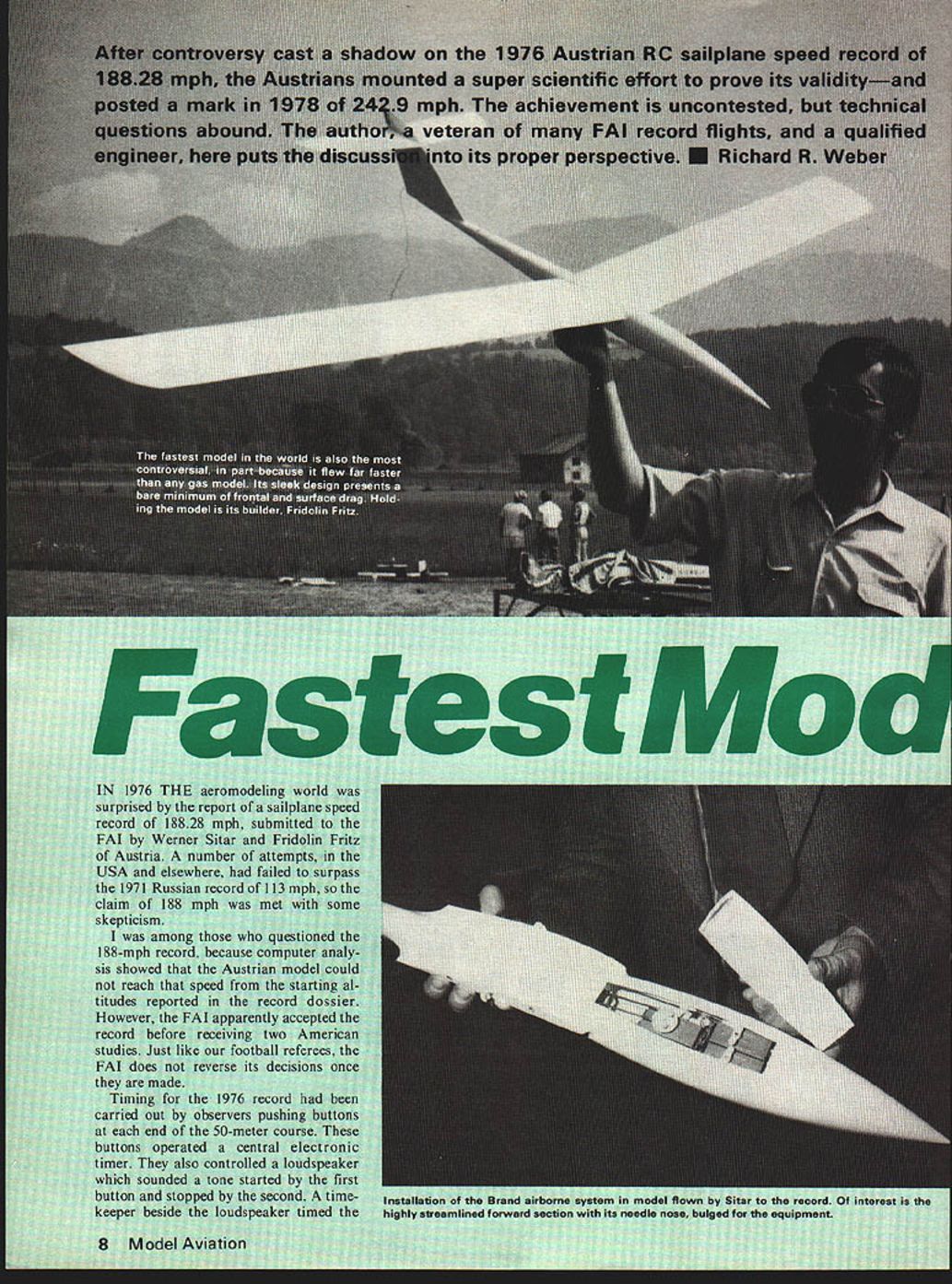
After controversy cast a shadow on the 1976 Austrian RC sailplane speed record of 188.28 mph, the Austrians mounted a super scientific effort to prove its validity—and posted a mark in 1978 of 242.9 mph. The achievement is uncontested, but technical questions abound. The author, a veteran of many FAI record flights, and a qualified engineer, here puts the discussion into its proper perspective. ■ Richard R. Weber
FastestMod
IN 1976 the aeromodeling world was surprised by the report of a sailplane speed record of 188.28 mph, submitted to the FAI by Werner Sitar and Fridolin Fritz of Austria. A number of attempts, in the USA and elsewhere, had failed to surpass the 1971 Russian record of 113 mph, so the claim of 188 mph was met with some skepticism.
I was among those who questioned the 188-mph record, because computer analysis showed that the Austrian model could not reach that speed from the starting altitudes reported in the record dossier. However, the FAI apparently accepted the record before receiving two American studies. Just like our football referees, the FAI does not reverse its decisions once they are made.
Timing for the 1976 record had been carried out by observers pushing buttons at each end of the 50-meter course. These buttons operated a central electronic timer. They also controlled a loudspeaker which sounded a tone started by the first button and stopped by the second. A timekeeper beside the loudspeaker timed the watch.
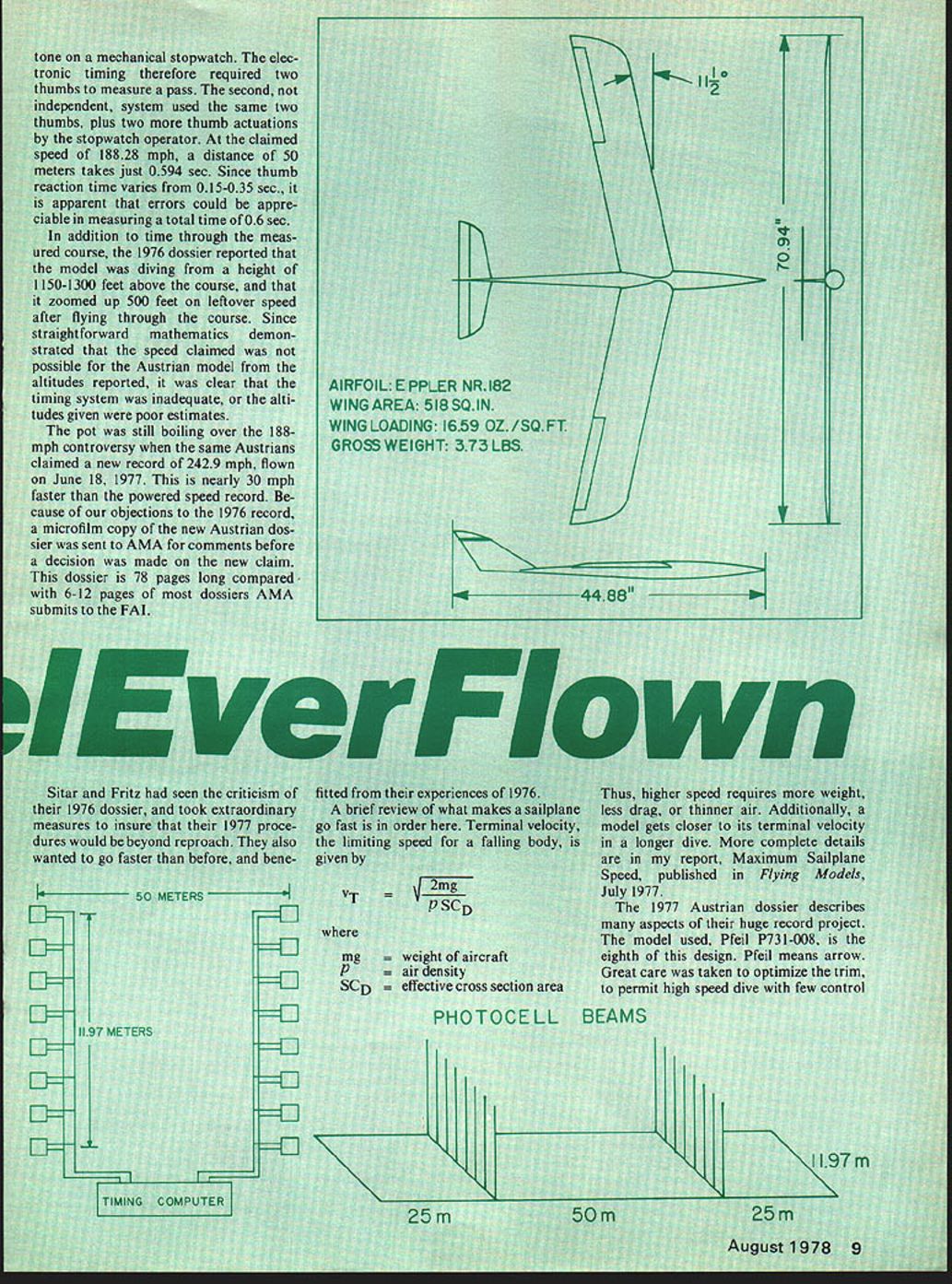
The timing system used in 1976 was manual; the primary system used in 1977 was fully automatic. Photocells detected passage of the airplane—the same kind of equipment used in international racing events. A 40-foot-wide bank of photocells was located at each end of the 50-meter measured course. Each bank consisted of eight Heuer HL 2-21 directional photocells pointed upward. Adjacent photocells were spaced less than a wing span apart. As the plane flew over the narrow-beam photocells, two banks of photocells were triggered. The photocells were connected to a Heuer HL 305 timing computer which printed elapsed time to 1/1000 second. This elaborate system provided superb accuracy in solving the timing problem. The latest technology is expensive, requires careful alignment, and also makes flying demanding, since the course was only 40 feet wide. A wider course permitted by FAI would have required photocells to be oriented so that the pilot would have had difficulty flying through a narrow corridor. A yellow ribbon on the ground extended far beyond the measured course.
The flying site was 6,600 feet above sea level. Normal air density at that altitude is about 19% lower than at sea level, allowing roughly 9% higher terminal velocity. Sitar and Fritz used the same design in 1977 but increased its weight by about 30%, which raised terminal velocity about 14% and also allowed climbs to much higher altitude.
The 1976 height was determined by two methods. One used wingspan carefully measured on frames of movie film taken at the start. Comparison of other frames with known distances along the ground showed altitudes in test flights from about 1,800 feet to over 4,000 feet. The second method used indicated height and time of the dives, with stopwatch records of dive times.
Knowing approximate aircraft terminal velocity and altitude, calculations were made for the dive of the Pfeil P731 assuming its terminal velocity to be 291 mph, including the combined effects of constant gravity and increasing drag, and a starting speed of 47 mph (normal level flight speed). Fifteen seconds after the start of the dive the model had descended 3,733 feet, traveling about 250 mph. The calculated times and speeds are in good agreement with the measured values.
The record project was undertaken by an organization in Innsbruck, Austria, known as Arbeitsgemeinschaft Modellsegelflug Entwicklung (working group for model sailplane development). Its technical leader was Fridolin Fritz and its pilot was Werner Sitar; evidently several other members of the group were involved. It is difficult for a brief article to convey the great care they took in all aspects of the flight project. The full story requires a 78-page dossier I have seen; other dossiers demonstrate the magnitude of the effort expended in the Austrian sailplane speed record. Theirs was a thoroughly professional job.
Can a sailplane fly faster than a powered model? Because a sailplane has less drag (a propeller and engine exhaust pipe limit speed attainable by a powered dive), a sailplane can attain very high speeds in a long dive. Appendages that actually use power produce little thrust near the end of a long dive. Gravity supplied about 25 horsepower to the Austrian model at the bottom of its dive.
Can the record be beaten? I think it can, but a major effort will be required. Every aspect of the flight must be optimized and will require an expert, dedicated group, flying the model at high altitude, with surface loading near the maximum allowable by FAI rules (2.457 oz/sq ft). Fliers in the mountain states can get started. One on a mechanical stopwatch. The electronic timing therefore required two thumbs to measure a pass. The second, not independent, system used the same two thumbs, plus two more thumb actuations by the stopwatch operator. At the claimed speed of 188.28 mph, a distance of 50 meters takes just 0.594 sec. Since thumb reaction time varies from 0.15-0.35 sec., it is apparent that errors could be appreciable in measuring a total time of 0.6 sec.
In addition to time through the measured course, the 1976 dossier reported that the model was diving from a height of 1150-1300 feet above the course, and that it zoomed up 500 feet on leftover speed after flying through the course. Since straightforward mathematics demonstrated that the speed claimed was not possible for the Austrian model from the altitudes reported, it was clear that the timing system was inadequate, or the altitudes given were poor estimates.
The pot was still boiling over the 188-mph controversy when the same Austrians claimed a new record of 242.9 mph, flown on June 18, 1977. This is nearly 30 mph faster than the powered speed record. Because of our objections to the 1976 record, a microfilm copy of the new Austrian dossier was sent to AMA for comments before a decision was made on the new claim. This dossier is 78 pages long compared with 6-12 pages of most dossiers AMA submits to the FAI.
Sitar and Fritz had seen the criticism of their 1976 dossier, and took extraordinary measures to insure that their 1977 procedures would be beyond reproach. They also wanted to go faster than before, and benefited from their experiences of 1976.
A brief review of what makes a sailplane go fast is in order here. Terminal velocity, the limiting speed for a falling body, is given by
v_T = sqrt(2mg / p S C_D)
where
- mg = weight of aircraft
- p = air density
- S C_D = effective cross section area
Thus, higher speed requires more weight, less drag, or thinner air. Additionally, a model gets closer to its terminal velocity in a longer dive. More complete details are in my report, Maximum Sailplane Speed, published in Flying Models, July 1977.
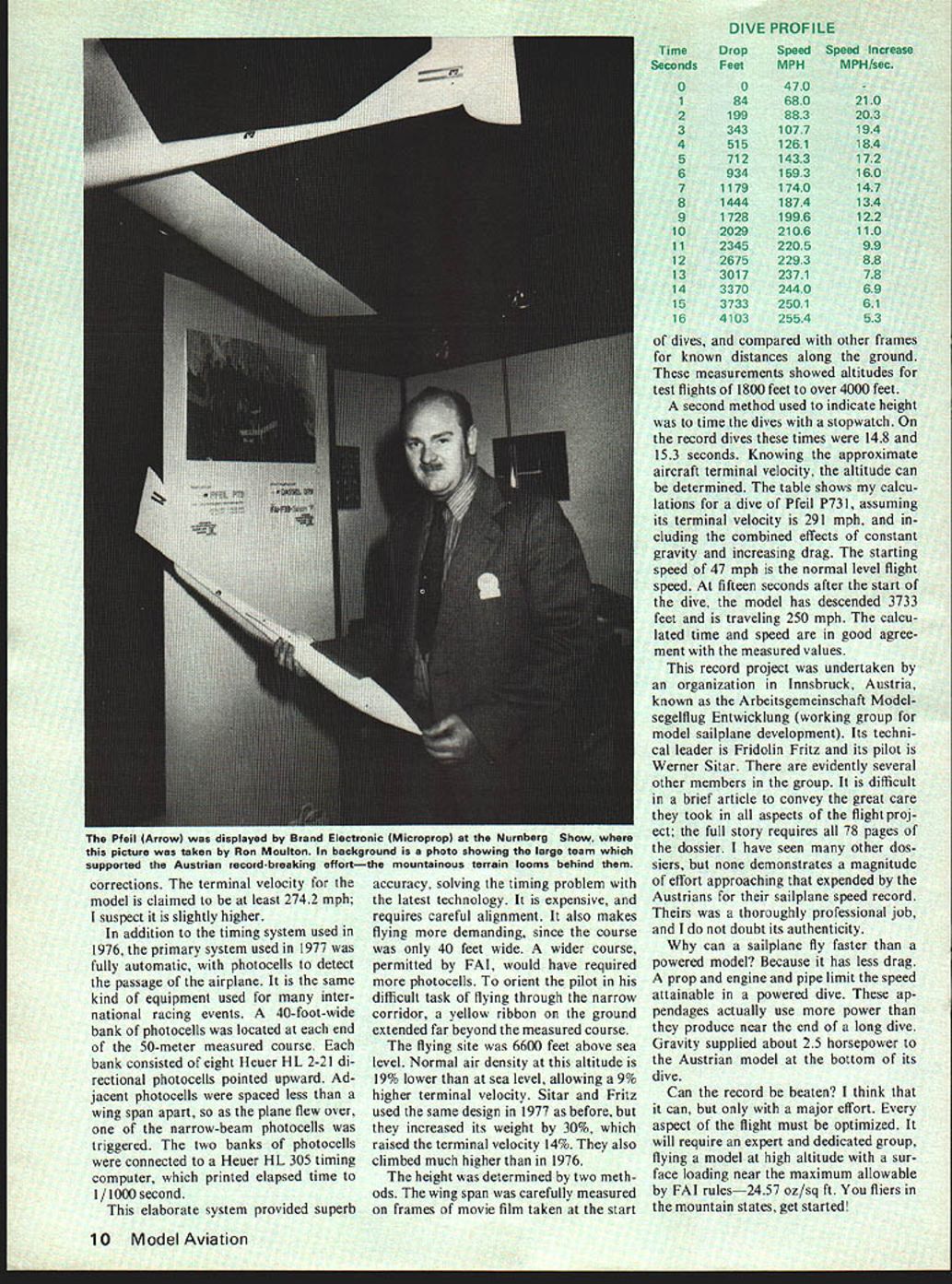
The 1977 Austrian dossier describes many aspects of their huge record project. The model used, Pfeil P731-008, is the eighth of this design. Pfeil means arrow. Great care was taken to optimize the trim, to permit high speed dive with few control corrections. The terminal velocity for the model is claimed to be at least 274.2 mph; I suspect it is slightly higher.
In addition to the timing system used in 1976, the primary system used in 1977 was fully automatic, with photocells to detect the passage of the airplane. It is the same kind of equipment used for many international racing events. A 40-foot-wide bank of photocells was located at each end of the 50-meter measured course. Each bank consisted of eight Heuer HL 2-21 directional photocells pointed upward. Adjacent photocells were spaced less than a wing span apart, so as the plane flew over, one of the narrow-beam photocells was triggered. The two banks of photocells were connected to a Heuer HL 305 timing computer, which printed elapsed time to 1/1000 second.
This elaborate system provided superb accuracy, solving the timing problem with the latest technology. It is expensive, and requires careful alignment. It also makes flying more demanding, since the course was only 40 feet wide. A wider course, permitted by FAI, would have required more photocells. To orient the pilot in his difficult task of flying through the narrow corridor, a yellow ribbon on the ground extended far beyond the measured course.
The flying site was 6600 feet above sea level. Normal air density at this altitude is 19% lower than at sea level, allowing a 9% higher terminal velocity. Sitar and Fritz used the same design in 1977 as before, but they increased its weight by 30%, which raised the terminal velocity 14%. They also climbed much higher than in 1976.
The height was determined by two methods. The wing span was carefully measured on frames of movie film taken at the start of dives, and compared with other frames for known distances along the ground. These measurements showed altitudes for test flights of 1800 feet to over 4000 feet.
A second method used to indicate height was to time the dives with a stopwatch. On the record dives these times were 14.8 and 15.3 seconds. Knowing the approximate aircraft terminal velocity, the altitude can be determined. The table shows my calculations for a dive of Pfeil P731, assuming its terminal velocity is 291 mph, and including the combined effects of constant gravity and increasing drag. The starting speed of 47 mph is the normal level flight speed. At fifteen seconds after the start of the dive, the model has descended 3733 feet and is traveling 250 mph. The calculated time and speed are in good agreement with the measured values.
DIVE PROFILE
Time Seconds Drop Feet Speed MPH Speed Increase MPH/sec. 0 0 47.0 1 84 68.0 21.0 2 199 88.3 20.3 3 343 107.7 19.4 4 515 126.1 18.4 5 712 143.3 17.2 6 934 159.3 16.0 7 1179 174.0 14.7 8 1444 187.4 13.4 9 1728 199.6 12.2 10 2029 210.6 11.0 11 2345 220.5 9.9 12 2675 229.3 8.8 13 3017 237.1 7.8 14 3370 244.0 6.9 15 3733 250.1 6.1 16 4103 255.4 5.3
This record project was undertaken by an organization in Innsbruck, Austria, known as the Arbeitsgemeinschaft Modellsegelflug Entwicklung (working group for model sailplane development). Its technical leader is Fridolin Fritz and its pilot is Werner Sitar. There are evidently several other members in the group. It is difficult in a brief article to convey the great care they took in all aspects of the flight project; the full story requires all 78 pages of the dossier. I have seen many other dossiers, but none demonstrates a magnitude of effort approaching that expended by the Austrians for their sailplane speed record. Theirs was a thoroughly professional job, and I do not doubt its authenticity.
Why can a sailplane fly faster than a powered model? Because it has less drag. A prop and engine and pipe limit the speed attainable in a powered dive. These appendages actually use more power than they produce near the end of a long dive. Gravity supplied about 2.5 horsepower to the Austrian model at the bottom of its dive.
Can the record be beaten? I think that it can, but only with a major effort. Every aspect of the flight must be optimized. It will require an expert and dedicated group, flying a model at high altitude with a surface loading near the maximum allowable by FAI rules—24.57 oz/sq ft. You fliers in the mountain states, get started!
Transcribed from original scans by AI. Minor OCR errors may remain.

