
FCC Approves AMA Petition For New RC Frequencies!
On April 1 of this year the Federal Communications Commission approved the Notice of Proposed Rule Making (NPRM) which promised practically all that we asked for in our original petition of November 1978. Then the FCC Commissioners on November 4, by a vote of 6–0, officially approved a Report and Order which is essentially the same as the NPRM.
The next step is to implement the AMA plan for gradual transition to the new frequencies. The plan has been carefully worked out to permit the old and new 72 MHz frequencies to co-exist for the next five years. Also, the FCC has authorized more frequencies than can practically be used at this time, with the idea that there will be enough for many years down the road if we use them right. To do that it is first necessary to operate for the next five years according to AMA's new plan, after which a transition will be made to converting our previous 72 MHz frequencies while we add still more new ones.
One important caution: the new FCC rules imply that frequency changing by modelers is possible. That's not quite so. The new FCC rules permit "removing and inserting a plug-in module that is part of a type-accepted RC transmitter," but they do not refer to crystal changing.
Our legal counsel's interpretation is that transmitter frequency changing by crystal swapping alone is only permissible if it involves a unique crystal configuration which is not interchangeable between manufacturers because it is common only to the specific transmitter design which a manufacturer has gotten type-accepted by the FCC. Otherwise, the crystal and other accompanying frequency-determining components must be exchanged in a module form. Regardless, most manufacturers have come up with economical plans to convert existing equipment to the new frequencies, for those who don't want to wait five years until that becomes necessary. In the meantime the old and new can operate compatibly, provided we use common sense.
Note: The new frequencies can use either AM or FM. This should not cause problems since, on any one frequency, at any given time, the operation will be either AM or FM, not both. Thus compatibility is a matter of frequency (channel) numbers rather than modulation type.
Suggestions:
- Study the new channel numbers and color codes on the pages which accompany this article. Learn how the new 72 MHz frequencies relate to the old.
- Get together with other RCers, particularly in club meetings, and develop new frequency controls (clothespin or other type) for your flying site.
- Think seriously about frequency monitoring as a means of knowing who is on what frequency.
For the first time we have more legal frequencies than the number of models we can fly safely at a typical club field. Think about that and the need for keeping track of all the possibilities. Adapt to the new situation in your area carefully. Remember that channel numbers refer to new frequencies only.
Otherwise — enjoy!
New AMA RC Identification And Control System Effective January 1, 1983
With the acquisition of new RC frequencies in the 72 and 75 MHz bands, the long-standing system of identifying RC frequencies by colored streamers alone has become outmoded; it is being replaced by a system able to cope with the larger number of now-usable frequencies.
A draft proposal for a new frequency identification and control system was presented to the AMA Executive Council by the Frequency Committee in the fall of 1980 and was published in the October 1980 Model Aviation magazine. In this proposal, AMA members' comments were requested, and a number were received, all of which were considered by the committee as it put together this new, approved AMA Frequency Identification and Control System.
Key guidelines:
- All new RC frequencies are assigned a unique channel number. Frequency flags will provide a dual method of identification at a glance: both a number (the "channel number") on a flag and a color-coding on both the flag and the wind ribbons on the transmitter antenna.
- This same channel number will be used to designate the frequency-determining elements (crystals, modules, synthesizers, etc.) in both the RC transmitter and receiver. Actual frequencies may also be shown on these items, but the channel number is the primary method of frequency identification.
- This concept of numbered channels has been used in Europe by R/Cers for some time with little confusion. It has also been used for many years in this country as a handy label to designate various TV, marine and CB frequencies.
- All old RC frequencies will not be given a channel number. Their frequency identification will remain as is; i.e., through the long-standing arrangement of color-coded flags and/or ribbons whose colors designate the frequency in use. This same arrangement applies to the 27 MHz, 49 MHz, and 72–75 MHz bands. (Please note, however, that all previous 72–75 MHz frequencies have only a five-year life following authorization of the new frequencies, after which the old frequencies are no longer authorized for RC use.) The 27 MHz and 53 MHz RC channels have no formal end-of-use date and are legal to continue to be used indefinitely.
- The system also provides immediate visibility for the existing 49 MHz low-power band (with its five authorized frequencies) — a band which is already in use for RC sailplane-to-ground telemetry purposes and also for actual radio control at some flying sites.
- The system is expandable — not only for the new frequencies in the 72–75 MHz band, but for new six-meter frequencies and for any others which may become available in the future.
- At least on the new 72–75 MHz frequencies, the system will provide some relief from the problem of color blindness on the part of a few of our RC fliers and/or color fading as has happened with our current flags and ribbons.
- During the five-year transition period when both old and new 72 and 75 MHz frequencies will be in use, the system avoids any duplication of color combinations which could lead to confusion at the flying field or ground operating site. In order to accomplish this, the white ribbon now used to designate the 72–75 MHz frequency band is not used on any of the new phase-in channels which will be authorized for use during this transition period.
- The channel numbers designating the new 72–75 MHz frequencies are made up of two digits, since all the channels lie between Channel 11 and Channel 90. Each digit, 0 through 9, will be represented on the flag both by its printed number and by the same color coding used in electronic parts value designation (see paragraph D2 below). This use of an already widely accepted color coding was suggested by a number of AMA members who responded with comments to the AMA Frequency Committee.
Details
The paragraphs which follow are the AMA-approved Frequency Identification and Control System. They will be included in the next issue of the AMA Official Model Aircraft Regulations as the official system to be used at all AMA-sanctioned events.
A. 27 MHz Band
Available to all types of models indefinitely. Frequency in use will be designated by a small triangular flag or by a single ribbon approximately 1/2 in. by 16 in. affixed to the top of the transmitter antenna according to the following table:
- 26.995 MHz — Brown
- 27.045 MHz — Red
- 27.095 MHz — Orange
- 27.145 MHz — Yellow
- 27.195 MHz — Green
- 27.255 MHz — Blue
(Note that no channel number is assigned.)
B. 49 MHz Band
Below-listed frequencies are available to all types of models indefinitely. This is a license-free band on which transmitters are restricted to very low power. Frequency in use will be designated by a single ribbon approximately 1 in. by 16 in. affixed to the top of the transmitter antenna according to the following table:
- 49.830 MHz — Purple
- 49.845 MHz — Gray
- 49.860 MHz — White
- 49.875 MHz — Black
- 49.890 MHz — Chrome
(Note that no channel number is assigned.)
C. Previous 72–75 MHz Frequencies
Below-listed frequencies are available for the types of models shown for a period of five years following release of the new frequencies; i.e., until the end of 1987.
Note: The AMA RC Frequency Phase-In Plan avoids the placing in use of a new channel within 50 kHz of any of these frequencies during the five-year period. Frequency in use will be designated by two ribbons approximately 1 in. by 16 in. affixed to the top of the transmitter antenna according to the following table:
- 72.080 MHz — White–Brown — Aircraft only
- 72.160 MHz — White–Blue — All kinds
- 72.240 MHz — White–Red — Aircraft only
- 72.320 MHz — White–Violet — All kinds
- 72.400 MHz — White–Orange — Aircraft only
- 72.960 MHz — White–Yellow — All kinds
- 75.640 MHz — White–Green — Aircraft only
(Note that no channel number is assigned.)
Special note on 75.640 MHz: This frequency creates special problems during the five-year phase-out period, since it falls in the 75 MHz sub-band allocated to surface models in the new RC frequency plan. While there is no legal bar to its continued use by model aircraft until the end of the five-year period, it will not be "protected" to the same extent as those in the 72 MHz sub-band listed above. It is recommended that all model aircraft fliers using 75.640 MHz have their sets converted to one of the new aircraft phase-in channels as soon as practicable, rather than waiting until late in the five-year period to do so.
D. New 72–75 MHz Frequencies
- General
The FCC has assigned new frequencies for model RC use — in the 72 MHz sub-band for model aircraft and in the 75 MHz sub-band for surface models (cars, boats, robots, etc.). These frequencies are spaced at 20 kHz intervals, a much closer spacing than heretofore used in the United States. Some of them are also adjacent to the existing 72–75 MHz frequencies discussed above in paragraph C. For these reasons, only certain of the new frequencies will be brought into use immediately. Thus, certain frequencies have AMA authorization for use during the phase-in period, and others do not.
- Frequency Identification
New channels are designated by a two-digit channel number, which will also be used to designate the frequency-determining elements (crystals, modules, synthesizers, etc.) of the RC transmitter and receiver.
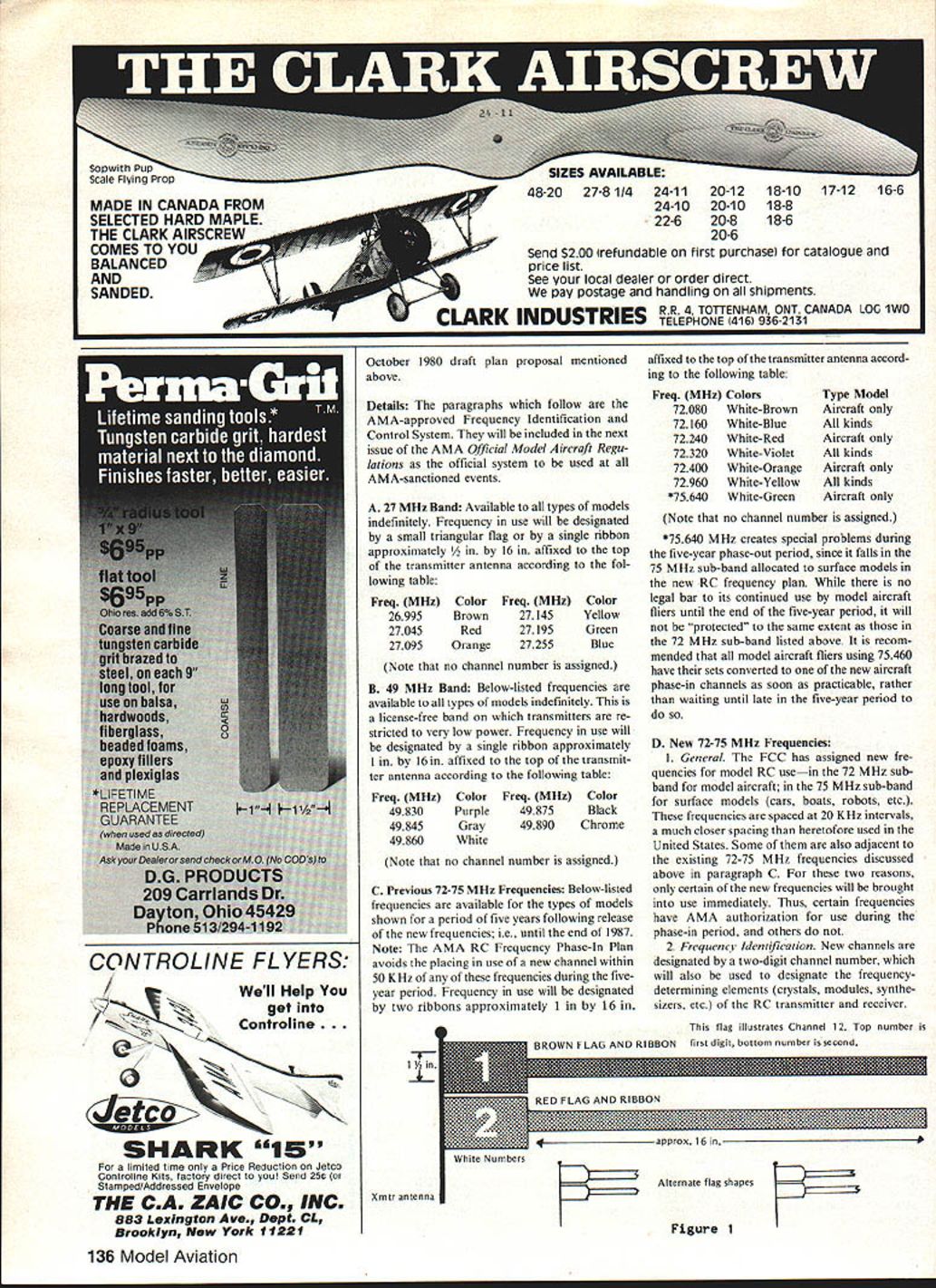
This flag illustrates Channel 12. Top number is the first digit; bottom number is the second. A channel identification flag/ribbon combination will be affixed to the top of the transmitter antenna to indicate the frequency in use. Unlike the simple ribbon (or streamer) system which has long been used, the flag will show the actual channel number in printed digits of 1/2-in. size on the flag, and each digit flag/ribbon combination will be color-coded according to the widely used electronic parts color-coding system. This system will be used on any set which is on one of the new frequency channels, whether it is a new set originally manufactured to use the new channels or an older set which has been converted to put it on one of the new channels.
Color coding for channel number flag/ribbon combinations (digit → color, with PMS where specified):
- 1 — Brown (PMS 483)
- 2 — Red (PMS Red 032)
- 3 — Orange (PMS Orange 021)
- 4 — Yellow (PMS Yellow 012)
- 5 — Green (PMS 354)
- 6 — Blue (PMS 293)
- 7 — Purple
- 8 — Gray (PMS 428)
- 9 — White
- 0 — Black
- 72 MHz Sub-band Aircraft Channels (Numbers 11 through 60): for model aircraft only
The following new channels are compatible with the old frequencies and are the only new aircraft channels which will be authorized for use at AMA-sponsored or sanctioned events during the five-year phase-in period, effective January 1, 1983. Additional channels will be authorized each year for the next three years. Channel numbers and colors will be published in advance of effectiveness.
- Channel 12 — 72.030 MHz — Top: Brown (1); Bottom: Red (2)
- Channel 38 — 72.550 MHz — Top: Orange (3); Bottom: Gray (8)
- Channel 40 — 72.590 MHz — Top: Yellow (4); Bottom: Black (0)
- Channel 42 — 72.630 MHz — Top: Yellow (4); Bottom: Red (2)
- Channel 44 — 72.670 MHz — Top: Yellow (4); Bottom: Yellow (4)
- Channel 46 — 72.710 MHz — Top: Yellow (4); Bottom: Blue (6)
- Channel 48 — 72.750 MHz — Top: Yellow (4); Bottom: Gray (8)
- Channel 50 — 72.790 MHz — Top: Green (5); Bottom: Red (2)
- Channel 52 — 72.830 MHz — Top: Green (5); Bottom: Yellow (4)
- Channel 54 — 72.870 MHz — Top: Green (5); Bottom: Blue (6)
- Channel 56 — 72.910 MHz — Top: Green (5); Bottom: Gray (8)
- Channel 58 — 72.950 MHz — Top: Green (5); Bottom: Red (2)
- Channel 60 — 72.990 MHz — Top: Green (5); Bottom: Yellow (4)
- 75 MHz Sub-band Surface Model Channels (Numbers 61 through 90): for surface models only (cars, boats, robots, etc.), available immediately
- Channel 62 — 75.430 MHz — Top: Blue; Bottom: Red
- Channel 64 — 75.470 MHz — Top: Blue; Bottom: Yellow
- Channel 66 — 75.510 MHz — Top: Blue; Bottom: Blue
- Channel 68 — 75.550 MHz — Top: Blue; Bottom: Gray
- Channel 70 — 75.590 MHz — Top: Purple; Bottom: Black
- Channel 74 — 75.670 MHz — Top: Purple; Bottom: Yellow
- Channel 76 — 75.710 MHz — Top: Purple; Bottom: Blue
- Channel 78 — 75.750 MHz — Top: Gray; Bottom: Black
- Channel 80 — 75.790 MHz — Top: Gray; Bottom: Red
- Channel 82 — 75.830 MHz — Top: Gray; Bottom: Gray
- Channel 84 — 75.870 MHz — Top: Gray; Bottom: Yellow
Note that Channel 72 (75.630 MHz) is omitted during this period to provide separation from 75.640 MHz (white–green). Since all the above channels are for surface model use, and 75.640 MHz remains authorized for model aircraft use only, it is believed that the 30 kHz spacing between 75.640 and Channel 74 (75.670 MHz) will provide reasonable protection during the period.
E. Amateur Radio Service 50–54 MHz (Six-Meter) Band
Operator license: An amateur radio license of Technician Class or higher is required to use these frequencies legally.
General: On this band, the RC frequencies listed below are "AMA suggested" since the FCC does not, on Amateur Radio Service bands, designate individual frequencies for specific uses as it does on the other RC frequency bands. These "AMA suggested" frequencies have been coordinated with the American Radio Relay League (ARRL — the amateur radio equivalent of the AMA) and are "protected" for RC only in the sense that the ARRL six-meter-band plan (a voluntary plan) establishes a frequency sub-band for RC frequencies outside of the sub-bands suggested for other types of amateur communications. The frequencies listed below are those which will be authorized for use at AMA-sponsored or sanctioned activities.
53 MHz frequencies. The below-listed frequencies continue to be available for all types of models. It is expected that these frequencies will become less in use and less useful over the next several years for RC as the growing number of amateur operators increases the probability of interference, particularly in or near urban areas. In the meantime, new RC frequencies in the low end of the 50–54 MHz band are expected to become available and will be announced as soon as possible. Until then it is recommended that existing, wide-band, six-meter RC equipment remain on the 53 MHz frequencies until the end of its useful life, and that any new six‑meter frequencies to come be reserved for new narrow‑band equipment.
Frequency in use will be designated by two ribbons (or streamers) approximately 1 1/2 in. by 16 in. affixed to the top of the transmitter antenna according to the following list:
- 53.000 MHz — Black–Brown
- 53.200 MHz — Black–Red
- 53.300 MHz — Black–Orange
- 53.400 MHz — Black–Yellow
- 53.500 MHz — Black–Green
- 53.600 MHz — Black–Blue
- 53.700 MHz — Black–Purple
- 53.800 MHz — Black–Gray
(Note that no channel number is assigned.)
*Not generally in use, but recognized as appropriate for RC use in the ARRL band plan in effect prior to April 1982.
F. Additional Items
- Frequency Pins: Frequency pins (usually clothespins) should also be employed with the new frequency (channel) control system at club flying sites and contests. New pins should be both channel‑numbered and color‑coded. As in the past, no RC transmitter should be turned on unless the pin for its frequency (or channel) is attached to its antenna.
- Special 72 MHz Considerations: To avoid coexistence problems between new and old 72 MHz frequencies during the phase‑in period, frequency control boards at club flying fields and at contests must only show those frequencies/channels that are authorized for use during the specific portion of the phase‑in period. For example: throughout the first five years, the 72 MHz aircraft‑only band control clipboard would show only those pins for six of our existing seven channels, new Channel 12 (72.030 MHz), and only even‑numbered Channels 38, 40, 42, etc., up to Channel 56. All odd‑numbered channels would be blocked out and would not be used during that period.
- Active Frequency Control: Local RC clubs are encouraged to look for new types of active frequency control devices. Scanning receivers, spectrum analyzers, and even simple tunable converters hooked up to automobile radios are typical of the types of devices which can help in this role.
- Telemetry Devices: If the flier is using a telemetry device, such as a thermal sensor, he or she should display a single ribbon or streamer on the transmitter antenna several inches below the flag/ribbon combination which designates the control frequency. If the telemetry device is on one of the 49 MHz frequencies, see paragraph B for the color coding. If the flier is a licensed amateur and the telemetry device is on the amateur two‑meter band (144–148 MHz), a single red streamer will be used.
Transcribed from original scans by AI. Minor OCR errors may remain.

