
FCC Notice of Proposed Rule Making
Before the FEDERAL COMMUNICATIONS COMMISSION Washington, D. C. 20554
G-3 FCC 82-145 31081
In the Matter of
Amendment of Parts 2, 21, 22, 81, 87, 90 and 95 of the Commission's Rules to provide additional spectrum between 72 and 76 MHz for the radio control of model aircraft, boats, cars and other similar devices.
General Docket 82-181 RM-3248
NOTICE OF PROPOSED RULE MAKING
Adopted: April 1, 1982 Released: April 13, 1982
By the Commission:
Introduction
- On November 17, 1978, the Commission received a petition (RM-3248) from the Academy of Model Aeronautics, Inc. (Academy) requesting that the Commission amend Parts 2 and 95 of the Commission's Rules to provide additional spectrum for the radio control of model airplanes, boats and cars. The Academy stated that additional spectrum is needed in order to cope with the anticipated expansion in model activities during the next ten years, and to compensate for diminished use of the existing thirteen frequencies in the 26.99 to 27.26 MHz and 72.0 to 76.0 MHz bands due to interference caused by other operations in those bands.
- The Academy states in its petition that because of spectrum congestion and high-power operation on the forty Citizen's Band Radio Service frequencies between 26.96 and 27.41 MHz (the 26–27 MHz band), the six interleaved channels in that band which are allocated to the Radio Control Radio Service are nearly useless for radio control operations.
- Currently, the Academy notes, the only other spectrum available to the Radio Control Radio Service is on seven channels in the 72–76 MHz band; however, this use is secondary to operational fixed stations in the Industrial, Land Transportation and Public Safety Services as well as to low-power land mobile stations in the Manufacturers Radio Service. According to the Academy, there are a number of cities (e.g., Houston, TX; Tampa, FL) in which only a few of the seven 72–76 MHz radio control channels are available due to interference from fixed and land mobile operations of industrial users; and the use of this spectrum by the land mobile services is growing.
- In addition to the need to find replacement frequencies for the 26–27 MHz and the 72–76 MHz channels, the Academy states that there is a need for some 20 to 25 additional channels to support the growth of the Radio Control Radio Service over the next ten years.
- As to where the additional radio control channels requested might be found, the Academy suggests secondary use of the ten 72–76 MHz channels currently allocated to low-power (1 watt or less) land mobile operations in the Special Industrial, Manufacturers and Railroad Radio Services along with the eleven "guard band" channels separating the Government and non-Government allocations between 30 and 42 MHz. The Academy also asks if spectrum might be found in the 222–224 MHz, the 450–460 MHz and the 900 MHz bands.
- A series of meetings were held during the fall of 1979 (see Note 1) between members of the Commission's staff, the Petitioner and representatives of several manufacturers of radio control equipment to discuss spectrum requirements. The manufacturers felt that because of the wide separation between the eleven "guard band" channels between 30 and 42 MHz, these channels would not be well suited for the radio control of models. The Commission's staff pointed out that the 222–224 MHz band was allocated in part to the Amateur Radio Service and that any attempt to re-allocate that spectrum would encounter much resistance from the amateur community. The staff also pointed out that heavy usage was being made of the 450–460 MHz band. Thus, those channels might not be readily available. With respect to spectrum at 900 MHz, the Academy indicated that a long-term solution might be the use of spectrum at 900 MHz; however, considerable testing would be required before a formal request could be made (see Note 2).
- As a result of this series of meetings, the Petitioner indicated that the near-term (10 to 20 years) spectrum requirements could best be served by the allocation of additional spectrum in the 72–76 MHz band. To this end, the Petitioner established a Joint Academy–Industry Committee to study the viability of expanded radio control operations on the interlaced, odd, 20 kHz channels in the 72–76 MHz band (i.e., 72.01, 72.03, 72.05 MHz, etc.) and to establish technical parameters of a workable 72–76 MHz assignment plan. On September 11, 1980, the Academy submitted to the Commission the findings and recommendations of the Joint Committee in Report on 72–76 MHz Radio Control Systems, dated September 1980, which was later modified by letter dated July 15, 1981.
- The Academy Report proposes implementation of additional 72–76 MHz frequencies as follows:
- Model aircraft only: fifty 8 kHz channels, starting at 72.010 MHz and proceeding every 20 kHz through 72.990 MHz.
- Terrestrial models only: twenty-three 8 kHz channels, starting at 75.410 MHz and proceeding every 20 kHz through 75.850 MHz.
- Phase out existing seven 72–76 MHz frequencies within five years.
- Permit any type of emission to be used.
- The current rules restrict the type of emission employed by radio control stations to amplitude modulation. The Academy feels that operations in the 72–76 MHz band should not be restricted to using only amplitude modulation. They point out that frequency (or phase) modulation is used in other countries and may prove beneficial if permitted in this country.
Discussion
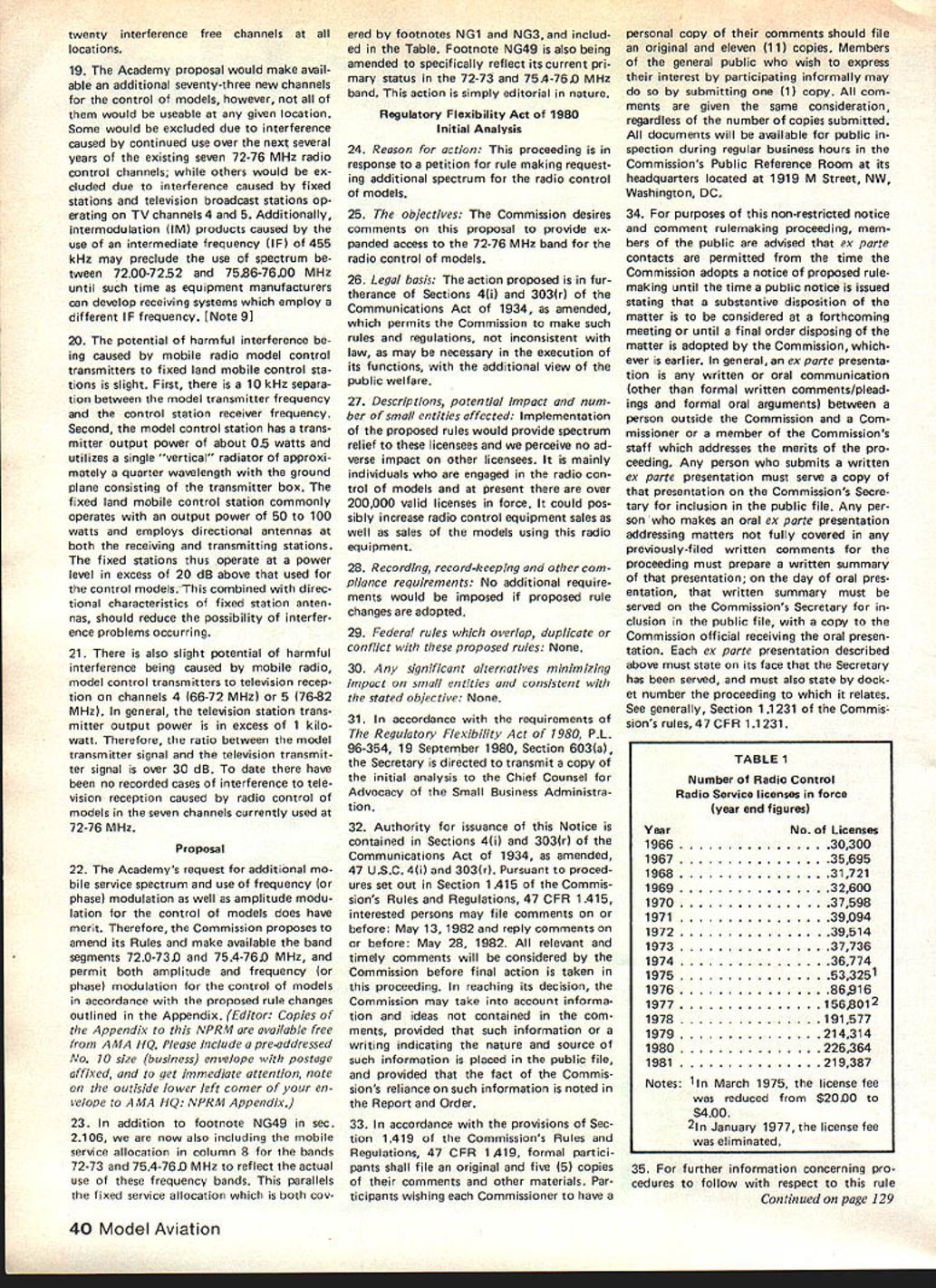
- The Commission's licensing records indicate that there has been considerable growth in the Radio Control Service over the last fifteen years; particularly in the last five years, as can be seen in TABLE 1 attached hereto. This growth trend tends to support the Academy's contention that there is a need for additional spectrum to support the anticipated expansion of model activities over the next ten years.
- At present, the Radio Control Radio Service licensees have access to thirteen 8 kHz channels, six in the 26–27 MHz band (see Note 3) and seven in the 72–76 MHz band (see Note 4), for the control of models. Of the thirteen channels, only four (see Note 5) are restricted solely to the control of model aircraft. The Academy claims that because of the sheer number of licensees and high-power operations on the forty Citizen's Band Radio Service channels at 27 MHz, the six interleaved radio control channels are nearly useless for radio control operation, particularly for the control of model aircraft in suburban and urban areas.
- The Academy also claims that, in many areas, the signal level of fixed stations operating in the 72–76 MHz band precludes the use of some of the 72–76 MHz radio control channels. Because of the growth of the land mobile radio service with which these 72–76 MHz fixed operations are associated, the Academy feels that the number of radio control channels precluded from use because of interference from facilities supporting land mobile operations will drastically increase unless some relief is forthcoming. The Academy suggests that one form of relief would be to expand the radio controllers' access to the 72–76 MHz band.
- In the United States, the band segments 72.0–73.0 MHz and 75.4–76.0 MHz (the 72–76 MHz band) are currently allocated on a primary basis to the non-Government Fixed Service (see sec. 2.106 of the Commission's Rules). In this band, a 20 kHz channeling plan, which begins at 72.02 MHz and proceeds to 72.98 MHz and then from 75.60 through 75.98 MHz, has been established. The following FCC radio services are permitted access to this spectrum: Alaska Public Fixed Service, Aviation Service, Domestic Public Fixed Radio Service, Domestic Land Mobile Radio Service, Industrial Radio Services, Land Transportation Radio Services, Maritime Service and Public Safety Radio Services. Non-Government footnote NG49 permits low-power (1 watt or less) non-Government mobile service use of a limited number of the same 72–76 MHz channels by several of the Industrial and Land Transportation sub-radio services (see Note 7). Additionally, non-Government footnote NG56 permits, on a secondary basis, the low-power (1 watt or less) mobile service use of seven channels for the control of models by licensees in the Radio Control Radio Service (see Note 8). All operations in this band are subject to the condition that no interference is caused to the reception of signals of television channels 4 and 5.
- The 72–76 MHz frequencies are predominantly used by licensees in the private (Part 90) and common carrier (Parts 21 and 22) radio services for control of remote transmitters operating in the 30–50 MHz, 152–162 MHz or 450–470 MHz bands; both are services with high growth rates. Developments are likely to increase demand for 72–76 MHz transmitter control links for the land mobile service. Telephone-company-supplied wireline control circuits, which 72–76 MHz systems can replace, have both increased in cost and declined in availability. The metallic copper pairs traditionally used for transmitter control circuits are not available in a number of areas, as carrier, digital and fiber optical technology has come into use. Even where wireline control circuits are available, prices have increased to the point where the cost of a 72–76 MHz radio system is matched in a relatively short time by savings of leased telephone line charges. The trend in the common carrier paging service is, moreover, to multiple site, simulcast operation. Control of simulcast transmitters, which requires precise matching of the amplitude and phase of audio signals supplied to the individual transmitters, is difficult, at best, to achieve using wireline control circuits due to day-to-day variations in frequency or phase response of the circuit. However, control of simulcast transmitters is easily achieved with radio circuits.
- The reallocation of twenty 35–43 MHz channels for common carrier paging (Report and Order, FCC 81-296, adopted June 30, 1981) in CC Docket 80-189, and the proposed allocation of up to one hundred twenty 900 MHz paging channels for both common carrier and private systems (General Docket 80-183: Notice of Proposed Rule Making, FCC 80-231, adopted April 24, 1980; Supplemental Notice of Proposed Rule Making, FCC 80-510, adopted October 21, 1980), can be expected to place an even greater demand upon frequency resources in the 72–76 MHz band for transmitter control purposes. Thus, additional channels will be precluded from use by possibilities for interference from these transmitter control operations.
- In justifying its request for additional spectrum for the control of models, the Academy states that experience has shown that when more than fifteen models are operated simultaneously in any given location, operator confusion becomes a major problem; therefore, for safety purposes, the number of models in operation at any given location is practically limited to fifteen or less. Additionally, the Academy states that it is desirable to have an additional five channels for testing of the models. Thus, at any given modeling area, the total number of desired interference-free channels would be twenty.
- In areas where fixed stations are operating on the "even" channels (i.e., 72.02, 72.04 ... 72.96, 72.98 MHz and 75.42, 75.44 ... 75.86, 75.98 MHz), mobile use of the adjacent channels (i.e., 72.01, 72.03 ... 72.97, 72.99 MHz and 75.41, 75.43 ... 75.97, 75.99 MHz) would also be precluded because of the potential of interference being caused to the model's receiver by the fixed station. The size of the area involved is dependent primarily upon the fixed station transmitter power and the amount of natural radio shielding between the fixed transmitter and the model's receiver. Thus, to provide the requested twenty interference-free channels at any given location, the modeler would need access to a block of significantly more than twenty channels.
- The Academy feels that if modelers are permitted access to fifty channels for the control of airborne models between 72.0 and 73.0 MHz and twenty-three channels between 75.40 and 75.86 MHz for the control of terrestrial models, they will be able to obtain sufficient channels for safe operation and testing.
BASICS OF THE NPRM
Assuming acceptance of the AMA proposals to the FCC, there will be 50 new RC frequencies for model aircraft, and...
- We will no longer be sharing our frequency numbers with the industrial users. If one of them, due to very high power and close proximity to an RC field, interferes with us, there will be plenty of other frequencies to move to.
- All existing equipment is usable for five years from the implementation date.
- All existing equipment is usable from year six to year eight from the implementation date with a change of crystals and re-tuning.
- After the eighth year all receivers that exist now will be made obsolete.
- Transmitters, as they exist now, operate on a narrow enough bandwidth to be usable forever with crystal and tuning changes.
- The Academy proposal would make available an additional seventy-three new channels for the control of models; however, not all of them would be useable at any given location. Some would be excluded due to interference caused by continued use over the next several years of the existing seven 72–76 MHz radio control channels; while others would be excluded due to interference caused by fixed stations and television broadcast stations operating on TV channels 4 and 5. Additionally, intermodulation (IM) products caused by the use of an intermediate frequency (IF) of 455 kHz may preclude the use of spectrum between 72.00–72.52 and 75.86–76.00 MHz until such time as equipment manufacturers can develop receiving systems which employ a different IF frequency (see Note 9).
- The potential of harmful interference being caused by mobile radio model control transmitters to fixed land mobile control stations is slight. First, there is a 10 kHz separation between the model transmitter frequency and the control station receiver frequency. Second, the model control station has a transmitter output power of about 0.5 watts and utilizes a single vertical radiator of approximately a quarter wavelength with the ground plane consisting of the transmitter box. The fixed land mobile control station commonly operates with an output power of 50 to 100 watts and employs directional antennas at both the receiving and transmitting stations. The fixed stations thus operate at a power level in excess of 20 dB above that used for the control models. This, combined with directional characteristics of fixed station antennas, should reduce the possibility of interference problems occurring.
- There is also slight potential of harmful interference being caused by mobile radio model control transmitters to television reception on channels 4 (66–72 MHz) or 5 (76–82 MHz). In general, the television station transmitter output power is in excess of 1 kilowatt. Therefore, the ratio between the model transmitter signal and the television transmitter signal is over 30 dB. To date there have been no recorded cases of interference to television reception caused by radio control of models in the seven channels currently used at 72–76 MHz.
Proposal
- The Academy's request for additional mobile service spectrum and use of frequency (or phase) modulation as well as amplitude modulation for the control of models does have merit. Therefore, the Commission proposes to amend its Rules and make available the band segments 72.0–73.0 and 75.40–76.0 MHz, and permit both amplitude and frequency (or phase) modulation for the control of models in accordance with the proposed rule changes outlined in the Appendix. [Editor: Copies of the Appendix to this NPRM are available free from AMA HQ. Please include a self-addressed, No. 10 size (business) envelope with postage affixed, and in order to preclude libel, note on the outside lower left corner of your return envelope to AMA HQ: "NPRM Appendix."]
- In addition to footnote NG49 in sec. 2.106, we are now also including the mobile service allocation in column 3 for the 72–73 and 75.4–76.0 MHz to reflect the use of these frequency bands. This parallels the fixed service allocation which is both covered by footnotes NG1 and NG3, and included in the Table. Footnote NG49 is also being amended to specifically reflect its current primary status in the 72–73 and 75.4–76.0 MHz band. This action is simply editorial in nature.
Regulatory Flexibility Act of 1980
Initial Analysis
- Reason for action: This proceeding is in response to a petition for rule making requesting additional spectrum for the radio control of models.
- The objectives: The Commission desires comments on this proposal to provide expanded access to the 72–76 MHz band for the radio control of models.
- Legal basis: The action proposed is in furtherance of Sections 4(i) and 303(r) of the Communications Act of 1934, as amended, which permits the Commission to make such rules and regulations, not inconsistent with law, as may be necessary in the execution of its functions, with the additional view of the public welfare.
- Descriptions, potential impact and number of small entities affected: Implementation of the proposed rules would provide spectrum relief to these licensees and we perceive no adverse impact on other licensees. It is mainly individuals who are engaged in the radio control of models and at present there are over 200,000 valid licenses in force. It could possibly increase radio control equipment sales as well as sales of the models using this radio equipment.
- Recording, record-keeping and other compliance requirements: No additional requirements would be imposed if proposed rule changes are adopted.
- Federal rules which overlap, duplicate or conflict with these proposed rules: None.
- Any significant alternatives minimizing impact on small entities and consistent with the stated objective: None.
- In accordance with the requirements of The Regulatory Flexibility Act of 1980, P.L. 96-354, September 19, 1980, Section 603(a), the Secretary is directed to transmit a copy of the initial analysis to the Chief Counsel for Advocacy of the Small Business Administration.
- Authority for issuance of this Notice is contained in Sections 4(i) and 303(r) of the Communications Act of 1934, as amended; 47 U.S.C. 4(i) and 303(r). Pursuant to procedures set out in Section 1.415 of the Commission's Rules and Regulations, 47 CFR 1.415, interested persons may file comments on or before: May 28, 1982. All timely comments will be considered by the Commission before final action is taken in this proceeding. In reaching its decision, the Commission may take into account information and ideas not contained in the comments, provided that such information or a summary indicating the nature and source of such information is placed in the public file and provided that the fact of the Commission's reliance on such information is noted in the Report and Order.
- In accordance with the provisions of Section 1.419 of the Commission's Rules and Regulations, 47 CFR 1.419, formal participants shall file an original and five (5) copies of their comments and other materials. Participants wishing each Commissioner to have a personal copy of their comments should file an original and eleven (11) copies. Members of the general public who wish to express their interest by participating informally may do so by submitting one (1) copy. All comments are given the same consideration, regardless of the number of copies submitted. All documents will be available for public inspection during regular business hours in the Commission's Public Reference Room at its headquarters located at 1919 M Street, NW, Washington, DC.
- For purposes of this non-restricted notice and comment rulemaking proceeding, members of the public are advised that ex parte contacts are permitted from the time the Commission adopts a notice of proposed rulemaking until the time a public notice is issued stating that a substantive disposition of the matter is to be considered at a forthcoming meeting or until a final order disposing of the matter is adopted by the Commission, whichever is earlier. In general, an ex parte presentation is any written or oral communication (other than formal written comments/pleadings and formal oral arguments) between a person outside the Commission and a Commissioner or a member of the Commission's staff which addresses the merits of the proceeding. Any person who submits a written ex parte presentation must serve a copy of that presentation on the Commission's Secretary for inclusion in the public file. Any person who makes an oral ex parte presentation addressing matters not fully covered in any previously-filed written comments for the proceeding must prepare a written summary of that presentation; on the day of oral presentation, that written summary must be served on the Commission's Secretary for inclusion in the public file, with a copy to the Commission official receiving the oral presentation. Each ex parte presentation described above must state on its face that the Secretary has been served, and must also state by docket number the proceeding to which it relates. See generally Section 1.1231 of the Commission's rules, 47 CFR 1.1231.
TABLE 1 Number of Radio Control Radio Service licenses in force (year-end figures)
Year No. of Licenses 1966 30,300 1967 35,695 1968 31,721 1969 32,600 1970 37,598 1971 39,094 1972 39,514 1973 37,736 1974 36,774 1975 53,325 1976 86,916 1977 156,801 1978 191,577 1979 214,314 1980 226,364 1981 219,387
Notes:
- In March 1975, the license fee was reduced from $20.00 to $4.00.
- In January 1977, the license fee was eliminated.
- For further information concerning procedures to follow with respect to this rulemaking proceeding contact Donald Draper Campbell, FCC, Office of Science and Technology, Spectrum Planning Branch, Washington, D.C. 20554, telephone (202) 653-8177.
Federal Communications Commission
William J. Tricarico Secretary
Note 1: Meetings held October 26, November 17 and December 12, 1979.
Note 2: To this end, the Academy applied for an experimental license (Part 5) on August 19, 1980, file number 8272-ER-PL-80, to operate on four 900 MHz frequencies. An experimental license, KK2FZK, was issued on January 28, 1981.
Note 3: 26.995, 27.045, 27.095, 27.145, 27.195 and 27.255 MHz. The latter frequency is shared with other services.
Note 4: 72.08, 72.16, 72.24, 72.32, 72.40, 72.96 and 75.64 MHz.
Note 5: 72.08, 72.24, 72.40 and 75.64 MHz.
Note 6: See sec. 2.106 of the Commission's Rules.
Note 7: NG49 — The following frequencies may be authorized for low-power (1 watt input) mobile operations in the radio services shown subject to the condition that no interference is caused to the reception of television stations operating on channels 4 and 5:
- Manufacturers Radio Service
MHz: 72.02 72.10 72.18 72.26 72.34 MHz: 72.04 72.12 72.20 72.28 72.36 MHz: 72.06 72.14 72.22 72.30 72.38 MHz: 72.08 72.16 72.24 72.32 72.40
- Special Industrial Radio Service, Manufacturers Radio Service, Railroad Radio Service
MHz: 72.44 72.52 72.60 75.48 75.56 MHz: 72.48 72.56 75.44 75.52 75.60
Note 8: NG56 — The frequencies 72.08, 72.16, 72.24, 72.32, 72.40, 72.96 and 75.64 MHz may be authorized for low-power (1-watt input) mobile operations in the Personal Radio Services for radio control of models subject to the condition that interference will not be caused to remote control of industrial equipment operating on the same or adjacent frequencies and to the reception of television stations operating on channels 4 or 5. TV interference shall be considered to occur when the reception of regularly used television signals is impaired or destroyed, regardless of the strength of the television signals or the distance to the television station.
Note 9: "No doubt it is for this reason the Academy has not requested access to the band segment 75.86–76.00 MHz."
Continued on page 132.
Transcribed from original scans by AI. Minor OCR errors may remain.

