
FF Glider
Chris Matsuno
A-1
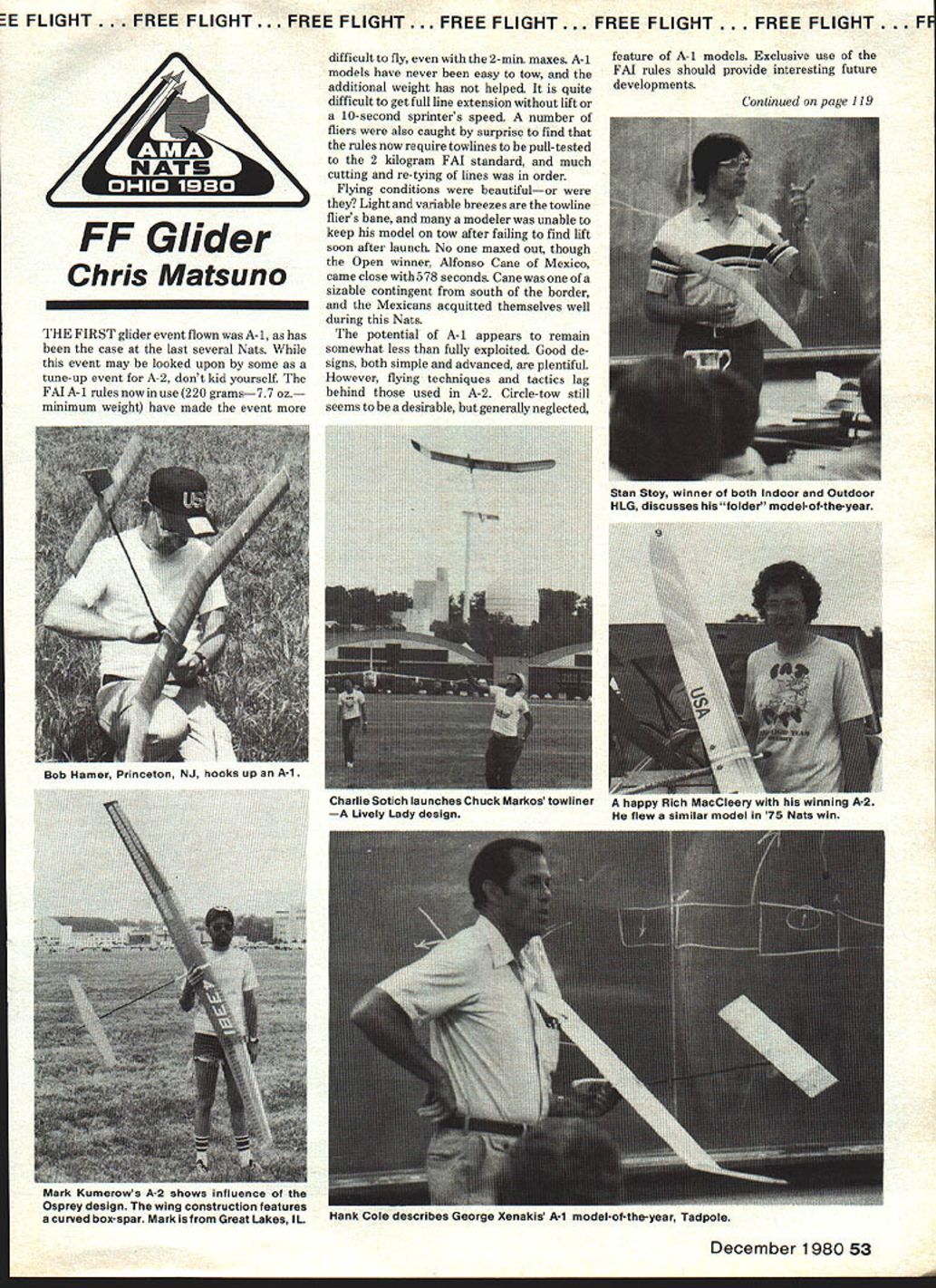
The first glider event flown was A-1, as has been the case at the last several Nats. While this event may be looked upon by some as a tune-up for A-2, don't kid yourself. The FAI A-1 rules now in use (220 grams — 7.7 oz. minimum weight) have made the event more difficult to fly, even with the 2-minute maxes. A-1 models have never been easy to tow, and the additional weight has not helped. It is quite difficult to get full line extension without lift or a 10-second sprinter's speed. A number of fliers were also caught by surprise to find that the rules now require towlines to be pull-tested to the 2-kilogram FAI standard, and much cutting and re-tying of lines was in order.
Flying conditions were light and variable. Light breezes are the towline flier's bane, and many a modeler was unable to keep his model on tow after failing to find lift soon after launch. No one maxed out in some divisions, though the Open winner, Alfonso Cane of Mexico, came close with 578 seconds. Cane was one of a sizable contingent from south of the border, and the Mexicans acquitted themselves well during this Nats.
The potential of A-1 appears to remain somewhat less than fully exploited. Good designs, both simple and advanced, are plentiful. However, flying techniques and tactics lag behind those used in A-2. Circle-tow still seems to be a desirable, but generally neglected, feature of A-1 models. Exclusive use of the FAI rules should provide interesting future developments.
In another division, the weather turned cloudy and quite breezy, with marginal air in the morning and partly sunny, turbulent conditions in the afternoon, with stronger thermals and their attendant "holes." This forced the usual decision—fly now or fly later? Do you need lift to max, with the increased risk of downers, or can you squeak it out in marginal air? With five flights to put in, most competitors had to fly in both conditions, and maxes did not come easily. At the end of the day there was a tie for first between David Evans and Chris Matsuno. Both had scored 539 points, with three maxes and "change." Following the precedent in A-2 at the '79 Nats, both were declared co-winners. Jim Miller, from Cincinnati, was 3rd, and a Senior, Tad Jones, had the 4th highest score overall, a creditable 525 points.
The co-champion models represented two widely different approaches. Matsuno's model was a "modern" high aspect-ratio model built to 100-gram rules with a large prop and slow cruise. Evans used a Gollywock with squared-off tips and original prop, which gives a fast-climbing model, as anyone who has seen a Gollywock go knows. Who says the old designs aren't competitive today?
Unofficial Events
Unofficials have more fun. As always, the National Free Flight Society sponsored several unofficial events, many being gum-band-powered.
- Rubber Speed: Terry Rimert, 47 mph.
- 7-11 Distance (7" diameter prop, 11" maximum motor length): George Perryman, 623 feet.
- Rise-Off-Water (ROW) Rubber: Dr. Bill Baker.
- P-30: Well-contested with a good turnout in all age classes. (In what seems to have been an oversight, P-30 was not sponsored by AMA as a Nats official event, even though it has been voted for official status in the latest rule book.)
Five intrepid individuals gathered for the McDonnell-Douglas FF Club–sponsored Dick Korda Open Rubber event—one flight, unlimited max. Jim O'Reilly, who wrote an article on the state of the art in Mulvihill for the '79 NFFS Symposium, repeated his '79 win in this event with a time of 8:14, out-of-sight in the low haze. The model was eventually found by a state trooper and returned. George Perryman, flying a 1.7-ounce, condenser-paper-covered model with 2 ounces of rubber, was second with 5:53. George Batluk landed on one of the base hangars at 5:51.
Mulvihill Rubber
Mulvihill Rubber was again flown in the windiest conditions of the week, and it was decided to go to 2-minute maxes. In retrospect, it would have been possible to start with 3-minute maxes, since all week Wright Field "flew" larger and longer than it appeared. A marathon contest seemed assured, and everyone got to it right away. The lead see-sawed back and forth as one max after another was turned in.
As flying drew to a close, David Evans, flying a model with a rolled balsa tube fuselage, stretched Gollywock wing and smallish prop, was in first, having maxed his 6-minute flight. Working on his 6-minute max was George Perryman. George had flown his Lanzo Stick model for his first four maxes, then switched to a "normal" model for his subsequent flights. During his 6-minute flight the model DT'ed early, but the flight was long enough to move him into first with only minutes remaining in the contest. The "Ol' Perfesser" finally scored another win. Norm Pett was 3rd, Nicholas Pitas 4th, and last year's winner, Dr. Bill Baker, finished 5th.
Although there was no serious problem with lost models this year, perhaps it is time for the AMA to reconsider the Mulvihill flyoff format at the Nats. The increasing-max method's principal drawback is the increased chance of lost models. There seems to be considerable support for an unlimited-max flyoff, either at the end of the day or perhaps early in the morning. If Mulvihill were flown sometime during the week, rather than on the last day of the Nats, the event director could be flexible in choosing the best time for the flyoff. This would have considerable drama and spectator interest, and would certainly be spectacular to see a score or more of models filling the air.
Nats FF Glider — Matsuno (continued)
A-2
The scene for A-2 flying was another story. Local weather forecasts had been predicting rain since Wednesday, and the rains finally came late Thursday night and Friday morning. After a contestants' meeting and some delay, the contest was started on the field behind the clubhouse. Fortunately, the rain subsided to a drizzle during the first round and stopped soon after, leaving overcast skies and almost no wind.
In the very dead air of the first round, only one flier out of 40, Greg Simon, maxed. The top three after Round 1 were all from the Detroit Fat City team—Simon, last year's co-champ Bill Shailor, and '75 Nats winner Rich MacCleery—and all were flying Paul Crowley–designed Happy Hookers.
The next four rounds produced some long waiting sessions and mass launches, with 10 to 15 models in the air at once. This mass mayhem resulted in the usual line tangles as well as a couple of mid-air collisions, both, ironically, involving Happy Hookers. Simon maintained his lead in Round 2 with another max, but disaster struck in Round 3: attempting to tow crosswind to reach a thermaling model, Simon's glider released prematurely. This dropped him out of first, with former team member Chuck Markos moving into the lead.
By resorting to overlapping rounds, event director Joe Guylas soon had the rounds back on schedule, and in fact flying was completed earlier than scheduled. Lift became spotty during the last two rounds, but Markos held on to the lead. At the start of the 7th round, Markos led MacCleery by 20 seconds. MacCleery's first two flights had been close to maxing, and he then strung together four maxes. Flying early in Round 7, he maxed for his fifth in a row and moved into the lead. Markos, who had won FAI Power the day before, needed 161 seconds to win his second FAI event of this Nats. After circle-towing for a few minutes with his Elton Drew–designed Lively Lady, he made a good launch into air that seemed promising; however, the air deteriorated, and he was down 22 seconds short of MacCleery, who finished with an even 1,200 seconds. Former team member Vince Croghan, on the comeback trail, finished third, also flying a Happy Hooker.
MacCleery won A-2 at Lake Charles in 1975, and it was suggested that he not bother coming to the Nats again until 1985—since he seems to be on a five-year cycle.
Hand-Launch Glider (HLG)
The last glider event flown was Hand-Launch Glider on Saturday. Interest in this event had been building during the week, with the prospect of an exciting competition involving six past winners of the Tulsa Glue Dobbers High Time trophy—Larry Sargent (1979), Bob Boyer (1978), Joe Mekina (1975), Mike Stoy (1974), Dan Domina (1973), and Bob Larsh (1968). The National HLG Team Challenge, sponsored by Steve Geraghty and Bob Boyer, also created much interest, with seven teams eventually entering.
Flying conditions on Saturday were less than ideal, with the strongest winds of the week, overcast sky and very unusual "air." Rising bubbles and cattail fluffies often seemed to be associated with cold air, while warm patches of air would produce no visible indications of lift. The HLG fliers soon created their own "launch pad" with a half dozen streamer poles, thermistors, bubble machines, and fluffies.
Joe Mekina turned in the first max of the day, but the action was slow until noon, when conditions improved slightly. For lift spotting, the HLG fliers were not able to depend on the high-climbing Mulvihill Rubber and B Gas models flown that day, so there was much waiting, with mass launches resulting when another HLG indicated good air.
Stan Stoy, who had obliterated the field in Indoor HLG with his NFFS Model of the Year folder series, was the first to max out, followed in short order by Joe Mekina and Bill Shailor. Stoy was also the first to put up his flyoff flight. The air looked promising, with the model "bumping" a few times, but the lift soon deteriorated, dropping Stoy at 48 seconds and Shailor at 37 seconds. Mekina was unable to better this, so the final order was:
- 1st: Stan Stoy
- 2nd: Joe Mekina
- 3rd: Bill Shailor
The Team Trophy was won by the Ohio team of Joe Mekina, Rudy Kuliber, and Norm Poti, who edged the Michigan team of Bill and Paul Shailor and Greg Simon, 964 seconds to 938 seconds. The Ohio team averaged 321 seconds apiece—their total was only 116 seconds short of nine maxes. Other teams participating, in order of finish, were California, Illinois, Indiana, Missouri, and Texas.
In closing, here's an item concerning Nats perennial Carl Goldberg. In addition to his appearance in A-2, he continued to compete in HLG. Carl received an NFFS special award for his development of the pop-up DT stabilizer, and here's hoping that he continues to grace the Nats with his presence in years to come.
Transcribed from original scans by AI. Minor OCR errors may remain.

