
FF Indoor
Larry Kruse
Site and facilities
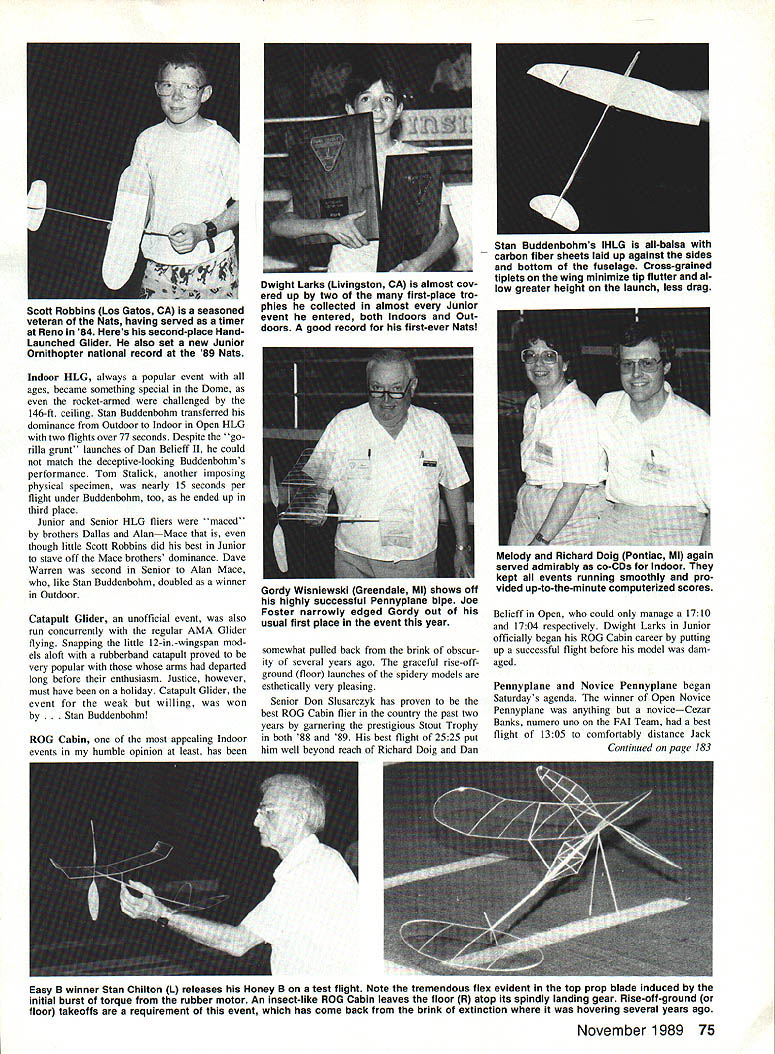
The site for the 1989 Nats Indoor contest was the Kibbie Dome on the campus of the University of Idaho in Moscow — possibly the best indoor site ever for the Nationals since the Navy opted out as sponsor. Located some 150 miles from the rest of the outdoor Nationals events, the huge Dome encloses a full-size football field surrounded by a 440-yard track. Parabolic arches of the domed roof reach a height of 146 ft. for the full length of the building, providing unparalleled Category IV flying space for all indoor events. My first impression as I walked in, loaded with model boxes and camera equipment, was simply: "Wow." That sense of awe never left throughout the three days of the contest.
How the Kibbie Dome became available late in the Nats planning stages is a saga in itself, but the effort of many people made it happen: Andy Tagliafico, Richard Doig, Tony Italiano; cooperation and compromises by the AMA, the FAI Team fund, and the NFFS; and grassroots support from individual modelers and the modeling press.
Organization and schedule
Friday was dedicated to Hand‑Launched Glider (HLG), Rise‑Off‑Ground (ROG) Cabin, two Indoor Scale events, two unofficial events, and the first three rounds of the FAI Team Finals. Contest directors Melody and Richard Doig split the flying schedule into staggered segments and divided the Dome into two flying sites so several events could run concurrently. Results for Scale and F1D are covered in separate reports; this write-up deals with the non‑Scale, non‑FAI events.
Contest directors and scoring
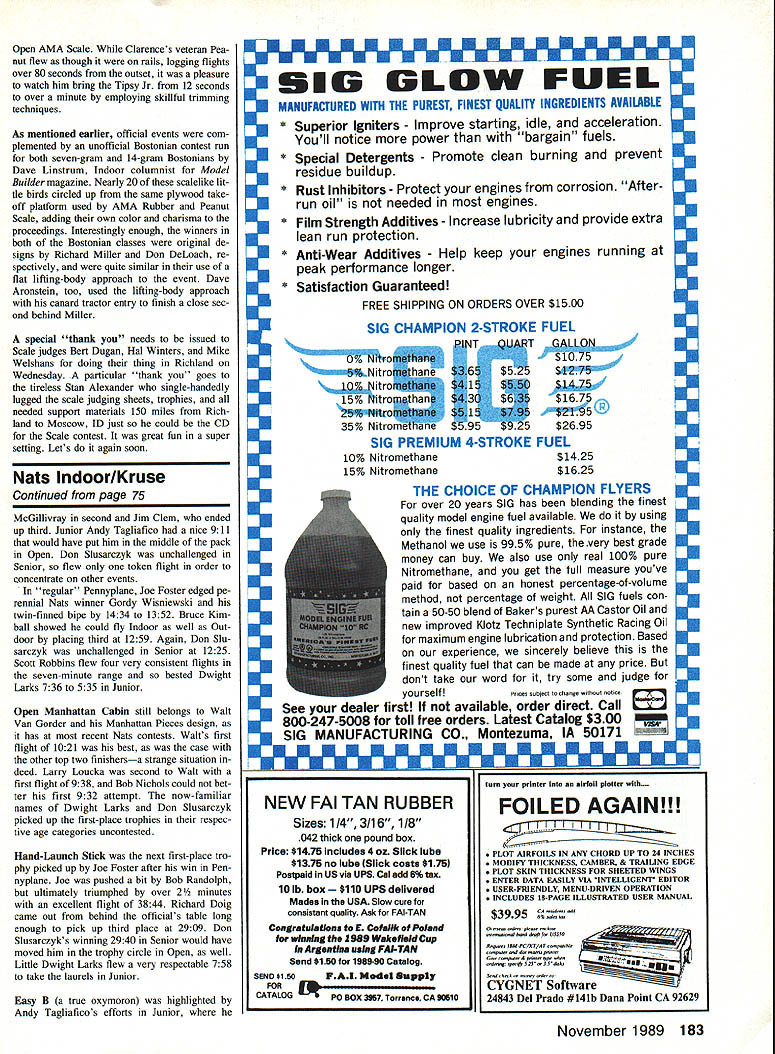
Melody and Richard Doig (Pontiac, MI) again served admirably as co‑CDs for Indoor, keeping events running smoothly and providing up‑to‑the‑minute computerized scoring.
Event highlights and results
Hand‑Launched Glider (HLG)
Indoor HLG, always popular, became something special in the Dome where even the rocket‑armed competitors were challenged by the 146‑ft. ceiling.
- Open: Stan Buddenbohm transferred his outdoor dominance to Indoor Open HLG with two flights over 77 seconds. Dan Belieff II put up strong, "gorilla‑grunt" launches but could not match Buddenbohm. Tom Stalick finished third, nearly 15 seconds per flight behind Buddenbohm.
- Junior and Senior: The Mace brothers (Dallas and Alan) were prominent. Junior Scott Robbins did his best to stave off the Mace brothers' dominance. Alan Mace doubled as a winner (also successful outdoors). Dave Warren finished second in Senior.
ROG Cabin
ROG Cabin has pulled back from the brink of obscurity in recent years; the graceful rise‑off‑ground launches of the spidery models are aesthetically very pleasing.
- Senior: Don Slusarczyk has proven the best ROG Cabin flier in the country for the past two years, garnering the prestigious Stout Trophy in both 1988 and 1989. His best flight of 25.25 put him well beyond reach.
- Open: Richard Doig and Dan Belieff managed 17:10 and 17:04 respectively.
- Junior: Dwight Larks officially began his ROG Cabin career with a successful flight before his model was damaged.
Catapult Glider (unofficial)
Run concurrently with regular AMA Glider flying, the snapping of little 12‑in. wingspan models aloft with a rubber‑band catapult was very popular. In a twist of justice (or humor), Catapult Glider — the event for the weak but willing — was won by Stan Buddenbohm.
Pennyplane
- Novice Pennyplane (Saturday): Winner in Open Novice Pennyplane was Cezar Banks. Best FAI Team flight recorded: 13.05.
- Regular Pennyplane (Open): Joe Foster won with 14:34, edging perennial Nats winner Gordy Wisniewski (13:52). Bruce Kimball placed third with 12:59.
- Senior Pennyplane: Don Slusarczyk was unchallenged with 12:25.
- Junior Pennyplane: Scott Robbins flew four very consistent flights in the seven‑minute range, besting Dwight Larks 7:36 to 5:35.
Manhattan Cabin
Open Manhattan Cabin remains Walt Van Gorder's domain with his Manhattan Paces design.
- Open: Walt's first flight of 10:21 was his best and secured the win. Larry Loocka was second (9:38) and Bob Nichols third (9:32).
- Age categories: Dwight Larks and Don Slusarczyk claimed first‑place trophies in their respective age categories uncontested.
Hand‑Launch Stick
Joe Foster added Hand‑Launch Stick to his list of wins after Pennyplane.
- Open: Joe Foster won with an excellent flight of 38:44, pushed by Bob Randolph. Richard Doig took third with 29:09.
- Senior: Don Slusarczyk won Senior with 29:40 — a score that would have placed him in Open.
- Junior: Dwight Larks flew a respectable 7:58 to take first.
Easy B
Easy B was highlighted by Andy Tagliafico in Junior, who showed skill and tenacity in this deceptively challenging event.
Bostonian (unofficial scale‑like events)
An unofficial Bostonian contest for both seven‑gram and 14‑gram classes was run by Dave Linstrum (Indoor columnist, Model Builder magazine). Nearly 20 of those small scalelike birds flew from the same plywood takeoff platform used by AMA Rubber and Peanut Scale.
- Winners: The winners in both Bostonian classes were original designs — Richard Miller and Don DeLoach — both using a flat lifting‑body approach. Dave Aronstein used a lifting‑body canard‑tractor to finish a close second behind Miller.
Open AMA Scale
Several memorable scale performances were noted. Clarence's veteran Peanut flew as though it were on rails, logging flights over 80 seconds from the outset. It was also a pleasure to watch a competitor bring a Tipsy Jr. from 12 seconds to over a minute through skillful trimming.
Thanks and acknowledgements
- Special thanks to scale judges Bert Dugan, Hal Winters, and Mike Welshans for their work in Richland.
- A particular thank‑you to Stan Alexander, who single‑handedly transported scale judging sheets, trophies, and support materials 150 miles from Richland to Moscow and served as CD for the Scale contest.
- Thanks to all who helped make the Kibbie Dome Nats Indoor a great success — the setting was superb.
Transcribed from original scans by AI. Minor OCR errors may remain.

