
FF Outdoor Glider
Larry Kruse
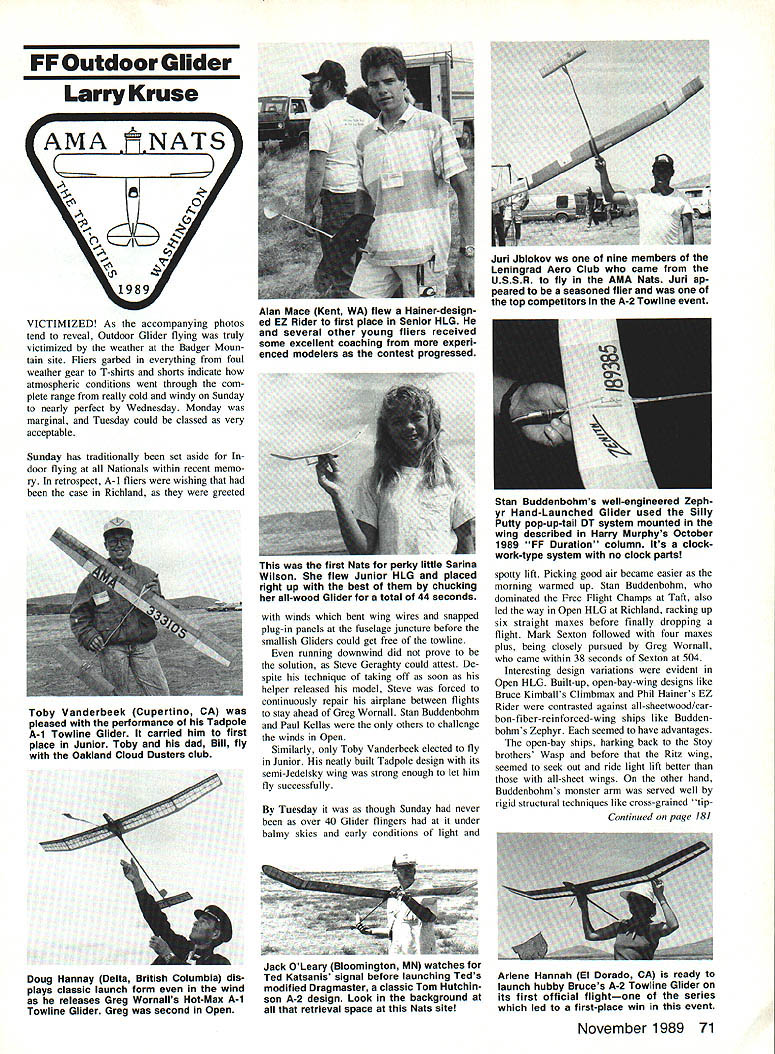
Victimized? As the accompanying photos tend to reveal, outdoor glider flying was truly victimized by the weather at the Badger Mountain site. Fliers garbed in everything from foul‑weather gear to T‑shirts and shorts indicated how atmospheric conditions went through the complete range — from really cold and windy on Sunday to nearly perfect by Wednesday. Monday was marginal, and Tuesday could be classed as very acceptable.
Sunday has traditionally been set aside for indoor flying at all Nationals within recent memory. In retrospect, A‑1 fliers wished that had been the case in Richland, as they were greeted with winds that bent wing wires and snapped plug‑in panels at the fuselage juncture before the smallish gliders could get free. Towline running downwind proved the solution, as Steve Geraghty can attest. Despite his technique of taking off as soon as his helper released the model, Steve was forced to continuously repair his airplane between flights to stay ahead of Greg Wornall. Stan Buddenbohm and Paul Kellas were the only others to challenge the winds in Open.
Similarly, only Toby Vanderbeek elected to fly Junior. His neatly built Tadpole design with its semi‑Jedelsky wing was strong enough to let him fly successfully.
By Tuesday it was as though Sunday had never been, as over 40 glider fliers enjoyed balmy skies and early conditions of light, spotty lift. Picking good air became easier as the morning warmed up. Stan Buddenbohm, who dominated the Free Flight Champs at Taft, also led the way in Open HLG at Richland, racking up six straight maxes before finally dropping a flight. Mark Sexton followed with four maxes, and Greg Wornall was close behind, coming within 38 seconds of Sexton with a 504.
Interesting design variations were evident in Open HLG. Built‑up open‑bay‑wing designs like Bruce Kimball's Climbmax and Phil Hainer's EZ Rider contrasted with all‑sheet wood/carbon‑fiber‑reinforced wings like Buddenbohm's Zephyr. Built‑up, open‑bay ships (harking back to the Stay brothers' Wasp and pre‑Ritz wings) seemed to find ride in light lift better. On the other hand, all‑sheet wings and Buddenbohm's "monster arm" served well where rigidity and launch speed were required.
Effective construction and trimming techniques included:
- Cross‑grained tips to alleviate tip flutter and provide washout.
- Carbon‑wrapped fuselages to eliminate fuselage flex.
Unlike some other FF events, there was good representation of both Junior and Senior fliers in HLG. Particularly impressive was the amount of mentoring — experienced modelers helping young people with launch techniques, fine‑trimming models, and generally providing encouragement and positive reinforcement to the youngsters.
Junior results:
- 1st: Brett Whiting — 110
- 2nd: Clint Hanneson
- 3rd: Dallas Mace
Senior results:
- 1st: Alan Mace — 276
- 2nd: Lance Bays
- 3rd: Jason Youck
Nats FF Glider/Kruse
A‑2 and the Russian contingent
The story in A‑2 was, of course, the arrival of the Russian contingent: A‑2 flier Jun Jblokov and his coach, Viktor Dubenko. Everyone was curious about the Russians' equipment, model design, and flying skills. Due to the language barrier and no interpreter present, real information came more from observation than conversation.
Jblokov's ship appeared to be a much‑flown and much‑repaired model of standard FAI configuration, featuring a circle‑tow hook and carbon‑fiber‑reinforced wing spars. I was only able to witness one flight by the Russian. Jblokov seemed very comfortable with his ship on tow and waited until several Americans had launched before trotting off down the field to make sure his ship was centered in lift as he zoomed it off the line.
Ultimately, he finished in fifth place, behind:
- Steve Geraghty
- Kevin Collins
- James Thornberg
- Bruce Hannah
Bruce Hannah's fine score of 1,500, registered with an appropriately decorated red, white, and blue ship, demonstrated both patriotic overtones and great flying skill.
Transcribed from original scans by AI. Minor OCR errors may remain.

