
FF Power
Larry Kruse
Site and overview
One of the largest bones of contention to plague recent Nationals contests has been the question of an acceptable site for flying outdoor Free Flight events. The critical nature of that site-selection decision has been pivotal to the point that last year's Nationals Free Flight Duration events were canceled when the preselected site was found to be unavailable at contest time. Given the immediate past history of Free Flight site problems in Virginia and before that in Nebraska, special care was taken by the AMA site-selection committee to find a location that would suit the needs of the Free Flight community.
This year's choice, by name the Badger Mountain site, was some 15 minutes southwest of the Nats headquarters in Richland, WA. Nominally a useful 1.5 miles by 2.5 miles area, the arid landscape south of Badger Mountain was gently rolling terrain with only a few small gullies covered with sparse sagebrush and occasional low scrubby desert bushes. Further to the west, taller mesquite posed some retrieval problems when the wind switched to the east. At some point in its recent history the field had been plowed, then allowed to go back to native grasses. Like the wagon ruts of the Oregon Trail, the ground retained the tracks of the plow and made retrieval by motorbike an uncomfortable ride.
In all, Badger Mountain was not only an acceptable site, but a potentially good Free Flight site—with one proviso: the wind could not blow. Unfortunately, Mother Nature does not subscribe to any particular human needs or wishes—and blow it did, at least at the start.
Sunday — Class C Gas and Payload
Class C Gas and Payload were flown on Sunday, neither event engendering much enthusiasm for either flying or the site, given the cold temperatures and windspeeds estimated at just under 25 mph. Only four Open fliers chose to enter the trophy dash and risk their ships.
- Bob Stalick's big 750-sq.-in. C-Quell climbed well into the wind, had trouble settling into its glide pattern, but ultimately carded three successive two-minute maxes to win the event.
- Norm Peterson dropped three seconds in three flights for second place.
- Larry Heagren's 289 brought him third place.
Payload's perennial Nats winner, Bob Nichols, was the only Open entrant and had everything his way. Dave Warren and Derek Walkington competed in Senior and finished in that order.
Monday — Half-A Gas and 1/2A events
By Monday the wind had mercifully dropped to acceptable levels and Half-A Gas fliers were able to put up many flights. Both high-thrust and low-thrust designs were in evidence, but neither seemed to have a distinct advantage.
Open 1/2A:
- Draycott Hooke appeared to pick good air early with his stock Starduster but fell to third late in the day.
- Clarence Bull had three maxes early and then lost his plane; he found it after the close of official flying.
- Richard Williamson won in a flyoff with Ken Youngman and Draycott Hooke—the flyoff ended up being a one-flight, go-for-broke affair.
Junior and Senior 1/2A Gas had an uncharacteristic entry with only two contestants in each age group.
- Junior: Clint Hanneson, coached by John Bortnak, finished first; Larry Heagren was a distant second.
- Senior: Jason Youck amassed 202 seconds to Dave Warren's 163-second total.
Open Cargo:
- Bob Nichols, with his Bull Moose design, again dominated this event as he has for the past four Nationals.
- Derek Walkington won Senior with a commendable flight.
Tuesday — Class D Gas
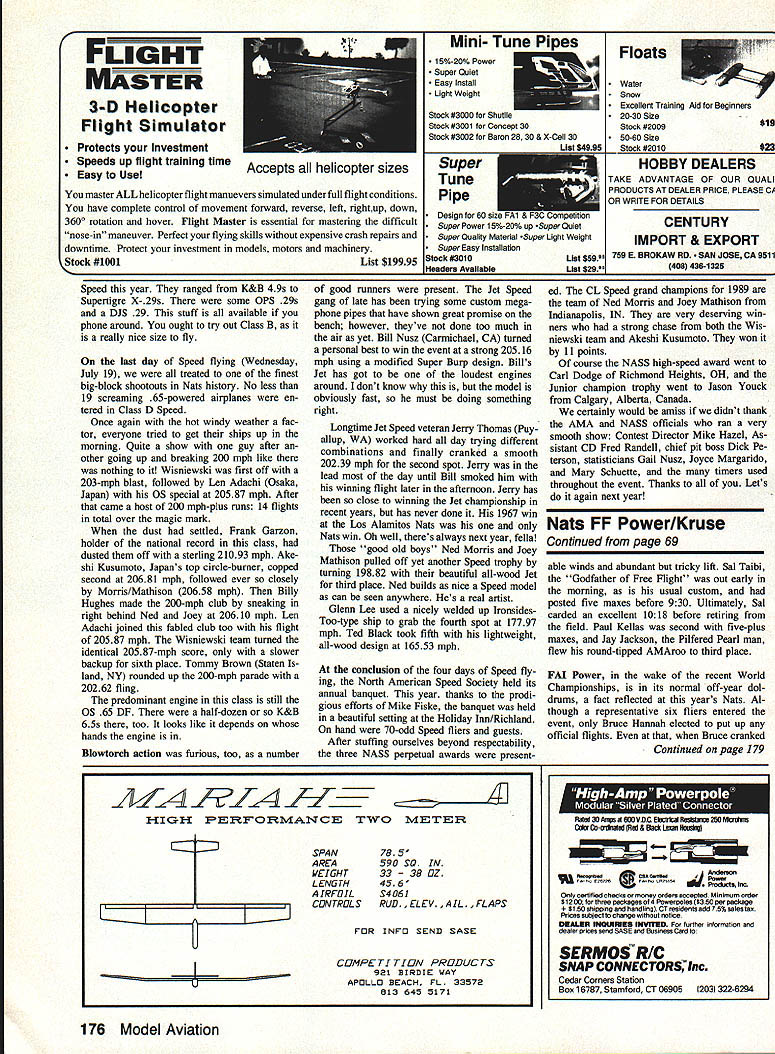
Class D Gas was flown on Tuesday, the weather having turned bee-you-tee-ful with light and variable winds and abundant but tricky lift. Sal Taibi, the "Godfather of Free Flight," was out early in the morning as usual and had posted five maxes before 9:30. Ultimately, Sal carded an excellent 10:18 before retiring from the field.
- Paul Kellas was second with five-plus maxes.
- Jay Jackson, flying his round-tipped Amarok, placed third.
FAI Power and Nostalgia
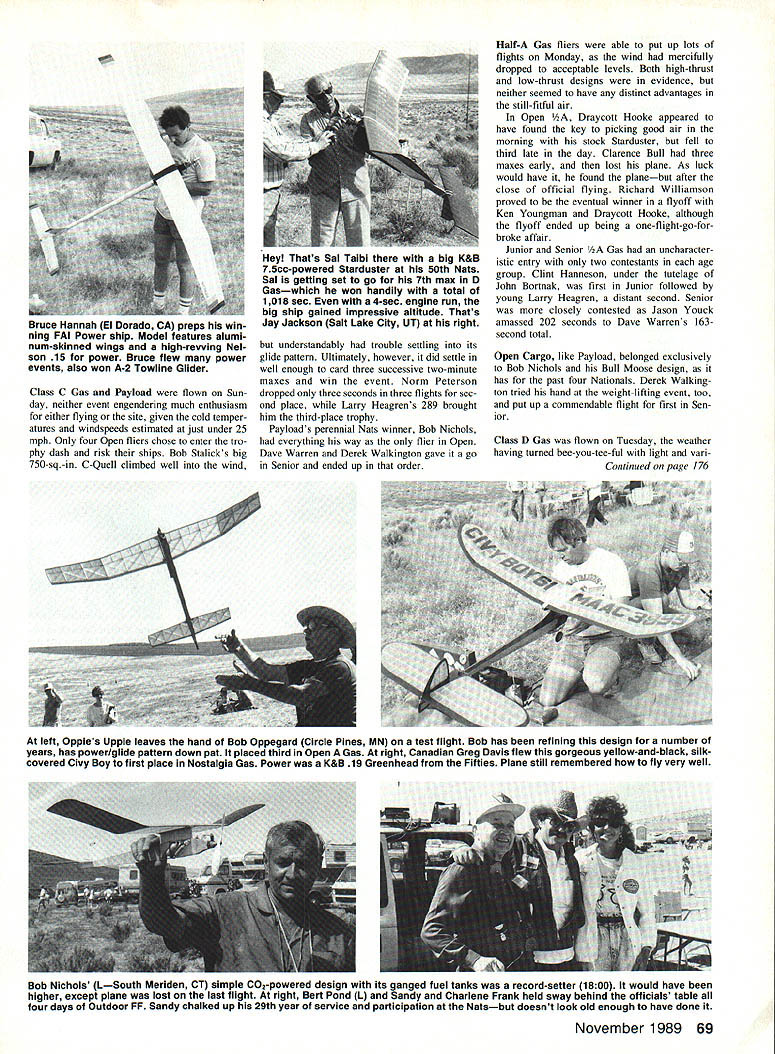
FAI Power, in the wake of the recent World Championships, was in its normal off-year doldrums—a fact reflected at this year's Nats. Although a representative six flyers entered, only Bruce Nannan elected to put up official flights. Even so, when Bruce cranked up his screaming Nelson .15, every eye and ear on the field turned to watch his sleek black-and-white rocket ascend.
Nostalgia Gas was flown as an unofficial contest concurrently with the AMA events, CD'd by Bob Stalick. More than 25 individuals brought Zeps, Scalpels, Clowns, City Boys, Ramrods, and Top Bananas re-creations, proving that the laws of gravity and nature are as immutable in 1989 as they were in 1959. It was great fun to watch the planes of my youth take to the air again and fly almost as well as memory suggested.
Wednesday — CO2 and Class A Gas
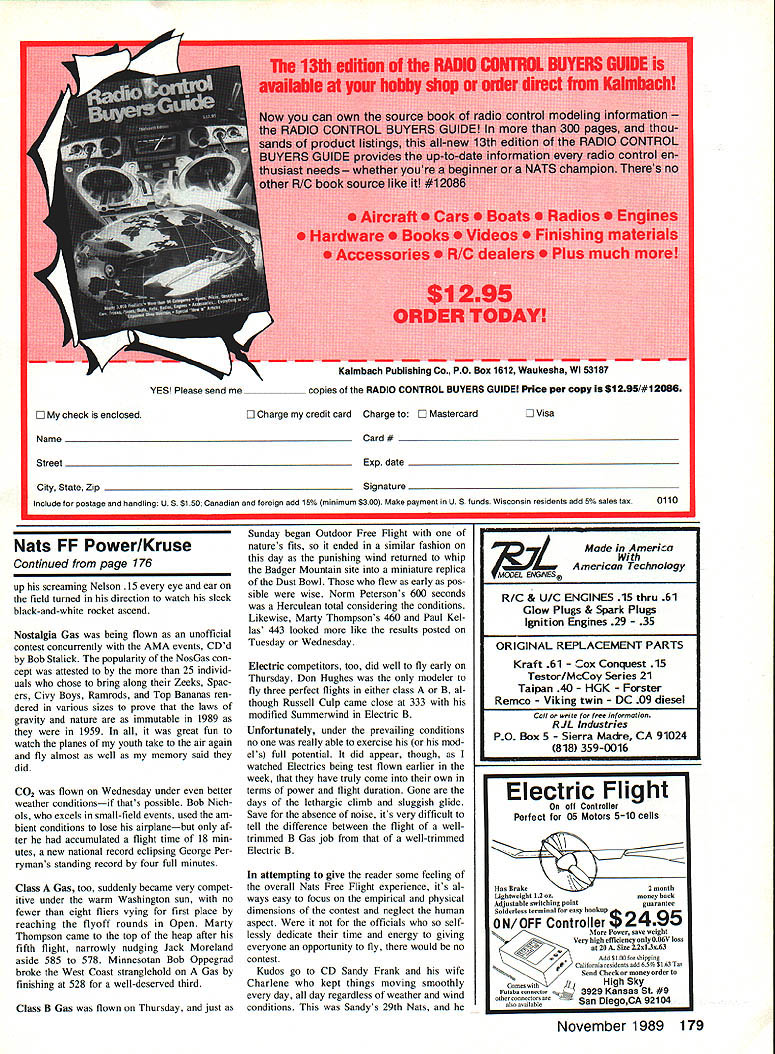
CO2 was flown on Wednesday under even better weather conditions. Bob Nichols, who excels in small-field events, lost his airplane after accumulating a flight time of 18 minutes—a new national record, eclipsing George Perryman's standing record by four full minutes.
Class A Gas suddenly became very competitive under the warm Washington sun, with several contestants reaching the top of the nine-minute limit.
- Marty Thompson won after his fifth flight, narrowly nudging Jack Moreland aside 585 to 578.
- Minnesotan Bob Oppegard finished third at 528.
Thursday — Class B Gas, Electrics, and bad wind return
Class B Gas was flown on Thursday, and the punishing wind returned to whip the Badger Mountain site into a miniature Dust Bowl. Those who flew early were wise.
- Norm Peterson's 600 seconds was a Herculean total given the conditions.
- Marty Thompson posted 460; Paul Kellas had 443—results comparable to calmer days earlier in the week.
Electric competitors also did well to fly early. Don Hughes was the only modeler to push perfect flights in either Electric A or B, although Russell Cuip came close at 333 with his modified Summerwind in Electric B. Electrics test-flown earlier in the week showed that they have truly come into their own as legitimate power and duration performers. Gone are the days of lethargic climbs and sluggish glides; save for the absence of noise, it's difficult to tell the difference between a well-trimmed B Gas job and a well-trimmed Electric B.
Officials and volunteers
In attempting to give the reader the overall Nats Free Flight experience, it's easy to focus on empirical contest dimensions and neglect the human aspect. Were it not for the officials who selflessly dedicate their time and energy, there would be no contest.
Kudos go to Contest Director Sandy Franks and his hard-working crew, who kept things moving smoothly every day regardless of weather and wind conditions. This was Sandy's 29th Nats, and he deserves a big hand for his organization and spirit. Sandy certainly is to be commended for his longtime service to the Free Flight fraternity.
Likewise, thanks go to Bert Pond and the many other unnamed volunteers who offered their services as timers, worked behind the officials' table, or filled many other needed capacities to bring this year's edition of the Nats to a successful conclusion.
Coupe, P-30, and other events
Open Coupe:
- Joe Foster easily eclipsed the field with an outstanding 1,140 total.
- John Bortnak, the ever-present Canadian, was second.
- James Sessums was third at 824.
P-30 is the most popular rubber event at any Nats since its placement in the AMA rule book. Along with Coupe d'Hiver, P-30 was the only rubber-powered event with representation in Junior, Senior, and Open.
Junior P-30:
- Toby Vanderbeck repeated his A-1 Glider win with 288.
- Jonathan Bauer was close at 282.
- Dwight Larks was third at 177.
Senior P-30:
- Lance Bays dominated with 297.
- Jason Youck and Dave Warren followed at a considerable distance.
Open P-30:
- Clarence Mather topped the heap, likely flying his Sweet P-30 design.
- Melvin Chaffin was second at 572.
- John Bortnak was third. In addition to competing in almost every event, John spent a lot of time helping younger flyers and other Juniors in power events.
Mulvihill day
As great as earlier competition had been, Mulvihill day deteriorated into a man-versus-nature endurance contest. The wind, which had blown nearly everything away on Sunday, returned with a vengeance on Thursday and picked up anything not nailed down.
Junior Mulvihill:
- Eric Weast won.
- Drew Rinalds was second.
- Kevin — results sparse due to conditions.
Senior and Open Mulvihill saw few contestants willing to risk their ships. Veteran Bud Romack won Open Mulvihill by finding a lull and a fair headwind for launch. Blake Jensen finished second after his ship was sandwiched between gusts and vanished. Mike Whittemore took third.
I had so much trouble keeping the powdery blowing dust off my camera lens that I quit the field in a huff.
Final notes — Bruce Nannan
FAI Power: Bruce Nannan of Corona, CA, flew a ship featuring aluminum-skinned wings and a high-revving Nelson .15. Bruce competed in power events and also won A-2 Towline Glider.
Transcribed from original scans by AI. Minor OCR errors may remain.

