
FF Rubber
By Chris Matsuno
Wakefield (Rubber)
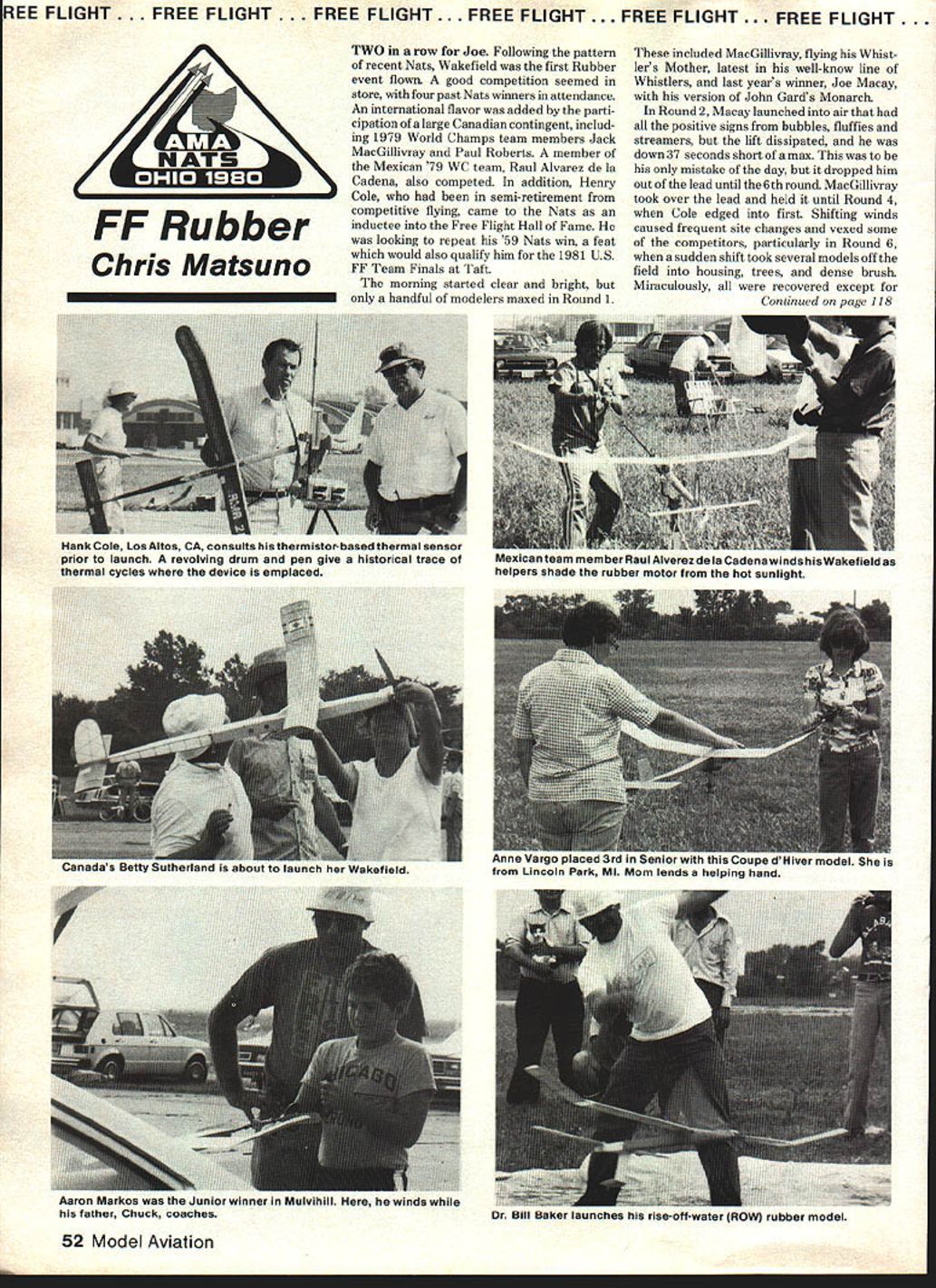
Two in a row for Joe. Following the pattern of recent Nats, Wakefield was the first Rubber event flown. A good competition seemed in store, with four past Nats winners in attendance. An international flavor was added by a large Canadian contingent, including 1979 World Champs team members Jack MacGillivray and Paul Roberts. A member of the Mexican '79 WC team, Raul Alvarez de la Cadena, also competed. In addition, Henry Cole, who had been in semi-retirement from competitive flying, came to the Nats as an inductee into the Free Flight Hall of Fame. He was looking to repeat his '59 Nats win, a feat which would also qualify him for the 1981 U.S. FF Team Finals at Taft.
The morning started clear and bright, but only a handful of modelers maxed in Round 1. These included MacGillivray, flying his Whistler's Mother, the latest in his well-known line of Whistlers, and last year's winner, Joe Macay, with his version of John Gard's Monarch.
In Round 2, Macay launched into air that showed positive signs from bubbles, fluffies, and streamers, but the lift dissipated and he was down 37 seconds short of a max. This was to be his only mistake of the day, but it dropped him out of the lead until the 6th round. MacGillivray took over the lead and held it until Round 4, when Cole edged into first.
Shifting winds caused frequent site changes and vexed some competitors, particularly in Round 6, when a sudden shift took several models off the field into housing, trees, and dense brush. Miraculously, all were recovered except one — Cole's number-one model, which landed next to a busy highway and was stolen. To compound Cole's woes, it appeared that his DT timer was short. Just as he had done in 1979, Macay wrapped things up with a solid max in Round 7, winning his second Nats in a row. Cole was 2nd, and Reid Hull, flying a V‑tailed model with sub‑rubber, was 3rd.
Coupe
Coupe day was much a repeat of last year — cloudy and quite breezy, with marginal air in the morning, and partly sunny, turbulent conditions in the afternoon with stronger thermals and their attendant "holes." This forced the usual decision: fly now or fly later? Do you need lift to max, with the increased risk of downers, or can you squeak it out in marginal air? Actually, with five flights to put in, most competitors had to fly in both conditions, and maxes did not come easily.
No one maxed out, but surprisingly the end of the day showed a tie for first between David Evans and Chris Matsuno. Both had scored 539 points, with three maxes and "change." Following the precedent in A-2 at the '79 Nats, both were declared co-winners. Jim Miller, from Cincinnati, was 3rd, and a Senior, Tad Jones, had the 4th highest score overall with a creditable 525 points.
The co-champion models represented two widely different approaches. Matsuno's model was a modern high-aspect-ratio design built to 100-gram rules with a large prop and slow cruise. Evans used a Gollywock with squared-off tips and the original prop, which gives a fast-climbing model, as anyone who has seen a Gollywock go knows. Who says the old designs aren't competitive today?
Unofficial events
Unofficials have more fun. As always, the National Free Flight Society sponsored several unofficial events, many being gumband-powered.
- Rubber Speed: Terry Rimer — 46 mph.
- 7-11 distance event (7" diameter prop, 11" maximum motor length): George Perryman, flying a modified P-30 — 623 feet.
- Rise-off-water (ROW) Rubber: Dr. Bill Baker.
- P-30: well-contested with a good turnout in all age classes. In what seems to have been an oversight, P-30 was not sponsored by the AMA as a Nats official event, even though it has been voted for official status in the latest rule book.
McDonnell-Douglas FF Club — Dick Korda Open Rubber
Five intrepid individuals gathered for the McDonnell-Douglas FF Club–sponsored Dick Korda Open Rubber event — one flight, unlimited max. Jim O'Reilly, who wrote an article on the state of the art in Mulvihill for the '79 NFFS Symposium, repeated his '79 win in this event with a time of 8:14, out of sight in the low haze. The model was eventually found by a state trooper and returned.
George Perryman, flying a 1.7-ounce, condenser-paper-covered model with 2 ounces of rubber, was second with 5:53. George Batiuk landed on one of the base hangars at 5:51.
Mulvihill Rubber
Mulvihill Rubber was again flown in the windiest conditions of the week, and it was decided to go to 2-minute maxes. In retrospect, it would have been possible to start with 3-minute maxes, since all week Wright Field "flew" larger and longer than it appeared. A marathon contest seemed assured, and everyone got to it right away. The lead see-sawed back and forth as maxes and outs were turned in.
As flying drew to a close, the picture developed: David Evans, flying a model with a rolled balsa tube fuselage, stretched Gollywock wing, and smallish prop, was in 1st, having missed his 6-minute max. Working on his 6-minute max was none other than George Perryman. George had flown his Lanzio Stick model for his first four maxes, then switched to a "normal" model (since when is a Perryman model normal?) for his subsequent flights. During his 6-minute max flight the model DT'd early, but the flight was long enough to move him into 1st with only minutes remaining in the contest. The "Ol' Perfesser" waited a long time for his first win in '77, but this second win was just as sweet.
Final standings (top five):
- 1st: George Perryman
- 2nd: David Evans
- 3rd: Norm Poti
- 4th: Nicholas Pitas
- 5th: Dr. Bill Baker (last year's winner)
Although there was no serious problem with lost models this year, perhaps it is time for the AMA to reconsider the Mulvihill flyoff format at the Nats. The increasing-max method's principal drawback is the increased chance of lost models. There seems to be considerable support for an unlimited-max flyoff, either at the end of the day or perhaps early in the morning. If Mulvihill were flown sometime during the week, rather than on the last day of the Nats, the event director could be flexible in choosing the best time for the flyoff. This would have considerable drama and spectator interest, and it would certainly be spectacular to see a score or more models filling the air.
Transcribed from original scans by AI. Minor OCR errors may remain.

