
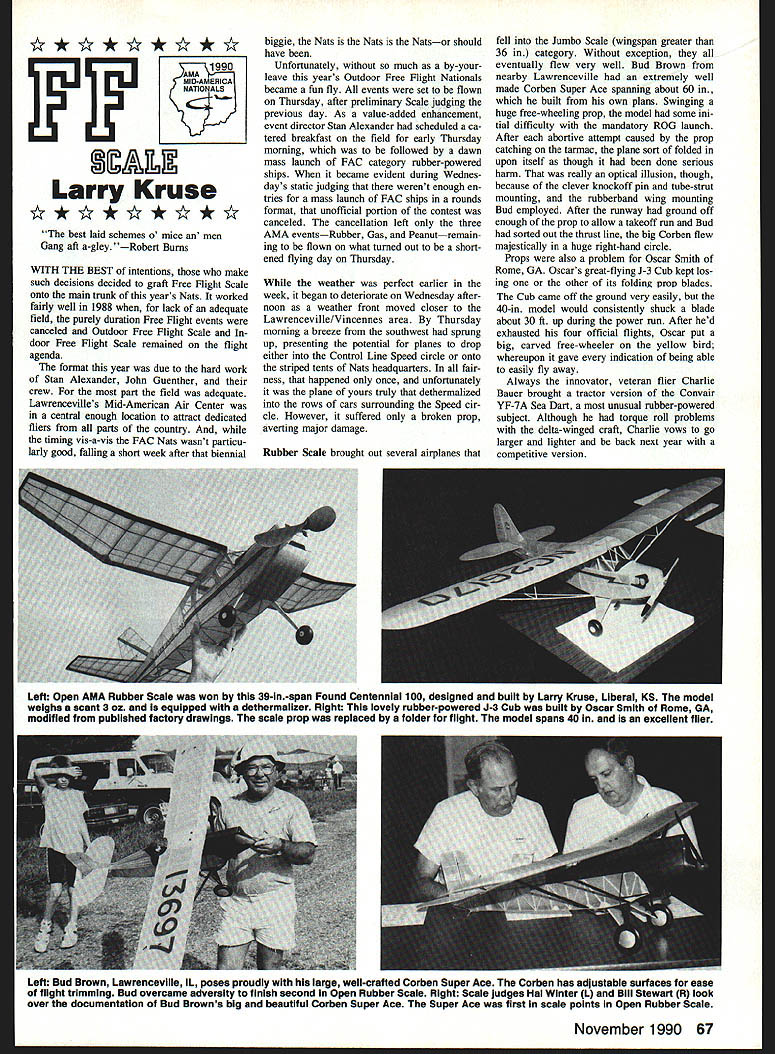
FF: Scale
Larry Kruse
"The best laid schemes o' mice an' men Gang aft a-gley." — Robert Burns
With the best of intentions, those who make such decisions decided to graft Free Flight Scale onto the main trunk of this year's Nats. It worked fairly well in 1988 when, for lack of an adequate field, the purely outdoor Free Flight events were canceled and Outdoor Free Flight Scale and Indoor Free Flight Scale remained on the flight agenda.
The format this year was due to the hard work of Stan Alexander, John Guenther, and their crew. For the most part the field was adequate. Lawrenceville's Mid-American Air Center was in a central enough location to attract dedicated fliers from all parts of the country. And, while the timing vis-à-vis the FAC Nats wasn't particularly good, falling a short week after that biennial biggie, the Nats is the Nats is the Nats—or should have been.
Unfortunately, without so much as a by-your-leave, this year's Outdoor Free Flight Nationals became a fun fly. All events were set to be flown on Thursday, after preliminary Scale judging the previous day. As a value-added enhancement, event director Stan Alexander scheduled a catered breakfast on the field for early Thursday morning, which was to be followed by a dawn mass launch of FAC-category rubber-powered ships. When it became evident during Wednesday's static judging that there weren't enough entries for a mass launch of FAC ships in a rounds format, that unofficial portion of the contest was canceled. The cancellation left only the three AMA events—Rubber, Gas, and Peanut—remaining to be flown on what turned out to be a shortened flying day on Thursday.
While the weather was perfect earlier in the week, it began to deteriorate on Wednesday afternoon as a weather front moved closer to the Lawrenceville/Vincennes area. By Thursday morning a breeze from the southwest had sprung up, presenting the potential for planes to drop either into the Control Line Speed circle or onto the striped tents of Nats headquarters. In all fairness, that happened only once, and unfortunately it was the plane of yours truly that dethermalized into the rows of cars surrounding the Speed circle. However, it suffered only a broken prop, averting major damage.
Rubber Scale brought out several airplanes that fell into the Jumbo Scale (wingspan greater than 36 in.) category. Without exception, they all eventually flew very well. Bud Brown from nearby Lawrenceville had an extremely well-made Corben Super Ace spanning about 60 in., which he built from his own plans. Swinging a huge free-wheeling prop, the model had some initial difficulty with the mandatory ROG launch. After each abortive attempt caused the prop to catch the tarmac, the plane sort of folded upon itself, though it had suffered no serious harm. That was really an optical illusion because of the clever knockoff pin-tube strut and tube-strut mounting and the rubber-band wing mounting Bud employed. After the runway had ground off enough prop to allow a takeoff run, Bud sorted out the thrust line and the big Corben flew majestically in a huge right-hand circle.
Props were also a problem for Oscar Smith of Rome, Ga. Oscar's great-flying J-3 Cub kept losing one or the other of its folding prop blades. The Cub came off the ground very easily, but the 40-in. model would consistently shuck a blade about 30 ft. up during the power run. After he'd exhausted four official flights, Oscar put a big carved free-wheeler yellow bird on the line, whereupon it gave every indication of being able to easily fly away.
Always the innovator, veteran flier Charlie Bauer brought a tractor version of the Convair YF-7A Sea Dart as an unusual rubber-powered subject. Although torque-roll problems with the delta-winged craft caused trouble, Charlie vows to go larger and lighter and be back next year with a competitive version.
Continuing his innovation in Gas Scale, Charlie's U-2 .049 ducted-fan spy plane, done up in NASA's civilian colors, drew spectator comments and attention. Rather than trying to start the Cox engine from the tail in the manner of RC ducted-fan models, Charlie designed the U-2 to come apart amidships for starting purposes. Once up and running, the spy plane had an appropriately wandering flight pattern which took it over various parts of the flying field, almost as though it were caught up in a need for an investigative fly-over. Unfortunately, the plane suffered some critical damage in landing, but with any luck it can be repaired to spy—er, that is, fly—again.
Peanut Scale can always be counted on to bring out the Laceys and the Fikes to do battle. This time around a new dimension was added to the Lacey/Fike derby. Howard Breshears of Spokane, WA, brought a nice-flying Fike to Lawrenceville. His wife, Jane, brought a Lacey. Second place in Open Peanut belonged to Jane practically all of Thursday morning, with Howard trailing in third. Howard must have been sandbagging his Fike, though, because as soon as Jane finished flying, Howard put up just a killer flight that knocked her into third by some 22 seconds. I'm sure that by now Jane has made that 22 seconds look like an eternity to Howard. She is competitive! Jane and Howard are also two of the nicest people you'll meet anywhere. Maybe Jane wasn't too vengeful!
All who flew had a good time. In the true spirit of a fun fly, as official AMA flying concluded people began dragging their less-than-pristine-but-excellent-flying planes out of their trunks and vans and lofting them into the air to the appreciation of the spectators and fellow fliers alike.
Acknowledgments
- John Guenther and Stan Alexander — organizers
- Judges and timers: Mike Stahl, Al Culver, Hal Winter, Bill Stewart, Dieter Guenther, Cliff Take
- Ann Underwood — scoring (incredibly well organized)
Conclusion
To conclude on a personal note, I think it is quite evident that Free Flight Scale belongs with all other Free Flight events. Even though it would seem that the attraction of Free Flight Scale in conjunction with Control Line and RC Scale would be sufficient to draw serious Scale fliers to a well-run Nats event, that has not proven to be the case. With appropriate credit to all who worked so hard to make this year's Nats a quality contest, it's time to give Free Flight Scale over to the NFFS to run as part of the combined United States Outdoor Free Flight Championships and AMA Free Flight National Championships, as long as they remain separate from the traditional Nats format.
Transcribed from original scans by AI. Minor OCR errors may remain.

