
FF Scale at Mile Square
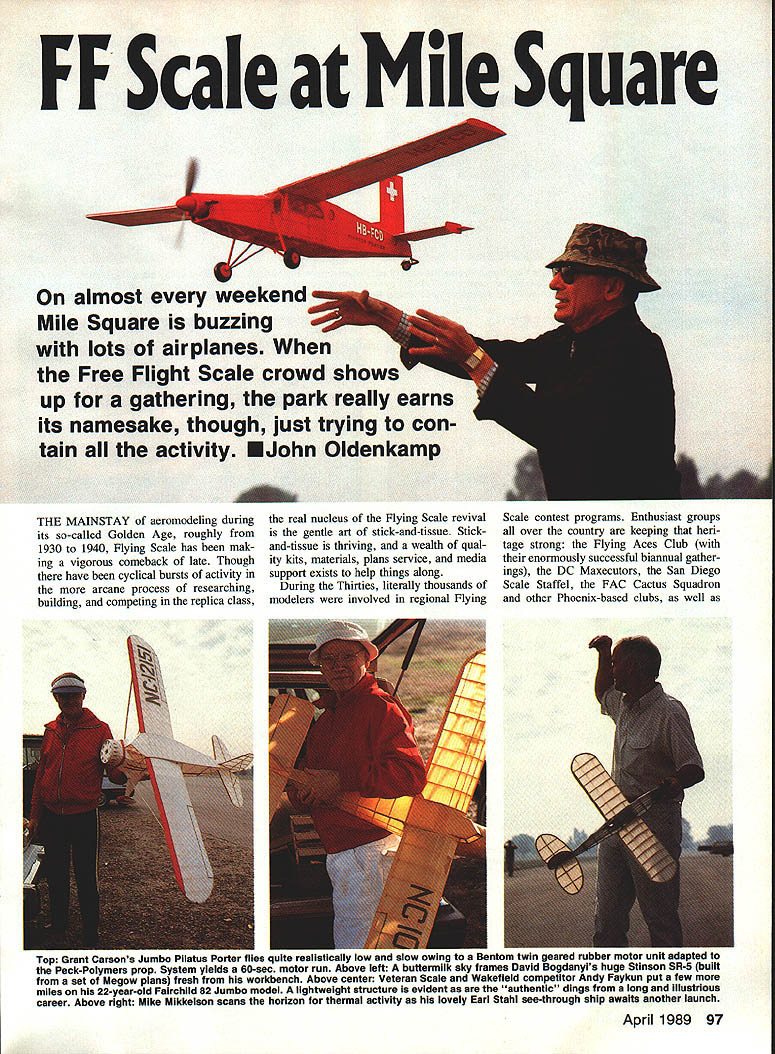
The mainstay of aeromodeling during its so‑called Golden Age, roughly 1930–1940, Flying Scale has made a vigorous comeback. Though there have been cyclical bursts of activity in the arcane work of researching, building, and competing with replicas, the real nucleus of the Flying Scale revival is the gentle art of stick‑and‑tissue. Stick‑and‑tissue is thriving, supported by a wealth of quality kits, materials, plans, service, and media.
Clubs and the revival
During the 1930s literally thousands of modelers were involved in regional Flying Scale contest programs. Enthusiast groups around the country are keeping that heritage strong, including:
- Flying Aces Club (enormously successful biannual gatherings)
- DC Maxecutors
- San Diego Scale Staffel
- FAC Cactus Squadron (and other Phoenix‑based clubs)
- Clubs in Las Vegas, Detroit, and elsewhere
- The venerable Flitemasters (drawn from Los Angeles and Orange County)
The Flitemasters annually schedule at least four major meets. A favorite is their Peanut, Jumbo, and multiengine bash held in December at Mile Square Park in Costa Mesa.
Mile Square Park — site and atmosphere
Mile Square is a kind of mini‑Taft (locus of the U.S. Free Flight Championships) for the modelers who come there. Developed in the mid‑1960s from a surplus Marine Corps/Navy auxiliary airfield, the gated, ranger‑operated complex is roughly divided into three segments for walking, picnicking, golf, and miniature aircraft/rocketry. Space for Free Flight, rockets, RC planes and cars, plus full‑sized land sailers, is carefully delineated so that all activities get a fair share of the available land. It’s not huge, but it’s more than adequate — and seems especially so on a day with mild conditions.
The Flitemasters enjoyed such a day for their December meet — a perfectly calm, warm, bright morning under a pearly, buttermilk‑pale sky.
Incidentally, Mile Square is a fair approximation of the kind of spacious, multipurpose site envisioned under proposed AMA plans to acquire and develop large permanent model/recreation properties nationwide.
The December meet — events and entries
On any given weekend at Mile Square a number of Free Flight contests are typically scheduled, and the site easily accommodates other modelers testing new equipment or sport fliers out for fun. On December 4th, along with the Flitemasters bash were:
- an OT Rubber and Glider competition sponsored by the Southern California Igniters Fliers (SCIFS)
- a SAM (Society of Antique Modelers) chapter meet
- a model rocket event
- numerous sport fliers and spectators
Perhaps 150 cars lined the asphalt flight line, each with people watching aircraft of all types from Nordic gliders to Scale to Control Line. From the time the park opened at 7:30 a.m., the air was literally saturated with flying machines. The mood was easy and informal — a laid‑back, low‑key meet that emphasized fun over a winner‑take‑all struggle.
Notable models and builders
What we saw was a veritable galaxy of models flown in an atmosphere of easy fun. Rather than chronicling contest placings, the focus here is on models and developments likely to be touchstones for future events.
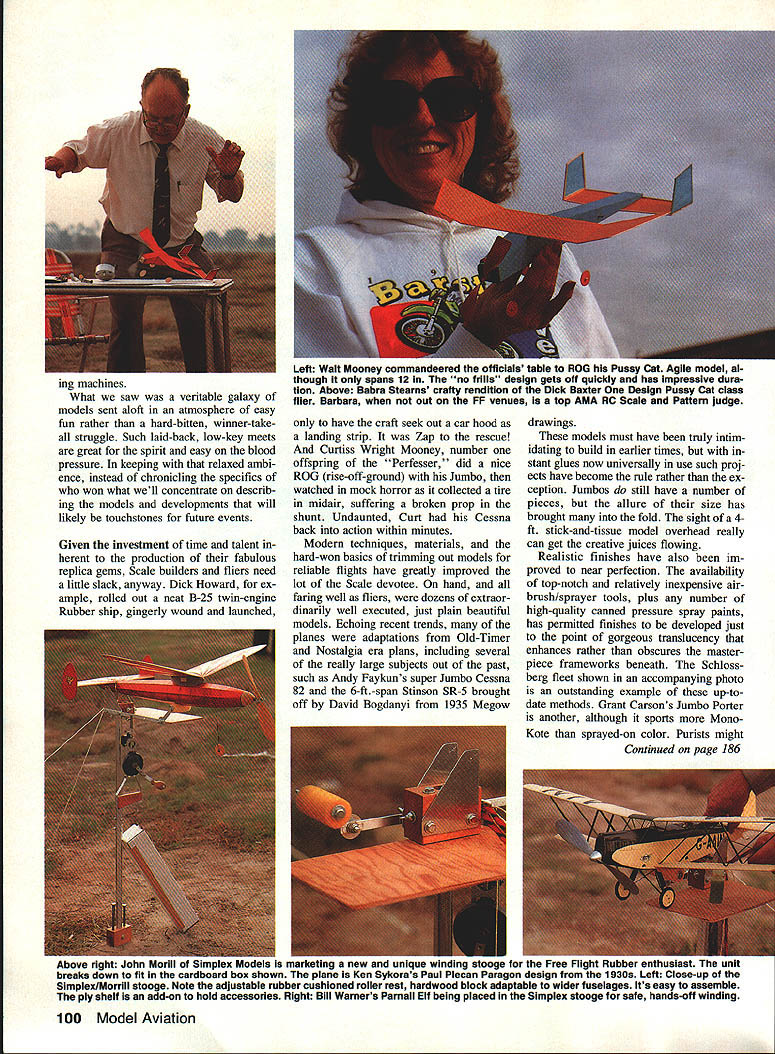
- Dick Howard rolled out a neat B‑25 twin‑engine rubber ship; after a gentle launch it unfortunately came down on a car hood.
- Curtiss Wright Mooney (son of the “Perfesser”) achieved a nice ROG with his Jumbo, though it later struck a tire in midair and suffered a broken prop; he had it flying again within minutes.
- Andy Faykun flew a super Jumbo Fairchild 82 and veteran Scale Wakefield entries; David Bogdanyi brought a 6‑ft‑span Stinson SR‑5 built from 1935 Megow drawings.
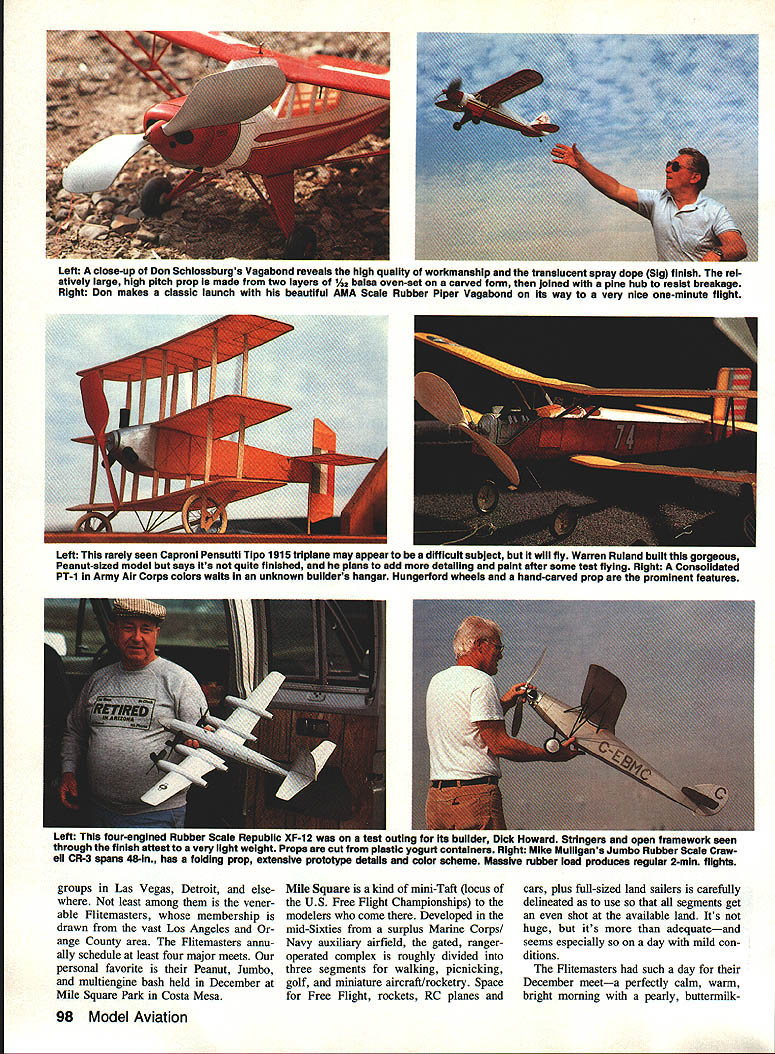
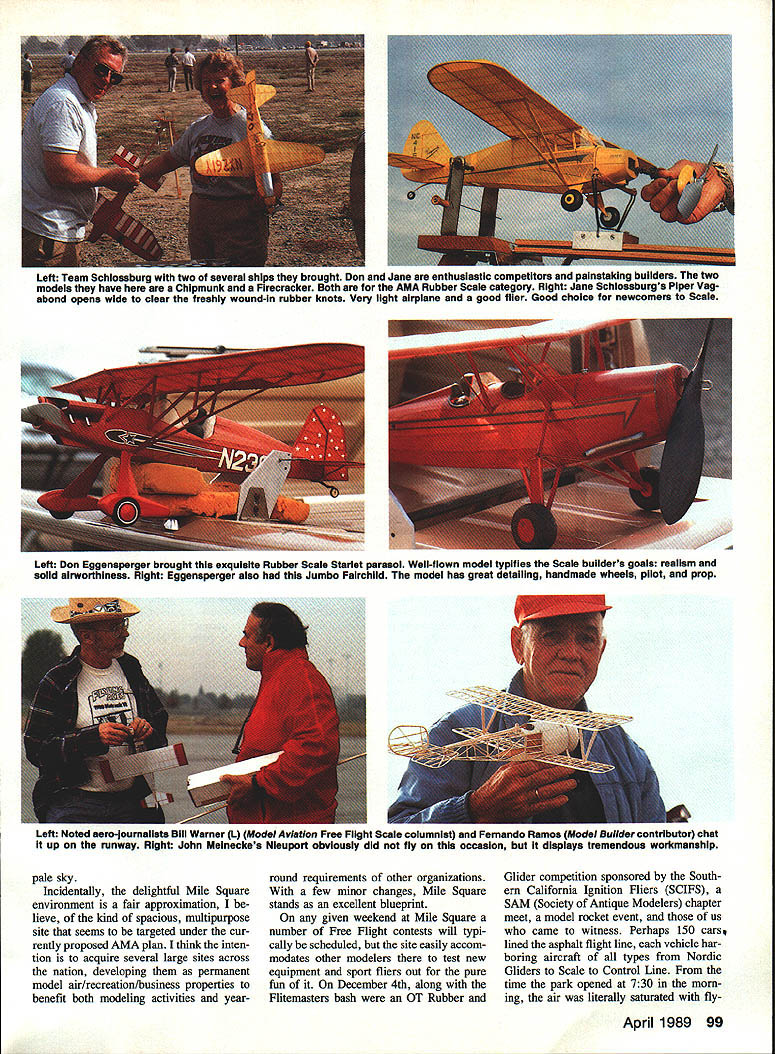
- Don Schiossburg’s Vagabond showed high‑quality workmanship: translucent spray‑dope Sig finish and a relatively large, high‑pitch prop made from two layers of 3/32" balsa, oven‑set and carved, joined to a pine hub for toughness. His AMA Scale Rubber Piper Vagabond turned in a healthy one‑minute flight.
- Warren Ruland built a gorgeous Peanut‑sized Caproni Pesutti Tipo 1915 triplane — a difficult subject to build — and planned additional detailing after test flying.
- Mike Mulligan’s Jumbo Rubber Scale Crow prototype carried a massive rubber load and produced regular two‑minute flights.
- Grant Carson’s Jumbo Pilatus Porter and other “Jumbo” entries demonstrated that modern materials make large stick‑and‑tissue projects much more feasible than in earlier times.
Multi‑engine rubber scale entries showed very light construction and careful detailing; several models featured folding props and other clever features.
Modern techniques and finishes
Modern techniques, materials, and hard‑won trimming knowledge have greatly improved outcomes for Scale builders. Instant glues and other modern adhesives make large projects practical; Jumbo models, once intimidating, are now common. The sight of a 4‑ft. stick‑and‑tissue model overhead can inspire newcomers.
Realistic finishes have improved to near perfection. Affordable airbrushes, spray guns, and high‑quality canned spray paints permit finishes that achieve gorgeous translucency and enhance—not obscure—the framework beneath. Some builders use MonoKote for durability and ease of finishing, while purists prefer traditional tissue and sprayed dope. Both approaches are well represented at modern meets.
One‑design innovation — the Pussy Cat
To lighten up meets and broaden participation, many contests include adjunct sport categories (Outdoor Bostonian, Embryo, Profile, etc.). At Mile Square this year the Flitemasters introduced a one‑design contest that drew 22 entries despite plans being available only since mid‑October.
Dubbed the Pussy Cat, this diminutive Dick Baxter creation features:
- supersimple building
- flat surfaces and tucked‑over covering
- tricycle gear for realistic takeoffs
- pre‑set adjustments to avoid trimming problems
Originally meant as an entry‑level or school project, the Pussy Cat has been adopted by experienced builders and shows great promise as a seminal, low‑cost, foolproof model that can fire up the Free Flight community. It appears to have no crippling engineering tradeoffs and offers a snappy flight envelope that should please both novices and veterans.
Tools and gear — the Simplex stooge
The fine art of “stooging” a rubber model for winding, prop attachment, and servicing has been simplified by a commercial product from Thom Morrill of Simplex Models. Historically, preflight winding required a helper to hold the tail while the modeler wound the motor with the prop attached — a procedure prone to mishaps (motor blowups, props turning crosswise, or helpers losing grip).
Stooges are rigs that permit independent preflight work. Many homemade stooges are cumbersome or overbuilt. Simplex Models’ unit is a clever, compact commercial stooge that:
- performs all the operations of a traditional stooge
- breaks down to fit a 3 x 3 x 18‑inch cardboard box for transport
- uses hardwood alder components that may be reversed to accept both large and small fuselage peg spreads
- assembles quickly with wing nuts and bolts and uses four oversized metal spikes for ground attachment
The stooge is a practical necessity for serious rubber fliers. Price and ordering:
- Price: $49.95
- Order from: Simplex Models, 143 Richland St., El Segundo, CA 90245
- Add $2.50 for shipping and handling
Conclusion
The Flitemasters’ contest reinforced the conviction that Scale model flying — particularly Free Flight — is not merely competitive but also an addictive, satisfying creative pursuit. It allows enthusiasts to realize fantasies of aircraft they never got to see or pilot in real life. The trend toward larger models is strong, but small‑to‑midsized entries remain full of interest and continue to draw newcomers and veterans alike.
Transcribed from original scans by AI. Minor OCR errors may remain.

