
FF Scale Outdoor
Bill Warner
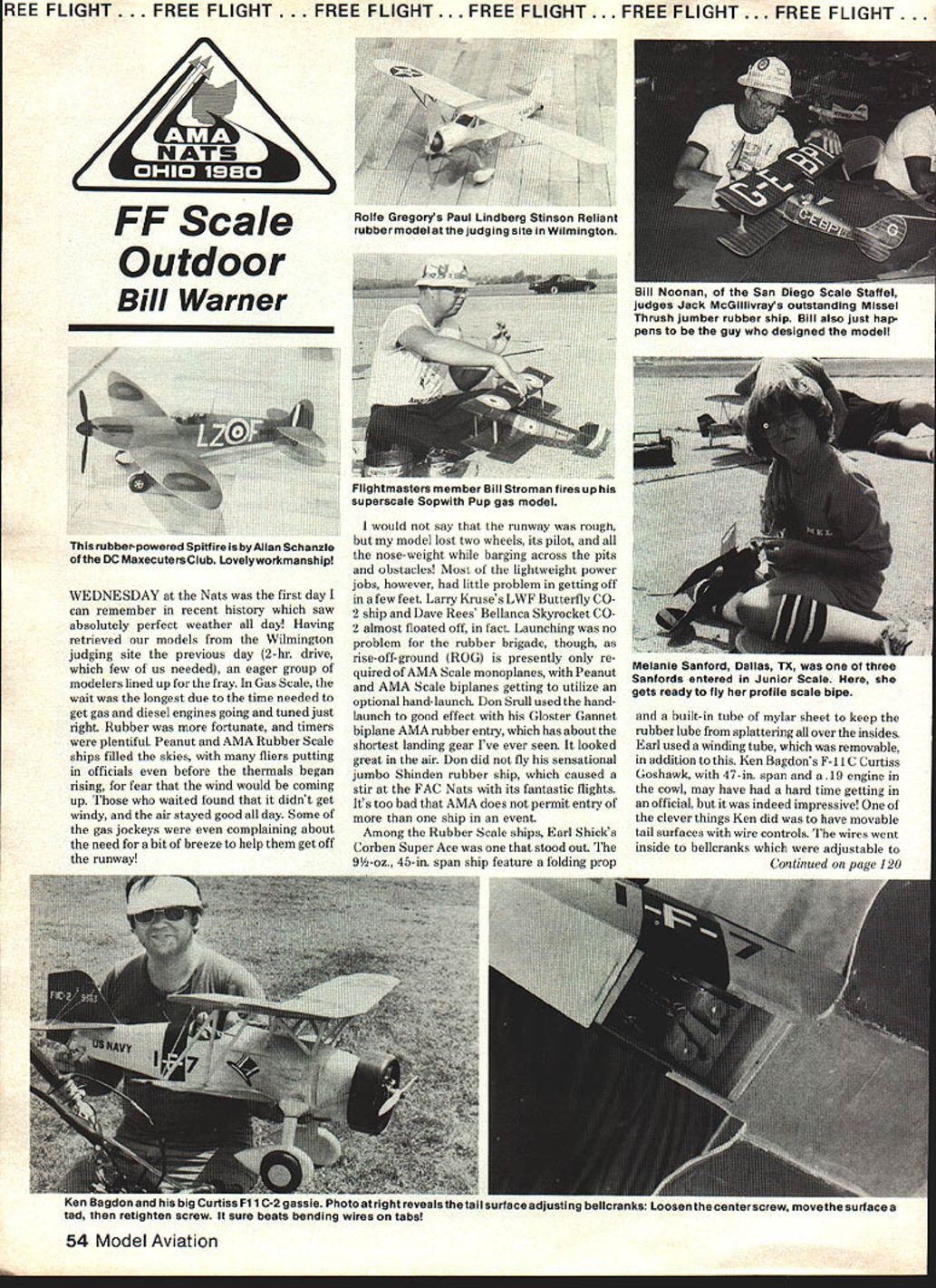
WEDNESDAY at the Nats was the first day I can remember in recent history which saw absolutely perfect weather all day. Having retrieved our models from the Wilmington judging site the previous day (a 2-hour drive, which few of us needed), an eager group of modelers lined up for the fray. In Gas Scale, the wait was the longest due to the time needed to get gas and diesel engines going and tuned just right. Rubber was more fortunate, and timers were plentiful. Peanut and AMA Rubber Scale ships filled the skies, with many fliers putting in officials even before the thermals began rising for fear that the wind would come up. Those who waited found that it didn't get windy, and the air stayed good all day. Some of the gas jockeys were even complaining about the need for a bit of breeze to help them get off the runway.
I would not say that the runway was rough, but my model lost two wheels, its pilot, and all the nose weight while barging across the pits and obstacles. Most of the lightweight power jobs, however, had little problem in getting off in a few feet. Larry Kruse's LWF Butterfly CO-2 ship and Dave Rees' Bellanca Skyrocket CO-2 almost floated off, in fact. Launching was no problem for the rubber brigade, though, as rise-off-ground (ROG) is presently only required of AMA Scale monoplanes, with Peanut and AMA Scale biplanes getting to utilize an optional hand-launch. Don Srull used the hand-launch to good effect with his Gloster Gannet biplane AMA rubber entry, which has about the shortest landing gear I've ever seen. It looked great in the air. Don did not fly his sensational jumbo Shinden rubber ship, which caused a stir at the FAC Nats with its fantastic flights. It's too bad that AMA does not permit entry of more than one ship in an event.
Among the Rubber Scale ships, Earl Shick's Corben Super Ace was one that stood out. The 9½-oz., 45-in. span ship features a folding prop and a built-in tube of mylar sheet to keep the rubber lube from splattering over the insides. Earl used a removable winding tube in addition to this. Ken Bagdon's F-11C Curtiss Goshawk, with 47-in. span and a .19 engine in the cowl, may have had a hard time getting in an official, but it was indeed impressive. One of the clever things Ken did was to have movable tail surfaces with wire controls. The wires went inside to bellcranks which were adjustable to hold in slight up, down, right, or left settings. He adds a drop of glue to hold the rudder or elevator in place once it's right on.
Allan Schanzle's Spitfire was a work of art, and he had a fine scale presentation to boot. Allan is of the opaque-finish school, and also one of the finest fliers around—makes for a great performance. One of the biggest contrasts at the meet was a comparison of Allan's Spitfire, which was turning in modest times with a super-scale appearance, with Dr. John Martin's Alco monoplane, which was condenser-paper covered, translucent, normally flown indoors, and which was an incredible flier, seemingly staying up for as long as Dr. John felt was prudent given the thermal activity. Scale never gets boring!
Bill Stroman and Bobby Haight, with incredibly detailed gas- and diesel-powered ships—a Bellanca Columbia and a Sopwith Pup, respectively—had problems getting the needed engine power. Whether it was the density-altitude change due to the humidity and heat, or whatever, the planes were not up to their usual form. Walt Eggert, flying a very nice DH 60, and Warren Weisenbach, with a lovely Ramsey Bathtub, had no power problems, and in fact they might even have gotten away with a bit less. It's nice to have a bit more engine than you normally fly with "just in case."
Dave Rees' Bellanca Skyrocket, from a Flyline kit, was neatly built and even featured curtains in the windows. Dave used the old O.K. CO-2 powerplant in conjunction with the large Peck tank. The Skyrocket had some very nice flights between 20 and 30 seconds. As power is judged on realism of flight, with a 20-second minimum, this is plenty.
The Lee-Richards annular monoplane that the writer brought was the only electric-powered plane there, and despite the rough takeoff surface we managed to get in a few good ROGs. With four wheels on the ground, the plane tracks straight as an arrow for a long run and gentle lift-off with the Astro .02 motor on near full-tilt NiCad packs. Mainly because of its configuration and good flight characteristics, the model was awarded the NASA FF Outdoor Scale Achievement award. The model weight is about 13 oz., with 265 square inches of wing area.
Some of the really outstanding and striking models at this year's outdoor event included:
- Dave Rees' rubber Caudron Simoun
- Jack McGillivray's red-and-white Missel Thrush jumbo
- Bob Clemens' lovely Farman Jabiru CO-2 and Peanut-class Pacific Standard C-1 racer
- Rolfe Gregory's Lindberg-kit Stinson Reliant rubber ship
- Joseph Sucro's nifty red Stinson Voyager rubber ship
- John Blair's Stinson SM-2
- Curt Sanford's J-3 Cub gasser
Curt also brought along a fine complement of Juniors who put on a great show with their profile gas models.
Transcribed from original scans by AI. Minor OCR errors may remain.

