
FF World Champs
For this first FAI Free Flight World Champs to be held in South America, history should record a very fine competition with popular winners. Argentina's La Cruz Airfield provided quite reasonable, though never easy, conditions.
There were 195 entrants from 30 nations. The contestants were warmly greeted by the Argentinian people and, by most accounts and standards, the fliers enjoyed a memorably pleasant stay, aside from occasional bouts of stomach trouble.
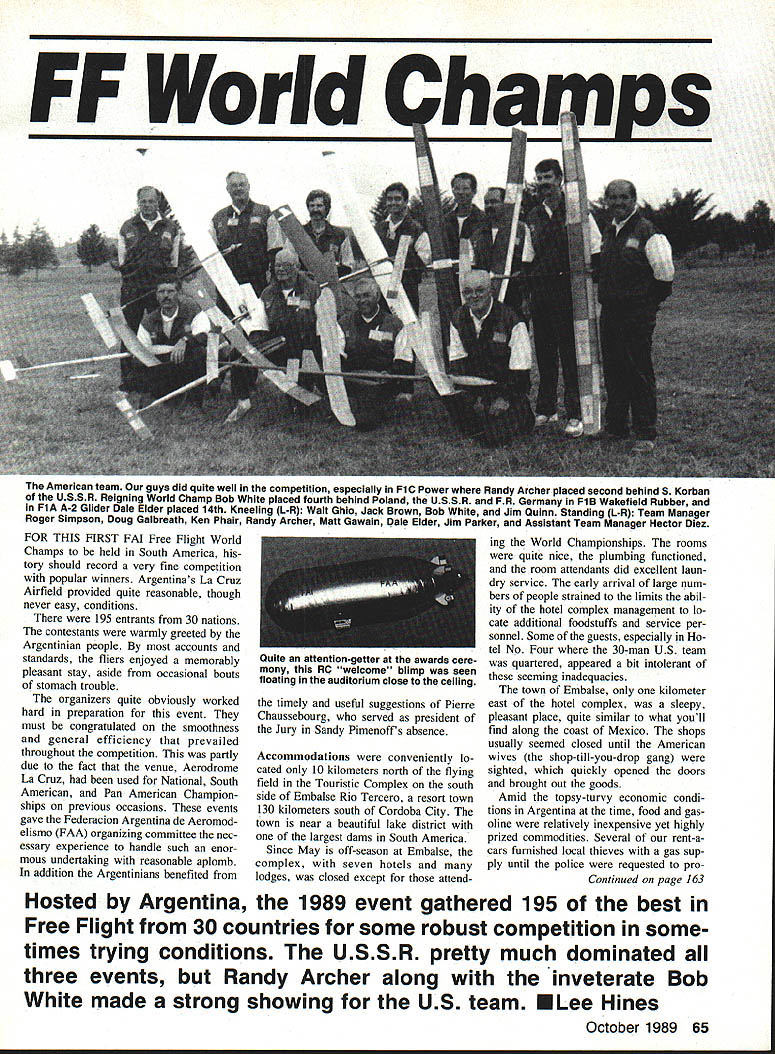
Hosted by Argentina, the 1989 event gathered 195 of the best in Free Flight from 30 countries for robust competition in sometimes trying conditions. The U.S.S.R. pretty much dominated all three events, but Randy Archer and the inveterate Bob White made a strong showing for the U.S. team. — Lee Hines
Accommodations and local conditions
Accommodations were conveniently located only 10 kilometers north of the flying field in the touristic complex on the south side of Embalse Río Tercero, a resort town 130 kilometers south of Córdoba City. The town is near a beautiful lake district with one of the largest dams in South America. Since May is off-season at Embalse, the complex—with seven hotels and many lodges—was closed except for those attending the World Championships. The rooms were quite nice; the plumbing functioned, and the room attendants did excellent laundry service.
The early arrival of large numbers of people strained the hotel complex management's ability to locate additional foodstuffs and service personnel. Some guests, especially in Hotel No. Four where the 30-man U.S. team was quartered, appeared a bit intolerant of these seeming inadequacies.
The town of Embalse, only one kilometer east of the hotel complex, was a sleepy, pleasant place, quite similar to what you'll find along the coast of Mexico. The shops usually seemed closed until the American wives (the shop-'til-you-drop gang) were sighted, which quickly opened the doors and brought out the goods.
Amid the topsy-turvy economic conditions in Argentina at the time, food and gasoline were relatively inexpensive yet highly prized commodities. Several rent-a-cars furnished local thieves with a gas supply until the police intervened. Wide guards were posted around the clock, both in the hotels and on the grounds.
With everyone housed in close proximity, this was a tremendous opportunity for fliers from around the globe to exchange ideas, make new friends, and renew old acquaintances. On more than one occasion many rooms were crowded with international visitors who could be seen waving arms, finding ways around language barriers, examining new model parts, and making notes and sketches.
Organization, social events, and the swap meet
The organizing committee was capably directed by Mario de Salvo, who put several years of planning and public-relations efforts, including multiple trips abroad, into the undertaking. The organizers must be congratulated on the smoothness and general efficiency that prevailed throughout the competition. This was partly due to the fact that the venue, Aerodrome La Cruz, had been used for national, South American, and Pan American championships on previous occasions. These events gave the Federación Argentina de Aeromodelismo (FAA) organizing committee the necessary experience to handle such an enormous undertaking with reasonable aplomb. The Argentinians also benefited from the timely and useful suggestions of Pierre Chaussebourg, who served as president of the jury in Sandy Pimenoff's absence.
The opening ceremony and barbecue-style banquet were very well received and provided a relaxing, happy prelude to the hard tasks ahead. The opening speeches were mercifully short. Events proceeded on a generally well-planned schedule, with allowances for flexibility when necessary. An excellent youth choral group serenaded us before the awards ceremony, allowing late arrivals to be seated. Awards were presented swiftly amid rousing cheers and flashing camera strobes. The final banquet capped the event with the attendant trading of souvenirs and toasts to the conquering heroes.
The World Champs swap meet was a magnet attraction and seemed to bring a record amount of cottage-industry Free Flight goodies for trade or sale from all over the world. You wanted a VP (variable-pitch) prop assembly? See the Poles, the Chinese, or the Russians. You wanted timers? Someone in a red T-shirt had them. One Chinese champion flew a model of his own design—built with engines, pans, carbon booms, and tubes from the U.S. and tow hooks sourced from everywhere—making the swap meet feel like going crazy in a candy store.
FFWC F1A Glider / Hines
Continued from page 67
The competition found the first thermal—and was swiftly trailed by a locust swarm of Nordics. Jim Parker was among the victims of the inevitable line tangles that ensued, but he landed in the soft grass undamaged. Not all of the flotilla in Tchop's soft lift achieved a max, with a flier from the Polish team and Australia's Peter Nash each missing out (Nash had a bad day, dropping in the fourth and fifth rounds as well).
Jim Parker, however, made no mistakes on his reflex, turning in flights to match team members Matt Gewain and Dale Elder. This put the U.S. team in the creditable position of having dropped only 1 second by the end of the second round. Several teams, notably the Russians and the Nyhgen family from Denmark, were already outstripping the Americans with perfect scores.
The rounds progressed fairly normally throughout the day, although the weather conditions—smallish thermals and a fair amount of afternoon turbulence—guaranteed plenty of drama. Among those who at times got easy flights were:
- de Boer (Netherlands) — 167 sec., Round 3
- Van Wallene (Netherlands) — 166 sec., Round 2; 91 sec., Round 5
- Somers (Netherlands) — 167 sec., Round 3; 109 sec., Round 6
- Dondero (Argentina) — 136 sec., Round 3
- Maddlen (Great Britain) — 84 sec., Round 3
- Kocharkev (U.S.S.R.) — 119 sec., Round 4
- Breeman (Belgium) — 63 sec., Round 4; 147 sec., Round 7
- Wilkening (F.R. Germany) — 53 sec., Round 4
- Matt Gewain (1983 Nordic Champ) — 148 sec., Round 4
The beginning of Round 6 saw both the Austrians and the Nyhgens of Denmark tied with full max scores. Close behind were Finland (by 16 sec.), the U.S.A. (by 32 sec.), and the U.S.S.R. (by 61 sec.). Then came the upheaval in the rankings. Henning and Bo Nyhgen crashed to 90-sec. times, Klaus Salzer of Austria recorded 101 sec., and Kim Henriksson dropped Finland out with 120 sec.
Two of the Bulgarians, Slavov and 1977 glider champ Kostadin Rogiadiev, had clean scores through Round 6, but in an uncanny coincidence the next round proved their undoing. Both fliers crashed with times of 12 sec., plunging them to an unenviable 34th-place tie.
The Round 6 shakeup left the U.S. team leading by 29 seconds over the Russians. With only one more round to go before the flyoffs, it looked as if the Nordic Team Trophy might go to the Americans.
Round 7, which began at 3 p.m., saw Dale max and advance to the flyoff. Jim finished strongly with six solid 180-sec. flights but ranked just below the flyoff group. I spoke with Eugene Verbist, who assured me that the Russians had indeed let the air out of the Americans. Matt made a great round earlier, but his flight in that crucial round was only 60 seconds, making the excellent team from the U.S.S.R. the glider champions once again.
As the four-minute flyoff round began at 4:30 p.m., the 15 remaining fliers faced a cooling breeze of three to five meters per second, lively enough to make circle towing an exercise in frustration for the less attentive. Andres Lepp towered up and died downwind, apparently in lift he had sensed on the ground. After two more circles progressively farther down-field, he zoomed off into the thermal, along with Rogiadiev, Sexton, Tchop, and others. Sebah then spotted a bigger piece of lift and was quickly intercepted by Arnon, who deftly sprinted crosswind with a massive zoom, placing his white-and-bright-orange glider at the same elevation as the Finn's climbing model. Gobo of Italy also got on that thermal and, along with the others, scored maxes.
The wind seemed to increase somewhat during the 15 minutes allotted for the flyoff, and the narrow columns of lift that could be found were both difficult to detect and transitory. Dale Elder was one of several contenders who had not yet found lift as the round neared its end. Kiting his bird some 200 meters upwind and trying to circle in what appeared to be a blue sink, he was unable to sprint fast enough in the grass to bring it around and off. After a crash landing, and with two minutes remaining, a very tired Dale ran back to the flight line where his backup model sat ready, but the round was almost over.
Transcribed from original scans by AI. Minor OCR errors may remain.

