
FFWC F1A Glider
Venue and conditions
A cool dawn bathed the Aeródromo La Cruz in crisp morning light as the glider fliers busied themselves with check flights for the challenging event about to begin. Actual sunrise occurred at 8:10 on Thursday, May 25th. A light mist rose from the lake about 10 miles to the west of La Cruz, in the Córdoba province of Argentina. A slight drift to the northeast pointed toward the only true obstructions F1A fliers had to worry about—the buildings and tree-lined compound of the airfield. The Aeródromo La Cruz is the local field of the Argentine Air Force, one of the hosts.
Competitors and absences
Twenty-six countries were represented in the Nordic A-2 event. Notable absences included:
- China (limited to six competitors due to extremely high airfare, $3,500 per return ticket; the Chinese Aeromodeling Association chose F1B and F1C teams as having the highest chances for victory)
- North Korea
- Czechoslovakia
- East Germany
- Cuba
Other notes on entries:
- Hungary had only its F1C power team.
- Denmark had four entries: Thomas Koster (three-time World Champion) in F1C, and the Nyhegn family (Henning, Bo, and Jes) in Glider.
- Japan had two F1C fliers.
- Ozzie Vasquez was the lone Wakefield flier for Venezuela (ten years after his country’s first World Champs entry).
- Lenny Breeman (1982 and 1984 European champ) represented Belgium in Glider.
Round 1
The 8:30 siren prompted swift—and probably nervous—action as several fliers launched in search of buoyant air. Prominent among them was Andres Lepp, back on the Soviet team for the first time since Spain ’81; he flew his long glider from that World Champs, AL-33, to a nice max. Matt Gewain for the U.S. team went upwind (southeast) a fair distance, parked awhile, then found the air he wanted and maxed with 20 ft. to spare.
Jim Parker of the U.S. followed. Though his glider had shown every promise of making the two-minute mark, it mushed and settled for a moment as it turned into the wind, leaving Jim with a less-than-hoped-for 179 seconds. Team mate Dale Elder closed Round 1 with a fine 180 seconds with his 90-in. still-air Grogan-designed bird.
As testament to the excellent flying in this opening round, 41 maxes were recorded in relatively neutral air. Misses of note included:
- Tahkapaa (Finland)
- Fantham (Great Britain)
- Palmieri (Argentina)
- Bucher (Switzerland)
- Blagojevic (Yugoslavia)
- Mackenzie (Canada) — foiled by gliding behind the trees at the aerodrome
Several nations posted perfect scores after Round 1:
- Austria
- Denmark
- Bulgaria
- F.R. Germany
- The Netherlands
- Poland
- Soviet Union
Round 2 and mid-day flying
Organizers provided a five-minute interval between rounds for station switching and testing. Round 2 began at 9:35 a.m. in variable, gentle conditions—what the reporter called "tweener-time"—with faint lift over the pampas grass terrain.
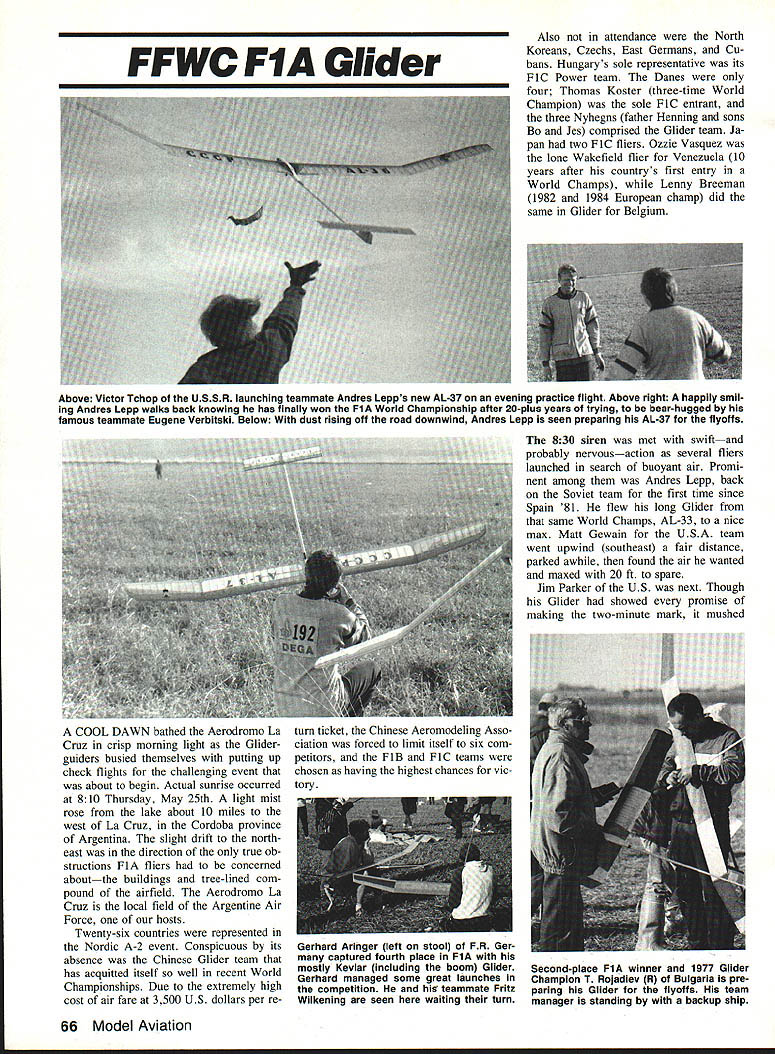
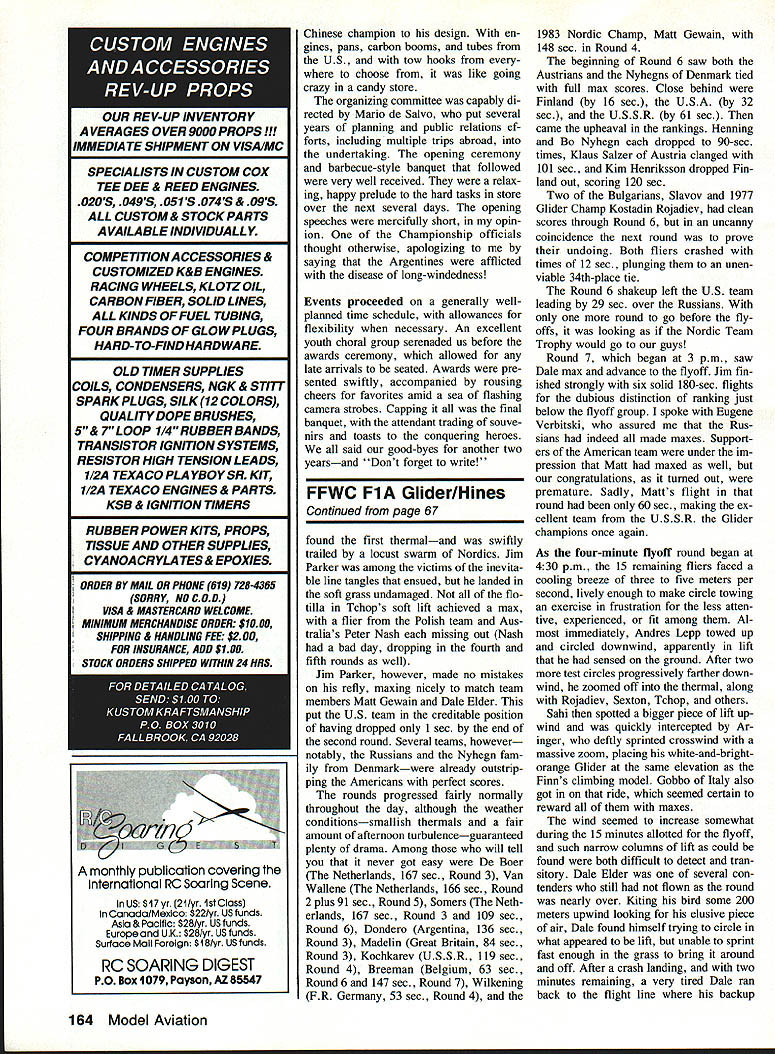
Lepp flew early, using his AL-33 again while the air was smooth to record his second max, then switched to a more conventional glider, AL-37 (2,100 mm span), for the remaining flights.
It was Victor Tchop, it appears, who found the first thermal in Round 2—and was swiftly trailed by a swarm of Nordics. Jim Parker was among those caught in the inevitable line tangles and landed in the soft grass undamaged. Not all who joined Tchop's soft lift achieved a max: a Polish flier and Australia's Peter Nash missed out (Nash had a bad day, dropping in Rounds 4 and 5 as well).
Jim Parker recovered with a max on his reply, matching team members Matt Gewain and Dale Elder and putting the U.S. team in the creditable position of having dropped only 1 second by the end of Round 2. Several teams—most notably the Russians and the Nyhegn family from Denmark—were already outstripping the Americans with perfect scores.
Rounds 3–6: drama and shakeups
The rounds progressed through the day with small thermals and a touch of afternoon turbulence guaranteeing plenty of drama. Notable lower scores and problems included:
- De Boer (The Netherlands): 167 sec., Round 3
- Van Walle (The Netherlands): 166 sec., Round 2; 91 sec., Round 5
- Somers (The Netherlands): 167 sec., Round 3; 109 sec., Round 6
- Dondero (Argentina): 136 sec., Round 3
- Madelin (Great Britain): 84 sec., Round 3
- Kochetkov (U.S.S.R.): 119 sec., Round 4
- Breeman (Belgium): 63 sec., Round 6; 147 sec., Round 7
- Wilkening (F.R. Germany): 53 sec., Round 4
- Matt Gewain (1983 Nordic Champ): 148 sec., Round 4
At the beginning of Round 6 both the Austrians and the Nyhegns of Denmark were tied with full-max scores. Close behind were Finland (by 16 sec.), the U.S.A. (by 32 sec.), and the U.S.S.R. (by 61 sec.). Then the rankings shifted: Henning and Bo Nyhegn each dropped to 90-sec. times, Klaus Salzer of Austria scored 101 sec., and Kim Henriksson's 120 sec. dropped Finland out of contention.
Two Bulgarians, Slavov and 1977 Glider Champion Kostadin Rojadiev, had clean scores through Round 6 but crashed in the next round with times of 12 seconds, plunging them down the standings to 34th place.
After Round 6 the U.S. team led by 29 seconds over the Russians, and with only one round before the flyoffs it looked as if the Nordic Team Trophy might go to the Americans.
Round 7 and flyoff qualifiers
Round 7 began at 3:00 p.m. Dale Elder maxed and advanced to the flyoff. Jim Parker finished strongly with six solid 180-sec flights, narrowly missing the flyoff group. Eugene Verbitski confirmed that the Russians had a bad day and that he and his sons were out of contention.
Flyoffs
The four-minute flyoff began at 4:30 p.m. with 15 remaining fliers facing a cooling breeze of 3–5 m/s—enough to make circle towing difficult for the less attentive or less fit. Andres Lepp worked up and circled downwind, sensing lift on the ground; after a few fast circles farther downwind he zoomed into the thermal, joined by Rojadiev, Sexton, Tchop, and others. Sahi spotted bigger lift upwind and was intercepted by Aringer, who sprinted crosswind with a massive zoom. Gobo of Italy also capitalized on that air.
The wind increased somewhat during the 15-minute flyoff, and narrow, transitory columns of lift were difficult to detect. Dale Elder, one of several who had not yet flown late in the round, kited his bird some 200 meters upwind and tried to circle in light lift but was unable to sprint fast enough in the grass. After a crash landing and with two minutes remaining he ran back to the flight line, launched his backup glider, and managed only a 70-sec time, placing 14th.
Best flyoff times tended to come from fliers launching from the southern end of the flight line—either over the longer pampas grass or just downwind in the stubblefield.
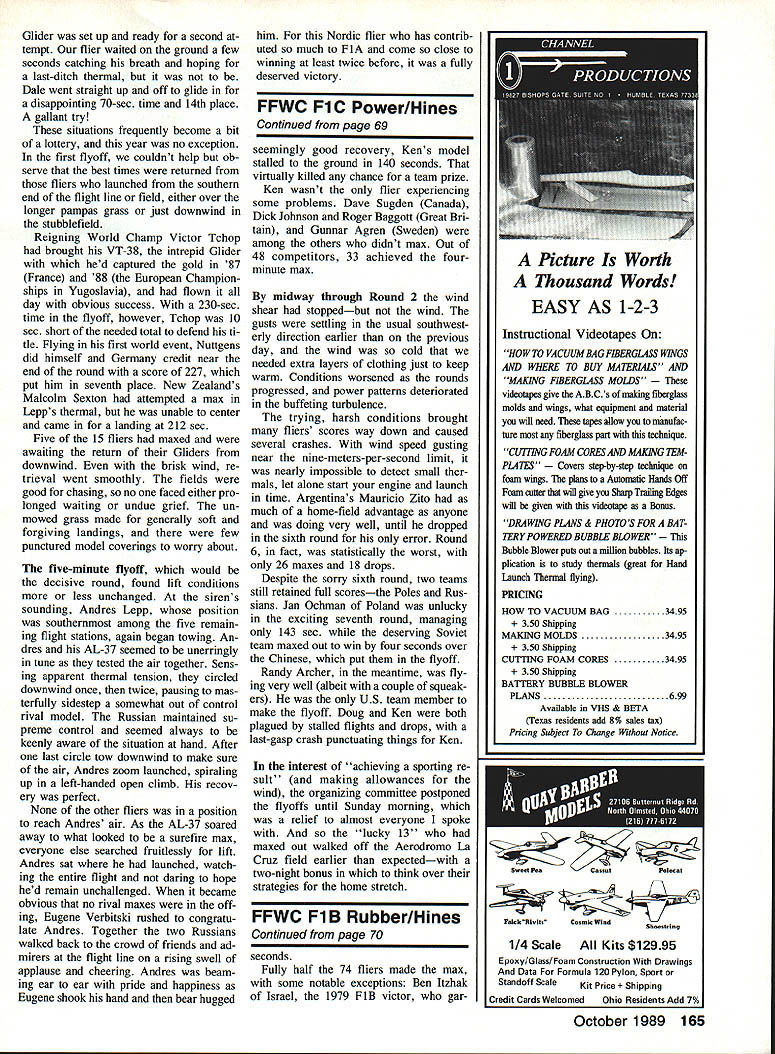
Reigning World Champion Victor Tchop had flown his VT-38 all day with success but scored 230 sec. in the flyoff—10 sec. short of the total needed to defend his title. Nuttgens, in his first world event, scored 227 and placed seventh. New Zealand's Malcolm Sexton attempted a max in Lepp's thermal but could not center it and landed at 212 sec.
Five of the 15 fliers maxed and awaited their gliders' return from downwind. Retrieval went smoothly despite the brisk wind; the fields were good for chasing, the unmowed grass provided soft landings, and there were few punctured model coverings.
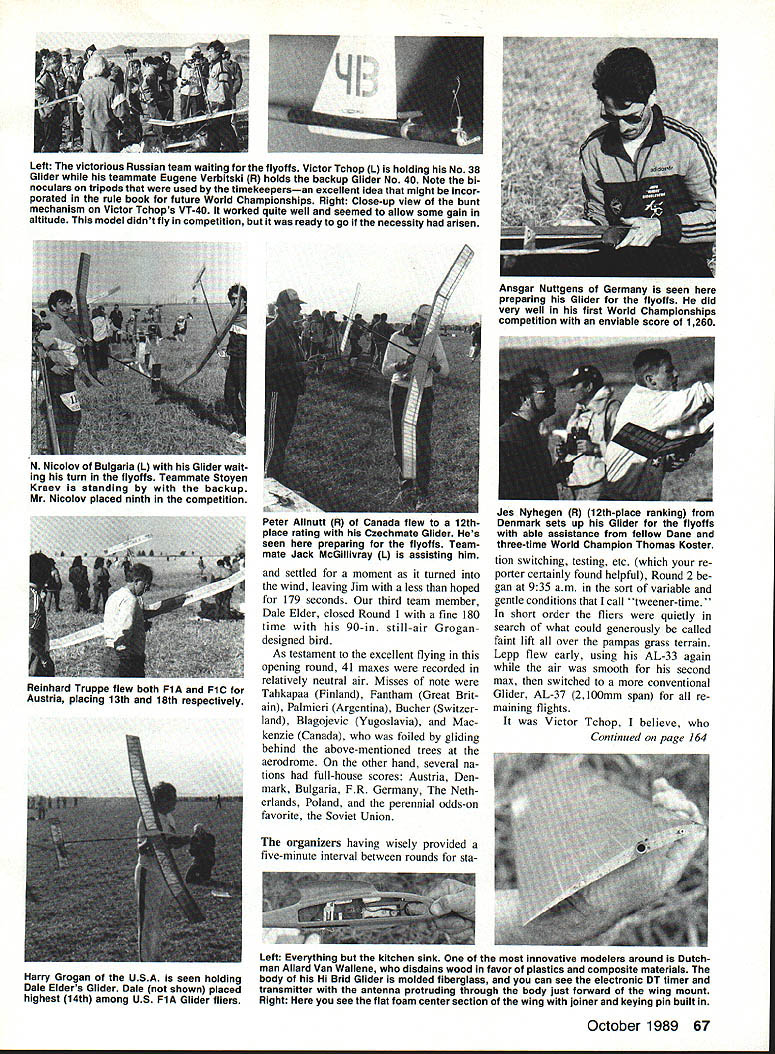
The decisive five-minute flyoff found lift conditions largely unchanged. Andres Lepp, launching from the southernmost station among the five remaining, again towed and tuned his AL-37 to the air. After carefully circling downwind and sidestepping a rival model, he zoom-launched in a left-handed open climb and centered strong lift. None of the other fliers could reach his air, and as Lepp climbed away it became clear his max would stand.
When rival maxes failed to materialize, Eugene Verbitski rushed to congratulate Andres. The two walked back to the crowd at the flight lines amid rising applause. Andres beamed with pride and happiness; for a Nordic flier who had contributed much to F1A and come close to winning before, it was a fully deserved victory.
Transcribed from original scans by AI. Minor OCR errors may remain.

