
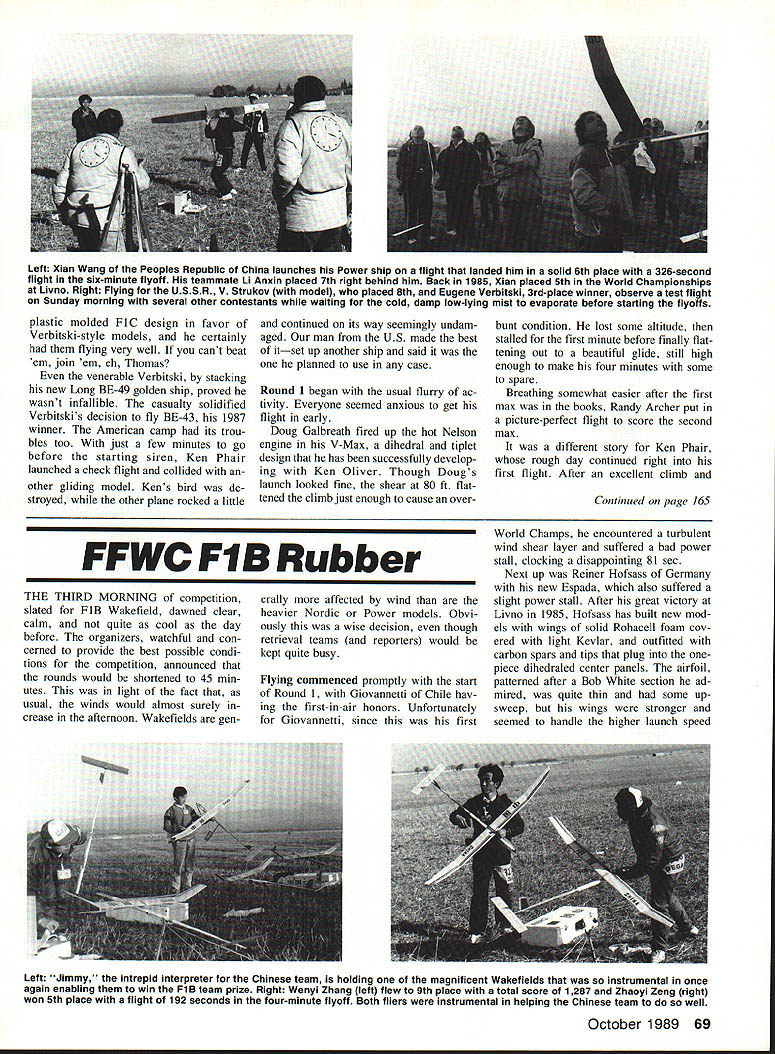
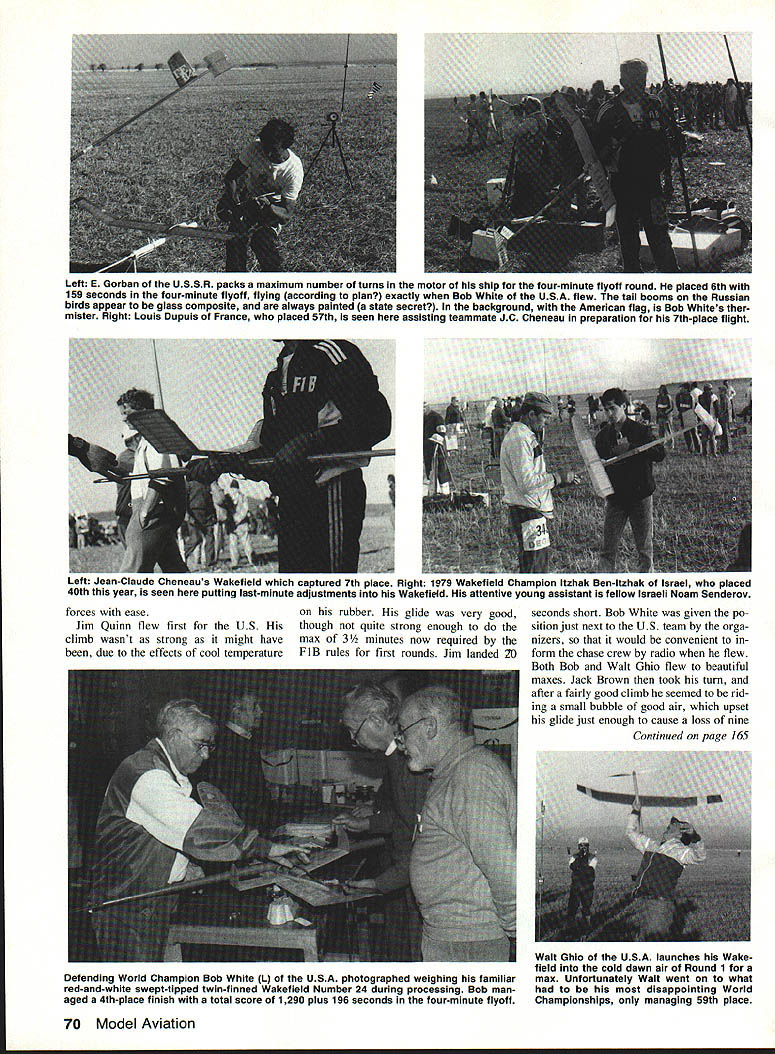
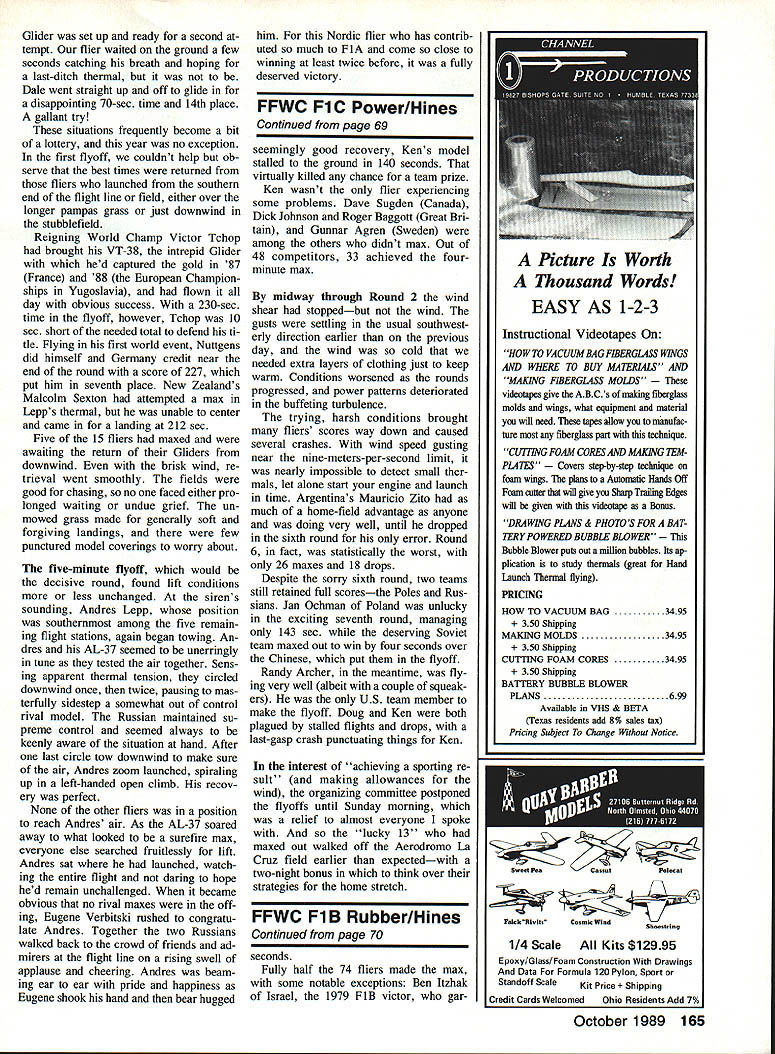
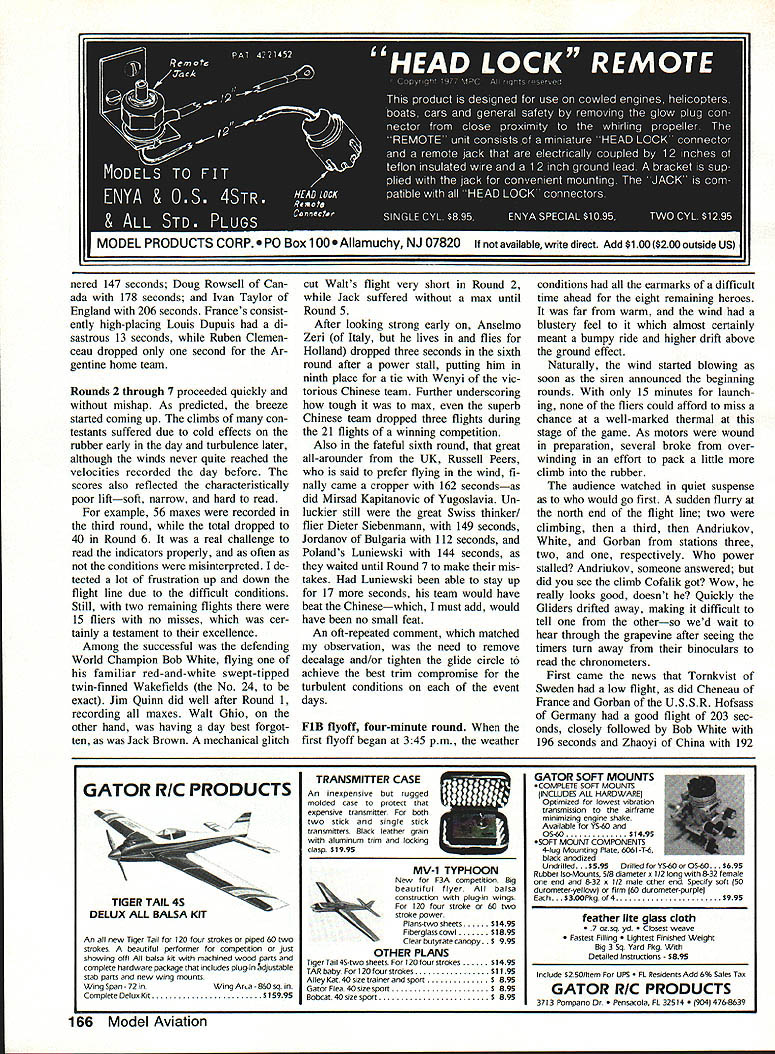
FFWC F1B Rubber
The third morning of competition, slated for F1B Wakefield, dawned clear, calm, and not quite as cool as the day before. The organizers, watchful and concerned to provide the best possible conditions for the competition, announced that the rounds would be shortened to 45 minutes in light of the fact that the winds would almost surely increase in the afternoon. Wakefields are generally more affected by wind than the heavier Nordic or Power models. It was a wise decision, even though retrieval teams (and reporters) would be kept quite busy.
Flying commenced promptly with the start of Round 1. Giovannetti of Chile had first-in-air honors, but being his first World Champs he encountered a turbulent wind-shear layer and suffered a bad power stall, clocking a disappointing 81 seconds. Reiner Hofsass of Germany flew next with his new Espada, which also suffered a slight power stall. After his great victory at Livno in 1985, Hofsass has built new models with wings of solid Rohacell foam covered with light Kevlar and outfitted with carbon spars and tips that plug into the one-piece dihedraled center panels. The airfoil, patterned after a Bob White section he admired, was quite thin and had some upsweep, but his wings were stronger and seemed to handle the higher launch speed.
Jim Quinn flew first for the U.S. His climb wasn't as strong as it might have been, due to the effects of cool temperature on his rubber. His glide was very good, though not quite strong enough to do the max of 3½ minutes then required for first rounds; Jim landed 20 seconds short. Bob White was positioned next to the U.S. team by the organizers so the chase crew could be informed by radio when he flew. Both Bob White and Walt Ghio flew to beautiful maxes. Jack Brown then took his turn; after a fairly good climb he seemed to be riding a small bubble of good air, which upset his glide just enough to cause a loss of nine seconds. Other Round 1 results included Doug Rowsell of Canada with 178 seconds and Ivan Taylor of England with 206 seconds. France's consistently high-placing Louis Dupuis had a disastrous 13 seconds, while Ruben Clemenceau dropped only one second for the Argentine home team.
Rounds 2–7
Rounds 2 through 7 proceeded quickly and without major mishap. As predicted, the breeze started coming up. The climbs of many contestants suffered due to cold effects on the rubber early in the day and turbulence later, although the winds never quite reached the velocities recorded the day before. The scores reflected the characteristically poor lift—soft, narrow, and hard to read. For example, 56 maxes were recorded in the third round, while the total dropped to 40 in Round 6. It was a real challenge to read the indicators properly, and as often as not the conditions were misinterpreted. I detected a lot of frustration up and down the flight line due to the difficult conditions.
Still, with two remaining flights there were 15 fliers with no misses, which was a testament to their excellence. Among the successful was the defending World Champion Bob White, flying one of his familiar red-and-white swept-tipped twin-finned Wakefields (No. 24). Jim Quinn did well after Round 1, recording all maxes. Walt Ghio, on the other hand, was having a day to forget; a mechanical glitch cut his Round 2 flight very short, and Jack Brown suffered without a max until Round 5.
After looking strong early on, Anselmo Zeri (of Italy, though he lives in and flies for Holland) dropped three seconds in the sixth round after a power stall, putting him in ninth place in a tie with Wenyi of the victorious Chinese team. Further underscoring how tough it was to max, even the superb Chinese team dropped three flights during the 21 flights of a winning competition. In the same fateful rounds, Russell Peers of the U.K.—who is said to prefer flying in the wind—had 162 seconds, as did Mirsad Kapitanovic of Yugoslavia. The great Swiss thinker/flier Dieter Siebermann had 149 seconds, Jordanov of Bulgaria 112 seconds, and Poland's Luniewski 144 seconds; had Luniewski been able to stay up for 17 more seconds his team would have beaten the Chinese—a remarkable near-miss.
A commonly repeated comment, which matched observer impressions, was the need to remove decalage and/or tighten the glide circle to achieve the best trim compromise for the turbulent conditions on each of the event days.
F1B flyoff — four-minute round
When the first flyoff began at 3:45 p.m., the weather had all the earmarks of a difficult contest for the eight remaining fliers. It was far from warm, and the wind had a blustery feel that suggested a bumpy ride and higher drift above ground effect. Naturally, the wind started blowing as soon as the siren announced the beginning of the rounds. With only 15 minutes for launching, none of the fliers could afford to miss a well-marked thermal at this stage. As motors were wound in preparation, several broke from overwinding in an effort to pack a little more climb into the rubber.
The audience watched in quiet suspense as the competitors launched. A sudden flurry at the north end of the flight line showed two models climbing, then Andriukov, White, and Gorban were seen. Observers called back about the climbs—"Wow, he really looks good," someone said—then the gliders drifted away, making it difficult to tell one from another until the first turns were observed and the chronometers read.
First reports indicated that Tornkvist of Sweden had a low flight, as did Cheneau of France and Gorban of the U.S.S.R. Hofsass of Germany posted a good flight of 203 seconds, closely followed by Bob White with 196 seconds and Zhaoyi Zeng of China with 192 seconds. The final placings showed great depth among the competitors, but it was the consistently solid performances by the Chinese team that secured them the team prize. Individual honors and exact finishing order reflected the narrow margins and trying conditions that characterized the contest.
After perhaps a minute's wait, Eugeniusz (Eugene) Cofalik of Poland made his launch, followed about 10 seconds later by Andriukov—the same strategy they had used earlier. Again the climbs were almost equal, making the final result dependent on the glide. The Polish team ran and waved their shirts under Cofalik's wake as the model headed south over taller pampas grass; the circle opened up and the glide began to bounce. Andriukov's plane, farther to the west, settled gently to the ground with 237 seconds, while Cofalik's ship, riding a light bubble, touched down with 317 seconds.
While his teammates rushed to congratulate him, the crowd applauded the first-ever Polish World Champion, Eugene Cofalik.
Transcribed from original scans by AI. Minor OCR errors may remain.

