
FFWC F1C & F1B Flyoffs
F1B and F1C flyoffs, Sunday, May 28.
As we drove to the aerodrome for the final flyoff morning, a low mist added another dimension to the task at hand. Everyone was bundled up and stomping about to keep warm in the 40°F air. Overhead was a clear blue sky, so test flying was possible and in progress up and down the line. The two Wakefield finalists were at the south and the Power finalists at the north of the abbreviated flight line, with a space between for demarcation.
The organizer-provided car, with translators aboard, went up and down the line announcing in the official languages that, regretfully, a delay was in order until the mist had cleared. As the sun slowly rose in its northward-sloping winter's arc, the mist, no doubt because of dewpoint conditions, got a bit thicker. None of this was doing anything to ease the nerves of the contestants or the organizers. Nine o'clock came and went, and the mist still hung.
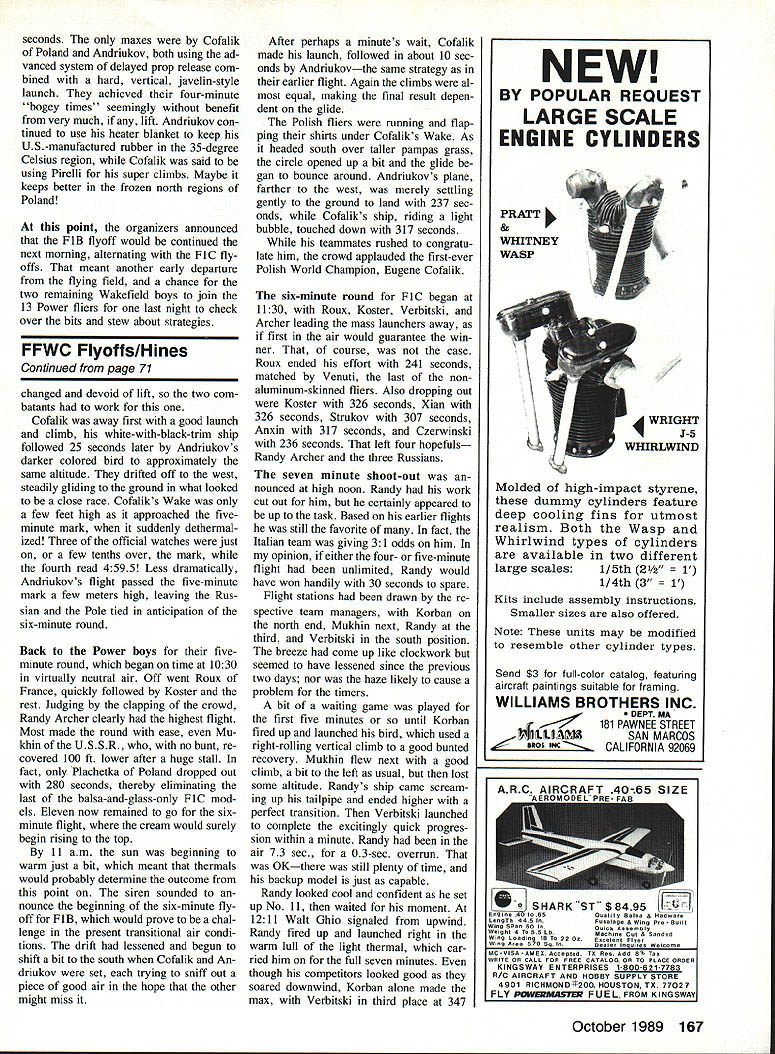
The delay allowed me the opportunity to look over who was flying what in greater detail. The aluminum-foil-covered Power ship was used by no fewer than 10 of the 13 finalists (with Venuti of Italy using glass-on-foam and Plachetka of Poland and Stetz of Germany still using balsa-and-glass). The Verbitski influence certainly was showing, but it is truly difficult to tell one from the other in flight after a mass launch.
Praise and thanks must go to the superb confidence of the timing crews who flawlessly manned the watches and followed the flights for four days using their tripod-mounted binoculars. In fact, this innovation worked so well that it was suggested that the CIAM consider it in future planning.
Visibility increased after 9:30, and soon the word came that the four-minute flyoff for F1C would begin at 10 a.m. At the sound of the siren, Koster of Denmark was the first to be away. Conditions were stable, and it was an easy round for a modern Power model making a normal flight. Everyone launched quite soon thereafter, and the only staller to miss was Stetz of Germany, who stalled nearly to the ground but still managed 215 seconds.
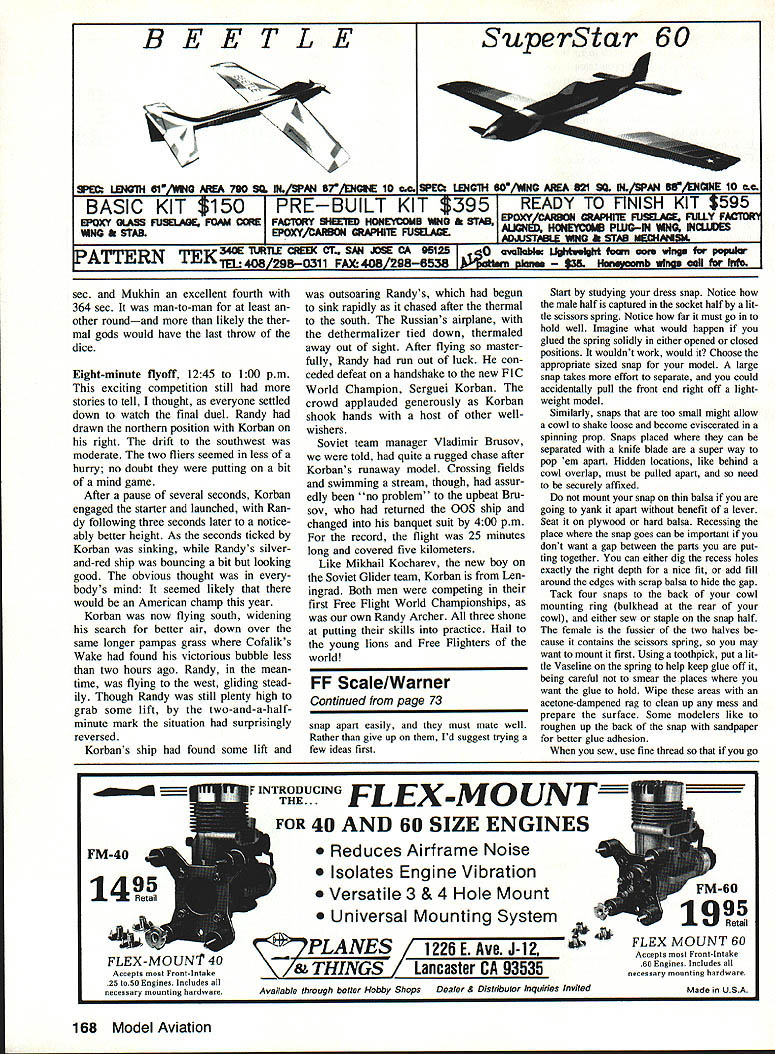
Attention now shifted a few meters southward to watch the five-minute F1B Rubber flight. The air and temperature seemed unchanged, devoid of lift. Two combatants worked. Cofalik was away first with a good launch and climb. The white-with-black-trim ship was followed 25 seconds later by Andriukov's darker-colored bird at approximately the same altitude. It drifted off west, steadily gliding toward the ground. What looked like a close race — Cofalik's Wake a few feet high — approached the five-minute mark and then suddenly dethermalized. Three official watches showed just a few tenths over the mark; the fourth read 4:59.5. Less dramatically, Andriukov's flight passed the five-minute mark a few meters high, leaving the Russian and Pole tied in anticipation of the six-minute round.
The six-minute round for F1C began at 11:30, with Roux, Koster, Verbitski, and Archer leading the mass launchers away, as if first in the air would guarantee the winner. That, of course, was not the case. Roux ended his effort with 241 seconds, matched by Venuti, the last of the non-aluminum-skinned fliers. Also dropping out were Koster with 326 seconds, Xian with 326 seconds, Strukov with 307 seconds, Anxin with 317 seconds, and Czerwinski with 236 seconds. That left four hopefuls — Randy Archer and the three Russians.
The seven-minute shoot-out was announced at high noon. Randy had his work cut out for him, but he certainly appeared to be up to the task. Based on his earlier flights he was still the favorite of many. In fact, the Italian team was giving 3:1 odds on him. In my opinion, if either the four- or five-minute flight had been unlimited, Randy would have won handily with 30 seconds to spare.
Flight stations had been drawn by the respective team managers, with Korban on the north end, Mukhin next, Randy at the third, and Verbitski in the south position. The breeze had come up like clockwork but seemed to have lessened since the previous two days; nor was the haze likely to cause a problem for the timers.
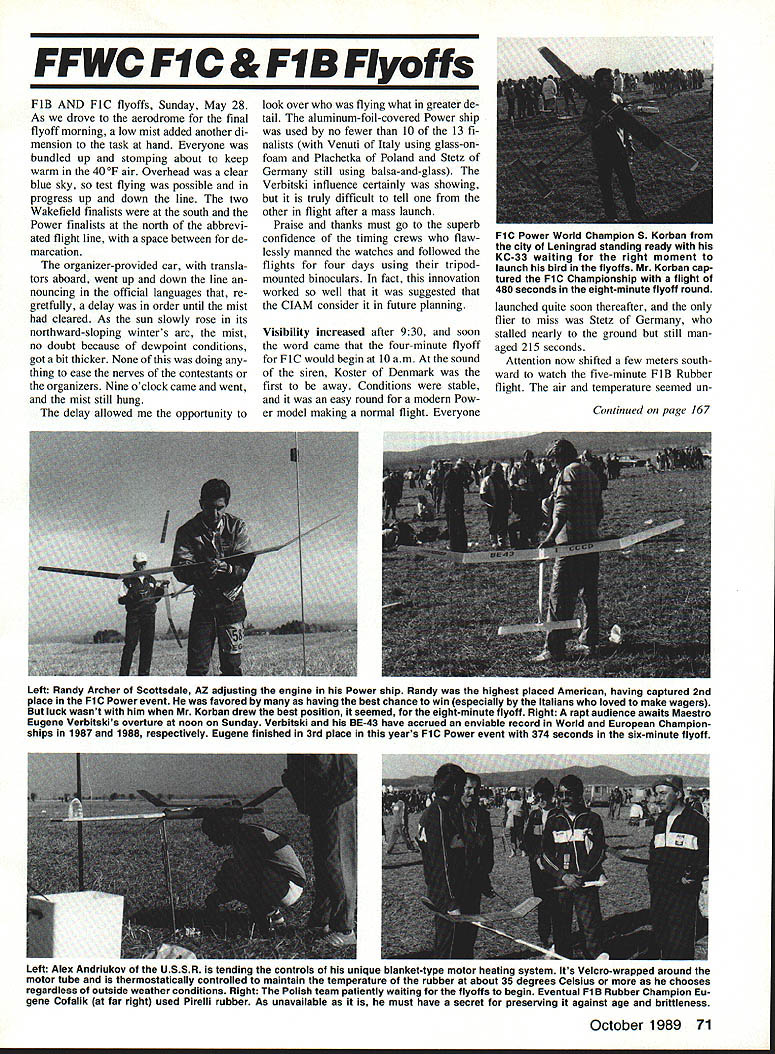
A bit of a waiting game was played for the first five minutes or so until Korban fired up and launched his bird, which used a right-rolling vertical climb to a good but limited recovery. Mukhin flew next with a good climb, a bit to the left as usual, but then lost some altitude. Randy's ship came screaming up in his tailpipe and ended higher with a perfect transition. Then Verbitski launched to complete the excitingly quick progression within a minute. Randy had been in the air 7.3 seconds, for a 0.3-second overrun. That was OK—there was still plenty of time, and his backup model is just as capable.
Randy looked cool and confident as he set up No. 11, then waited for his moment. At 12:11 Walt Ghio signaled from upwind and Randy fired up and launched right in the warm lull of the light thermal, which carried him on for the full seven minutes. Even though his competitors looked good as they soared downwind, Korban alone made the max, with Verbitski in third place at 347 seconds. Randy’s performance left little doubt as to his skill and poise under pressure.
Back to the Power boys for their five-minute round, which began on time at 10:30 in virtually neutral air. Off went Roux of France, quickly followed by Koster and the rest. Judging by the clapping of the crowd, Randy Archer clearly had the highest flight. Most made the round with ease, even Mukhin of the U.S.S.R., who, with no bunt, recovered 100 ft. lower after a huge stall. In fact, only Plachetka of Poland dropped out with 280 seconds, thereby eliminating the last of the balsa-and-glass-only F1C models. Eleven now remained to go for the six-minute flight, where the cream would surely begin rising to the top.
Eight-minute flyoff, 12:45 to 1:00 p.m.
This exciting competition still had more stories to tell, I thought, as everyone settled down to watch the final duel. Randy had drawn the northern position with Korban on his right. The drift to the southwest was moderate. The two fliers seemed in less of a hurry; no doubt they were putting on a bit of a mind game.
After a pause of several seconds, Korban engaged the starter and launched, with Randy following three seconds later to a noticeably better height. As the seconds ticked by Korban was sinking, while Randy's silver-and-red ship was bouncing a bit but looking good. The obvious thought was in everybody's mind: it seemed likely that there would be an American champ this year.
Korban was now flying south, widening his search for better air, down over the same longer pampas grass where Cofalik's Wake had found his victorious bubble less than two hours ago. Randy, in the meantime, was flying to the west, gliding steadily. Though Randy was still plenty high to grab some lift, by the two-and-a-half-minute mark the situation had surprisingly reversed.
Korban's ship had found some lift and was outsailing Randy's, which had begun to sink rapidly as it chased after the thermal to the south. The Russian's airplane, with the dethermalizer tied down, thermaled away out of sight. After flying so masterfully, Randy had run out of luck. He conceded defeat on a handshake to the new F1C World Champion, Serguei Korban. The crowd applauded generously as Korban shook hands with a host of other well-wishers.
Soviet team manager Vladimir Brusov, we were told, had quite a rugged chase after Korban's runaway model. Crossing fields and swimming a stream, though, had assuredly been "no problem" to the upbeat Brusov, who had returned the OOS ship and changed into his banquet suit by 4:00 p.m. For the record, the flight was 25 minutes long and covered five kilometers.
Like Mikhail Kocharov, the new boy on the Soviet Glider team, Korban is from Leningrad. Both men were competing in their first Free Flight World Championships, as was our own Randy Archer. All three shone at putting their skills into practice. Hail to the young lions and Free Flighters of the world!
Transcribed from original scans by AI. Minor OCR errors may remain.

